Experiential marketing is marketing that gets people to take part in a brand rather than watch it: they visit, try, play, taste or build something, in person or online. Pop-ups, brand activations, immersive installations, sampling, workshops and owned events are its main formats.
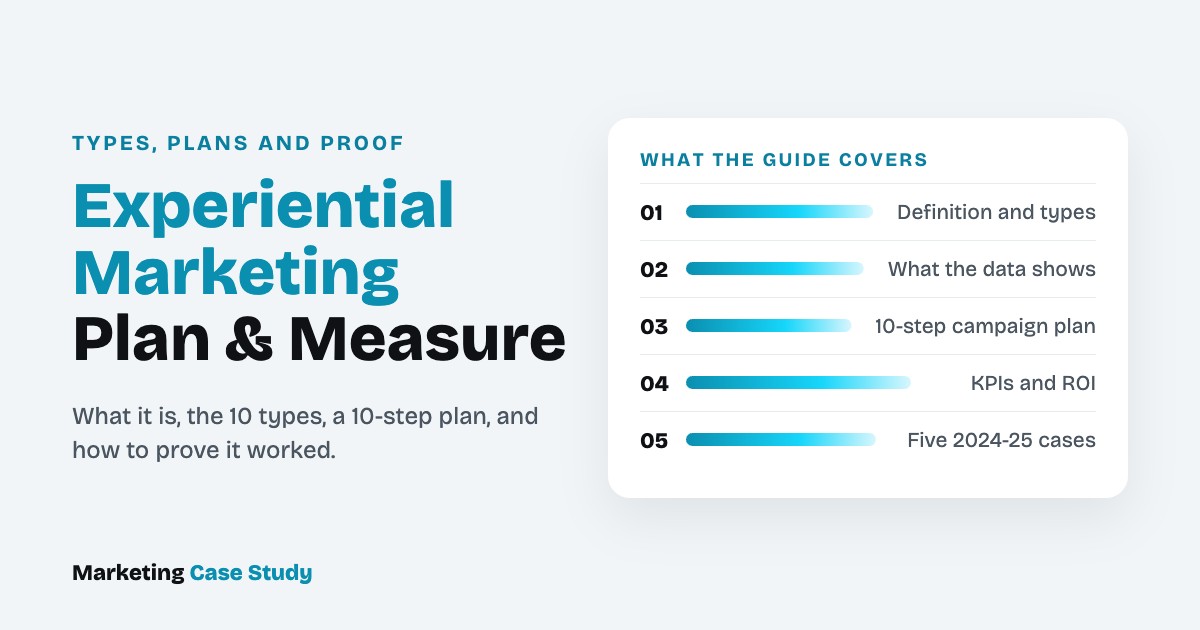
The evidence most often quoted for it is weaker than it looks. The popular claim that 85% of consumers are likely to buy after an event comes from a 2018 survey of stated intent, and recent public campaigns mostly report attention, not sales. This guide covers the definition, the types, planning, measurement and five sourced campaigns from 2024 and 2025, one of them a failure.
What is experiential marketing?
Experiential marketing treats the experience as the message. Instead of telling people a product is fun or clever, the brand creates a situation where they find out for themselves, and ideally share it. It is also called engagement marketing, live marketing, participation marketing or brand experience.
The idea has an academic lineage. B. Joseph Pine II and James H. Gilmore argued in “Welcome to the Experience Economy” (Harvard Business Review, July 1998) that as goods and services become commodities, staged experiences become what customers value. Bernd Schmitt’s book Experiential Marketing (Free Press, 1999) sorted experiences into five types: sense, feel, think, act and relate. That list still works as a creative brief: strong activations usually hit at least two.
What is an experiential marketing campaign?
It is a time-bound program built around one or more brand experiences, plus the promotion before and the follow-up after. The experience may last one afternoon, but the campaign includes the teaser, the content captured on the day, its distribution, and the lead or sales follow-up.
Experiential vs event marketing
In event marketing, the brand uses an event to reach people: a sponsor banner, a trade-show booth. In experiential marketing, the brand experience is the reason people come: a pop-up built around a show, a hands-on product lab. A booth becomes experiential when visitors do something with the product rather than collect a brochure.
Experiential vs traditional advertising
Traditional advertising buys reach and repetition. Experiential buys depth with fewer people and relies on them, and the press, to carry it further. It fits when the product has to be felt to be understood or a launch needs a visible moment. Broad reach at a known cost is still a job for paid media.
Types of experiential marketing
| Type | What it is | Best for |
|---|---|---|
| Pop-up shops and experiences | Temporary, often themed spaces open for days or weeks | Launches, scarcity, press and social content |
| Brand activations | Interactive stands or games at festivals, sports events, conferences or busy public spaces | Reaching an audience that has already gathered |
| Immersive installations | Multi-sensory sets using light, sound, AR or VR | Making an abstract product or fictional world tangible |
| Sampling and product demos | Letting people taste, test or try on the spot | Products that sell once tried |
| Workshops and classes | Hands-on sessions tied to the product | Depth with small groups, community |
| Owned events and conferences | The brand’s own festival, user conference or roadshow | B2B pipeline, launches, loyal communities |
| Trade show installations | Booths designed for participation | B2B lead capture |
| Guerrilla and stunts | Unexpected moments in public space | Earned media on a small footprint |
| Exclusive experiences | Limited-access stays or visits, often by lottery | Positioning and social reach far beyond attendees |
| Virtual and hybrid | AR filters, VR showrooms, livestreams, in-game events | Scale beyond one location |
Most campaigns mix two or three. A pop-up with an AR layer and a livestream is one campaign, not three.
Why it works, and what the data actually shows
The mechanisms are well described: taking part creates a stronger memory than watching, trying a product removes doubt, and a good experience produces content attendees post for free. The numbers behind those claims need careful reading.
- The 85% figure (likely to purchase after events, with 91% feeling more positive about the brand) comes from EventTrack 2018 (industry study, Event Marketer and Mosaic). It measures what respondents said they would do, not what they bought, and it is eight years old.
- The newer figures. EventTrack 2025 (industry study, Event Marketer, underwritten by Freeman’s agency Sparks, November 2024) surveyed more than 1,000 US marketers and attendees: 74% of Fortune 1000 marketers expected to raise experiential spending in 2025, and 66% of attendees said they felt more positive about a brand after a live interaction.
- What is missing. Neither is a sales result. A stated likelihood to buy cannot be compared with a conversion rate.
The fair conclusion: experiential reliably creates attention and goodwill, and budgets keep rising. Whether it pays back has to be measured campaign by campaign, so measurement belongs at the start of the plan.
How to plan an experiential marketing campaign
- Set one primary objective. Awareness, trial, leads, sales or brand perception. It decides the format, the place and the KPI.
- Define the audience and the barriers. Where they already are and what might stop them: price, distance, accessibility, time. Commuters give an activation 90 seconds; festival crowds give it an hour.
- Find the idea, then the format. One sentence on why anyone would stop. Test it against Schmitt’s five types, then choose pop-up, installation, workshop or stunt.
- Give a reason to take part and share. A task, a reward, a photo moment, access nobody else gets, or something personalized to take home.
- Write the measurement plan before the build. KPI, capture method and baseline (see the next section).
- Budget the whole campaign. Venue and permits, fabrication, staffing, technology, insurance, promotion, content capture, paid amplification and follow-up, with 10% to 15% held back for overruns.
- Plan logistics, safety and risk. Capacity, queues, weather, permits, a crowd plan and a cancellation plan, each with one owner.
- Keep the run-up short. Tease through paid social, email and creators, but long teasing loses attention. A launch activation should be dated against the wider go-to-market strategy.
- Capture and extend. Film the day and schedule the posts in advance; teams can compare social media scheduling tools, and brands relying on creators can review influencer marketing platforms.
- Follow up within days. Captured leads go into a nurture sequence while the memory is fresh; this marketing automation case study shows how such programs perform.
Two more checks. EventTrack 2025 found 76% of experiential marketers had no sustainability policy, though 81% of attendees noticed it. And the audience need not be customers: employees, partners and members respond to experiences too, and internal events are a cheap place to test a format.
How much does experiential marketing cost?
There is no reliable public benchmark, and cost figures quoted without a scope mean little. Cost is driven by location and permits, build complexity, number of days, staffing, technology and paid promotion. A one-day sampling stand and a multi-city tour sit at opposite ends.
Fit matters more than size: a simple activity in the right place often beats an expensive build in the wrong one. The useful planning number is cost per outcome (per trial, per qualified lead, per thousand earned impressions), so the budget can sit in the annual marketing plan and be judged like any other channel.
How to measure experiential marketing
EventTrack 2018 found the metrics event teams most often reported to senior management were sales impact and social and digital engagement, and brands named “more data capture and improved measurement” as a key opportunity. Match the KPI to the objective:
| Objective | Primary KPIs | How to capture them |
|---|---|---|
| Awareness | Attendance, earned impressions, press mentions, branded search | Footfall counters, social listening, media monitoring |
| Engagement | Dwell time, participation rate, user-generated posts | Staff counts, sensors, social listening |
| Product trial | Demos completed, trial-to-purchase rate | Unique offer codes, QR redemptions |
| Leads (B2B) | Qualified leads, meetings, pipeline, closed revenue | Badge scans routed into the CRM with a campaign tag |
| Sales | Incremental sales | Offer codes, matched-market test against a similar area |
| Brand perception | Change in favourability or consideration | Pre and post lift surveys with a control group |
ROI. (Attributed revenue minus total cost) divided by total cost. Illustrative inputs, not a real campaign: a $60,000 pop-up captures 2,400 emails, 300 buy within 60 days with an event-only code, average order $150. Attributed revenue is $45,000, so direct ROI is negative 25%. If customers buy three times a year, the lifetime view changes the answer. Report both, with assumptions stated.
Return on experience (ROX). Some event teams pair ROI with a survey measure of how attendees felt and what they remember. It suits perception goals if compared with a control group.
Attribution. Experiences rarely produce a clean last click. Codes, matched markets and lift surveys cover most cases; larger paid programs sometimes add a multi-touch tool (see these Northbeam alternatives). Decide the method before the event, because measurement designed afterwards tends to find what the campaign needs.
Five recent experiential campaigns and what they show
These were chosen because outcomes were published by the company or a major outlet, all are from 2024 or 2025, and they cover different formats, including one failure.
| Campaign | Year | Format | Reported outcome | Source type |
|---|---|---|---|---|
| Airbnb Icons | 2024 | Exclusive experiences | Nearly 40 million views, 850 million+ social impressions | Company filing |
| Apple TV+ Severance | 2025 | Stunt and fan event | Viral coverage; no viewing figure tied to it | Major press, company release |
| Salesforce Dreamforce | 2024 | Owned B2B event | 45,000+ expected in person, 140+ countries | Company newsroom |
| Netflix House | 2025 | Permanent brand venue | 100,000 sq ft Philadelphia venue; no visitor figures | Company newsroom |
| Willy’s Chocolate Experience | 2024 | Immersive pop-up (failed) | Police called, about 850 refunds | Major press |
Airbnb Icons (2024)
The play. On May 1, 2024, Airbnb launched Icons, stays hosted by names from film, music and sport, such as the house from Pixar’s Up and a night at the Musée d’Orsay for the Paris 2024 Olympics. Requests were free; a few guests were selected.
The numbers. Airbnb’s Q2 2024 shareholder letter reported “nearly 40 million views of Icons on our site” and “more than 850 million social impressions” (company figure, 2024). The stated goal was positioning, “expanding Airbnb’s brand positioning beyond travel accommodations”, not bookings.
What to copy. Scarce access in an unusual setting lets a handful of attendees carry a campaign seen by millions, and the KPI matched the goal. What depends on scale: licensed settings and a brand already known worldwide.
Apple TV+ Severance (2025)
The play. On January 14, 2025, three days before season two, Apple TV+ put cast members to work in character inside a glass office in Grand Central’s Vanderbilt Hall while commuters watched (major press, TIME, January 2025). In April it turned Bell Works, the show’s Lumon building, into a fan event that surprised “thousands of fans” (company press release, Apple TV Press, April 2025).
The numbers. TIME said the stunt went viral but that its effect on streaming was unclear. In March 2025 Apple called season two “the most-watched series on Apple TV+” (company press release), with no figure.
What to copy. A small footprint where the right people already pass, with a scene that rewards fans. What not to assume: the record cannot be credited to the pop-up; trailers, reviews and paid media ran at the same time.
Salesforce Dreamforce (2024)
The play. In September 2024 Salesforce used its San Francisco conference to launch Agentforce, with a zone where attendees built their first AI agent on site with Salesforce staff.
The numbers. Salesforce expected more than 45,000 people from over 140 countries in person, “millions more” online, and estimated $93 million generated for San Francisco (company newsroom, September 2024). It published no pipeline figures from the event.
What to copy. The hands-on zone turned an announcement into a trial, the B2B version of sampling. What depends on scale: a community big enough to fill a city.
Netflix House (2025)
The play. On November 10, 2025, Netflix opened a permanent 100,000-square-foot venue at King of Prussia mall near Philadelphia, with show-based experiences, screenings, themed food and location-only merchandise; Dallas followed in December (company newsroom, Netflix, November 2025).
What it shows. Experiential is moving from pop-ups to permanent venues that charge admission, which turns the question from “what did it cost” into “does it pay for itself”. Netflix released staffing (about 300 people) but no visitor numbers. A model for giant entertainment brands, not most marketers.
Willy’s Chocolate Experience (2024): a failure
What happened. In February 2024 an organizer called House of Illuminati sold £35 tickets to an “immersive” Wonka-themed event in a Glasgow warehouse. Families found a bare room and children got a jelly bean and lemonade. Police Scotland said officers were called after the event was cancelled, and the organizer showed about 850 refunds issued (major press, TIME, February 2024).
The lesson. The promotion promised more than the room delivered, and every attendee had a phone. In experiential marketing the audience is also the media, so a weak experience is worse than none.
Is experiential marketing worth it?
Experiential works best when the product has to be felt to be believed, the audience is already gathered, or a launch needs a moment the press will cover. It fits poorly when the goal is cheap, broad reach or when the team cannot capture data from attendees.
The decision rule: go ahead when the one objective, the one KPI and the baseline can be named before anything is built. Without them, the likely result is a well-photographed event and an unanswered budget question.