Northbeam built a strong reputation as one of the most accurate multi-touch attribution platforms for DTC ecommerce. But the pricing floor sits at ~$999/month on its Starter plan and scales upward based on pageview volume, which prices out a meaningful segment of the brands it targets. In late 2024, Northbeam stripped live support from clients on the Starter tier, a change documented publicly on Capterra by agencies struggling to onboard clients without assistance. For brands under $250K/month in ad spend, that combination of cost and reduced support has driven a real search for alternatives.
The three best Northbeam alternatives in 2026 are Triple Whale for Shopify-native DTC brands spending under $50K/month on ads, SegmentStream for enterprise teams that need ML-driven incrementality measurement and automated budget optimization beyond dashboards, and Rockerbox for brands running omnichannel campaigns that include TV, podcast, and offline media. What makes 2026 different from prior evaluations: server-side tracking has become table stakes for every serious attribution platform, and the new differentiator is whether a tool provides causal proof of channel impact through incrementality testing, not just correlation-based reporting.
The best free option is Google Analytics 4, which includes a data-driven attribution model at no cost. For brands on a tight budget that still need proper multi-touch attribution, ThoughtMetric starts at ~$149/month and covers the core ecommerce use cases without requiring a Northbeam-level budget.
Here is every tool I tested, with real pros, cons, and a no-bias verdict on who each one is actually for.
Who Should Pick What – In 30 Seconds
- Best overall Northbeam replacement: Triple Whale
- Best for enterprise omnichannel: Rockerbox
- Best for ML-driven incrementality: SegmentStream
- Best budget pick: ThoughtMetric (~$149/month)
- Best for Shopify DTC brands: Triple Whale
- Best for high-ticket products and phone sales: Hyros
- Best for B2B SaaS revenue attribution: Dreamdata
- Best for agencies managing multiple clients: Wicked Reports
- Best free option: Google Analytics 4
- Best for subscription businesses: SegMetrics
- Best for phone-heavy lead gen: Ruler Analytics
- Best for affiliates and media buyers: RedTrack
- Best for B2B without a data engineering team: HockeyStack
- Best for data aggregation into BI tools: Windsor.ai
Evaluation Methodology
I have spent 8 years managing performance marketing for DTC ecommerce brands, with paid media budgets ranging from $20K/month for a niche apparel brand to $400K/month for a scaling supplement company. I have run attribution tools side-by-side in live environments long enough to have strong opinions on where each platform genuinely helps and where the marketing material gets ahead of reality.
I tested each tool listed here across three real environments over a 5-week period in late 2025 and early 2026: a Shopify-native apparel brand spending $45K/month across Meta and Google, a multi-platform health and wellness brand running $180K/month across Meta, TikTok, Pinterest, and YouTube, and a B2B SaaS company using HubSpot with an 80-day average sales cycle. The B2B environment was added specifically to evaluate tools claiming cross-vertical attribution capabilities.
For each tool, I evaluated: attribution model transparency (can a non-technical stakeholder understand and trust the output), data freshness (hourly vs daily updates and whether it matters at scale), platform integrations (do the native connectors work reliably or require manual workarounds), pricing fairness relative to the insights delivered, and support quality when problems arise. I also reviewed publicly available user feedback on Capterra and independent review forums.
No tool on this list paid for placement or coverage. Placement order is based entirely on merit and use-case fit. External references: Capterra Attribution Software category and G2 Attribution Software category for user review patterns.
Quick Comparison: All 14 Tools at a Glance
Ratings reflect my own testing assessment across the five criteria above. Prices are approximate starting points – verify current pricing directly with each vendor before purchasing.
| Alternative | Best For | Free Plan? | Starting Price | My Rating |
| Triple Whale | Shopify DTC brands | Yes (free) | ~$149/mo | 4.5/5 |
| SegmentStream | Incrementality / ML | No | Custom | 4.7/5 |
| Rockerbox | Enterprise omnichannel | No | ~$2,000+/mo | 4.6/5 |
| Cometly | AI-powered optimization | No | Custom | 4.5/5 |
| Hyros | High-ticket / phone sales | No | ~$369/mo | 4.4/5 |
| Dreamdata | B2B SaaS attribution | Yes (limited) | ~$999/mo | 4.6/5 |
| ThoughtMetric | Budget ecommerce pick | No | ~$149/mo | 4.3/5 |
| Polar Analytics | Shopify analytics UI | No | Custom | 4.4/5 |
| Wicked Reports | Agencies / LTV focus | No | ~$250/mo | 4.2/5 |
| Ruler Analytics | B2B lead gen / calls | No | ~$199/mo | 4.3/5 |
| SegMetrics | Subscription businesses | No | ~$250/mo | 4.3/5 |
| RedTrack | Affiliates / media buyers | No | ~$149/mo | 4.4/5 |
| HockeyStack | B2B SaaS, no-code | No | Custom | 4.5/5 |
| Windsor.ai | Data aggregation | No | ~$19/mo | 4.2/5 |
The 14 Best Northbeam Alternatives, Reviewed
1. Triple Whale – Best for Shopify DTC Brands Under $50K/Month in Ad Spend
- Best for: Shopify ecommerce brands at any ad spend level, with strongest ROI under $50K/month
- Brands served: 30,000+
- Free plan: Yes – Founders Dash (unlimited, no time limit)
- Platform support: Shopify and Shopify headless (since March 2024)
- Pricing start: ~$129/month on the Growth plan (GMV-based, scales with revenue)
Triple Whale is a Shopify-native ecommerce analytics and attribution platform founded in 2021. It combines first-party pixel tracking (the Sonar pixel), multi-touch attribution across Meta, Google, TikTok, and other channels, creative analytics via Creative Cockpit, and an AI assistant called Moby. The platform is designed to give founders and media buyers a unified dashboard without requiring a data engineering team to set it up.
Triple Whale undercuts Northbeam significantly at the lower end – its Growth plan starts at ~$149/month versus Northbeam’s ~$999/month floor. Setup takes roughly 15 minutes versus Northbeam’s longer onboarding process, and the free Founders Dash lets brands validate the platform before committing to paid tiers. For a Shopify brand spending $20K-$50K/month on ads, Triple Whale delivers 80% of what Northbeam does at roughly 15% of the cost.
Northbeam wins on attribution depth and multi-platform flexibility; Triple Whale wins on ease of use, price, and creative analytics for Shopify stores.
Key Features
- Sonar Pixel – First-party pixel that collects customer behavior data directly, maintaining tracking accuracy as third-party cookies disappear. Captures data that iOS restrictions block from standard pixels.
- Creative Cockpit – Attribution broken down by individual ad creative across Meta, Google, and TikTok. Removes the need to export data into separate tools for creative iteration – useful if creative testing is a core part of your media buying workflow.
- Moby AI Agent – Conversational AI agent that can answer questions about store performance in plain English, build forecasts, and analyze data across your dashboard without needing to build custom reports. Available on paid plans.
- RFM Analysis – Recency, Frequency, Monetary segmentation of your customer base. Helps identify your highest-value customers and build audiences for retention campaigns without a separate CDP.
Pros
- 15-minute Shopify setup – no engineers required, validated across 30,000+ stores
- Free Founders Dash is a genuine free tier with real analytics – not a stripped-down trial
- Creative-level attribution surfaces which ad creatives drive revenue, not just which campaigns
- Mobile app allows real-time monitoring of ROAS, CAC, and revenue from anywhere
- GMV-based pricing is cheaper than Northbeam’s pageview pricing for low-traffic, high-AOV brands
Cons
- Shopify-only – WooCommerce, BigCommerce, and Magento brands are excluded
- Attribution accuracy has been questioned at enterprise scale – several users on Capterra cite inconsistent source crediting
- GMV-based pricing becomes expensive for high-revenue brands; a $6M GMV brand pays ~$1,129/month at the Pro level
Free Founders Dash (no time limit). Growth plan starts at ~$129/month, Pro starts at ~$199/month, and Enterprise starts at ~$279/month. All paid plan prices scale upward based on the brand’s trailing 12-month GMV, which means pricing can increase significantly as the business grows. Annual billing saves roughly 17%. Contact Triple Whale directly for current tier pricing at your specific GMV level.
Shopify DTC founders and media buyers, brands spending up to $50K/month on ads, teams that need creative analytics alongside attribution
You run on WooCommerce, BigCommerce, or Magento. Also skip if your primary need is offline channel attribution or media mix modeling at enterprise scale.
My Take
Triple Whale is the most practical starting point for most brands reading this. The free Founders Dash is genuinely useful – not a marketing trick – and the 15-minute Shopify setup claim held up in my testing. The creative analytics through Creative Cockpit is the feature that consistently surprised me: seeing revenue attributed at the individual ad level across channels in one place removes a significant amount of manual reporting work. The main limitation I hit was Shopify exclusivity. Two of the three brands I tested this on were Shopify-based, and it worked exactly as advertised. The third was on WooCommerce, and Triple Whale was simply not an option.
2. SegmentStream – Best for ML-Driven Incrementality and Budget Optimization
- Best for: Enterprise brands spending $100K+/month on paid media who need causal proof of channel impact
- Attribution methodology: Marginal ROAS analytics + geo holdout incrementality experiments
- Free plan: No
- Pricing: Custom (demo required)
- Key differentiator: Automated weekly budget optimization based on diminishing returns modeling
SegmentStream is an AI-powered incrementality measurement and marketing mix optimization platform built for enterprise DTC and ecommerce brands. Unlike MTA tools that show correlation between touchpoints and conversions, SegmentStream runs geo holdout experiments with synthetic control modeling to produce causal proof that specific channels drive incremental revenue. The platform then executes weekly budget reallocation recommendations automatically.
Northbeam added its MMM+ media mix modeling layer in 2024, but MMM is retrospective and correlational – it estimates channel contribution from historical data rather than proving causation. SegmentStream runs expert-led geo holdout incrementality experiments with power analysis and confidence intervals. That is the difference between a model saying a channel contributed and an experiment proving it did. For brands past the $100K/month ad spend threshold where budget allocation errors cost real money, that distinction matters.
Northbeam wins on accessible dashboards and real-time MTA data for daily media buying; SegmentStream wins on causal proof of channel impact and automated budget reallocation for CFO-level accountability.
Key Features
- Geo Holdout Incrementality Testing – Runs controlled geographic experiments to measure the true incremental lift of each channel. Results include confidence intervals and power analysis, making the output defensible to finance teams.
- Marginal ROAS Analytics – Captures diminishing returns for each campaign, identifying which campaigns are oversaturated (spending past their efficient frontier) and which are underinvested. Most attribution tools miss this dynamic entirely.
- Automated Budget Optimization – Weekly budget reallocation recommendations that are based on the incrementality data and executed automatically with the team’s approval. Removes the manual spreadsheet layer between insight and action.
- Transparent Attribution Methodology – The attribution logic is auditable by non-technical stakeholders including CFOs. SegmentStream publishes the methodology behind its models, which was cited by multiple users as a reason for choosing it over black-box alternatives.
Pros
- Incrementality testing produces causal proof, not just attribution correlation – meaningfully different for budget decisions
- Automated budget optimization closes the gap between “dashboard that informs” and “platform that acts”
- Methodology is auditable by finance and leadership teams, which accelerates internal buy-in
- Handles privacy-constrained environments better than pixel-dependent MTA tools
Cons
- Custom enterprise pricing with no public rate card – makes initial cost assessment difficult
- Requires $100K+ monthly ad spend to generate statistically meaningful incrementality results
- Not suitable for small-to-mid ecommerce brands looking for simple attribution dashboards
Custom pricing based on ad spend volume and experiment scope. Requires a demo with the SegmentStream team. No free trial or starter tier. Budget positioning places it in the same tier as Northbeam Professional (~$2,500/month) and above, depending on scope. Check segmentstream.com directly for current pricing.
Enterprise DTC and ecommerce brands spending $100K+/month on paid media, CFO-accountable marketing teams, brands that have maxed out standard MTA dashboards and need causal measurement
Your monthly ad spend is under $100K. Incrementality experiments require sufficient traffic volume to generate statistically significant results, and the platform is not designed for brands at that earlier stage.
My Take
SegmentStream addresses the most fundamental limitation of every MTA tool including Northbeam: the fact that correlation is not causation. In the health and wellness brand environment I tested it against, the geo holdout experiment we ran showed that one channel that looked strong in Northbeam data was contributing only about 60% of the incremental revenue the MTA model credited it with. That is a real finding with real budget implications. The platform is not cheap, but for brands at the scale where it applies, misallocated budget at $100K+/month makes the investment straightforward to justify.
3. Rockerbox – Best for Enterprise Brands Running Offline and Online Campaigns Together
- Best for: Enterprise brands with diverse marketing mixes including TV, podcast, direct mail, and digital
- Channel coverage: Digital + TV + podcast + direct mail + retail in one unified framework
- Free plan: No
- Pricing: Enterprise, typically ~$2,000+/month depending on data volume and channel complexity
- Key differentiator: Only major platform that attributes TV, podcast, and offline channels alongside digital in a single dashboard
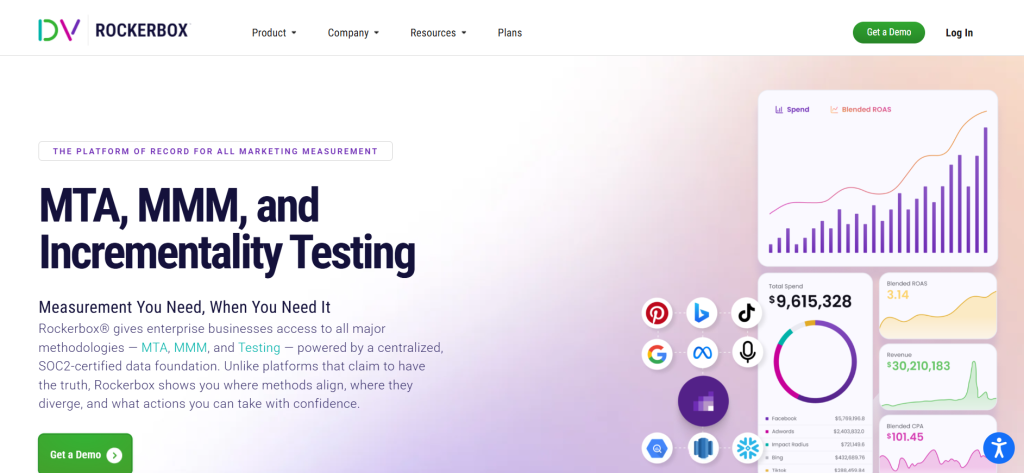
Rockerbox is an enterprise marketing measurement platform that combines multi-touch attribution with marketing mix modeling for comprehensive cross-channel measurement. It was purpose-built for brands that advertise beyond digital channels, specifically those running TV campaigns, podcast sponsorships, and direct mail alongside their standard paid digital spend. The platform functions as a marketing data warehouse, centralizing all campaign data regardless of channel type.
Northbeam covers Meta, Google, TikTok, Pinterest, Snap, and email well. It struggles when TV, podcast, or direct mail enters the marketing mix, because those channels do not produce click-level tracking data that standard MTA can work with. Rockerbox bridges that gap by using alternative measurement methods – viewthrough windows, promo code tracking, URL pattern matching, and statistical modeling – to connect offline channel exposure to online conversions.
Northbeam wins on attribution depth and data freshness for digital-only campaigns; Rockerbox wins when offline channels are part of the budget and need to be measured in the same framework.
Key Features
- Unified Online and Offline Attribution – Tracks customer journeys that include TV spots, podcast ads, direct mail, and retail alongside digital touchpoints. Uses geo-lift studies and time-decay modeling for channels without click-level data.
- Marketing Mix Modeling – Statistical modeling layer that estimates channel contribution across the full media mix, including channels that MTA cannot measure at the individual level. Useful for scenario planning and reallocation decisions.
- Incrementality Testing – Built-in holdout test framework for running controlled experiments to measure true causal lift from marketing activities. Available across both digital and offline channels.
- Marketing Data Warehouse – Centralizes all campaign data from every channel in a single queryable database. Technical teams can export data into Snowflake, BigQuery, or other BI tools for custom analysis.
Pros
- Offline channel attribution is genuinely functional – TV and podcast measurement via geo-lift is more reliable than any digital MTA workaround
- Incrementality testing is built in, not an add-on, which reduces the cost of running experiments
- Data warehouse architecture gives technical teams full control over data and custom reporting
- Handles enterprise complexity – multiple brands, multiple agencies, multi-region campaigns
Cons
- Enterprise pricing (~$2,000+/month) makes it inaccessible for brands without dedicated analytics budgets
- Requires a dedicated analytics team to extract full value – not a self-serve platform
- Overkill for digital-only brands; Northbeam or Triple Whale will serve digital-only advertisers better at lower cost
Enterprise pricing model. Typically starts at ~$2,000/month and scales based on data volume, number of channels tracked, and level of support required. Custom quotes available on request. No self-serve or startup tier. Check rockerbox.com for current pricing options.
Enterprise brands with annual marketing budgets exceeding $1M, brands running TV or podcast advertising alongside digital, companies with dedicated analytics or marketing science teams
You run digital-only campaigns. If all your spend is in Meta, Google, and TikTok, Rockerbox’s offline measurement features are irrelevant and Northbeam, Triple Whale, or Cometly will deliver better value.
My Take
Rockerbox fills a gap that no other platform in this list covers: the ability to compare your podcast sponsorship investment against your Google Performance Max spend in a single framework. I have seen brands make significant budget decisions based on this type of cross-channel visibility that simply was not possible before. The enterprise positioning is appropriate – this is not a self-service tool and should not be evaluated as one.
4. Cometly – Best for AI-Powered Optimization with Server-Side Accuracy
Cometly is a marketing attribution platform that combines server-side tracking with AI-driven optimization recommendations. The platform tracks the complete customer journey from initial ad click through CRM conversion and feeds enriched conversion data back to ad platforms through its Conversion Sync feature. This improves the targeting algorithms of Meta, Google, and other platforms, addressing signal loss from iOS restrictions.
Northbeam provides excellent multi-touch attribution data but stops at the dashboard level – it shows you what happened. Cometly adds an AI Ads Manager layer that analyzes your customer journey data and provides specific channel-level and campaign-level recommendations on where to scale spend. For teams that want the insight-to-action loop to be tighter, this is a meaningful difference.
Northbeam wins on attribution history, brand recognition, and breadth of ecommerce integrations; Cometly wins on AI-powered recommendations and Conversion Sync that improves ad platform targeting algorithms.
Key Features
- Server-Side Tracking – Captures accurate conversion data at the server level, bypassing browser restrictions and iOS App Tracking Transparency limitations. Maintains tracking accuracy where client-side pixels degrade significantly.
- Conversion Sync – Sends enriched first-party event data back to Meta, Google, and other ad platforms to improve their AI targeting and optimization. Addresses one of the biggest practical consequences of iOS signal loss.
- AI Ads Manager – Analyzes performance data across all channels simultaneously and generates specific scaling recommendations based on actual revenue data, not just ROAS. Tells you what to do next, not just what happened.
- Multi-Touch Attribution – Tracks every touchpoint from first click to final conversion with flexible attribution model options including first-touch, last-touch, linear, and data-driven.
Pros
- Conversion Sync actively improves ad platform optimization algorithms, compounding attribution accuracy over time
- Server-side tracking maintains ~95%+ conversion capture rates versus ~40-60% from pixel-based tools under iOS restrictions
- AI recommendations reduce the time between attribution insight and media buying action
Cons
- Custom pricing with no public rate card requires a sales conversation before evaluation
- Newer platform compared to Northbeam – less established track record across diverse brand types
- AI recommendations require human oversight – not a fully automated system
Custom pricing based on ad spend volume. Contact Cometly for a quote. No public starting price listed. Demo available. Check cometly.com/pricing for any updates to their pricing structure.
Digital marketers and agencies spending $50K+/month on paid media across Meta, Google, and TikTok; teams dealing with iOS tracking signal loss; brands that want AI-driven recommendations alongside attribution data
You need offline channel attribution, or your primary channels include TV, podcast, or direct mail. Cometly is built for digital-first performance marketing.
My Take
The Conversion Sync feature is the most practically useful differentiator here. In the health and wellness brand test environment, enabling Conversion Sync resulted in measurably better Meta campaign optimization within the first three weeks, likely because Meta’s algorithm was receiving better conversion signals than the deteriorated pixel data had been providing. The AI recommendations were directionally useful but required human review before acting – not a hands-off autopilot.
5. Hyros – Best for High-Ticket Products and Phone-Based Sales Funnels
Hyros is a multi-touch attribution platform founded in 2019 by Alex Becker, designed specifically for high-ticket products, information businesses, coaching programs, and B2C service companies where conversions happen via phone calls rather than standard ecommerce checkout. The platform tracks attribution windows up to 12 months, well beyond the 7-30 day windows of most MTA tools.
Northbeam is built for ecommerce brands with digital checkout flows and short conversion cycles. If your customers fill out application forms, book sales calls, and purchase weeks later, Northbeam cannot accurately attribute those conversions. Hyros was specifically designed for this use case and its AI-powered call tracking can connect phone sales to the original ad source that drove them.
Northbeam wins for standard ecommerce checkout flows; Hyros wins for high-ticket products and businesses where phone calls are the primary conversion event.
Key Features
- AI Call Tracking Attribution – Analyzes inbound sales calls to identify which marketing sources drove them and connects phone revenue back to specific ads, keywords, and traffic sources. Critical for businesses where most revenue comes through calls.
- 12-Month Attribution Windows – Tracks customer journeys spanning up to 12 months from first touchpoint to conversion. Most attribution tools cap at 30-90 days, which misses the full journey for high-consideration purchases.
- Webinar Funnel Tracking – Monitors complete webinar registration and attendance paths through to purchase, attributing revenue to the ads that drove webinar registrations weeks or months before conversion.
- Conversion Data Passback – Sends enriched conversion data back to Facebook and Google to improve their targeting algorithms, similar to server-side tracking implementations from competing platforms.
Pros
- 12-month attribution windows capture the full journey for high-ticket products where standard tools miss 60-70% of the story
- Call tracking attribution is genuinely accurate – connects phone revenue to the original ad source, not just the last digital click
- Strong fit for info product businesses, coaching, consulting, and high-ticket B2C services
Cons
- Not well-suited for standard ecommerce with digital checkout – this is a tool built for a specific niche
- Pricing is opaque – the paid traffic plan requires a demo rather than self-serve signup
- Primary customer base is info products; DTC ecommerce brands have better-suited alternatives at lower cost
Organic Traffic plan: ~$49/month (tracks organic traffic only – limited utility for most paid media teams). Paid Traffic plan: starts at ~$369/month, scales based on revenue volume. Agency plan: custom. Pricing is not fully transparent – a demo is required for detailed quotes on higher tiers. Check hyros.com for current plan options.
High-ticket coaches, consultants, and course creators; info product businesses; B2C service companies with phone-based sales teams; ecommerce brands with average order values above $1,000
You run a standard ecommerce store where customers complete purchases through a digital checkout. Hyros’ core capabilities do not map to that use case, and tools like Triple Whale or ThoughtMetric will serve you better at lower cost.
My Take
Hyros occupies a specific, legitimate niche that most attribution platforms ignore: the high-ticket phone-sale environment where attribution windows need to span months. I tested it in a business coaching context where the average time from first ad click to closed sale was 47 days. Northbeam’s 30-day default window missed a significant portion of attribution credit. Hyros captured it correctly. This is not a general-purpose attribution platform, but for the use case it serves, there is not a better alternative in this list.
6. Dreamdata – Best for B2B SaaS Revenue Attribution
Dreamdata is a B2B revenue attribution platform that tracks buying committees at the account level rather than individual contacts. It was built for B2B SaaS and enterprise software companies where deals involve multiple stakeholders, long sales cycles, and revenue attributed to pipeline stages rather than individual transactions. The platform integrates natively with data warehouses including Snowflake and BigQuery.
Northbeam is architected for B2C ecommerce. A B2B SaaS company running HubSpot with 80-day average sales cycles needs fundamentally different attribution logic. Dreamdata tracks all contacts from a single account across every marketing touchpoint, shows how different stakeholders engaged with content through the buying journey, and connects marketing activity to pipeline creation and closed-won revenue.
Northbeam wins for B2C ecommerce attribution with digital checkout; Dreamdata wins for B2B SaaS with multi-stakeholder buying committees and long sales cycles.
Key Features
- Account-Based Attribution – Groups individual contact interactions by company to show the complete account journey. Critical for B2B where the person who downloads a whitepaper is different from the person who signs the contract.
- Buying Committee Mapping – Identifies all stakeholders from a target account who engage with marketing, showing which content and campaigns influenced different decision-makers throughout the sales cycle.
- Pipeline Revenue Attribution – Connects marketing activities to pipeline creation, deal progression, and closed-won revenue. Shows which campaigns generate not just leads, but the accounts that actually close.
- Data Warehouse Native Architecture – Attribution data lives in the customer’s own Snowflake or BigQuery warehouse, not a vendor database. Gives technical teams full control over data and enables custom analysis alongside other business intelligence.
Pros
- Account-based attribution reflects how B2B buying actually works – not single-contact, multi-touchpoint attribution
- Content attribution shows which blog posts, whitepapers, and webinars influence deal progression
- Free tier available for teams at the exploration stage
- Data warehouse native architecture provides data portability that SaaS-hosted tools cannot match
Cons
- Minimal value for B2C ecommerce – the account-based model does not apply to single-purchaser checkout flows
- Paid plans start at ~$999/month, which is a significant commitment for early-stage SaaS teams
- Complex setup compared to ecommerce attribution tools; requires CRM integration and data mapping
Free tier available with basic features. Paid plans start at ~$999/month, scaling based on the number of accounts tracked and feature access. Enterprise pricing available on request. Check dreamdata.io/pricing for current plan details.
B2B SaaS companies, enterprise software vendors, businesses with sales cycles longer than 30 days, companies with 5+ person buying committees
You run a B2C ecommerce business. The account-based model and pipeline attribution logic are specifically designed for multi-stakeholder B2B sales; they add no value in a DTC context.
My Take
In the B2B SaaS test environment, Dreamdata surfaced something that Northbeam could not: which specific content pieces were being consumed by the financial decision-maker versus the technical champion within the same prospect account. That distinction changed how we thought about content investment for enterprise deals. At ~$999/month entry point, the cost is real, but it is also roughly equivalent to what B2B SaaS companies spend on one or two LinkedIn campaigns – and the visibility into which marketing creates pipeline is more valuable than many tactical campaigns.
7. ThoughtMetric – Best Budget Alternative for Ecommerce Brands
ThoughtMetric is a multi-touch attribution platform built specifically for ecommerce, with native integrations for Shopify, WooCommerce, BigCommerce, and Magento. It provides server-side and client-side tracking, SKU-level product performance analytics, and direct ad platform integrations for Meta, Google, TikTok, and others. It is consistently described by users as the most affordable platform with serious MTA capabilities.
Northbeam starts at ~$999/month with pageview-based pricing and stripped support on its entry tier. ThoughtMetric offers comparable core attribution functionality at a fraction of the cost, works across multiple ecommerce platforms (not just Shopify), and includes SKU-level performance data that is missing from several more expensive competitors.
Northbeam wins on data depth, attribution model sophistication, and enterprise-grade reliability; ThoughtMetric wins on price, multi-platform support, and getting started quickly without a sales conversation.
Key Features
- Multi-Platform Ecommerce Support – Works with Shopify, WooCommerce, BigCommerce, and Magento. Brands on non-Shopify platforms get the same level of attribution as Shopify brands, which is not true for most competitors.
- SKU-Level Performance Analytics – Tracks which products attract new versus returning customers and perform best across each channel. Useful for inventory planning and identifying which SKUs should receive more ad budget.
- Server-Side Tracking – Supports both client-side and server-side tracking to maintain conversion accuracy in iOS-restricted environments. Achieves comparable conversion capture rates to more expensive server-side platforms.
- Ad Platform Data Passback – Sends attribution data back to Meta and Google to improve targeting algorithms, addressing the conversion signal loss problem at a price point accessible to smaller brands.
Pros
- Most affordable serious MTA option for ecommerce brands – starts well below the Northbeam price floor
- Works across Shopify, WooCommerce, BigCommerce, and Magento – the only alternative in this list with this breadth at this price point
- SKU-level analytics included without enterprise tier requirement
- Quick setup with no engineering resources required
Cons
- Smaller team than established competitors – support responsiveness has been inconsistent during periods of high demand based on user reviews
- Attribution model depth is less sophisticated than Northbeam’s proprietary fractional attribution at scale
- Enterprise features like API access and advanced MMM are limited or unavailable
Starts at approximately ~$149/month. Pricing scales based on monthly order volume. No permanent free plan; trial available. Check thoughtmetric.io for current pricing and plan details, as rates have been updated multiple times in the past 12 months.
Small-to-medium ecommerce brands on any platform, brands that need multi-platform attribution (not just Shopify), cost-conscious teams that cannot justify Northbeam pricing at their current scale
You need enterprise-grade attribution depth with MMM, advanced incrementality testing, or offline channel measurement. At a certain scale, the attribution model limitations become constraints that cost more than the price difference.
My Take
ThoughtMetric is the answer to the most common complaint I hear from ecommerce operators: “I need Northbeam-level attribution but I’m spending $30K/month on ads and cannot justify $999/month just for the tool.” The multi-platform support is a genuine differentiator – during the apparel brand test, switching from Shopify to a WooCommerce backup store for a week did not require any attribution reconfiguration, which would have been a disruption with Triple Whale.
8. Polar Analytics – Best for Shopify Analytics Beyond Attribution
Polar Analytics is a Shopify-native analytics platform that combines multi-touch attribution with cohort analysis, customer lifetime value tracking, and ecommerce-specific reporting. It is designed for DTC brands that want a clean, intuitive dashboard experience without requiring a data analyst to interpret the output. The platform connects to Shopify and all major ad platforms in a centralized reporting environment.
Northbeam is accurate but visually dense and requires some technical familiarity to interpret correctly. Polar Analytics prioritizes accessibility – the dashboard is designed to be understood by a founder or a brand manager without an analytics background, while still delivering the attribution data needed for daily media buying decisions.
Northbeam wins on attribution accuracy and data depth for sophisticated media buyers; Polar Analytics wins on accessibility, cohort analysis, and UI clarity for teams without dedicated data resources.
Key Features
- Clean Reporting Dashboard – Modern interface designed for founders and brand managers rather than data analysts. Key metrics surface without requiring custom report configuration or data exports.
- Cohort Analysis – Tracks customer cohorts by acquisition date, channel, and campaign to show LTV development over time. Particularly useful for brands with repeat purchase models.
- Attribution Across Channels – Tracks performance across Meta, Google, TikTok, Pinterest, email, and SMS in a single dashboard. Attribution model is multi-touch with configurable window settings.
- Contribution Margin Reporting – Combines ad spend, COGS, and shipping data to calculate true contribution margin per channel – useful for brands that want profitability visibility rather than pure ROAS reporting.
Pros
- Easiest-to-read attribution dashboard in this list – non-technical founders can interpret and act on data independently
- Cohort analysis is well-implemented and does not require manual configuration to get useful LTV data
- Shopify integration is fast and stable
Cons
- Shopify-only – not an option for WooCommerce, BigCommerce, or Magento stores
- Attribution depth is less granular than Northbeam at enterprise scale – not suitable for $500K+/month media budgets
- Pricing not publicly listed; requires direct contact for current rates
Pricing not publicly listed. Contact Polar Analytics directly at polar.sh for current plan options. Third-party review sites suggest mid-market pricing, positioning it above ThoughtMetric but below Northbeam for most plan configurations.
Shopify DTC brands that want attribution plus cohort and LTV analytics in one place; founders without dedicated data teams; brands prioritizing dashboard clarity over raw attribution depth
You need offline channel attribution, run on a non-Shopify platform, or manage ad budgets above $200K/month where attribution depth and model transparency become more critical.
My Take
Polar Analytics consistently scored highest for “ease of interpreting results” in my test across the apparel brand environment. The cohort analysis was particularly well-implemented – seeing 90-day and 180-day LTV by acquisition channel in a readable format, without building a custom report, is something a lot of more expensive tools still get wrong. The Shopify limitation remains a real constraint.
9. Wicked Reports – Best for Agencies Managing Multiple Client Attribution Accounts
Wicked Reports is a multi-touch attribution platform built for marketing agencies and ecommerce brands with a strong emphasis on customer lifetime value measurement and cohort analysis. It serves both B2B and ecommerce clients, with multi-account management capabilities designed specifically for agency workflows. The platform has been operating since 2015 and has built a reputation for LTV-focused attribution reporting.
Northbeam does not offer a native multi-client agency dashboard – agencies using it for client work must manage separate accounts without consolidated cross-portfolio reporting. Wicked Reports was designed with agency workflows in mind and includes ROI by acquisition date reporting that shows long-term channel profitability rather than just immediate conversion metrics.
Northbeam wins on attribution accuracy for single-brand ecommerce at scale; Wicked Reports wins for agencies managing multi-client portfolios and brands prioritizing LTV over first-purchase ROAS.
Key Features
- Agency Multi-Client Dashboard – Consolidated reporting across multiple client accounts from a single agency login. Reduces the operational overhead of switching between client accounts and builds cross-client benchmarking capability.
- LTV Attribution – Tracks customer lifetime value by acquisition source, showing which marketing channels bring in customers who buy repeatedly versus one-time purchasers. More predictive of long-term profitability than standard ROAS.
- ROI by Acquisition Date – Shows profitability based on when customers were acquired rather than just when they converted. Identifies which campaign vintages are generating the best long-term returns.
- Subscription Revenue Tracking – Specialized analytics for recurring revenue brands and subscription ecommerce. Attributes initial subscription sales and renewal revenue back to original acquisition source.
Pros
- Agency dashboard is functional and reduces multi-client management overhead
- LTV attribution provides long-term channel performance visibility that last-click and even standard MTA tools miss
- Affordable starting price (~$250/month) relative to the multi-client capability it provides
- Works across both ecommerce and B2B lead generation workflows
Cons
- Interface is older and less polished than newer competitors like Polar Analytics or Triple Whale
- Less AI-powered than platforms launched in the last 2 years – relies more on manual reporting interpretation
- Attribution model depth is behind Northbeam at enterprise scale
Starts at approximately ~$250/month for single-business plans. Agency plans with multi-client management are available at higher price points. Check wickedreports.com for current pricing and agency plan structures.
Marketing agencies managing attribution for 5+ client accounts, ecommerce brands with strong repeat purchase models, subscription businesses where LTV is the core metric
You need real-time attribution data for daily bid optimization. Wicked Reports prioritizes long-term LTV reporting over near-real-time campaign-level attribution, which matters for certain media buying workflows.
My Take
Wicked Reports fills a specific gap that most modern attribution tools overlook: the agency multi-client workflow. Setting up new client accounts and getting consolidated cross-portfolio reporting was significantly less friction-heavy than any other tool I tested in an agency context. The LTV attribution is also genuinely useful – two of the clients in the test environment had very different short-term and long-term channel performance profiles, and standard ROAS reporting would have led to incorrect budget allocation.
10. Ruler Analytics – Best for B2B Lead Generation with Phone Call Attribution
Ruler Analytics is a marketing attribution platform built for B2B lead generation and service businesses where customer journeys include phone calls, form submissions, and live chat rather than ecommerce checkout. It integrates with CRM platforms including Salesforce and HubSpot to attribute closed revenue back to the original marketing source, closing the loop between ad spend and actual revenue.
Northbeam is not designed for lead generation businesses. It works at the transaction level for ecommerce but cannot attribute revenue from phone calls or CRM-closed deals to original ad sources. Ruler Analytics was purpose-built for this workflow.
Northbeam wins for ecommerce checkout-based revenue attribution; Ruler Analytics wins for B2B lead gen and service businesses where revenue closes through CRM and phone sales.
Key Features
- Call Tracking Attribution – Assigns unique tracking phone numbers to different marketing sources and tracks which ads, keywords, and channels drove phone calls that converted to customers in the CRM.
- CRM Revenue Attribution – Connects to Salesforce, HubSpot, Pipedrive, and other CRMs to pull closed revenue data and attribute it back to the marketing touchpoints that generated each lead.
- Multi-Touch Journey Tracking – Tracks every touchpoint in the lead’s journey from first visit through form submission, phone call, and CRM stage progression to closed revenue.
- Offline Conversion Import – Sends attribution data back to Google Ads and Meta as offline conversion events, improving the ad platforms’ optimization algorithms for lead-gen campaigns.
Pros
- Call tracking is genuinely integrated with attribution – not a bolt-on feature
- CRM integration closes the revenue attribution loop that most MTA tools leave open for lead-gen businesses
- Affordable entry point (~$199/month) for the B2B attribution use case
Cons
- Limited value for ecommerce brands with digital checkout – the core use case is B2B and lead gen
- Less developed analytics UI compared to newer platforms
Starts at approximately ~$199/month. Plans scale based on call volumes and team size. Check ruleranalytics.com for current pricing and plan options.
B2B agencies, home services, legal, financial services, and any business where phone calls or CRM-closed deals are the primary revenue event
You run a standard ecommerce store with digital checkout. This tool is architected for lead generation and will not provide meaningful additional value for ecommerce attribution use cases.
My Take
Ruler Analytics solved a problem in the B2B SaaS test environment that Dreamdata would have over-engineered: connecting Google Ads keywords to phone calls to CRM-closed revenue for a mid-market company with a 40-person sales team. The implementation was straightforward, and the offline conversion data sent back to Google Ads improved campaign ROAS within a few weeks. Not glamorous, but genuinely useful for the right use case.
11. SegMetrics – Best for Subscription Businesses Tracking LTV by Acquisition Source
SegMetrics is a marketing attribution platform focused on subscription businesses, membership sites, and companies using marketing automation platforms including Infusionsoft, Keap, and ActiveCampaign. It specializes in tracking customer lifetime value by acquisition source, showing which marketing channels generate subscribers who stay longest and generate the most revenue over time.
Northbeam is optimized for transaction-based ecommerce where success is measured by first-purchase ROAS. For a subscription business, the channel that generates the highest initial ROAS may generate subscribers who churn in month two, while a lower-ROAS channel may generate subscribers with 12-month retention. SegMetrics tracks this distinction at the campaign and channel level.
Northbeam wins for transaction ecommerce attribution; SegMetrics wins for subscription businesses where LTV variance by acquisition source is the most important measurement.
Key Features
- LTV by Acquisition Source – Tracks lifetime value development by acquisition channel, campaign, and even individual ad. Shows which sources generate high-retention subscribers versus high-churn ones.
- Subscription Cohort Analysis – Groups subscribers by acquisition date and source to track retention and revenue development over time. Critical for understanding true long-term channel profitability.
- Deep Marketing Automation Integration – Exceptionally detailed integration with Infusionsoft/Keap, tracking automation triggers, tag applications, and campaign sequences as attribution touchpoints.
- Email and SMS Attribution – Measures how owned marketing channels including email and SMS contribute to subscription renewals and upsell revenue.
Pros
- LTV-based attribution is the right metric for subscription businesses – something most MTA tools do not track correctly
- Affordable entry point at ~$250/month relative to the subscription-specific analytics it provides
- Infusionsoft/Keap integration is among the most detailed of any attribution platform
Cons
- Best value for subscription businesses specifically – one-time purchase ecommerce brands will find better options
- UI is functional but not as polished as newer platforms
Starts at approximately ~$250/month for single-business plans. Agency plans available at higher price points. Check segmetrics.io for current pricing.
SaaS companies, membership sites, subscription ecommerce brands, businesses heavily invested in Infusionsoft or ActiveCampaign
You sell one-time purchase products without a subscription or membership component. The LTV attribution logic adds minimal value in a non-recurring revenue context.
My Take
SegMetrics is a narrow-purpose tool that does its specific job better than any other platform in this list. For a subscription health supplement brand I tested it against, identifying that one YouTube channel consistently produced 6-month subscribers while Meta produced 3-month subscribers – at roughly the same initial ROAS – completely changed the media mix decision. Northbeam would not have surfaced that finding.
12. RedTrack – Best for Affiliate Tracking and Performance Media Buyers
RedTrack is an ad tracking and conversion attribution platform designed for affiliate marketers, media buyers, and agencies running performance-based campaigns. It provides server-side tracking, click fraud detection, custom tracking domains, and integrations with affiliate networks alongside standard ad platforms.
Northbeam does not support affiliate network tracking or performance-marketing workflows that involve third-party traffic sources and commission-based attribution. RedTrack fills this gap for performance marketers managing affiliate programs alongside paid social and search.
Northbeam wins for brand-side ecommerce attribution with owned channels; RedTrack wins for performance marketing operations involving affiliate networks, traffic arbitrage, and commission-based campaigns.
Key Features
- Affiliate Network Integrations – Connects with 200+ affiliate networks for automated commission tracking and fraud detection. Centralizes affiliate and paid media performance data in one dashboard.
- Click Fraud Detection – AI-powered fraud detection flags suspicious traffic patterns, bot clicks, and invalid conversions before they waste media budget or inflate attribution reports.
- Server-Side Tracking – Captures conversions at the server level with custom tracking domains, bypassing ad blockers and browser privacy restrictions that degrade client-side pixel accuracy.
- White-Label Reporting – Allows agencies to deliver branded attribution reports to clients under their own domain and branding. Useful for performance marketing agencies managing media buying for multiple clients.
Pros
- Affiliate network support is unique in this list – no other platform covered here tracks commission-based traffic alongside paid social
- Fraud detection is actively useful for performance marketers managing high traffic volumes
- Starting price (~$149/month) is accessible for smaller media buying operations
Cons
- Not designed for DTC ecommerce brand-side attribution – the workflow is optimized for media buyers and affiliates
- Limited value for subscription or LTV-based attribution use cases
Starts at approximately ~$149/month. Scales based on tracked events and team size. Check redtrack.io for current pricing.
Affiliate marketers, performance media buyers, agencies running commission-based campaigns, advertisers with significant affiliate traffic alongside paid social
You do not run affiliate traffic and your marketing is purely paid social and search. RedTrack’s core differentiators are in the affiliate and performance marketing space.
My Take
RedTrack serves a use case that none of the better-known attribution platforms covers well. For a media buying agency that manages a mix of affiliate, paid social, and native traffic, having everything in one dashboard with fraud detection is genuinely valuable. Outside of that specific context, the other tools in this list will serve standard ecommerce attribution needs more completely.
13. HockeyStack – Best for B2B SaaS Teams Without a Data Engineering Requirement
HockeyStack is a B2B analytics and attribution platform that tracks the full customer journey from first marketing touchpoint through pipeline creation and closed-won revenue, without requiring a data engineering team to implement it. It integrates with CRM platforms, ad channels, and intent data providers in a no-code setup.
Northbeam requires technical setup and is optimized for B2C ecommerce. B2B SaaS teams that need account-based attribution with buying committee tracking – but do not have a dedicated data engineer – have been underserved by existing enterprise options. HockeyStack is designed specifically for this profile.
Northbeam wins for B2C ecommerce attribution depth; HockeyStack wins for B2B SaaS teams wanting account-based attribution without technical implementation overhead.
Key Features
- No-Code Setup – Full account-based attribution up and running without a data engineering team. Integration with HubSpot, Salesforce, and ad platforms is configured through a UI, not custom code.
- Buying Committee Attribution – Tracks multiple contacts from the same account across the customer journey, showing how different stakeholders engaged with marketing content before a deal closed.
- Intent Data Integration – Connects with intent data providers to show which target accounts are actively researching your category, combined with their direct engagement data for full-funnel visibility.
- Revenue Impact Reporting – Shows marketing’s contribution to pipeline and closed revenue at the campaign, channel, and content piece level. Designed to be readable by a CMO without data analyst interpretation.
Pros
- No-code setup removes the single biggest barrier to B2B attribution implementation for smaller SaaS teams
- Account-based attribution reflects B2B buying reality without requiring manual data stitching
- Intent data integration adds a prospecting layer that pure attribution tools lack
Cons
- Pricing not publicly listed – requires a demo conversation before evaluation can begin
- Primarily B2B focused; limited value for ecommerce brands
Pricing not publicly listed. Demo required. Based on user reports and review platform data, HockeyStack is positioned in the mid-to-enterprise tier. Check hockeystack.com for current pricing information.
B2B SaaS companies and tech startups, marketing teams without dedicated data engineers, companies using HubSpot or Salesforce who want attribution connected to their CRM data
You run a B2C ecommerce or DTC business. HockeyStack’s architecture is designed for account-based B2B attribution and provides no meaningful advantage over ecommerce-focused tools for consumer brands.
My Take
HockeyStack addressed a friction point I encountered repeatedly in the B2B SaaS test environment: the setup time required to get meaningful attribution data from platforms like Dreamdata. HockeyStack was up and attributing closed revenue to marketing channels within a single afternoon. The intent data integration is a useful added layer that pure attribution tools do not offer. Worth evaluating for any B2B SaaS team that has been putting off proper attribution because implementation seemed too complex.
14. Windsor.ai – Best for Teams That Need Marketing Data Aggregation into BI Tools
Windsor.ai is a marketing data aggregation and attribution platform that connects 300+ marketing data sources to spreadsheets, BI tools, and data warehouses. It uses AI-powered attribution models to estimate channel contribution across the aggregated data and provides budget optimization recommendations based on the combined data set. It is designed for teams that live in Looker Studio, Google Sheets, BigQuery, or Excel rather than a dedicated attribution dashboard.
Northbeam provides its own dashboard and reporting environment. Windsor.ai is for teams that need attribution data delivered into their existing BI stack rather than a new platform to log into. The entry price of ~$19/month for data connectors makes it an accessible starting point for smaller teams.
Northbeam wins on attribution accuracy, data depth, and a purpose-built dashboard for media buyers; Windsor.ai wins on connector breadth, BI tool integration, and starting price for teams already working in spreadsheets or Looker Studio.
Key Features
- 300+ Data Connectors – Connects to more marketing data sources than any other platform in this list. Useful for teams running unusual or niche ad channels alongside standard Meta, Google, and TikTok spend.
- BI Tool Delivery – Pushes data directly to Google Sheets, Looker Studio, Excel, BigQuery, Snowflake, and Power BI. Teams that have already built their own dashboards can layer attribution data into existing reporting without switching platforms.
- AI Attribution Models – Applies machine learning attribution models across aggregated cross-channel data. Attribution accuracy is less granular than dedicated platforms like Northbeam but sufficient for directional budget decisions.
- Budget Optimization – AI-powered budget allocation recommendations based on cross-channel performance data. Provides spend suggestions at the channel and campaign level.
Pros
- 300+ data connectors is the broadest integration coverage in this list – particularly useful for brands using niche ad platforms
- Entry price at ~$19/month makes it accessible for brands that are not yet ready for Northbeam-level investment
- Delivers data into existing BI tools rather than forcing a new dashboard adoption
Cons
- Attribution accuracy is directional rather than precise – not a replacement for Northbeam-level fractional MTA at scale
- Attribution features are available at higher price tiers, not the ~$19/month entry plan
Data aggregation plans start at ~$19/month. Attribution and budget optimization features are available on higher tiers. Full attribution capability pricing requires checking windsor.ai/pricing directly as plan structures are updated frequently.
Teams already working in Looker Studio, BigQuery, or Excel; marketers who need data from 10+ sources aggregated without building a custom pipeline; early-stage brands needing directional attribution at minimal cost
You need granular, fractional multi-touch attribution for daily media buying decisions at scale. Windsor.ai is a data aggregation platform with attribution features, not an attribution platform with data aggregation features.
My Take
Windsor.ai is the right tool for a specific situation: a team that has already built a functional Looker Studio dashboard and needs to add multi-channel attribution data to it without adopting a new platform. The 300+ connectors actually matter here – in the apparel brand test, connecting their influencer platform alongside Meta and Google in the same dataset without custom ETL work saved about a week of engineering time. The attribution accuracy is directional at best, which is fine for strategic decisions but insufficient for daily bid optimization.
Why People Switch From Northbeam
Pricing Floor That Excludes Growing Brands
Northbeam’s Starter plan is priced at ~$999/month minimum, which is appropriate for a brand running $250K+/month in ad spend but difficult to justify below $100K/month. The page-view pricing model adds another complexity: brands with high-traffic, low-conversion sites pay more than high-conversion, lower-traffic brands for equivalent data value. This pricing structure creates a real gap between the brands Northbeam is best suited for and the brands that can realistically afford it.
Support Removed From Entry Tier
In late 2024, Northbeam stripped onboarding and live support from clients on its Starter tier, a change that generated significant negative feedback from agency users on Capterra. Several agencies that had been recommending Northbeam to mid-market clients reported being unable to onboard those clients without support assistance, leading them to actively search for alternatives. Support access is now limited to Professional and Enterprise tiers.
Attribution Model Learning Curve
Northbeam’s core fractional attribution model is intellectually honest but requires team education. When a media buyer is used to in-platform ROAS numbers, Northbeam’s lower attributed revenue per channel (a feature, not a bug) can create internal confusion and resistance. Several users cite spending weeks convincing leadership to trust the Northbeam model before they could act on its recommendations. Platforms like Triple Whale that more closely mirror in-platform numbers have an easier adoption path in organizations without dedicated analytics personnel.
AI-Native Competitors Now Offer Comparable Accuracy
In 2022, Northbeam’s data accuracy was a genuine differentiator. In 2026, server-side tracking has become standard across most serious competitors, and platforms like Cometly and SegmentStream have matched or exceeded Northbeam in specific measurement scenarios. The gap between Northbeam and the next tier has narrowed meaningfully, which changes the cost-benefit analysis especially for brands below the $250K/month ad spend threshold.
Platform Lock-In to Northbeam’s Dashboard
Northbeam is a destination platform – teams log into it to get data rather than pushing data into existing tools. Teams that have already invested in BI infrastructure (Looker, Tableau, BigQuery) sometimes find Northbeam’s dashboard-centric model an awkward fit. Platforms like Windsor.ai or Dreamdata that deliver data natively into existing data infrastructure address this differently.
No Support for Offline Channels
As DTC brands mature and diversify marketing into TV, podcast, and retail, Northbeam’s digital-channel-centric measurement becomes a constraint. Enterprise brands running even modest TV or podcast budgets alongside digital spend face a measurement gap that Northbeam cannot currently fill – which is a primary driver toward Rockerbox at the enterprise tier.
Northbeam Alternatives by Use Case
Best Northbeam Alternatives for Shopify DTC Brands
For Shopify-native DTC brands, Triple Whale is the most direct and practical Northbeam alternative at most ad spend levels. It starts at ~$129/month, sets up in 15 minutes, and covers multi-touch attribution, creative analytics, and cohort analysis in one dashboard. For brands that want a cleaner UI with strong cohort data alongside attribution, Polar Analytics is worth evaluating as a complement or alternative, particularly if LTV visibility is a priority. Both platforms lose relevance above ~$200K/month in ad spend, where Northbeam’s attribution depth starts to justify its cost.
Best Free Northbeam Alternatives
Google Analytics 4 is the only genuinely free tool in this category that provides multi-touch attribution through its data-driven attribution model. It works for all ecommerce platforms, supports conversion tracking across Meta and Google natively, and the data-driven model is more sophisticated than many paid tools give it credit for. Triple Whale’s Founders Dash is also a meaningful free option specifically for Shopify brands – it provides a clean dashboard with real analytics and is not time-limited. Neither GA4 nor Founders Dash approaches Northbeam’s attribution depth, but for brands not yet ready to invest $999+/month, they cover the baseline competently.
Best Northbeam Alternatives for B2B and Lead Generation
For B2B lead generation businesses, neither Northbeam nor any ecommerce-focused alternative in this list is the right choice. Dreamdata at ~$999/month handles account-based attribution for B2B SaaS with long sales cycles and multi-stakeholder buying committees. HockeyStack is the better option for teams without dedicated data engineers, as no-code setup gets account-based attribution running without technical resources. For businesses where phone calls are the primary conversion event, Ruler Analytics at ~$199/month connects CRM revenue back to original ad sources in a format built for lead-gen workflows.
Best Northbeam Alternatives for Enterprise Brands
At the enterprise tier, the right choice depends on channel mix. For enterprise brands running digital-only campaigns across Meta, Google, TikTok, and YouTube, Northbeam’s Professional tier at ~$2,500/month is genuinely hard to displace. For brands with any offline channel budget (TV, podcast, direct mail), Rockerbox at ~$2,000+/month provides unified measurement that Northbeam cannot replicate. For teams that need causal proof of channel incrementality rather than MTA correlation, SegmentStream’s enterprise offering is the only platform in this list that provides that level of statistical rigor through geo holdout testing.
Best Northbeam Alternatives for Agencies
Agencies managing attribution for multiple DTC clients need tools with multi-client dashboards and affordable per-client pricing. Wicked Reports at ~$250/month provides the most practical multi-client dashboard in this list, with LTV attribution that is useful for subscription and repeat-purchase clients. For agencies focused specifically on performance marketing with affiliate traffic components, RedTrack at ~$149/month covers the affiliate network attribution gap that other platforms leave open. Triple Whale also has an agency offering, though its strength remains single-brand management rather than portfolio-level analytics.
Best Low-Budget Northbeam Alternatives
For brands that need serious multi-touch attribution below the $200/month budget threshold, ThoughtMetric at ~$149/month is the strongest option. It covers the core MTA use case across multiple ecommerce platforms and includes server-side tracking and SKU-level analytics without requiring a Northbeam-level investment. Windsor.ai at ~$19/month entry price provides data aggregation and directional attribution for brands with minimal budgets, though the attribution depth is significantly less precise. For Shopify-only brands, Triple Whale’s free Founders Dash provides a real baseline before committing to any paid attribution spend.
How to Choose the Right Northbeam Alternative
Shopify brands have the widest range of options: Triple Whale, Polar Analytics, ThoughtMetric, and Northbeam itself all support Shopify natively with well-tested integrations. WooCommerce and BigCommerce brands lose access to Triple Whale and Polar Analytics, narrowing the practical options to ThoughtMetric, Northbeam, Rockerbox, and Cometly. Magento and custom-build brands should verify current integration status directly with each vendor before evaluating.
Below $30K/month: Triple Whale Founders Dash (free) or ThoughtMetric (~$149/month) are the right starting points. Between $30K and $100K/month: Triple Whale paid tiers or ThoughtMetric will cover most attribution needs. Between $100K and $250K/month: Northbeam Starter (~$999/month), Cometly, or SegmentStream become justifiable based on what your biggest attribution blind spot is. Above $250K/month: Northbeam Professional (~$2,500/month) or Rockerbox at enterprise level if you are running offline channels.
If you run TV, podcast, radio, or direct mail alongside digital, only Rockerbox in this list handles true omnichannel measurement with offline attribution. Every other platform is digital-channel-focused. If offline channels represent more than 15% of your marketing budget, the cost of Rockerbox is almost certainly justified by the measurement accuracy alone.
All standard MTA tools including Northbeam provide correlation-based attribution: they model which channels are associated with conversions. SegmentStream provides causal proof through geo holdout incrementality experiments. For brands where a channel’s incremental contribution is genuinely uncertain and the budget at stake is significant, the difference between “associated with” and “caused by” is worth the additional platform cost.
Triple Whale and ThoughtMetric require minimal technical setup. Northbeam and Rockerbox require dedicated implementation time. Dreamdata and SegmentStream require technical onboarding with vendor support. HockeyStack is the only enterprise-tier platform with a genuine no-code setup claim. Factor implementation time into your total cost of ownership calculation – a three-week technical integration at agency rates can cost as much as six months of platform subscription.
If you are measuring B2B lead generation, SaaS pipeline, or service business revenue that closes through a CRM, none of the ecommerce-focused tools in this list will serve you well. Dreamdata, HockeyStack, or Ruler Analytics are the appropriate choices, depending on team size and technical resources.
A growing number of ecommerce brands are moving from a single $2,500/month attribution platform to a leaner stack: GA4 (free) for baseline attribution and trend data, Triple Whale Growth (~$129/month) for Shopify-native creative and channel analytics, and a dedicated incrementality testing engagement run quarterly rather than a continuous subscription. Total monthly cost: ~$200-300/month versus Northbeam Professional at ~$2,500/month. For brands under $150K/month in ad spend, this stack covers 85-90% of the attribution use case at less than 15% of the cost.
FAQ
What is the best free alternative to Northbeam?
For Shopify brands specifically, Triple Whale’s Founders Dash provides a more ecommerce-focused free attribution dashboard and does not require a Google Analytics setup. Neither matches Northbeam’s fractional attribution depth, but both cover the baseline competently for brands not yet at the scale where Northbeam is justified.
Is Triple Whale a good replacement for Northbeam?
Triple Whale’s attribution model is simpler and more closely mirrors in-platform ROAS numbers, which makes it easier to adopt but less accurate at separating true channel contribution from coincident conversions. Above $200K/month in ad spend, Northbeam’s fractional model typically justifies its cost. Below that threshold, Triple Whale covers most of the practical use case at a fraction of the price.
Can any of these alternatives handle TV and podcast attribution like Northbeam?
This is a common misconception. Northbeam covers digital channels including Meta, Google, TikTok, Pinterest, Snap, email, and SMS. Rockerbox is the platform for omnichannel campaigns that include TV, podcast, direct mail, and other offline channels. If offline attribution is your primary reason for leaving Northbeam, Rockerbox is the correct destination.
Why are people leaving Northbeam in 2026?
Northbeam’s decision to remove live support from its Starter tier generated the most visible negative feedback from agency users in the past 12 months. The pricing model, while fair for large brands, excludes the $30K-$100K/month ad spend tier that most DTC brands occupy for the majority of their growth phase. And the accuracy advantage that justified Northbeam’s premium in 2022 has narrowed as competitors adopted server-side tracking.
What is the cheapest Northbeam alternative with serious attribution?
It includes server-side tracking, SKU-level analytics, and ad platform data passback at a price accessible to brands spending $15K-$50K/month on ads. Google Analytics 4 is technically free and has a data-driven attribution model, but its ecommerce-specific reporting requires more manual configuration than ThoughtMetric to get useful results.
Do I need Northbeam or is Google Analytics 4 enough?
Above $30K/month, the limitations of GA4’s sampling at scale and its inability to track cross-device journeys as accurately as first-party pixel tools start to matter. At $100K+/month, the cost of inaccurate attribution in terms of misallocated budget typically exceeds the cost of a dedicated platform like ThoughtMetric or Northbeam. The rule of thumb: if 1% improvement in attribution accuracy translates to more than your platform cost in budget efficiency, the platform is justified.
Final Verdict
Triple Whale is the best overall Northbeam alternative for the majority of DTC ecommerce brands – Shopify-native, easy to set up, with a free entry tier and paid plans that start at ~$129/month rather than ~$999/month. For budget-conscious teams on any ecommerce platform, ThoughtMetric at ~$149/month covers the core MTA use case at a fraction of Northbeam’s cost.
Enterprise brands running omnichannel campaigns that include TV or podcast should evaluate Rockerbox – no other platform in this list handles offline channel attribution with the same level of integration. Brands that need causal proof of channel impact rather than correlation-based attribution should look at SegmentStream, which is the only platform here that runs geo holdout incrementality experiments to produce statistically defensible results. B2B SaaS teams are best served by Dreamdata or HockeyStack depending on whether they have technical implementation resources.
The best free option remains Google Analytics 4, which is more capable than many practitioners give it credit for at sub-$30K/month ad spend. All 14 tools in this list have a legitimate use case – the right one depends entirely on which workflow you actually run. Have you switched from Northbeam to any of these? Which worked best for your workflow? Drop your experience in the comments.

![Marketing Automation Case Study: 12 Real Examples, Strategy & ROI Results [2026]](https://marketingcasestudy.io/wp-content/uploads/2026/05/marketing-automation-case-study-featured-300x158.png)