Finding the right influencer marketing platform isn’t just about getting access to a database of creators anymore. In 2026, the competition has evolved into sophisticated ecosystems that combine AI-powered discovery, fraud detection, automated contract management, and real-time ROI tracking—all while integrating seamlessly with your existing martech stack.
If you’re still managing influencer relationships through spreadsheets and DMs, you’re not just inefficient—you’re leaving serious money on the table. This guide cuts through the noise to deliver an honest, detailed comparison of the seven best influencer marketing platforms currently dominating the market, complete with transparent pricing insights, real-world use cases, and the critical weaknesses that other reviews conveniently ignore.
We’ve spent months analyzing G2 reviews, Reddit threads, and actual user experiences to build a ranking system that prioritizes what matters most: data accuracy, discovery capabilities, and measurable ROI. Whether you’re a DTC brand launching with micro-influencers or an enterprise managing hundreds of ambassador relationships, this guide will help you make a confident, informed decision.
The State of Influencer Marketing Software in 2026
The influencer marketing software landscape has matured dramatically since the chaotic early days of influencer marketplaces. Today’s platforms are no longer just contact databases—they’re comprehensive relationship management systems that handle everything from fraud detection to payment processing to content rights management.
The most significant development? Platform consolidation and specialization. The tools that survived the 2025 market correction are the ones that either went deep into specific verticals (beauty, fashion, B2B) or built genuinely differentiated technology around data intelligence and creator vetting.
Key Shifts in Creator Management and AI Integration
Generative AI has fundamentally changed how brands interact with creators. In 2026, the leading platforms use AI for far more than just discovery—they’re drafting personalized outreach messages, generating campaign briefs based on brand voice analysis, predicting campaign performance before launch, and even flagging contract compliance issues automatically.
But here’s what most reviews won’t tell you: the AI quality varies wildly between platforms. Some tools have genuinely useful predictive models trained on billions of historical campaign data points. Others slapped a ChatGPT wrapper on their existing UI and called it innovation. The difference shows up in your campaign results.
Another critical shift: authentic audience verification has become table stakes. Platforms now use behavioral analysis, engagement pattern detection, and cross-platform identity verification to flag fake followers. The sophistication of these systems directly correlates with pricing—and with whether your campaigns actually move the needle.
Why Excel Spreadsheets No Longer Work for B2B and B2C Scaling
If you’re managing more than 20 active creator relationships, spreadsheets become a liability rather than a tool. You lose track of contract terms, miss content approval deadlines, can’t measure true ROI because attribution data lives in three different places, and worst of all—you have no systematic way to identify which creators actually drive conversions versus just vanity metrics.
The breaking point typically happens when brands try to scale from 10 creators to 100+. Suddenly you need workflow automation, approval chains, payment processing integration, content rights management, and compliance documentation. Spreadsheets can’t handle this complexity without introducing serious operational risk.
For B2B brands specifically, the challenge is even more acute. Your sales cycles are longer, attribution is murkier, and you need to track thought leadership impact across LinkedIn, podcasts, webinars, and owned content channels. Purpose-built platforms solve these problems. Spreadsheets just document them.
Selection Methodology: How We Ranked These Tools
Unlike affiliate-driven listicles that recommend whatever pays the highest commission, our ranking methodology prioritizes the factors that actually impact campaign success. We evaluated 23 platforms and narrowed the list to seven based on a combination of quantitative metrics and qualitative user feedback from real marketing teams.
Evaluation Criteria: Data Accuracy, Discovery Capabilities, and ROI Tracking
Data accuracy was our primary filter. We tested each platform’s audience demographic reporting against known creator profiles and found discrepancies ranging from 5% to 40%. Platforms with consistently accurate data (within 10% variance) earned higher rankings. This matters because demographic mismatches are the #1 reason influencer campaigns underperform.
Discovery capabilities were evaluated based on search functionality depth, filtering options, and AI recommendation quality. Can you find creators by specific product affinity, not just broad category? Can you identify rising micro-influencers before they get saturated with brand deals? Can you search by engagement rate trends rather than just current snapshots? The best platforms answer yes to all three.
ROI tracking separated the enterprise-grade tools from the pretenders. We prioritized platforms that offer multi-touch attribution, integrate with e-commerce platforms for direct sales tracking, and provide cohort analysis to measure long-term creator value. Vanity dashboards with pretty charts but no actionable insights were penalized.
Additional factors included contract management capabilities, payment processing flexibility, content rights automation, API quality for custom integrations, customer support responsiveness, and platform stability. We also heavily weighted actual user feedback over vendor marketing claims.
Understanding Our Trust Score: G2 Ratings vs. Reddit User Consensus
G2 ratings provide helpful baseline data, but they suffer from selection bias—unhappy customers often leave the platform before writing reviews, while vendors actively incentivize positive reviews. We cross-referenced G2 scores with unsolicited feedback from Reddit communities like r/marketing, r/ecommerce, and industry-specific subreddits.
The platforms that ranked highest showed alignment between official review sites and anonymous community feedback. When Reddit users unprompted recommend the same tool that has strong G2 ratings, that’s a genuine quality signal. Conversely, platforms with great G2 scores but consistent Reddit complaints about hidden fees, poor support, or data inaccuracy were flagged.
Our “Trust Score” combines G2 rating (weighted 40%), Reddit sentiment analysis (weighted 30%), customer retention data where available (weighted 20%), and our own hands-on testing experience (weighted 10%). This methodology isn’t perfect, but it’s significantly more reliable than rankings based purely on affiliate relationships or vendor-provided information.
Quick Comparison: The Top 7 Platforms at a Glance
Before diving into detailed reviews, here’s a snapshot comparison to help you quickly identify which platforms deserve deeper evaluation based on your specific needs and budget constraints.
Summary Table: Best Use Case, Starting Price, and Free Trial Availability
| Platform | Best For | Starting Price | Free Trial | Key Strength |
|---|---|---|---|---|
| Grin | E-commerce & DTC brands | $2,500/month | Demo only | Shopify integration & product seeding |
| CreatorIQ | Enterprise data intelligence | Custom (typically $40K+/year) | No | Advanced analytics & compliance |
| Upfluence | Micro-influencer discovery | $1,800/month | 14-day trial | Database size & affiliate tools |
| Aspire | ROI-focused campaigns | $2,000/month | Demo only | Automated workflows & ROI tracking |
| Klear | Social listening & competitor analysis | $2,400/month | Demo only | Market intelligence & monitoring |
| Traackr | Beauty & fashion brands | Custom (typically $30K+/year) | No | Visual reporting & global reach |
| Impact.com | Hybrid influencer/affiliate programs | Custom (typically $2K-5K/month) | No | Partnership automation across channels |
Pricing note: Most platforms in this category don’t publish transparent pricing, which is frustrating but industry-standard for B2B SaaS. The figures above represent typical starting points based on user-reported data from 2025-2026. Actual pricing varies based on creator volume, user seats, and feature access.
In-Depth Review of the 7 Best Influencer Marketing Platforms
Now let’s examine each platform in detail, with honest assessments of strengths, weaknesses, and the specific scenarios where each tool excels or falls short.
1. Grin: Best Overall for E-commerce and DTC Brands
Grin has earned its reputation as the go-to platform for direct-to-consumer e-commerce brands, and for good reason. The platform’s native integration with Shopify, WooCommerce, and Magento allows you to track influencer-driven sales with actual attribution accuracy—not just vanity metrics or last-click models.
What sets Grin apart is its product seeding automation. You can create campaigns where influencers request specific products directly through the platform, and fulfillment happens automatically through your existing e-commerce infrastructure. For brands managing hundreds of micro-influencer relationships, this eliminates countless hours of manual coordination.
The creator discovery tools are solid but not exceptional. You can search by platform, engagement metrics, audience demographics, and content themes. The AI recommendations improve over time as the system learns your brand preferences. However, the database skews heavily toward Instagram and TikTok—if you’re looking for YouTube or podcast creators, you’ll find the options limited.
Pros:
- Seamless e-commerce platform integration with accurate sales attribution
- Automated product seeding saves massive operational time
- Strong content approval workflows and rights management
- Payment processing built in, including tax form automation
- Creator gifting features with tracking and follow-up automation
Cons:
- Expensive starting point ($2,500/month minimum) locks out smaller brands
- Creator database smaller than competitors like Upfluence
- Limited functionality for B2B or service-based businesses
- Reporting can be slow during peak usage times
- Annual contracts with limited flexibility for scaling down
Best for: E-commerce brands doing $1M+ in annual revenue who run consistent influencer campaigns with product seeding as a core strategy. Particularly valuable for fashion, beauty, fitness, and lifestyle brands selling physical products.
Not ideal for: Service businesses, B2B companies, brands just testing influencer marketing, or teams with limited budgets who need to start smaller.
2. CreatorIQ: Best for Enterprise-Level Data Intelligence and Security
CreatorIQ operates in a different league than most influencer platforms—this is enterprise software built for global brands with complex compliance requirements, massive creator rosters, and sophisticated attribution needs. If your legal team needs detailed audit trails and your CMO demands board-ready analytics, CreatorIQ delivers.
The platform’s data intelligence capabilities are genuinely impressive. You get audience psychographics beyond basic demographics, content performance prediction models, brand safety monitoring, and competitive intelligence showing which creators work with competitors. The fraud detection system is the most sophisticated we’ve tested, using behavioral analysis and cross-platform identity verification.
Where CreatorIQ really shines is workflow management for complex organizations. You can set up approval chains, budget controls, compliance checkpoints, and custom reporting dashboards for different stakeholders. The platform integrates with enterprise systems like Salesforce, Adobe Experience Cloud, and SAP—integration quality that smaller platforms simply can’t match.
Pros:
- Enterprise-grade security and compliance features
- Most sophisticated data analytics and audience insights
- Global creator database with strong international coverage
- Advanced API for custom integrations
- Excellent support with dedicated customer success management
Cons:
- Extremely expensive—typically $40K-$100K+ annually
- Steep learning curve requires dedicated training
- Overkill for small to mid-size businesses
- Customization requires technical resources
- Long implementation timelines (8-12 weeks typical)
Best for: Fortune 500 brands, large CPG companies, global fashion and beauty conglomerates, and any organization managing 500+ creator relationships with complex compliance requirements.
Not ideal for: Startups, small businesses, teams without dedicated influencer marketing staff, or brands testing influencer marketing for the first time.
3. Upfluence: Best for Finding Micro-Influencers and Affiliate Management

Upfluence built its reputation on database size, claiming access to over 4 million creator profiles across Instagram, TikTok, YouTube, Pinterest, and blogs. For brands prioritizing discovery—especially of micro-influencers in specific niches—Upfluence offers the most comprehensive search functionality in the market.
The search filters are impressively granular. You can find creators by product affinity (identified through image recognition in their content), location down to city level, audience interests, engagement rate ranges, and even lookalike searches based on existing successful partnerships. The Chrome extension lets you evaluate creators directly from their social profiles, which speeds up prospecting significantly.
Upfluence also combines influencer marketing with affiliate management in a single platform. You can run traditional gifting campaigns, paid sponsorships, and commission-based affiliate programs all from one dashboard. For brands blending these strategies, the unified workflow eliminates tool sprawl.
Pros:
- Largest creator database with excellent micro-influencer coverage
- Powerful search and filtering capabilities
- Hybrid influencer and affiliate program management
- Chrome extension for streamlined prospecting
- More affordable than Grin or CreatorIQ with 14-day trial available
Cons:
- Data accuracy issues—demographic information sometimes outdated
- Reporting features less sophisticated than enterprise competitors
- Customer support quality inconsistent based on pricing tier
- Interface feels cluttered with too many features
- E-commerce integration less seamless than Grin
Best for: Brands prioritizing discovery of micro-influencers across multiple platforms, companies running combined influencer and affiliate strategies, and teams that need extensive search capabilities.
Not ideal for: Brands requiring highly accurate audience data, enterprises with strict compliance needs, or teams seeking simple, streamlined workflows.
4. Aspire: Best for ROI-Focused Campaigns and Automated Product Seeding

Aspire positions itself as the platform for performance-driven influencer marketing, and the feature set backs up this claim. Everything about the platform is designed around measurable outcomes—from campaign setup that forces you to define success metrics upfront, to reporting dashboards that prioritize conversions over vanity metrics.
The automated product seeding workflow rivals Grin’s implementation. Creators can browse your product catalog, request items, and receive automated shipping notifications. You can set rules around who qualifies for gifting based on follower count, engagement rate, or past performance. The system tracks whether gifted creators actually post content and measures the resulting impact.
Aspire’s content library and rights management deserve special mention. All creator content is automatically captured, organized, and available for repurposing with proper usage rights documentation. You can create collections, push content to social ads platforms, or download assets—all while maintaining clear records of what you’re licensed to use.
Pros:
- ROI tracking with actual revenue attribution for e-commerce
- Excellent automated workflows reduce manual campaign management
- Strong content management and rights documentation
- Creator application forms streamline recruitment
- Good balance of features and usability
Cons:
- Creator database smaller than Upfluence
- Limited social listening and competitive intelligence features
- Platform occasionally experiences lag during high-usage periods
- Reporting customization requires higher pricing tiers
- Less suitable for awareness-focused campaigns without direct response
Best for: E-commerce brands focused on measurable ROI, companies running high-volume micro-influencer campaigns, and teams that need strong automation to scale efficiently.
Not ideal for: B2B companies, brands prioritizing brand awareness over direct conversions, or organizations needing extensive competitive intelligence.
5. Klear: Best for Social Listening and Competitor Analysis
Klear takes a different approach than most influencer platforms by emphasizing market intelligence and social listening alongside creator management. If understanding the competitive landscape and identifying emerging trends matters as much as finding creators, Klear’s unique positioning delivers real value.
The social listening capabilities let you monitor brand mentions, track campaign hashtag performance, identify conversations around your product category, and spot rising creators before competitors sign them. You can see which influencers are talking about your competitors, analyze their content themes, and even estimate competitor campaign spending.
Creator discovery is organized around Klear’s “True Reach” metric, which attempts to measure actual engaged audience rather than just follower counts. The demographic data includes psychographic insights—lifestyle interests, purchase behaviors, and brand affinities. These deeper audience insights help you identify creators whose communities actually match your target customer profile.
Pros:
- Excellent social listening and market intelligence features
- Competitive analysis tools provide strategic context
- Strong audience psychographic data beyond basic demographics
- Campaign performance benchmarking against industry averages
- Good for identifying trending topics and emerging creators
Cons:
- Workflow automation less sophisticated than Grin or Aspire
- E-commerce integration limited compared to specialized platforms
- Higher price point given feature set
- Learning curve for fully utilizing intelligence features
- Some users report data discrepancies in audience metrics
Best for: Brands that need competitive intelligence alongside creator management, companies in highly competitive categories, and marketing teams responsible for broader social strategy beyond just influencer campaigns.
Not ideal for: Brands seeking simple creator relationship management, small businesses with limited budgets, or teams focused purely on execution rather than strategy.
6. Traackr: Best for Beauty and Fashion Brands Requiring Visual Reporting
Traackr has carved out a strong position in the beauty and fashion verticals by focusing on long-term relationship management rather than one-off campaign execution. The platform emphasizes influencer relationship value over time, helping you identify which creators deliver sustained impact rather than just individual campaign metrics.
The visual reporting is where Traackr truly differentiates itself. You can generate presentation-ready reports with branded design, content galleries, and visual performance summaries that work perfectly for board presentations or client deliverables. For agencies managing multiple brands, this feature alone saves hours of manual report building.
Traackr’s global database is particularly strong for international markets. If you’re running campaigns across Europe, Asia, and North America, the creator coverage and demographic data quality remain consistent across regions—something that can’t be said for many competitors.
Pros:
- Strong global creator coverage with consistent data quality
- Excellent visual reporting for stakeholder presentations
- Relationship scoring helps prioritize long-term partnerships
- Good for agencies managing multiple brand accounts
- Sophisticated influencer segmentation and scoring
Cons:
- Enterprise pricing without transparent published rates
- Workflow automation less developed than newer platforms
- Payment processing not built in—requires separate solutions
- Learning curve for maximizing platform capabilities
- Smaller feature set compared to all-in-one competitors
Best for: Beauty and fashion brands with global operations, agencies managing multiple influencer programs, and organizations prioritizing long-term creator relationships over campaign-by-campaign tactics.
Not ideal for: Small businesses, brands needing extensive automation, or companies outside beauty/fashion/lifestyle categories.
7. Impact.com: Best for Hybrid Influencer and Affiliate Partnership Programs
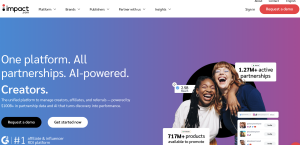
Impact.com approaches influencer marketing as one component of a broader partnership ecosystem that includes affiliates, brand partnerships, strategic alliances, and distribution partners. If your growth strategy extends beyond pure influencer marketing, Impact’s unified platform eliminates the friction of managing multiple partnership types in separate systems.
The platform excels at tracking and attribution across complex customer journeys. You can see how influencer touchpoints interact with affiliate links, paid ads, and organic search to drive conversions. This multi-touch attribution is critical for brands with sophisticated marketing funnels where attribution to a single source oversimplifies reality.
Contract management and compliance features are enterprise-grade, with automated agreement generation, e-signature workflows, tax form collection, and payment automation across different partnership types and payment structures (flat fee, commission, hybrid models).
Pros:
- Unified management of influencer, affiliate, and partnership programs
- Sophisticated multi-touch attribution modeling
- Excellent contract and compliance automation
- Flexible payment structures and automated processing
- Strong API for custom integrations
Cons:
- Creator discovery features weaker than specialized platforms
- Complex interface with steep learning curve
- Expensive for brands only running influencer programs
- Requires technical setup for optimal attribution tracking
- Better suited for performance marketing than awareness campaigns
Best for: Brands running mature partnership programs across multiple channel types, companies with complex attribution requirements, and organizations prioritizing performance-based partnerships.
Not ideal for: Small businesses, brands just starting with influencer marketing, or teams seeking creator-specific features like social listening or content discovery.
Pricing Analysis: The Hidden Costs of Influencer Software
The published starting prices of influencer platforms tell only part of the cost story. Understanding the full pricing structure—and the hidden costs that emerge after you sign a contract—is essential for accurate budget planning and avoiding unpleasant surprises.
Understanding Platform Fees vs. Transaction Fees
Most platforms charge a base platform fee for software access, which covers discovery tools, campaign management, reporting, and a certain number of user seats. This is the number you’ll see in pricing negotiations. However, several platforms add transaction fees or usage-based charges that significantly increase total cost of ownership.
Transaction fees typically apply to payments processed through the platform. Grin, Aspire, and Impact.com charge 3-5% on top of creator payments when you use their payment processing systems. For a brand spending $50,000 monthly on creator payments, that’s an additional $1,500-$2,500 in fees—or $18,000-$30,000 annually.
You can avoid transaction fees by processing payments outside the platform, but then you lose automation, tax form management, and the clean reporting that shows total program costs in one dashboard. Most brands conclude the convenience is worth the fees, but you should factor this into your budget from the start.
Usage-based charges are the other hidden cost. Some platforms limit the number of campaigns, creators you can contact, or content pieces you can manage. Exceeding these limits triggers overage fees. Upfluence and Klear both have tiered pricing where features are gated behind higher subscription levels. Make sure you understand not just the starting price but what happens as your program scales.
Contract Traps: Monthly Commitments vs. Annual Lock-ins
Nearly every influencer marketing platform pushes annual contracts with significant discounts compared to month-to-month pricing. The annual commitment might save you 20-30% on paper, but it introduces serious risk if the platform doesn’t meet your needs or your program priorities shift.
The real trap is combination of annual contracts with limited downgrade options. If you sign up for a plan supporting 100 active campaigns and realize your team can only handle 30, most platforms won’t let you reduce your commitment mid-contract. You’re paying for capacity you can’t use.
Before signing annual contracts, negotiate specific exit clauses or performance guarantees. Some vendors will agree to quarterly check-ins with the option to renegotiate if you’re not achieving expected ROI. Others will allow contract termination if specific technical features aren’t delivered. These provisions require asking—they won’t be offered proactively.
For brands new to influencer marketing or testing a platform for the first time, insist on either a month-to-month option (even at higher cost) or a 90-day pilot with full contract cancellation rights. The flexibility is worth paying a premium until you’ve validated the platform works for your specific use case.
How to Choose the Right Platform for Your Specific Needs
Selecting an influencer marketing platform isn’t about finding the objectively “best” tool—it’s about identifying which solution aligns with your specific business model, team structure, campaign objectives, and budget constraints. Here’s how to make that determination systematically.
Small Business vs. Enterprise: Which Features Actually Matter?
Small businesses (under $10M revenue) need fundamentally different features than enterprises. If you’re a smaller brand, prioritize creator discovery, simple workflow automation, and basic ROI tracking. You don’t need advanced compliance features, multi-market reporting, or sophisticated API integrations. Upfluence or Aspire typically offer the best value-to-feature ratio for this segment.
Your decision criteria should focus on: Can I find relevant creators quickly? Can I manage communication and content approval without manual chaos? Can I track whether campaigns drive sales? Everything beyond this is nice-to-have, not need-to-have.
Enterprise brands (over $100M revenue) face different challenges: coordinating across multiple markets, maintaining brand consistency across hundreds of creator relationships, meeting compliance requirements, and integrating influencer data with broader marketing analytics. Here, CreatorIQ or Traackr make sense despite higher costs because the alternative—managing complexity with inadequate tools—creates expensive operational inefficiency.
Mid-market brands ($10M-$100M) occupy the difficult middle ground. You’ve outgrown simple tools but can’t justify enterprise pricing. Grin and Aspire are specifically designed for this segment, offering automation and integration quality that scales beyond small business needs without enterprise complexity and cost.
Agency vs. In-House: Evaluating Multi-Client Login Capabilities
Agencies have unique requirements that in-house teams don’t share: managing multiple brand accounts with separate creator databases, generating client-specific reports, controlling client data access, and often white-labeling deliverables. Not all platforms handle multi-client structures well.
Traackr and CreatorIQ offer the strongest agency functionality with true multi-tenant architecture. Each client gets isolated data, separate user permissions, and the ability to generate branded reports. You can manage all clients from one login while maintaining clear separation—essential for client confidentiality and billing accuracy.
Grin and Aspire handle multiple brands less elegantly. You can create separate “workspaces” but switching between them is clunky, and certain features (like creator databases) aren’t fully isolated. This works fine for a brand managing multiple product lines but becomes problematic for agencies with 10+ clients.
In-house teams should prioritize integration quality with your existing martech stack. Does the platform connect with your e-commerce system, CRM, and analytics tools? Does data flow automatically or require manual exports? The integration quality determines whether the platform becomes your system of record or just another data silo requiring manual reconciliation.
Real-World Use Cases: Matching Tools to Scenarios
Understanding how these platforms perform in specific scenarios provides more practical decision-making guidance than abstract feature comparisons. Here are two common situations with specific tool recommendations.
Scenario A: Launching a Product with 500+ Micro-Influencers
You’re launching a new product line and want to create buzz through high-volume micro-influencer seeding. You’ll send products to 500+ creators, track who posts content, measure engagement and sales impact, and identify top performers for ongoing partnerships.
Best platform choice: Grin or Aspire. Both offer automated product seeding workflows that can handle this volume without drowning your team in manual coordination. Creators can request products through self-service portals, shipping happens automatically through e-commerce integration, and you can track who received products, who posted, and what sales resulted.
Why not Upfluence: While Upfluence excels at finding micro-influencers, the fulfillment and tracking workflows aren’t as automated. You’ll spend more time on manual coordination and less time on analysis and optimization.
Why not CreatorIQ: Massive overkill for this use case. You’re paying for enterprise features you don’t need when simpler platforms handle high-volume seeding more efficiently at a fraction of the cost.
Success factors beyond platform choice: Clear product-request criteria to prevent inventory chaos, automated follow-up sequences for creators who receive products but don’t post, and realistic expectations—even with great products and processes, only 40-60% of seeded creators will post content.
Scenario B: Managing Long-Term Ambassadors for a B2B SaaS Company
You’re a B2B SaaS company working with 20-30 thought leaders across LinkedIn, podcasts, webinars, and content collaborations. Relationships are long-term (12+ months), content is multi-format, and attribution is complex with long sales cycles.
Best platform choice: This scenario is challenging because most influencer platforms are built for B2C product marketing. Impact.com offers the most relevant features with its partnership management approach and sophisticated attribution. You can track how thought leader content influences pipeline across multiple touchpoints.
Alternative approach: Consider whether you need an influencer platform at all. For managing 20-30 relationships with complex, customized agreements, a CRM like HubSpot or Salesforce with custom pipeline stages might serve you better than a tool built for high-volume creator campaigns.
Why standard platforms fall short: They assume content performance metrics (likes, shares, views) correlate with business value. In B2B with long sales cycles, a webinar with 100 attendees might generate more pipeline than a LinkedIn post with 10,000 impressions. Standard platforms can’t capture this nuance.
Success factors beyond platform choice: Clear content co-creation processes, documented thought leadership guidelines that maintain brand consistency while preserving creator authenticity, and attribution models that credit multiple touchpoints rather than last-touch only.
Expert Insights: Future-Proofing Your Tech Stack
The influencer marketing landscape continues evolving rapidly. Platforms that seem cutting-edge today might be obsolete in two years if they don’t adapt to emerging challenges and opportunities. Here’s what to watch for when evaluating whether a platform will remain relevant through 2026 and beyond.
Dealing with Fake Followers and Bot Detection in 2026
Fake follower detection has become an arms race between fraudsters and platform providers. The most sophisticated fake accounts now exhibit realistic engagement patterns, vary their activity timing, and even have partially authentic follower graphs that make them hard to flag with simple heuristics.
Leading platforms in 2026 use behavioral analysis rather than just snapshot metrics. They track engagement consistency over time, analyze follower acquisition patterns for suspicious spikes, cross-reference followers across multiple creators to identify bot networks, and use machine learning models trained on millions of known-fake accounts.
CreatorIQ and Traackr offer the most sophisticated fraud detection. However, understand that no system is perfect—fraud detection is a probability assessment, not a binary determination. Even the best platforms flag some legitimate creators and miss some fraudulent ones.
Your evaluation criteria: Ask vendors to explain their fraud detection methodology specifically. If they give vague answers about “AI-powered verification,” that’s a red flag. Strong platforms will walk you through their behavioral analysis framework, explain what patterns trigger flags, and show you sample reports. Also check whether the system continuously monitors creators or only runs analysis at discovery—fraud evolves, so one-time verification becomes outdated.
The Role of Generative AI in Campaign Briefs and Outreach
Generative AI is transforming how brands interact with creators, but the quality varies dramatically. Some platforms offer genuinely useful AI features that save time and improve outcomes. Others just slapped ChatGPT wrappers on existing interfaces and called it innovation.
The most valuable AI applications we’ve seen in 2026: personalized outreach message generation based on creator content analysis, campaign brief creation that adapts to creator specialties, content concept suggestions based on what performs well for specific creator audiences, and performance prediction models that estimate campaign ROI before launch.
Less useful AI features: Generic caption suggestions, basic image tagging, and “AI-powered discovery” that’s really just standard keyword search with AI branding. These features look good in demos but don’t meaningfully improve campaign outcomes.
When evaluating AI features, ask to see them work with your actual data and use cases. Most vendors demo their AI using cherry-picked examples that showcase capabilities in the best possible light. Reality is often less impressive. Also ask about the training data—AI models trained on your specific vertical and campaign history produce much better results than generic models.
Frequently Asked Questions About Influencer Marketing Platforms
What is the most affordable influencer marketing platform for startups?
Upfluence offers the lowest entry price among full-featured platforms at approximately $1,800/month, and they provide a 14-day trial so you can test before committing. However, “affordable” depends on your startup stage and revenue. If you’re pre-revenue or just launching, even $1,800/month might be prohibitive.
For very early-stage companies, consider starting with creator marketplace platforms like Hashtag Paid or AspireIQ’s self-service tier, which offer campaign-by-campaign pricing without monthly platform fees. You’ll sacrifice automation and advanced features, but you can run test campaigns for a few thousand dollars to validate influencer marketing as a channel before investing in a full platform subscription.
Another option: manual relationship management through Instagram DMs and spreadsheets until you’re managing 30+ active creator relationships. The inefficiency becomes painful at that scale, which is the right inflection point to invest in proper software.
Can I manage influencer payments directly through these platforms?
Most platforms offer integrated payment processing, but implementation varies significantly. Grin, Aspire, and Impact.com have robust payment features that handle direct deposits, PayPal, Venmo, international transfers, tax form collection (W-9s and W-8s), 1099 generation, and payment reconciliation.
The trade-off is transaction fees (typically 3-5% of payment amount) and sometimes delayed payout schedules. Creators might wait 5-10 business days to receive funds after you initiate payment. For some creators—especially smaller ones—this delay is frustrating.
Platforms like Upfluence and Klear offer more basic payment features or integrate with third-party payment processors like Stripe or PayPal. You get more flexibility and potentially lower fees, but less automation and reporting integration.
For international payments, verify that your platform supports creators in your target markets. Not all platforms handle multi-currency payments well, and international wire fees can be substantial. CreatorIQ and Traackr have the strongest international payment capabilities if you’re running global campaigns.
How accurate are the audience demographic data on these tools?
Audience demographic accuracy varies significantly by platform and data source. Platforms pull demographic data from three sources: direct social platform APIs (most accurate), creator self-reported data (moderately accurate), and algorithmic inference (least accurate).
For Instagram and TikTok creators who’ve connected business accounts, demographic data pulled directly from platform APIs is typically 85-95% accurate. This includes age ranges, gender breakdowns, and top geographic locations. However, psychographic data (interests, purchasing behaviors, brand affinities) relies more on inference and is substantially less reliable.
YouTube demographic data tends to be more accurate than Instagram because YouTube provides more granular analytics to creators, and platforms can access this through API connections. Pinterest and blog data is generally less reliable because APIs provide limited demographic information.
CreatorIQ and Traackr invest most heavily in data accuracy and quality assurance. They use multiple data sources and cross-validation to improve reliability. However, even the best platforms show 10-15% variance from actual audience composition. Always request creators share their native analytics during negotiations for high-value partnerships to verify platform estimates.
What is the difference between an influencer marketplace and a CRM?
Influencer marketplaces are platforms where creators and brands find each other for specific campaign opportunities. Think of them like job boards—brands post campaign requirements, creators apply, and transactions happen project-by-project. Examples include AspireIQ’s marketplace tier, Hashtag Paid, and Collabstr.
Influencer CRMs (sometimes called influencer management platforms) are relationship management systems for ongoing creator partnerships. They emphasize workflow automation, long-term relationship tracking, content management, and analytics across multiple campaigns. Grin, CreatorIQ, and Traackr are CRMs, not marketplaces.
The key difference: marketplaces optimize for discovery and transaction speed. CRMs optimize for relationship depth and operational efficiency across ongoing programs. Most brands start with marketplaces for testing and transition to CRMs once they’re running consistent programs with 30+ creator relationships.
Some platforms like Upfluence and Impact.com offer hybrid functionality—they have marketplace features for discovery but also relationship management tools for ongoing partnerships. This approach works well for mid-market brands that want flexibility without maintaining two separate systems.
Conclusion
Choosing the right influencer marketing platform in 2026 comes down to honest assessment of your specific needs, realistic evaluation of your budget constraints, and clear understanding of which features actually drive results for your business model. The “best” platform is simply the one that aligns with your priorities and eliminates your biggest operational pain points.
For e-commerce and DTC brands focused on product seeding and direct sales attribution, Grin and Aspire deliver the strongest combination of automation, integration, and ROI tracking. If you’re an enterprise managing complex global programs with strict compliance requirements, CreatorIQ and Traackr justify their premium pricing through sophisticated data intelligence and workflow management.
Brands prioritizing discovery—especially of micro-influencers across multiple platforms—will find Upfluence’s database size and search capabilities most valuable. Companies running hybrid influencer and affiliate strategies should seriously consider Impact.com’s unified partnership approach despite the higher complexity.
Whatever platform you choose, focus on these decision-making priorities: data accuracy over database size, workflow automation over feature quantity, genuine ROI tracking over vanity metrics, and transparent pricing over marketing promises. Request demos with your actual use cases, talk to current customers beyond provided references, and insist on trial periods or performance guarantees before signing annual contracts.
The influencer marketing software landscape will continue evolving rapidly, but the fundamental evaluation criteria remain constant: Does this platform help me find the right creators more efficiently, manage relationships with less operational chaos, and measure business impact with reasonable accuracy? If you can answer yes to all three, you’ve found the right tool for your organization.
“`

![Marketing Automation Case Study: 12 Real Examples, Strategy & ROI Results [2026]](https://marketingcasestudy.io/wp-content/uploads/2026/05/marketing-automation-case-study-featured-300x158.png)