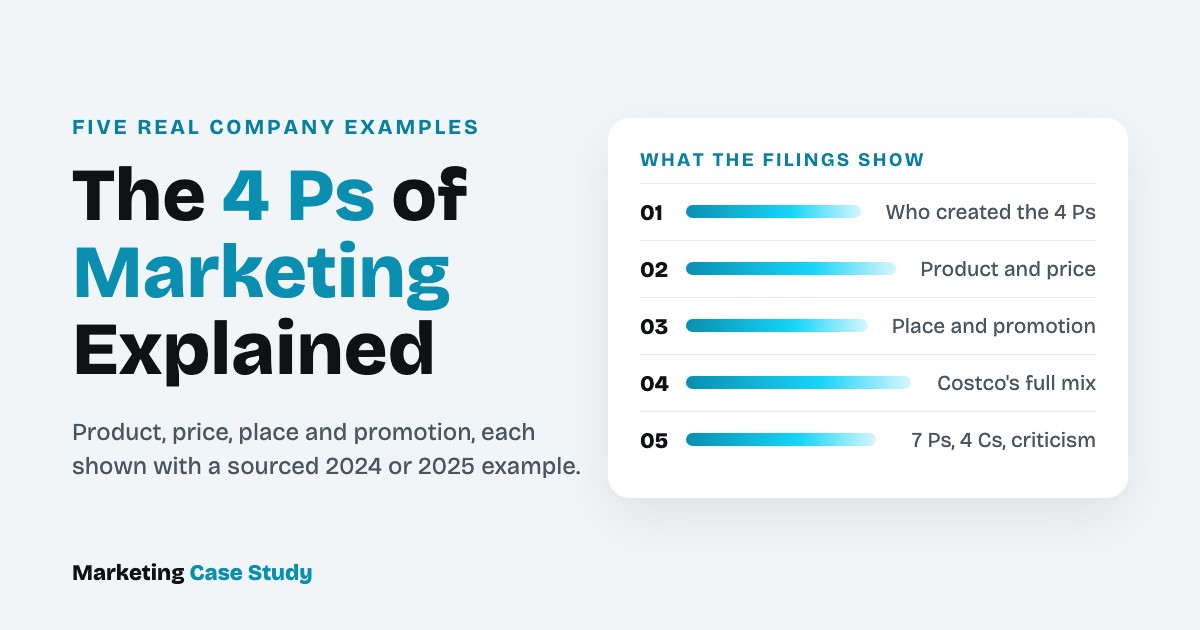
The 4 Ps of marketing are product, price, place and promotion: the four decisions a company controls when it takes an offer to market. E. Jerome McCarthy introduced them in his 1960 textbook Basic Marketing: A Managerial Approach. Below, each P is explained with a sourced company example from 2024 or 2025, followed by the full model applied to one company, how to measure each P, and the model’s limits.
The examples point to one finding: when a company changes one P, the result depends on how that change affects the other three.
What are the 4 Ps of marketing?
The 4 Ps are the controllable parts of a marketing program. A company cannot control the economy or its competitors, but it decides what it sells, what it charges, where it sells and how it tells people.
| P | The decision | Typical choices |
|---|---|---|
| Product | What the customer gets | Features, quality, range, branding, packaging, service and warranty |
| Price | What the customer gives up | List price, tiers, discounts, subscriptions, payment terms |
| Place | Where and how the customer buys | Own stores, retailers, wholesale partners, ecommerce, marketplaces, delivery |
| Promotion | How the customer hears about it | Advertising, PR, social media, influencers, email, sales promotions, personal selling |
The order does not matter, because the four are decided together.
Who created the 4 Ps of marketing?
The idea came in three steps. In a 1948 study of marketing costs, Harvard professor James Culliton described the business executive as a “mixer of ingredients.” His colleague Neil Borden coined the term “marketing mix” and listed 12 ingredients for manufacturers, from product planning and pricing to packaging and display, in “The Concept of the Marketing Mix” (1964).
McCarthy’s contribution was compression. In Basic Marketing (Richard D. Irwin, 1960) he grouped the ingredients into four memorable headings, product, price, place and promotion, and placed the target customer at the centre. Philip Kotler’s Marketing Management, first published in 1967, later adopted the same four headings.
The marketing mix is the broader idea; the 4 Ps are its most common structure.
Product: what is product in the 4 Ps?
Product is everything the customer receives: the core item, its features and quality, the range of versions, the brand name, the packaging and the after-sale service.
Example: Nintendo Switch 2 (2025). Nintendo released the Switch 2 on June 5, 2025, as a $450 device. The company said it sold more than 3.5 million consoles in the first four days, the highest global sales level for any Nintendo device in that period (company statement, reported by CNN, June 2025). The product decision was a successor, not a new concept: the original Switch had sold 152 million units since its 2017 release, giving the new console a large audience that already knew the format.
What you can apply. A product decision includes deciding what not to change. Extending a format customers already know lowers the cost of educating buyers. Four-day sales show launch demand, not long-term success.
Price: how companies use the price P
Price is what the customer pays, but the decision covers more than one number: tiers, discounts, bundles, subscriptions and payment terms. Price also signals quality. Common methods are cost-plus, value-based, competitive and penetration pricing.
Example: Netflix (2024). Netflix uses a price ladder rather than one price. Its fourth-quarter 2024 shareholder letter says the lower-priced ads plan “accounted for over 55% of sign-ups in our ads countries” in the quarter, and ads plan membership grew nearly 30% from the previous quarter. In the same letter, Netflix announced it was “adjusting prices today across most plans in the US, Canada, Portugal and Argentina.” Netflix ended 2024 with 302 million paid memberships (company figures).
What you can apply. A cheaper entry tier and a price rise on other tiers can work together: the low tier catches price-sensitive buyers, while the higher tiers raise revenue per member. The ads plan is also a product change.
Place: distribution and channels
Place covers every route between the product and the buyer: owned stores, retailers and wholesale partners, the company’s own website and app, marketplaces, and the logistics behind them. The goal is to be where the target customer already shops.
Example: Nike (2024). For several years Nike prioritised selling directly through its own stores, website and apps over wholesale partners. In December 2024, new CEO Elliott Hill told analysts that “prioritizing Nike digital revenue has impacted the health of our marketplaces” and that “some partners and channels feel we’ve turned our back on them” (earnings call, reported by Retail Dive, December 2024). In that quarter revenue was $12.4 billion, down from $13.4 billion a year earlier, with Nike Direct sales down 13% and wholesale down 3%. Hill said Nike would rebuild ties with retailers such as Foot Locker and Dick’s Sporting Goods.
What you can apply. Direct channels give higher margins and customer data, but leaving retail partners cuts the brand’s presence where many customers still shop. The quarterly figures do not isolate the channel decision from other factors, so the decline should not be attributed to place alone.
Promotion: how the offer is communicated
Promotion is how a company makes its target customers aware of the offer and persuades them to buy: advertising, public relations, social media, influencers, content, email, sales promotions and personal selling. It cannot fix a product, price or channel the customer does not want.
Example: e.l.f. Beauty (fiscal 2025). The cosmetics company says in its annual report for the year ended March 31, 2025 that it seeks “to attract and engage consumers primarily through digital and social media.” Marketing and digital expenses were $318.8 million that year against net sales of $1,313.5 million, about 24% of sales ($318.8 million divided by $1,313.5 million). Net sales grew 28%, and the company reported its 25th consecutive quarter of net sales growth and market share gains (company filings, fiscal 2025).
What you can apply. Promotion spending can be a fixed share of sales rather than an afterthought. A ratio near a quarter of revenue depends on a product and price that suit social channels: low-priced cosmetics make trial easy once a post reaches a buyer.
A 4 Ps of marketing example: Costco
Costco’s annual report for fiscal 2025 shows how the four fit together in one business.
| P | Costco’s decision (company figures, fiscal year ended August 31, 2025) |
|---|---|
| Product | Fewer than 4,000 active SKUs per warehouse in the core business, and 9,000 to 10,000 online. Its private label, Kirkland Signature, is described as “high quality, offered at prices that are generally lower than national brands.” |
| Price | Two prices: a membership fee ($65 a year for the basic U.S. membership, raised in the U.S. and Canada effective September 1, 2024) and low merchandise prices. The filing says Costco operates at “significantly lower gross margins” than most other retailers. |
| Place | 914 warehouses: 629 in the U.S. and Puerto Rico, 110 in Canada and 175 elsewhere, plus ecommerce sites in eight countries. |
| Promotion | The filing reports more memberships sold online, “including through digital membership promotions,” and notes these lowered the renewal rate. |
The results: 81.0 million paid members, renewal rates of 92.3% in the U.S. and Canada and 89.8% worldwide, and net sales up 8% to $269.9 billion. A limited range lets Costco buy each item in volume, volume supports low prices, and the membership fee funds those prices.
The promotion line shows the trade-off: digital promotions won sign-ups but lowered renewals, and renewals fund the price model.
How to use the 4 Ps: a template
- Define the target customer first. McCarthy placed the customer at the centre; choose the segment before setting any P.
- Answer the questions for each P in the table below, using customer research.
- Check that the four answers agree. Price must match quality, and place and promotion must match where the segment shops and pays attention.
- Write the mix into the marketing plan. The 4 Ps become the tactics section of a marketing plan; for a new product, they sit inside a wider go-to-market strategy that also covers sales.
- Test before committing. Try a price or a channel in one region first.
- Review the mix regularly. Nike’s reversal shows a working mix can stop working.
| P | Questions to answer | What to measure |
|---|---|---|
| Product | Which need does it meet? How is it different from competitors? What is in the range? | Unit sales, market share, reviews and ratings, return rate, repeat purchase |
| Price | What is it worth to the buyer? How price-sensitive is the segment? What do competitors charge? | Gross margin, average order value, conversion rate by price point, share of sales at discount |
| Place | Where does the segment shop? Which channels can the business serve profitably? | Sales and margin by channel, availability, delivery time, partner sell-through |
| Promotion | Which channels reach the segment? What message? What budget? | Customer acquisition cost, return on ad spend, reach, retention of acquired customers |
For pricing research, these competitor analysis tools show rivals’ positioning. Teams running a social-led promotion plan like e.l.f.’s will need a publishing workflow; this comparison of social media scheduling tools and this list of influencer marketing platforms cover the main options. Retention usually runs through email and automation, as this marketing automation case study shows.
4 Ps vs 7 Ps vs 4 Cs
| Model | Origin | Elements | Use it when |
|---|---|---|---|
| 4 Ps | McCarthy, 1960 | Product, price, place, promotion | Planning a physical product or a simple offer |
| 7 Ps | Bernard Booms and Mary Jo Bitner, 1981, in work on service firms published by the American Marketing Association | The 4 Ps plus people, process and physical evidence | Selling a service, where staff, the delivery process and the setting are part of what the customer buys |
| 4 Cs | Robert Lauterborn, Advertising Age, 1990 | Consumer wants and needs, cost, convenience, communication | Checking the mix from the buyer’s side |
Some writers add other Ps, such as positioning or packaging, to make a 5 Ps model, but there is no single agreed version.
Criticism of the 4 Ps
- Seller-centred. The model lists what the company does to the market. Lauterborn’s 4 Cs reverse that view.
- Built for physical goods. Services depend on people and process, which the original four leave out. That is why the 7 Ps exist.
- Blurred lines online. A social media shop or an app store page is place and promotion at once, and a subscription tier, like Netflix’s ads plan, is price and product at once.
- No retention. The model ends at the sale, though Costco’s results depend on renewals.
The model still works as a starting checklist, extended where the business needs it.
What the 2024 and 2025 examples show
None of the companies above changed just one P. Netflix’s cheaper tier changed the product, Nike’s channel shift changed how customers found the brand, and Costco’s online promotions changed renewal rates and with them the membership pricing model. Before changing any P, list its effect on the other three and how each will be measured. An effect nobody measures is the one most likely to surprise.