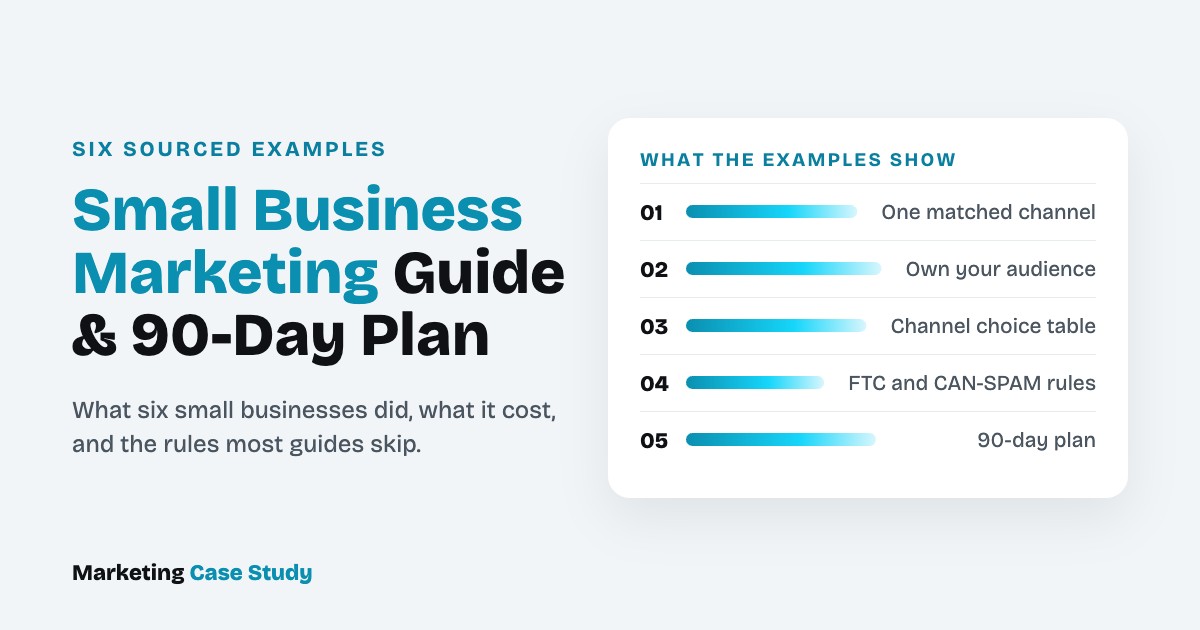
Small business marketing is the work of getting the right customers to find, trust and buy from a business that has little money and less time. The small businesses in this guide that grew fastest did not spread themselves across every channel. Each one concentrated on the single channel that matched how its customers already looked for it, measured it, and only then added a second.
This guide covers six examples with published numbers, how to build the foundations, how each channel works in practice, the tools and rules that apply, what to spend, how to measure results, and a 90-day plan for owners starting from zero.
What is small business marketing?
Small business marketing covers every activity that brings in and keeps customers: the offer, the price, where it is sold and how it is promoted. Those four decisions are the classic 4 Ps of marketing (product, price, place, promotion), and they apply to a bakery as much as to a software company. What changes for a small business is the constraint: one owner often makes all four decisions with a budget in hundreds of dollars a month, but with speed, local knowledge and direct customer relationships that large companies lack.
The scale of the group is easy to underestimate. The U.S. Small Business Administration’s Office of Advocacy counted 36.2 million small businesses in 2025, employing almost 46% of the private sector workforce (SBA Office of Advocacy, June 2025). Most of them compete for attention in the same search results and social feeds as national brands.
In practice, small business marketing draws on seven types of activity:
- Local marketing: a Google Business Profile, local search, directories and community presence.
- Content marketing and SEO: pages, articles and videos that answer what buyers search for.
- Social media marketing: organic posts, short video and social commerce.
- Email and SMS marketing: messages to people who opted in.
- Paid advertising: search ads, social ads and retargeting.
- Reviews, referrals and loyalty: turning existing customers into a sales channel.
- Partnerships, influencers and offline activity: other businesses’ audiences, creators, events, print and networking.
A small business does not need all seven. The examples below show why one or two, chosen well, usually beat seven done thinly.
Six small business marketing examples with published results
Each example has a result published by a named source, a year and a clear main channel. Five of the six were reported between December 2024 and June 2026. Vendor and platform figures are labelled, because vendors publish their best results.
| Business | Year reported | Main channel | Published result | Source type |
|---|---|---|---|---|
| El Amasadero (online baking supplies, Spain) | 2025 results, published 2026 | Email segmentation and automation | Revenue up 23% in 2025 | Vendor customer story (Mailchimp) |
| Mavwicks Fragrances (US) | 2026 | Social commerce (TikTok Shop) | From about $300,000 to $400,000 a year to $32 million in its first year on the platform | Trade press (Modern Retail), founder’s figures |
| Mississippi Candle Company (US) | 2026 | Short-form video | Sales up more than 600% year over year after a viral video | Trade press (Modern Retail) |
| Crown’s Corner Mechanic (Conyers, Georgia) | 2024 | Local video content | Two to three new customers a day from TikTok; from solo mobile work to a 9,000 sq ft shop | Major press (Associated Press) |
| TikTok’s US shutdown | January 2025 | Risk of a rented channel | App unavailable to US users until service was restored the next day | Major press (Associated Press) |
| River Pools and Spas (Virginia) | 2009 to 2013 (classic) | Content that answers buyer questions | Ad spend of about $250,000 a year cut to roughly a tenth; revenue back above its pre-2007 peak | Major press (The New York Times, 2013) |
1. El Amasadero: email built on purchase history
The business and the year. El Amasadero is an online shop in Málaga, Spain, that sells flour and baking tools. It has a team of eight and reports more than €1.5 million in annual revenue (vendor customer story, Mailchimp, published June 2026).
The play. Working with Disruptivos, a Málaga consultancy in Mailchimp’s partner program, the shop connected its store data to its email platform, split customers into more than 50 segments across home bakers, professional buyers and resellers, and replaced a single abandoned cart email with a multi-step recovery flow.
The numbers. For 2025, the story reports a 23% increase in revenue, 66% more orders from subscribers than from non-subscribers, and a 17% shorter time to first purchase for subscribers. The list passed 30,000 subscribers.
Why it worked, and the caveat. Segmenting by what people bought made each message relevant to a professional or a hobbyist. The 23% figure covers the whole business, so it cannot be credited to email alone, and the story gives no baseline for email revenue before the change.
What you can copy. Separate customers by type before writing a single campaign. An abandoned cart sequence and a welcome sequence are the two automations worth building first. This marketing automation case study shows how other retention programs performed after their first 90 days.
2. Mavwicks Fragrances: one platform, fully committed
The business and the year. Mavwicks Fragrances, founded by Megan Reep, had annual sales of roughly $300,000 to $400,000 before joining TikTok Shop. “The first year we were on TikTok Shop, we jumped to $32 million in sales,” Reep told Modern Retail (trade press, Modern Retail, May 2026).
The play. The brand sold directly inside the platform where its customers were already watching videos, rather than sending them to an outside website.
Why it worked. Social commerce removes the steps between seeing a product and buying it. The same report cites a GlobalData survey commissioned by TikTok Shop, of 6,000 US consumers, in which 67% said they go to TikTok Shop when they want to discover new products and brands, ahead of Amazon at 57%. A survey paid for by the platform is a claim about the platform, not independent research.
What depends on luck. This is an outlier, with no profit, ad spend or creator commission given. Copy the commitment to one channel, not the expected outcome.
3. Mississippi Candle Company: a viral video, then infrastructure
The business and the year. Founder Jessica Simon told Modern Retail that Mississippi Candle Company grew more than 600% year over year after one of its candle videos went viral. It now employs more than 20 people and is building a 20,000 square foot warehouse (trade press, Modern Retail, May 2026).
The context. The same report says TikTok Shop sales from US small sellers, defined as under $15 million in annual revenue, grew 66% in 2025 compared with 2024, and that more than 215,000 such sellers were active (platform figures).
What you can copy. A viral moment is not a plan, but being ready for one is. Stock, fulfillment and customer service decide whether a spike becomes a business or a wave of refund requests. The growth figure has no baseline, so it shows direction, not scale.
4. Crown’s Corner Mechanic: local service, local content
The business and the year. Desiree Hill started Crown’s Corner Mechanic in Conyers, Georgia, as a solo mobile mechanic. In December 2024 the Associated Press reported that she had opened a 9,000 square foot shop with five employees about 18 months earlier, and quoted her: “every day I get at least two to three customers that have seen me on TikTok” (major press, AP, December 2024).
Why it worked. Short repair videos showed competence, the main worry when choosing a mechanic. Local services sell trust first.
What you can copy. Film the work itself. A plumber, electrician or landscaper can show a real job in under a minute and answer the buyer’s main question: can this person do it well? Then make sure the same videos appear on the Google Business Profile, where local buyers compare options.
5. The January 2025 shutdown: the risk of renting your audience
What happened. Late on January 18, 2025, TikTok stopped working for US users as a federal ban took effect, and began restoring service the next day after President-elect Donald Trump said he would delay enforcement (major press, AP, January 2025). Weeks earlier, TikTok had estimated that small businesses on the app would lose more than $1 billion in revenue in a single month if a ban took effect (the platform’s own estimate, reported by the AP in December 2024).
The lesson for the examples above. Hill told the AP that losing TikTok would cost her “a large part” of her business. Crystal Lister, a Texas owner in the same report, was already moving video to YouTube and teasers to Instagram Reels. Every business that grows on a platform it does not control needs a channel it owns: an email list, an opted-in phone list or a website that ranks in search.
6. River Pools and Spas: answering every buyer question (classic, 2009)
The business and the year. When pool orders at River Pools and Spas in Virginia fell from an average of six a month to barely two in early 2009, co-owner Marcus Sheridan stopped relying on paid media (major press, The New York Times, February 2013).
The play and the numbers. The company had been spending about $250,000 a year on radio, television and pay-per-click ads and planned to cut that to about a tenth, replacing it with blog posts and videos that answered every question buyers asked, including what a fiberglass pool costs. By 2013 the Times reported that River Pools had recovered to exceed its peak pre-2007 revenue. No traffic or lead figures were given.
Why it still matters. Buyers search for answers about price, problems and comparisons, and the business that answers honestly gets the visit. It is the one example here older than three years, kept because the play has been copied so widely and because AI Overviews now reward the same clear answers. Two recent search-led results on this site show the pattern: a small business that doubled its organic traffic in two months and an ecommerce site that reached 252,000 organic visits in five months.
The pattern across the examples
None of the five businesses won by being everywhere. Each matched one channel to how its customers already behaved:
| Customer behavior | Examples | Channel that fits |
|---|---|---|
| Searching for a solution | River Pools, local services | Google Business Profile, local SEO, content that answers questions |
| Discovering while scrolling | Mavwicks, Mississippi Candle Company, Crown’s Corner | Short-form video and social commerce |
| Already bought once | El Amasadero | Email, segmentation and automation |
The second pattern is ownership. The January 2025 shutdown showed that an audience on a platform can vanish overnight; an email list or search traffic cannot be switched off by someone else.
How do I do marketing for my small business?
Build the foundations first, then add channels one at a time. The order below works for most local and online businesses.
- Define the customer. Write down who buys, their age range, income and location, what problem sends them looking, what frustrates them about current options, and where they look first. Two or three short buyer personas, each with a name, situation and goal, are enough.
- Research the market and the competition. Search for your service the way a customer would. Note who ranks, what they charge, what their reviews praise and what they complain about. Ask ten recent customers why they chose you and what nearly stopped them. The gaps are your positioning. A list of competitor analysis tools helps once the manual check is done.
- Write the value proposition and brand message (see below).
- Fix the website (see the checklist below).
- Claim the free local listings. A verified Google Business Profile is the first asset to build for any business with local customers.
- Set SMART goals. Specific, measurable, achievable, relevant and time-bound, for example “30 booked calls a month from search by the end of March.” Write down the starting number so progress can be measured.
- Pick one main channel using the pattern above, run it for 90 days, and only then add a second.
For a business that needs the full document, this guide on how to write a marketing plan turns these steps into a template with budgets and owners.
Value proposition, positioning and brand voice
Four short statements keep every post, ad and email consistent:
| Element | What it does | Example for a local bakery |
|---|---|---|
| Value proposition | Why a customer should choose you, as a benefit, not a feature | “Custom cakes delivered the same week, for events other bakeries turn down.” |
| Positioning statement | “We do X for Y people and drive Z result” | “We bake custom cakes for families in east Austin who need them at short notice.” |
| Brand promise | One or two sentences on what every customer can expect | “On time, as ordered, or the delivery is free.” |
| Voice and tone | How the business sounds everywhere | Warm and plain, never formal |
The test of a good positioning statement is that a competitor could not sign it. “Quality service at fair prices” fails that test.
Website checklist
- Domain and hosting: the business name on a .com where possible, with auto-renewal switched on.
- Mobile first: fast loading on a phone, readable fonts, buttons large enough to tap.
- First screen: what you do, where, and one action (call, book or buy) one tap away.
- Core pages: home, a page per service or product category, about, contact, and one page per town served if you cover several.
- Accessibility: alt text on images, sufficient color contrast and forms that work with a keyboard.
- Measurement: Google Analytics (free) or a similar tool installed, with bookings, calls or purchases set up as conversions, before any money is spent on ads.
What is the best marketing for a small business?
The best channel is the one that matches how your customers find businesses like yours. The table compares the main options.
| Channel | Best for | Cost | Typical time to first results |
|---|---|---|---|
| Google Business Profile and local SEO | Local services, shops, restaurants | Free, plus time | Weeks |
| Content and SEO | Considered purchases where buyers research first | Low cash, high time | Three to six months or more |
| Email marketing | Repeat purchases, ecommerce, services with return visits | Free tiers, then low monthly fees | The first send, once a list exists |
| SMS marketing | Time-sensitive offers, appointments, restocks | Per-message fees | Immediate, with consent |
| Organic social and short video | Visual products, personalities, local trades | Free, plus time | Unpredictable; often two to three months of consistent posting |
| Paid search and social ads (PPC) | Testing offers quickly, high-intent searches | Pay per click; stops when spending stops | Days |
| Reviews, referrals and loyalty programs | Every business with satisfied customers | Low; incentives where allowed | Builds steadily |
| Partnerships, influencers and affiliates | Reaching a complementary audience | Varies; often a swap or commission | Per campaign |
| Offline: events, print, direct mail, networking | Local and B2B businesses, community brands | Moderate | Per campaign |
The time ranges are working estimates from practice, not study results; search in particular varies with competition.
Google Business Profile and local SEO
For any business with a location or a service area, the Google Business Profile decides whether it appears in Google Maps and the local results above the organic listings. It is free.
- Claim and verify the profile, then fill in every field: primary and secondary categories, hours, holiday hours, service area, services with prices where possible, and a description that uses the words customers search for.
- Add real photos of the premises, the team and the work, and keep adding new ones every month.
- Publish updates (offers, events, new products) and answer common questions in the profile.
- Reply to every review within a day or two, positive or negative.
- Keep the name, address and phone number identical on the website, Bing Places, Apple Business Connect, Yelp, Nextdoor, the local chamber of commerce and industry directories.
On the website, local SEO means using location terms where they read naturally (“emergency plumber in Tacoma”), creating a separate page for each town or neighborhood served, and earning local links: a sponsorship page on a community group’s site, a mention in local news, a listing with the chamber of commerce.
The most common mistake is claiming the profile once and never touching it again. Outdated hours and a page of unanswered reviews tell a buyer the business may not be active.
Content marketing and SEO
Content marketing works the way River Pools used it: write down every question customers ask before buying, then answer each one on the website. The best sources of questions are sales calls, enquiry emails and the terms customers misunderstand.
- Formats: service and product pages, how-to articles, cost guides, comparison pages, short videos, and for B2B businesses case studies, webinars and downloadable guides.
- On-page basics: one main topic per page, the search phrase in the title and first paragraph, a clear meta description, links between related pages, and fast loading.
- Distribution: each article becomes several social posts, an email and a short video, so one piece of work feeds every channel.
A business that answers price questions honestly, as River Pools did, earns the click that competitors who hide their prices lose.
Social media: one or two platforms, not five
Choose the platform where your customers already spend time, and master it before adding another.
| Platform | Fits | Content that works |
|---|---|---|
| Instagram and TikTok | Visual products, food, beauty, retail, trades with visible results | Short video, behind the scenes, before and after |
| Home services, community businesses, local retail, older audiences | Community posts, events, groups, reviews | |
| B2B services, consultants, accountants, agencies | Expertise, client results, opinion on industry news | |
| YouTube | Considered purchases and how-to topics | Explainers and tutorials that also rank in search |
Mix three kinds of posts: the product, the process (how it is made or done) and education (answers to customer questions). Post on a steady schedule, reply to comments and messages quickly, and use video, as every social example above did. A social media scheduling tool makes a steady rhythm realistic for a one-person team.
Email: the channel you own
Building the list. Collect addresses at checkout, on the website, in person at the counter or at the end of a job, and through a link in social profiles. Give a clear reason to subscribe: a first-order discount, early access, or a useful guide. On-site messages can also grow a list quickly: in one OddBalls onsite notification case study, a launch campaign collected far more emails than a social post did.
What to send and how often:
- Automations first: a welcome sequence of three to five emails, an abandoned cart or quote follow-up, a post-purchase email asking for a review, and a re-engagement email for subscribers who have gone quiet.
- A regular newsletter, at least monthly: news, tips, a customer story, an offer.
- Promotional campaigns a few times a year around seasons, launches and events.
Segment early. El Amasadero’s results came from separating customer types. Even two segments, customers and prospects, make messages more relevant. Track open rate, click rate and, most of all, orders or bookings from each email. Small teams can compare options in this guide to email marketing platforms for startups.
SMS marketing
Text messages suit short, time-sensitive messages: appointment reminders, flash offers, restock alerts. They need prior written consent under the Telephone Consumer Protection Act, a clear way to opt out by replying STOP, and restraint; a few well-timed texts a month outperform daily messages that drive opt-outs.
Paid ads, retargeting and remarketing
Pay-per-click search ads (Google Ads, Microsoft Advertising) reach people already searching for the service; social ads (Meta, TikTok, LinkedIn) reach people by interest and location. Both stop the moment spending stops.
Two terms are often confused. Retargeting shows ads to people who visited the website but did not buy. Remarketing usually means following up with known contacts by email, such as an abandoned cart reminder. Both work best once the site has steady traffic.
Organic or paid first?
Paid ads test an offer in days; organic channels compound but take months. A sensible sequence is a small paid test to learn which message converts, then using the winning message in the organic channels. Treat early ad spend as the cost of learning, and stop any ad that has not produced a customer after a set budget.
Influencers and creators
Micro-influencers, typically with a few thousand to tens of thousands of followers, often have closer audiences and accept free product, a flat fee or a commission. Larger creators reach more people at a higher price. In the GlobalData survey commissioned by TikTok Shop, 70% of TikTok Shop consumers said they had bought a product a creator recommended (platform-commissioned survey, reported by Modern Retail, May 2026). Any paid or gifted post has to be disclosed as such under FTC endorsement rules.
Reviews, referrals, loyalty and affiliate programs
Reviews. Research from Northwestern University’s Spiegel Research Center found that a product with five reviews was 270% more likely to be bought than one with none, and that purchase likelihood peaked at average ratings between 4.0 and 4.7, not at a perfect 5.0 (study, Spiegel Research Center, first published 2017). Ask for a review within a day or two of a good experience, send a direct link, reply to every review, and show the best ones on the website and in emails. Answer negative reviews quickly and politely in public, then resolve the issue privately.
Referrals. Three levels work: a simple ask after a job well done; an incentive for both sides, such as a discount for the referrer and the new customer; and a structured program for frequent buyers.
Loyalty programs (points, tiers, members-only offers) reward repeat purchases. Affiliate programs pay partners a commission only when they deliver a sale, which keeps the cost tied to results.
Partnerships, community and offline marketing
- Partner with non-competing businesses that serve the same customer: a florist and a wedding photographer, a gym and a nutrition shop, an accountant and a bookkeeper.
- Join the community: the local chamber of commerce, an industry association, a business networking group or a service club; sponsor a local team or event.
- Become a source: offer expert comment to local reporters, answer questions in industry forums and write on LinkedIn.
- Use print where customers are local: direct mail postcards to nearby postcodes, flyers on community boards, and printed cards handed out after every job.
- Run promotions with care: a free sample or gift with purchase, a giveaway with a partner, or an exit-intent offer on the website.
Small business marketing tools
A small business needs a short stack, not a long one. Most categories have free or low-cost entry plans.
| Tool type | What it does | When to add it |
|---|---|---|
| Google Business Profile | Local search and Maps presence | Day one, for any local business |
| Web analytics (Google Analytics or similar) | Traffic, sources and conversions | Before spending on any channel |
| CRM or a structured spreadsheet | Every lead and customer, with source and history | Once enquiries come from more than one channel |
| Email platform | List, automations, segments, reports | As soon as you collect addresses |
| Social scheduler | Plans and publishes posts in batches | When posting weekly on one or more platforms |
| Design tool | Graphics, social images, simple video edits | From the start |
| Content calendar | Shared plan of posts, emails and campaigns, one to three months ahead | When more than one person creates content |
| AI writing assistant | First drafts, subject lines, product descriptions | Any time, with human editing |
Rules small business marketers have to follow
Three federal rules apply to almost every US small business that markets online.
Reviews. The FTC’s final rule on fake reviews and testimonials, announced in August 2024, bans buying or creating fake reviews, offering incentives for reviews that express a particular sentiment, undisclosed reviews from employees or relatives, suppressing negative reviews through threats, and buying fake followers or views (FTC press release, August 2024). On December 22, 2025, the FTC sent its first warning letters under the rule to ten companies, citing practices such as paying employees to get five-star reviews from friends and family. Asking every customer for an honest review is allowed; offering a discount only for five-star reviews is not.
Email. The CAN-SPAM Act requires accurate sender details, honest subject lines, identification of the message as an ad, a valid postal address and a working opt-out that is honored within 10 business days. The FTC lists penalties of up to $53,088 for each email in violation (FTC CAN-SPAM compliance guide). Hiring an agency to send email does not transfer the legal responsibility.
Texts and endorsements. Marketing texts need prior written consent under the Telephone Consumer Protection Act, and influencer or affiliate posts must disclose the business relationship.
How much should a small business spend on marketing?
There is no official benchmark for small businesses. The best-known figure comes from Gartner’s 2026 CMO Spend Survey: marketing budgets average 7.8% of company revenue, up from 7.7% in 2025, but most of the 401 companies surveyed report revenue above $1 billion. A practical approach is to pick a share of revenue the business can sustain, spend more in the launch year, and less once referrals and search traffic carry part of the load.
A worked example: a local service business with $400,000 in annual revenue that sets aside 5% has $20,000 a year, or about $1,670 a month. Where it goes matters more than the total: most of it on the one channel that already works, a small share for tests.
What is the 70/20/10 rule for marketing budget?
The 70/20/10 rule is a budgeting convention, not a law or a study result: about 70% of the budget goes to channels that are proven to work, 20% to promising channels being scaled, and 10% to experiments. Applied to the $1,670 a month above, that is about $1,170 on the proven channel, $330 on the channel being scaled and $170 on tests. It guards against both never testing and chasing every new platform.
In-house, freelancer or agency?
| Option | Best when | Trade-off |
|---|---|---|
| Owner does it | Budget is tight and the owner knows the customer best | Time taken from running the business |
| Freelancer or consultant | One channel needs a specialist (SEO, ads, design) | Needs clear goals and oversight |
| Agency | Several channels at once, with budget for retainers | Highest cost; small accounts can get less attention |
| In-house hire | Marketing is steady, full-time work | Salary and training before results |
Three questions decide it: what are the goals, what is the budget, and which tasks fall outside the owner’s skills? Time is the other cost. Guides often suggest five to ten owner hours a week; no study supports a specific number, but a fixed weekly calendar block keeps the work from slipping.
How to measure small business marketing
Track a few numbers that connect to revenue, not likes. The core set:
| Metric | How to calculate it | What it tells you |
|---|---|---|
| Customer acquisition cost (CAC) | Marketing spend in a period ÷ new customers in that period | What one new customer costs |
| Customer lifetime value (CLV) | Average order value × purchases per year × years as a customer | How much a customer is worth |
| Conversion rate | Customers or leads ÷ visitors | Whether the website and offer work |
| Marketing ROI | (Revenue from marketing − marketing cost) ÷ marketing cost | Whether a channel pays for itself |
| Leads by source | Ask “how did you hear about us?” at every sale and record it | Which channel is actually working |
| Channel metrics | Website visits, profile calls, email clicks, engagement | Early signals, read alongside the numbers above |
A rule of thumb, not a study finding: CLV should be at least three times CAC before a channel is scaled. Review the numbers monthly, cut what does not produce customers, and set a baseline after the first campaign on any channel so later results have something to be compared with. The same data makes personalization possible: names, past purchases and location.
What’s hot in marketing right now?
Three shifts stand out for small businesses in 2026.
AI. The U.S. Chamber of Commerce’s 2026 Empowering Small Business report, published in October 2026, found that 66% of small businesses now use AI, up from 23% in 2023. AI tools are good at first drafts of posts, emails, subject lines and product descriptions; the owner still has to add the local knowledge, the facts and the voice, and check everything before it goes out.
Social commerce. Customers increasingly discover and buy without leaving a social app, as the Mavwicks and Mississippi Candle Company examples show.
Answer engines. Google’s AI Overviews and chat assistants summarize the businesses and pages that answer questions clearly, which rewards the River Pools approach: specific, honest answers on your own website.
What is the 3-3-3 rule in sales?
The 3-3-3 rule has no single agreed definition; sales trainers use it for different follow-up cadences, such as three contact attempts across three channels. The useful part for a small business is the discipline: decide in advance how many times, and through which channels, every enquiry gets a reply.
What is the 3-3-3 rule in marketing?
The marketing version is just as loose. The label circulates for several rules of thumb about attention spans and posting cadence, and none traces to published research. Treat it as a reminder to plan repetition: most people need to see a message several times, across more than one channel, before they act.
Common small business marketing mistakes
- Too many channels at once. A small budget spread across five platforms leaves none with enough to work, and the messaging drifts.
- No defined customer. Marketing written for everyone persuades no one.
- No baseline. A goal of “more leads” cannot be measured if nobody wrote down the starting number.
- Under-sharing. One post or one email rarely registers; the message has to repeat.
- Depending on one rented platform. The January 2025 shutdown showed how fast a channel can disappear.
- Ignoring feedback and analytics. Reviews, enquiry questions and the source of each sale say what to change.
- Quitting too early. Search and content take months; judging them after three weeks wastes the work.
- Ignoring the rules. Incentivized five-star reviews and emails without an opt-out carry federal penalties.
A one-page small business marketing plan
Before the 90 days start, fill in one page. Every line should fit in a sentence or two.
| Section | What to write |
|---|---|
| Objective | One SMART goal with the current baseline |
| Target customer | The main persona and the problem that sends them looking |
| Key message | The value proposition and positioning statement |
| Main channel | The one channel that matches how this customer searches or discovers |
| Owned channel | The email list, phone list or website that no platform controls |
| Budget | Monthly amount, split 70/20/10 |
| Metrics | CAC, conversion rate and leads by source, reviewed monthly |
| Roles | Who does what each week, and which tasks go to a freelancer |
| Timeline | The 90-day plan below |
Launching a new product or entering a new market is a different problem from steady marketing; this guide to go-to-market strategy covers that case.
A 90-day small business marketing plan
| Period | Focus | Done when |
|---|---|---|
| Days 1 to 30 | Foundations: customer definition, competitor check, value proposition, website fixes, analytics, Google Business Profile completed with photos, review requests to recent customers | Baseline numbers recorded; profile verified; every new customer asked how they found you |
| Days 31 to 60 | One main channel chosen by how customers find you, with a weekly rhythm; email capture and a welcome sequence live; first content answering the top five customer questions | Weekly publishing or campaign rhythm running; first CAC figure calculated |
| Days 61 to 90 | Review: keep what produced customers, cut what did not, test one second channel with 10% of the budget; start a referral ask | Decision written down for each channel, with the number that justified it |
The decision rule that ties the guide together: put most of the effort on the one channel that matches how your customers already look for you, own at least one route to them that no platform can switch off, and let the numbers, not the latest trend, decide what gets the next dollar.