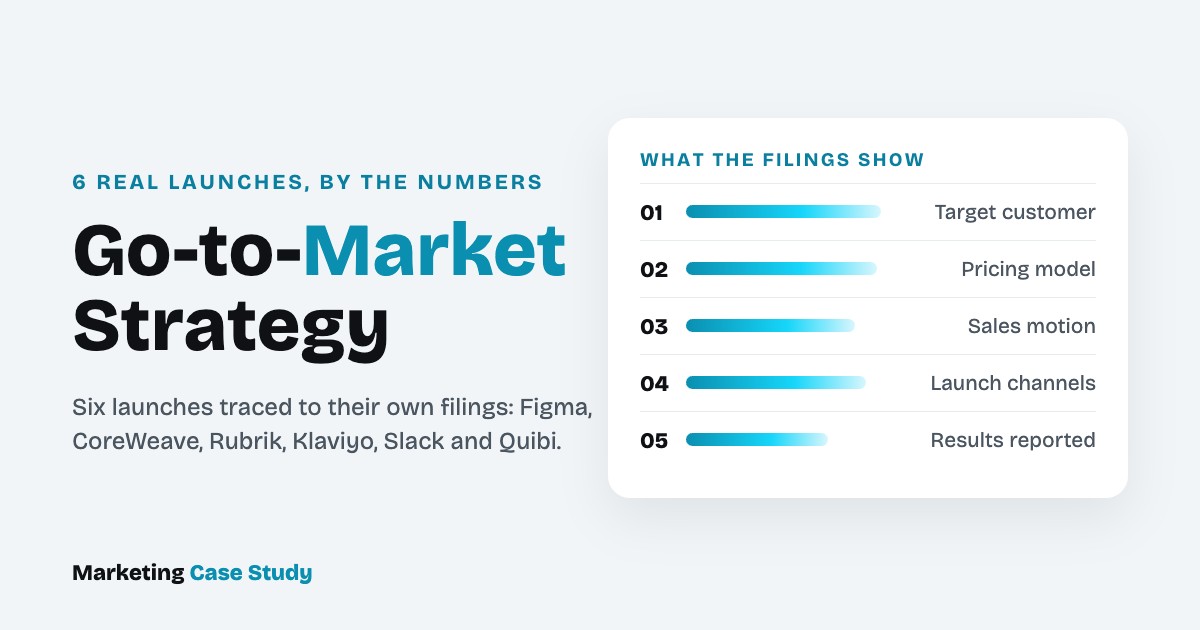
A go-to-market strategy is the plan for how a product reaches its first paying customers and then the next thousand: who it is for, what problem it solves, how it is priced, which channel and sales motion carry it, and which numbers prove it is working. The clearest way to see what a good one looks like is in IPO filings, where companies have to report the results under penalty of law. This guide breaks down six launches from those filings, four of them from the last three years, and turns the pattern into a step-by-step method.
Most guides on this topic list the same components and stop there. The examples below add the part they leave out: what each company chose, what it measured, and how the result looked when it was disclosed to investors.
What is a go-to-market strategy?
A go-to-market (GTM) strategy is a cross-functional plan for launching a product or entering a market. It answers five questions in order: who buys, why they buy, what they pay, how they find and buy the product, and how the company knows it is working.
It is broader than a marketing strategy. A marketing plan covers demand generation, messaging, channels and campaigns. A go-to-market strategy also decides pricing, the sales motion (self-serve, sales-led or a mix), distribution partners and onboarding. Marketing is one part of it.
| Go-to-market strategy | Marketing strategy | |
|---|---|---|
| Scope | Product, pricing, sales motion, channels, onboarding, metrics | Positioning, messaging, campaigns, channel mix |
| Owner | Product, sales, marketing and finance together | Marketing team |
| Time frame | A launch or market entry, then revised as data comes in | Usually annual, with quarterly campaigns |
| Key question | How does this product make money in this market? | How do we create and capture demand? |
What are the five pillars of a go-to-market strategy?
The five pillars are the target customer, the value proposition, pricing, the channel and sales motion, and the metrics. Each one depends on the one before it, which is why the order matters.
- Target customer (ICP). The specific companies or people most likely to buy, defined tightly enough that a sales rep or an ad platform could find them.
- Value proposition. The problem solved and why the product beats the alternatives, including doing nothing.
- Pricing. Free tier, subscription, seat-based, usage-based or contract. Pricing decides which sales motion can pay for itself.
- Channel and sales motion. Self-serve sign-up, inside sales, field sales, partners or marketplaces. This is where most launches succeed or fail.
- Metrics. Customer acquisition cost (CAC), payback period, activation, retention and net revenue retention. These tell the team whether to scale, adjust or stop.
Six go-to-market strategies, by the numbers
The examples were chosen because each company disclosed its results in a regulatory filing or the results were reported by a major news organization. They cover the three common motions (product-led, sales-led and hybrid) and one well-funded failure.
| Company | Year reported | Motion | Key result | Source type |
|---|---|---|---|---|
| Figma | 2025 | Product-led, then direct sales | 13M+ monthly active users; 132% net dollar retention | SEC filing (S-1) |
| CoreWeave | 2025 | Sales-led, a few very large contracts | $1.92B revenue; 62% from Microsoft | SEC filing, reported by Fortune |
| Rubrik | 2024 | Sales-led with partners | $784.0M subscription ARR, up 47% | SEC filing (S-1) |
| Klaviyo | 2023 | Self-serve and agency partners, then sales | 130,000+ customers; 119% net revenue retention | SEC filing (S-1) |
| Slack | 2019 | Bottoms-up, free plan | 88,000+ paid customers; 143% net dollar retention | SEC filing (S-1) |
| Quibi | 2020 | Top-down consumer launch | Shut down about six months after launch | Associated Press report |
Figma (2025): free product first, sales team second
The play. Figma gives away a free Starter plan and lets the product spread from designers to everyone who works with them. Its 2025 S-1 filing describes “product-led, bottoms-up adoption” alongside a direct sales process that sets up larger accounts.
The numbers (company figures, S-1, 2025). More than 13 million monthly active users in the three months ended March 31, 2025, two-thirds of them not designers. Revenue of $749.0 million in 2024, up 48%. Net dollar retention of 134% at the end of 2024 and 132% in March 2025. According to the filing, 95% of the Fortune 500 used Figma in March 2025.
What you can copy. The non-designer share is the real story. Figma’s free tier was built for collaboration, so every designer brought in product managers, engineers and marketers. A free plan works as a go-to-market channel only when using the product invites other people into it.
What depends on scale. Figma had years of free usage before it built the sales team. A startup with six months of runway cannot wait that long for free users to turn into enterprise contracts.
CoreWeave (2025): a sales-led launch built on very few customers
The play. CoreWeave sells GPU cloud capacity to AI companies through large, committed contracts rather than self-serve sign-ups.
The numbers (S-1 figures, as reported by Fortune, March 2025). Revenue of $1.92 billion in 2024, up more than 700%. Microsoft accounted for 62% of 2024 revenue and a second customer for another 15%, so two customers made up 77%. The filing lists customer concentration as a top risk factor.
What you can copy. When a product solves an expensive, urgent problem for a short list of buyers, a sales-led motion with large contracts can grow revenue faster than any free plan.
What to avoid. The same structure is fragile. If one buyer changes plans, most of the revenue goes with it. A sales-led go-to-market plan needs a target for how many customers the business has to win before it is safe, not only a revenue target.
Rubrik (2024): enterprise sales plus a partner network
The play. Rubrik sells data security subscriptions to large organizations. Its 2024 S-1 filing says it sells “through our sales team and partner network” and runs a land-and-expand strategy.
The numbers (company figures, S-1, 2024). Subscription annual recurring revenue (ARR) of $784.0 million as of January 31, 2024, up 47% from $532.9 million. 1,742 customers paying more than $100,000 a year. Average subscription net retention of 133%.
What you can copy. Partners extend reach into accounts a direct team cannot cover, and a high retention rate shows that the first sale is only the start. The 133% figure means existing customers spent a third more each year, which is where much of the growth came from.
What depends on budget. Field sales and partner programs are expensive. This motion fits products with high contract values, where one closed deal pays for months of sales effort.
Klaviyo (2023): self-serve and agencies first, sales later
The play. Klaviyo, the email and SMS platform for online stores, says in its 2023 S-1 that most new customers arrived through inbound channels such as word of mouth and agency partnerships, many signing up on their own. It later added a sales team for mid-market and enterprise accounts, and then an outbound team for larger ones.
The numbers (company figures, S-1, 2023). More than 130,000 customers as of June 30, 2023. Revenue grew 62.7% from $290.6 million in 2021 to $472.7 million in 2022. Net revenue retention of 119%. 1,458 customers above $50,000 in ARR, up 94% in a year.
What you can copy. Agencies are a distribution channel that many software companies overlook. Each agency that adopts a tool brings several clients with it, and the tool’s integrations with e-commerce platforms such as Shopify put it where store owners already work.
Slack (2019): bottoms-up adoption inside companies
The play. Slack’s 2019 S-1 filing says usage inside organizations “is typically initially driven bottoms-up, by end users,” with a self-service path for both free and paid plans.
The numbers (company figures, S-1, 2019). More than 600,000 organizations with three or more users as of January 31, 2019: more than 88,000 paid customers and more than 500,000 on the free plan. Daily active users above 10 million. Net dollar retention of 143%. Sales and marketing expense was $233.2 million in fiscal 2019, up from $140.2 million the year before.
What you can copy. Only about one in seven of those organizations paid. That ratio is normal for a free plan, and the company still had 143% net retention because paying teams kept adding seats. A product-led plan should be judged on how much paying customers expand, not on what share of free users convert.
What depends on timing. Slack also spent heavily on sales and marketing. Bottoms-up adoption reduced the cost of winning a team, but it did not remove the need for a sales team once whole companies were buying.
Quibi (2020): what a failed go-to-market looks like
The play. Quibi launched a paid mobile streaming service for short episodes in April 2020, backed by Hollywood studios and investors.
The numbers (Associated Press, October 2020). Quibi raised $1.75 billion and announced it would wind down about six months after launch. It did not release subscriber figures; Sensor Tower estimated 9.6 million app installs. The founders wrote that the service failed “likely for one of two reasons: because the idea itself wasn’t strong enough to justify a standalone streaming service or because of our timing.”
What you can learn. Money, content and distribution deals could not substitute for the first two pillars. The target customer and the value proposition were never proven before the launch was funded at full scale. Every other example in this list either tested demand cheaply first (Figma, Slack, Klaviyo) or sold to buyers with a known, urgent need (CoreWeave, Rubrik).
What these launches have in common
Three patterns appear across the filings.
- Retention drives growth. Figma, Rubrik and Slack all reported net retention above 130%. Each year, existing customers spent more than a third more than they did the year before. Acquisition starts the growth; expansion sustains it.
- Most companies end up hybrid. Figma, Klaviyo and Slack started product-led and added sales teams. The pure version of either motion rarely lasts past the first large customers.
- The motion follows the contract size. Free plans and self-serve fit products sold to individuals and small teams. Sales-led and partner motions fit products where a single contract is worth tens of thousands of dollars or more.
Which go-to-market model fits your product?
There is no single best go-to-market strategy. The right model depends mainly on who signs the contract and how much it is worth.
| If your product… | Start with | Watch | Example |
|---|---|---|---|
| Can be tried alone in minutes and gets better with more users | Product-led: free plan or trial, self-serve checkout | Activation rate, expansion within accounts | Figma, Slack |
| Is bought by small businesses through advisers or platforms | Self-serve plus partners or marketplaces | Share of sign-ups from partners, retention by channel | Klaviyo |
| Needs security, legal or IT approval and sells for $50,000+ a year | Sales-led with partners | Sales cycle length, CAC payback, win rate | Rubrik |
| Serves a handful of buyers with a large, urgent need | Direct enterprise sales, committed contracts | Customer concentration, contract renewals | CoreWeave |
How to build a go-to-market strategy in six steps
- Define the target customer narrowly. Write the ideal customer profile as filters a team could act on: industry, company size, role of the buyer, the trigger that makes them look for a solution. Figma’s filing shows how the definition can widen over time, from designers to everyone who works with them, but it started narrow.
- Write the value proposition against the real alternative. For most products, the alternative is not a competitor but a spreadsheet, an agency or doing nothing. State what changes for the customer in one sentence.
- Choose pricing before the channel. A $20-a-month product cannot pay for a field sales team, and a $200,000 contract will rarely close through a checkout page. Pricing sets the budget for acquiring each customer.
- Pick one primary motion and one secondary. Use the table above. Most launches fail by trying every channel at once with too little behind any of them. Teams choosing a sales-led motion will need a way to find and qualify accounts; this comparison of B2B lead generation tools and this one of sales prospecting tools cover the main options.
- Set the metrics and the thresholds. Decide in advance what result means “scale,” “adjust” or “stop.” The core calculation is CAC payback: customer acquisition cost divided by monthly gross margin per customer. A customer who costs $3,000 to acquire and brings in $250 a month in gross margin pays back in 12 months.
- Run a limited launch, then review. Launch to one segment or region, review the metrics after a fixed period such as 90 days, and adjust. Quibi’s launch shows the cost of skipping this step.
Common go-to-market mistakes
- Treating launch as the plan. A launch is one day. The go-to-market strategy has to cover the months after, when early buyers decide whether to renew and expand.
- Measuring free sign-ups instead of revenue. Slack’s filing shows that a minority of organizations paid. The useful number was how much the paying ones grew.
- Ignoring concentration. A few large deals can make a launch look like a success while leaving the business dependent on one customer, as CoreWeave’s filing warns.
- Building a sales team before the product sells itself to anyone. Klaviyo and Figma built sales teams after inbound demand proved the product, not before.
- Copying a model from a different contract size. A product-led playbook from a $10-a-seat tool will not work for a six-figure enterprise platform, and the reverse is also true.
Teams planning how to keep customers after launch can see how retention programs perform in this marketing automation case study, and early-stage companies choosing a first email tool can compare options in this guide to email marketing platforms for startups. For a small-scale example of a focused launch tactic paying off, see how Oddballs boosted revenue with onsite notifications.
The decision rule
Start from the contract size and the buyer. If one person can try, buy and expand the product without anyone’s approval, lead with the product and add sales once whole companies want it. If a committee signs a large contract, lead with sales and partners and track how many customers the revenue depends on. In both cases, the number that shows whether a go-to-market strategy is working is not the launch-day sign-up count but how much customers spend a year later.