In the information age, methods created to modify or hide one’s IP address – the unique identifier of a device on the internet – are everywhere. Most popular among them are Virtual Private Networks (VPNs) and Residential Proxies. Yet while these technologies mask your digital location and identity, to varying degrees, their underlying design, primary function and purpose, ethical sourcing, and applicability in the business world are just a few examples of this.
Online, IP identity controls have now reached new heights in the realm of computer technology. If we conflate the two, we risk using the wrong route to execute, the security of data being at stake, or not functioning properly, especially when scaling automation.
Key Differences Based on Architecture and Origin
The most significant difference between a VPN and a residential proxy is what IP address they offer to you, and how that service sends your traffic. This difference is the crux of their detection status.
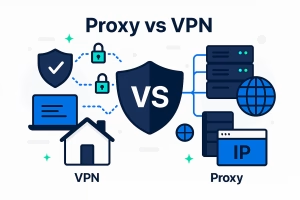
A Virtual Private Network (VPN) creates an encrypted tunnel which routes all your internet traffic through one location and connects it with a different server. Its IP address is nearly always used and registered with a commercial data centre or server farm. VPNs primarily focus on Privacy and Security for individuals, guarding connections from both surveillance and hacking, which happen on public networks.
On the other hand, a Residential Proxy is an IP address acquired from an actual real ISP (Internet Service Provider) and assigned to another user, such as a home computer or mobile phone. It serves as an intermediary (or a proxy server) for some application traffic (like a browser or a scraping script) and does not encrypt all device traffic.
Since these IP addresses are linked to a real consumer and can be identified in normal residential traffic, they are highly anonymous and trusted. The main focus of a residential proxy is Anonymity and scaling for high-volume automated data requests, as well as precise geo-targeting.
When a sophisticated website, like a big retailer or streaming service, receives consistent connection requests from known data centre IPs (which is what VPNs do), they flag it instantly as non-residential or automated traffic and block it. However, a residential proxy is harder to block because the IP address is inherently trusted—it’s behaving like another home user.
Purpose and Use Case Suitability
Differences in origin dictate suitable use scenarios.
VPNs: Best for the individual and General Access
VPNs are designed specifically for end users, prioritising individual users’ security best interests and providing basic geo-access protection. They mainly perform the following functions:
- Secure Browsing on insecure networks: Protecting data on insecure networks (e.g. airports, cafés).
- Personal Privacy: Obfuscating personal browsing history from the ISP or local observers.
- Streaming Access: Using location as a bypass to streaming (many big streaming services now block VPN IPs too).
- General Access: Bypassing simple geographic firewalls that block based on country alone.
Residential Proxies: Essential for automation and scalable automated services
Proxies should be built into the digital operations needed for professional scaling, where detection of online operations is critical and extremely challenging for organisations; that means having a residential proxy in place. They are used for all operational processes in this way:
- Web Scraping & Data Aggregation: A secure way to collect large amounts of data from anti-bot-protected websites (e-commerce websites, search engines, etc.) at scale.
- Ad Verification & SEO Monitoring: Testing ad placements and SERP rankings in the real world from the perspective of consumers worldwide, requiring extremely granular regional accuracy.
- E-Commerce & Automated Transactions: High-speed, localised, automated transactions, not flagged as a bot.
- Account Management: Operating with more than one social media or transactional account in which the platforms heavily limit access to user-visible IP ranges.
Why VPNs Fail Businesses: The Scaling Imperative
So when a company tries to scale an automated task—say, processing 10,000 requests an hour—with a VPN, they rapidly reach a wall for various reasons. First, a VPN service has a very small list of servers and IP addresses, and all of them are in a corporate data centre.
Second, this results in mass detection: a target site only has a single point to block each specific data centre IP, and the whole operation shuts down at once. Finally, VPNs also have low granularity (usually limited to large cities or nations), which is insufficient for accurate, local market research.
In contrast, residential proxy providers offer access to networks consisting of millions of unique, rotating IPs. When one residential IP is flagged or temporarily blocked by a target site, the system immediately switches to a new, real residential IP from a different location, enabling automated operation without interruption. That capacity to rotate through millions of trusted IPs is what makes scaling feasible and secure.
Ethical Considerations
The ethical sourcing of the IP addresses is just as important. Legitimate VPN companies own their devices and network infrastructure. Legitimate residential proxy providers, however, work under contracts and explicit user consent – typically an opt-in network or SDK embedded in a free application, where users agree to share bandwidth and consent to proxy bandwidth for free. Ethical sourcing and strict adherence to privacy policies are paramount for any business utilising residential proxies to ensure legal compliance and responsible usage.
Choosing the Right Tool
The choice between residential proxies and VPNs is an ethical and legal matter. If your target is individual privacy and protecting general web traffic, VPN technology is the right one. If you want automation on a mass scale, access to geo-restricted data, and near-complete invisibility when relying on sophisticated detection, Residential Proxies are the cornerstone of today’s digital environments.
The technologies complement each other but are not interchangeable. The unique feature of residential proxies—that they are indistinguishable from a real user—is the part enabling safe, massive, and continuous automation, and this is something that businesses needing to scale in a competitive digital world must realise when scaling safely and securely.

![Marketing Automation Case Study: 12 Real Examples, Strategy & ROI Results [2026]](https://marketingcasestudy.io/wp-content/uploads/2026/05/marketing-automation-case-study-featured-300x158.png)