AI has not just entered marketing. It has fundamentally restructured how marketing teams operate. A 2026 survey found that 88 percent of marketers now use AI tools in their daily workflow, up from 29 percent in 2021. Teams using AI report 22 percent higher campaign ROI, 32 percent more conversions, and 29 percent lower customer acquisition costs. These are not theoretical projections. They are measured results from thousands of marketing organizations that have integrated AI into their content creation, SEO optimization, email campaigns, ad management, and customer analytics.
But the market is flooded. Hundreds of products call themselves AI marketing tools, and most are thin wrappers around the same language models with different branding. The tools that deliver genuine value combine AI capabilities with practical workflows that integrate into your existing marketing stack. They do not replace your marketing team. They eliminate the repetitive, time-consuming tasks that prevent your team from focusing on strategy, creativity, and the judgment calls that determine whether a campaign succeeds or fails.
This guide separates the tools that produce measurable results from the tools that produce impressive demos. We tested 12 AI marketing platforms across content creation, SEO optimization, email and ad optimization, CRM-integrated automation, and autonomous campaign management. Every recommendation includes the specific marketing function where that tool excels, the team size it fits, and the situations where you should spend your budget elsewhere.
Quick Comparison: Top 12 AI Marketing Tools for 2026
| Tool | Best For | Starting Price | Free Plan | Primary AI Use | Our Rating |
| Jasper | Brand-voice content at scale | $59/mo (Creator) | 7-day trial | Content generation | 8.8/10 |
| Surfer SEO | NLP content optimization | $99/mo (Essential) | Limited free | SEO optimization | 9.0/10 |
| Copy.ai | Short-form marketing copy | $29/mo | Yes (2,000 words) | Copywriting | 8.2/10 |
| HubSpot AI (Breeze) | CRM-integrated marketing AI | $900/mo (Marketing) | Free CRM | Full-stack automation | 9.1/10 |
| Clearscope | Enterprise content optimization | $189/mo | 14-day trial | Semantic SEO | 8.6/10 |
| Anyword | Data-driven copy optimization | $49/mo | 7-day trial | Predictive scoring | 8.3/10 |
| Writer | Enterprise brand-safe AI | Custom | No | Governance + content | 8.5/10 |
| Surfer AI + Jasper | Write + optimize in one flow | $138/mo combined | No | Content + SEO | 9.2/10 |
| Klaviyo AI | Email/SMS marketing AI | $60/mo | Free (250 contacts) | Email optimization | 8.7/10 |
| Albert AI | Autonomous ad management | Custom | No | Ad campaign AI | 8.4/10 |
| Canva AI (Magic Studio) | Visual marketing content | $15/mo (Pro) | Yes (limited) | Design generation | 8.9/10 |
| ChatGPT / Claude | General marketing AI assistant | $20/mo | Yes (limited) | Versatile assistant | 8.5/10 |
How We Evaluated These AI Marketing Tools
Every tool in this guide was assessed across six dimensions that determine whether an AI marketing platform delivers ROI or just generates impressive-sounding content that nobody reads.
Output quality: We generated real marketing content with each tool, including blog posts, ad copy, email sequences, and social media content, then measured quality against human-written benchmarks. Tools were rated on accuracy, brand-voice consistency, and the amount of human editing required before publishing.
Workflow integration: AI tools that operate in isolation create more work, not less. We assessed how each tool connects to existing marketing stacks: CRM systems, CMS platforms, analytics tools, ad platforms, and project management systems. Seamless integration scored higher than copy-paste workflows.
Measurable impact: We evaluated whether each tool provides data on its own effectiveness. Can you measure the performance difference between AI-assisted and manual content? Tools with built-in analytics, A/B testing, and performance prediction scored higher.
Brand safety: AI-generated content that contradicts your brand voice, includes inaccurate claims, or uses inappropriate language is worse than no content at all. We assessed each tool’s brand voice controls, fact-checking capabilities, and content governance features.
Pricing transparency: We calculated the true monthly cost for a 5-person marketing team producing 50 pieces of content per month, including base subscriptions, per-word or per-article charges, required add-ons, and integration costs.
Scalability: We tested each tool at individual, team, and enterprise scale points to identify where pricing, performance, or features break down as usage grows.
Why AI Marketing in 2026 Demands a Different Approach
Three shifts have fundamentally changed how AI tools fit into the marketing stack since 2023. The first is the rise of AI visibility and generative engine optimization (GEO). As consumers increasingly get answers from AI systems like ChatGPT, Google AI Overviews, and Perplexity rather than traditional search results, marketing teams need tools that optimize content for AI citation, not just search engine ranking. Surfer SEO’s AI Tracker and specialized GEO tools represent this new category.
The second shift is the move from AI-assisted content to AI-governed content. In 2023, marketers used AI to write first drafts. In 2026, the challenge is ensuring that AI-generated content across dozens of team members remains on-brand, factually accurate, and legally compliant. Tools like Jasper IQ, Writer, and HubSpot Breeze now embed brand intelligence and governance guardrails directly into the generation process, preventing off-brand content before it is created rather than catching it after.
The third shift is the full deprecation of third-party cookies. The post-cookie world of 2026 has made first-party data the only reliable foundation for targeting and personalization. AI marketing tools that connect to your CRM data (HubSpot, Klaviyo) now produce dramatically better results than standalone tools working without customer context. The tools that integrate with your actual business data have a structural advantage over those that operate in isolation.
Detailed Reviews: Best AI Marketing Tools for 2026
1. Jasper — Best for Brand-Voice Content at Enterprise Scale
| Best For | Marketing teams of 3+ people producing high-volume brand content across channels who need voice governance and workflow consistency |
| Pricing | Creator $39/mo ($49 monthly). Pro $59/mo ($69 monthly), up to 5 seats. Business custom (12-month min). 7-day free trial |
| Free Plan | No permanent free tier. 7-day free trial on Creator and Pro plans |
| AI Capabilities | 100+ specialized marketing agents, Jasper IQ brand intelligence, Jasper Grid for content pipelines, campaign generation, image creation, browser extension, 30+ languages |
| Key Strengths | Best-in-class brand voice governance (Jasper IQ), Surfer SEO integration for SEO mode, 100+ marketing templates, team collaboration with brand guardrails, multimodal content (text + images) |
| Key Weaknesses | Expensive for solo creators ($39–$69/mo when ChatGPT is $20), 2023 price hike damaged trust, plagiarism checker is pay-per-use add-on, SEO mode requires separate Surfer subscription, Business plan locks behind custom pricing |
| Integrations | Surfer SEO, Google Docs, WordPress, Grammarly, Webflow, Chrome extension, Zapier, API (Business only) |
| Best Pairing | Surfer SEO for content optimization, HubSpot for distribution, Canva for visuals |
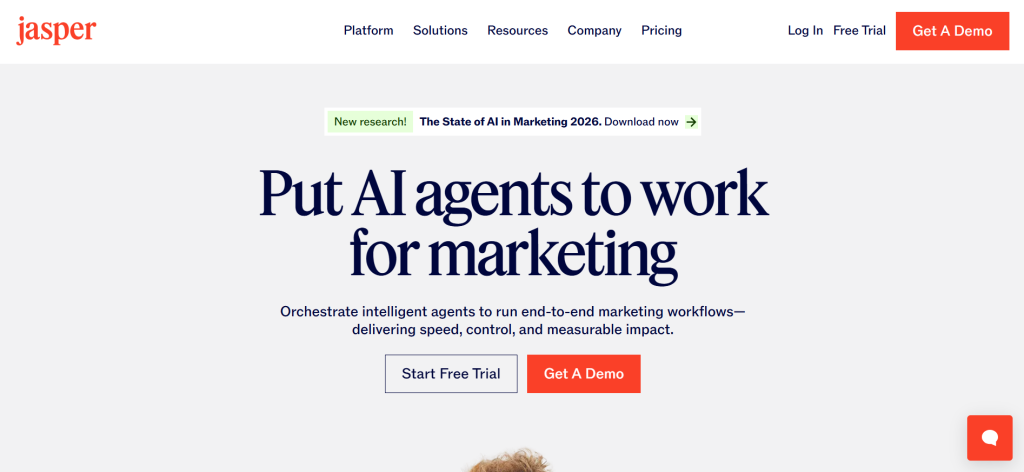
Jasper has evolved from a general AI writing tool into an enterprise marketing content platform. The 2026 version centers on Jasper IQ, a brand intelligence layer that learns your voice, messaging, and style guidelines and enforces them across every piece of content generated by any team member. For marketing teams where brand consistency matters, this governance layer is what separates Jasper from simply giving everyone a ChatGPT account and hoping for coherence.
The Pro plan provides up to five seats, three brand voices, 150 knowledge assets where you upload product information, style guides, and competitive intelligence, and Surfer SEO integration for content optimization. Jasper Grid introduces a spreadsheet-like interface for orchestrating content pipelines at scale, letting teams plan, assign, and track dozens of content pieces across formats and channels in a single view. Instant Campaigns generate multi-piece campaigns from a single brief, producing coordinated email, social, ad, and landing page content simultaneously.
The use case has narrowed since 2023. Two years ago, Jasper made sense for any content creator who wanted AI assistance. In 2026, the case is strongest for marketing teams of three or more people producing brand content at scale, where the governance and workflow features justify the cost. Solo creators and small teams get better value from ChatGPT or Claude at $20 per month for general-purpose AI writing, supplemented with Surfer SEO for optimization when needed.
Where Jasper Falls Short
Jasper’s pricing has been a sore point since a controversial 300-plus percent price increase for existing customers in 2023, which still appears in reviews as a trust concern. The plagiarism checker is a pay-per-use add-on rather than included. SEO mode requires a separate Surfer SEO subscription, adding $79 or more per month to the total cost. Many of the most valuable features, including unlimited brand voices, API access, content pipelines, and agents, are locked behind the custom-priced Business plan. For teams where brand governance is not a primary concern, the premium over general-purpose AI tools is difficult to justify.
The Verdict on Jasper
Jasper is the right choice for marketing teams of three or more who produce brand content at volume and need governance guardrails that prevent off-brand output. The Jasper IQ and team collaboration features genuinely solve a problem that general-purpose AI tools cannot address. For solo marketers, freelancers, or teams where brand consistency is not mission-critical, ChatGPT or Claude provides 80 percent of the content generation capability at a third of the cost.
2. Surfer SEO — Best for Data-Driven Content Optimization
| Best For | SEO-focused content teams who need data-driven optimization guidance to rank higher in search results and AI-generated answers |
| Pricing | Essential $99/mo ($79/mo annual). Scale $219/mo ($175/mo annual). Enterprise custom. Surfer AI articles $29 each. 7-day money-back guarantee |
| Free Plan | Limited free plan available with restricted features. Keyword Surfer Chrome extension free |
| AI Capabilities | NLP-based content scoring, real-time optimization suggestions, AI Tracker for monitoring AI search visibility, Surfer AI article generation, Content Audit for refreshing existing pages, Topical Map for content planning |
| Key Strengths | Most accurate content optimization scoring in the market, Content Editor provides real-time SEO feedback while writing, AI Tracker monitors visibility in AI answer engines, Jasper integration for write-and-optimize workflow, Google Docs and WordPress plugins |
| Key Weaknesses | Not a writing tool by itself (pairs with writers or Jasper), $29 per AI-generated article adds up fast, no integration with Ahrefs or Semrush for keyword data, free NLP limited to first month on Essential plan, Rank Tracker is an add-on ($17/mo) |
| Integrations | Jasper, Google Docs, WordPress, Google Search Console. API on Enterprise only |
| Best Pairing | Jasper for AI writing + Surfer for optimization. Or use Surfer’s Content Editor with human writers |
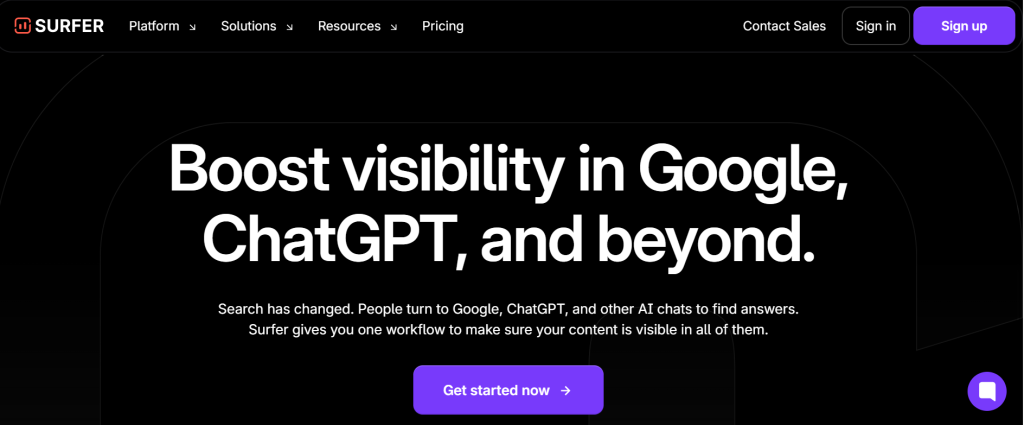
Surfer SEO is the leading content optimization platform for marketing teams that prioritize organic search performance. The tool analyzes the top-ranking pages for any target keyword and provides specific, data-driven recommendations on word count, heading structure, keyword usage, NLP terms, and content depth. The Content Editor delivers this guidance in real time as you write, showing a dynamic optimization score that quantifies how well your content matches what search engines reward.
The AI Tracker is Surfer’s most strategically important feature for 2026. As AI answer engines like ChatGPT, Google AI Overviews, and Perplexity increasingly provide answers directly rather than linking to websites, the AI Tracker monitors whether your content is being cited by these AI systems. This gives marketing teams visibility into a channel that most analytics tools completely miss. Content Audit automatically scans your existing pages against current SERP competitors and identifies specific improvements that could recover lost rankings or improve existing positions.
The Jasper plus Surfer combination creates the most powerful AI content workflow available: Jasper generates on-brand drafts, and Surfer ensures those drafts are optimized for search performance. With the integration, you can access Surfer’s Content Editor directly within Jasper, writing and optimizing in a single interface. The combined cost of $138 per month (annual billing) is significant, but for teams where organic search drives meaningful revenue, the investment pays for itself with a single high-ranking article.
Where Surfer SEO Falls Short
Surfer is an optimization tool, not a writing tool. The built-in Surfer AI article generator costs $29 per article on top of your subscription and produces lower-quality output than dedicated writing tools like Jasper or Claude. The Essential plan provides only 15 Content Editor credits per month, which may not be enough for prolific content teams. The tool lacks integration with comprehensive SEO platforms like Ahrefs and Semrush, meaning you still need separate subscriptions for keyword research and backlink analysis. The free NLP feature is limited to the first month on the Essential plan, after which it becomes an additional cost.
3. Copy.ai — Best Free Entry Point for AI Marketing Copy
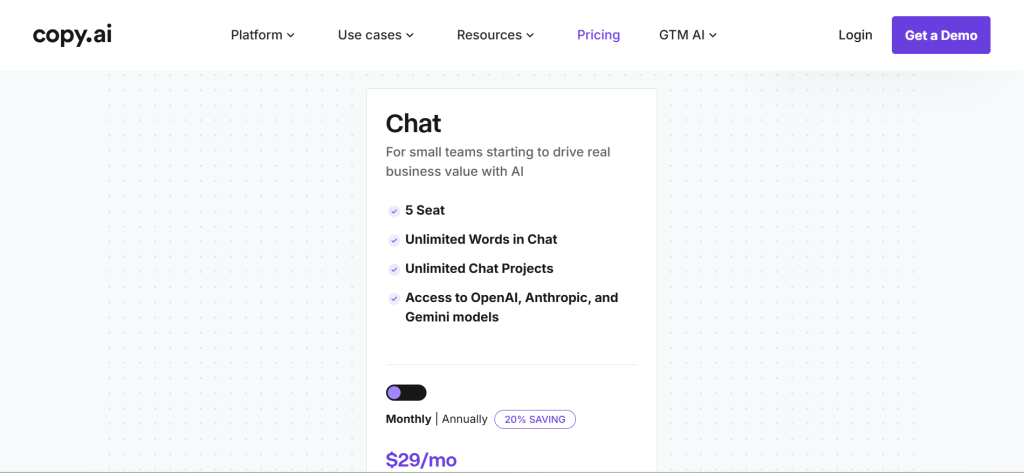
| Best For | Solo marketers and small teams needing quick, channel-specific copy generation with a generous free tier to start |
| Pricing | Free (2,000 words/mo, 1 seat). Pro $49/mo. Enterprise custom pricing |
| Free Plan | Yes — 2,000 words per month with access to 90+ templates. Best free tier for AI marketing copy |
| AI Capabilities | 90+ copywriting templates (ads, emails, product descriptions, social), workflow automation chains multiple generation steps, brand voice on paid plans, Infobase for company knowledge |
| Key Strengths | Best free tier of any AI marketing tool (2,000 words/mo), strong at short-form copy (ads, emails, social captions), workflow automation chains multi-step generation, user-friendly interface non-technical marketers adopt quickly |
| Key Weaknesses | Long-form content quality trails Jasper and Claude, brand voice customization less sophisticated than Jasper IQ, limited third-party integrations, output quality varies by content type, has pivoted toward sales workflow automation |
| Integrations | Zapier, HubSpot, Salesforce, Slack. More limited than Jasper’s ecosystem |
| Best Pairing | Surfer SEO for content optimization, Canva for visual assets |
Copy.ai earns its place in this guide by offering the best free tier of any dedicated AI marketing tool. The free plan provides 2,000 words per month with access to over 90 copywriting templates covering product descriptions, social media captions, email subject lines, Google Ads copy, Facebook ad variations, and sales outreach messages. For freelancers, solopreneurs, and small businesses testing AI marketing copy for the first time, this free tier provides enough volume to evaluate AI-generated content on real projects before committing to a paid subscription.
The workflow automation feature distinguishes Copy.ai from simple text generators. You can chain multiple generation steps together, automating sequences like competitive research to messaging framework to ad copy variations. The Infobase feature on paid plans lets you store company information, product details, and brand guidelines that the AI references when generating content, improving relevance without re-explaining context for every request.
Copy.ai has pivoted significantly toward sales workflow automation in recent years, adding features like automated prospect research, personalized outreach sequences, and lead enrichment. This makes it increasingly useful for sales-marketing alignment but has diluted its focus on pure marketing content generation. For teams that span sales and marketing functions, this expansion adds value. For teams focused purely on content marketing, the pivot means fewer resources are being invested in improving content quality.
Where Copy.ai Falls Short
Long-form content quality consistently trails Jasper, Claude, and ChatGPT. Blog posts generated by Copy.ai require more extensive editing to achieve publication quality, particularly for technical or nuanced topics. Brand voice customization exists on paid plans but lacks the depth and governance capabilities of Jasper IQ or Writer. The integration ecosystem is more limited than competitors, and the platform’s pivot toward sales workflows means marketing-specific features receive less development attention than they did two years ago.
4. HubSpot AI (Breeze) — Best CRM-Integrated AI Marketing Platform
| Best For | Businesses already using HubSpot CRM that want AI embedded across their entire marketing, sales, and service stack with customer data context |
| Pricing | Free CRM with basic AI. Starter $20/mo. Professional $800/mo (Marketing Hub). Enterprise $3,600/mo. AI features included in plans |
| Free Plan | Yes — free CRM includes basic AI content assistant, chatbot builder, and email tools. Substantial AI requires Professional tier |
| AI Capabilities | Breeze AI agents for content, social, prospecting, and customer service. AI email optimization (send time, subject lines, personalization). AI lead scoring. AI chatbots. AI-powered reporting and forecasting |
| Key Strengths | AI draws on your actual CRM data for context-aware recommendations, reduces campaign deployment time by ~3x, AI across marketing + sales + service in unified platform, Breeze agents automate multi-step workflows, strongest first-party data advantage |
| Key Weaknesses | $800/mo minimum for meaningful marketing AI (Professional), ecosystem lock-in limits flexibility, AI features add complexity to already complex platform, smaller businesses struggle to justify investment, content generation quality trails specialized tools |
| Integrations | Native CRM data. 1,600+ app integrations including Salesforce, WordPress, Shopify, Google Ads, Facebook Ads, Slack, Zoom |
| Best Pairing | Jasper for content quality, Surfer for SEO, Canva for visuals — all feeding into HubSpot for distribution and analytics |
HubSpot AI, now branded as Breeze, represents a fundamentally different approach from standalone AI marketing tools. Rather than generating content in isolation, Breeze operates within your CRM data: your customer interactions, deal history, engagement patterns, email performance, and conversion data. This context awareness produces recommendations and content that standalone tools cannot match because they lack access to your business reality.
Breeze AI agents automate complex marketing workflows end to end. The Content Agent generates blog posts, landing pages, and case studies informed by your product data and customer personas stored in HubSpot. The Social Agent creates and schedules social media content aligned with your campaign calendar. The Prospecting Agent identifies and engages potential customers based on your ideal customer profile. The Customer Agent handles service inquiries with knowledge of each customer’s history. Mid-market teams report that Breeze reduces campaign deployment time by approximately three times compared to traditional workflows.
The AI email optimization is where HubSpot’s data advantage is most visible. Send time optimization analyzes each contact’s historical engagement patterns to determine the optimal delivery time. Subject line recommendations draw on your actual open rate data. Content personalization adapts email content based on CRM properties, lifecycle stage, and behavioral data. Lead scoring uses AI to analyze hundreds of signals and prioritize the prospects most likely to convert, improving sales team efficiency by focusing attention on high-probability opportunities.
Where HubSpot AI Falls Short
The $800 per month minimum for Marketing Hub Professional puts meaningful AI capabilities out of reach for many small businesses. The platform’s ecosystem approach creates lock-in: once your data, workflows, and team processes are built around HubSpot, switching becomes prohibitively expensive. Content generation quality, while improved by CRM context, trails specialized tools like Jasper for marketing copy and Claude for strategic content. The AI features add another layer of complexity to an already feature-dense platform, increasing the training investment required for full adoption.
5. Clearscope — Best Enterprise Content Optimization for Editorial Teams
| Best For | Enterprise content teams and agencies that prioritize editorial quality and semantic depth over volume-driven optimization |
| Pricing | Essentials $189/mo. Business $399/mo. Enterprise custom pricing. No free tier or trial |
| Free Plan | No free plan or trial. Minimum commitment at $189/mo |
| AI Capabilities | Semantic content analysis, topic coverage scoring, competitive content comparison, keyword recommendations based on semantic relevance rather than density, content report cards |
| Key Strengths | Highest-quality content optimization for editorial teams, focuses on semantic coverage over keyword stuffing, cleaner interface than Surfer, content report cards provide shareable quality scores, excellent for agencies managing client content |
| Key Weaknesses | Most expensive content optimization tool at $189/mo, no free trial to test before committing, fewer features than Surfer (no AI writing, no AI Tracker), limited integrations, report credits restrict high-volume usage |
| Integrations | Google Docs, WordPress. More limited integration ecosystem than Surfer |
| Best Pairing | Jasper or Claude for writing, Clearscope for optimization quality assurance |
Clearscope takes a quality-first approach to content optimization that resonates with editorial teams and premium publishers. Where Surfer SEO provides granular, metric-heavy optimization guidance, Clearscope focuses on semantic coverage: ensuring your content comprehensively addresses the topics and subtopics that search engines associate with a given query. The result is content that reads naturally while covering the depth that earns rankings, rather than content that hits keyword density targets but feels mechanical.
The content report card feature makes Clearscope particularly valuable for agencies and editorial teams. Each piece of content receives a letter grade (A++ through F) based on semantic coverage, readability, and competitive positioning. These shareable report cards provide a standardized quality metric that editors, clients, and stakeholders can understand without SEO expertise. For agencies managing content across multiple clients, this standardized scoring system simplifies quality assurance.
At $189 per month for the Essentials plan and $399 per month for Business, Clearscope is the most expensive content optimization tool in this guide. The premium pricing reflects its target market: enterprise content teams and agencies where the quality of optimization guidance matters more than the volume of features. Teams that produce fewer, higher-quality pieces rather than high-volume content mills will find Clearscope’s approach more aligned with their workflow.
Where Clearscope Falls Short
The absence of a free trial means you must commit $189 per month to evaluate the platform, which is a significant barrier for teams accustomed to testing tools before purchasing. Clearscope lacks the AI writing capabilities, AI Tracker for AI search visibility, and broader feature set that Surfer provides at a lower price point. The integration ecosystem is more limited, with support for Google Docs and WordPress but fewer connections to the broader marketing tech stack. For teams that prioritize feature breadth over optimization purity, Surfer provides better value.
6. Anyword — Best for Predictive Copy Performance Scoring
| Best For | Performance marketers who want data-driven predictions on which copy variations will perform best before publishing |
| Pricing | Starter $49/mo. Data-Driven $99/mo. Business $499/mo. Enterprise custom. 7-day free trial |
| Free Plan | No free plan. 7-day free trial available |
| AI Capabilities | Predictive performance scoring for copy variations, AI-generated copy with performance predictions, audience-specific scoring, A/B copy testing recommendations, brand voice training |
| Key Strengths | Unique predictive scoring predicts copy performance before publishing, generates multiple variations ranked by predicted engagement, audience-specific predictions (by channel, demographic), reduces A/B testing cycles by pre-selecting winners, strong ad copy and email subject line generation |
| Key Weaknesses | Predictive scores are probabilistic not guaranteed, requires historical data to calibrate predictions, less effective for long-form content, $99/mo needed for data-driven features, smaller user community than Jasper or Copy.ai |
| Integrations | HubSpot, WordPress, Canva, social media platforms, ad platforms |
| Best Pairing | HubSpot for CRM data, Surfer for SEO, ad platforms for performance validation |
Anyword’s defining feature is predictive performance scoring: the ability to predict how well a piece of copy will perform before it is published. The platform generates multiple copy variations for any marketing asset, whether an ad headline, email subject line, landing page copy, or social media post, and assigns each variation a predicted performance score based on its analysis of billions of data points from actual marketing campaigns.
This predictive capability changes the content creation workflow from create, publish, and hope to create, score, select the predicted winner, and then validate with real-world data. For performance marketing teams that run extensive A/B testing, Anyword reduces testing cycles by pre-selecting the variations most likely to win. Audience-specific predictions let you optimize for different segments: the same product might need different messaging for enterprise buyers versus small business owners, and Anyword predicts which approach will resonate with each audience.
The Data-Driven plan at $99 per month provides the full predictive analytics suite, including custom scoring models trained on your historical performance data. As the platform ingests your actual campaign results, its predictions become increasingly calibrated to your specific audience and market. This creates a compounding advantage: the longer you use Anyword, the more accurate its predictions become for your business specifically.
Where Anyword Falls Short
Predictive scores are probabilistic estimates, not guarantees. Copy that Anyword predicts will perform well can still underperform due to factors the model cannot account for, such as market timing, competitive actions, or audience mood shifts. The predictions are most accurate for short-form copy like ads and subject lines and less reliable for long-form content where engagement depends on sustained quality rather than initial hook. The $49 Starter plan lacks the data-driven features that are Anyword’s primary differentiator, meaning the effective starting price for the core value proposition is $99 per month.
7. Writer — Best for Enterprise Brand Safety and AI Governance
| Best For | Large enterprises that need AI content generation with strict brand safety, compliance, and governance controls across distributed teams |
| Pricing | Custom pricing only. Typically enterprise contracts. No public pricing tiers |
| Free Plan | No free plan or trial. Enterprise engagement required |
| AI Capabilities | Palmyra LLM (Writer’s own model trained on business writing), brand voice enforcement, terminology management, compliance checking, content governance workflows, custom AI applications |
| Key Strengths | Purpose-built for enterprise brand safety and compliance, own LLM (Palmyra) means less dependency on OpenAI, strongest governance and approval workflows, terminology management prevents off-brand language, SOC 2 and enterprise security certifications |
| Key Weaknesses | No transparent pricing (enterprise-only), inaccessible to small and mid-sized businesses, requires significant implementation investment, smaller ecosystem than Jasper, content generation quality competitive but not category-leading |
| Integrations | Chrome extension, Microsoft Word, Google Docs, Figma, Contentful, custom API. Enterprise SSO support |
| Best Pairing | Standalone for enterprise content governance. Complement with Surfer for SEO optimization |
Writer occupies a unique position by building its own large language model, Palmyra, rather than wrapping around OpenAI’s models. This gives enterprises a layer of independence from the OpenAI ecosystem and allows Writer to fine-tune its model specifically for business content generation, brand safety, and compliance. For organizations in regulated industries such as finance, healthcare, or legal services, where content accuracy and brand compliance carry legal consequences, Writer’s governance-first approach provides assurances that consumer-facing AI tools cannot.
The terminology management feature prevents the most common brand safety failures. You define approved terms, prohibited language, competitor mentions to avoid, and style rules, and Writer enforces them across every piece of content generated by any team member. Compliance checking screens content against regulatory requirements before it reaches the approval stage. Governance workflows route content through defined review and approval processes, ensuring that AI-generated content receives the same oversight as human-written content.
Writer’s custom AI application builder lets enterprises create purpose-built AI tools for specific business processes: proposal generators trained on past successful proposals, compliance document builders informed by regulatory requirements, and customer communication tools calibrated to brand voice standards. This extensibility makes Writer a platform rather than just a writing tool, though the implementation investment required to realize this potential is substantial.
Where Writer Falls Short
Writer is enterprise-only, with no public pricing, no free tier, and no self-serve option. This makes it inaccessible to the vast majority of marketing teams. Implementation requires significant investment in setup, training, and configuration. The content generation quality is competitive with but not demonstrably superior to Jasper or high-quality Claude prompting, meaning the premium is primarily for governance and compliance features rather than output quality. The smaller user community means fewer templates, integrations, and community resources compared to Jasper or Copy.ai.
8. Klaviyo AI — Best AI for Email and SMS Marketing
| Best For | E-commerce and DTC brands that want AI-optimized email and SMS campaigns powered by customer behavioral data |
| Pricing | Free (250 contacts, 500 emails/mo). Email from $20/mo (scaled by contacts). Email + SMS from $35/mo. Contact sales for large lists |
| Free Plan | Yes — 250 contacts, 500 email sends, 150 SMS credits per month. Generous for testing |
| AI Capabilities | AI subject line generation, predictive analytics (churn risk, CLV, next purchase date), AI-powered segmentation, personalized product recommendations, send time optimization, SMS AI optimization, A/B testing automation |
| Key Strengths | Deep e-commerce data integration (Shopify, WooCommerce, BigCommerce), predictive analytics predict churn, CLV, and purchase timing, AI segmentation creates behavioral segments automatically, free plan for testing, scales pricing with contact list size |
| Key Weaknesses | Primarily e-commerce focused (less effective for B2B or SaaS), pricing scales rapidly with large contact lists, SMS features add significant cost, AI content generation quality is basic, interface learning curve is steeper than Mailchimp |
| Integrations | Shopify, WooCommerce, BigCommerce, Magento, Salesforce, Facebook Ads, Google Ads, Stripe, 350+ integrations |
| Best Pairing | Shopify for e-commerce, Canva for email visuals, Surfer for blog SEO driving email list growth |
Klaviyo is the AI email marketing tool that earns its spot through data, not just content generation. While most AI marketing tools generate text, Klaviyo’s AI analyzes customer behavior to predict what each individual customer will do next: when they will make their next purchase, what their lifetime value will be, whether they are at risk of churning, and which products they are most likely to buy. These predictions power automated campaigns that send the right message to the right person at the right time without manual intervention.
For e-commerce brands, Klaviyo’s deep integration with Shopify, WooCommerce, BigCommerce, and other platforms creates a closed feedback loop. Purchase data, browsing behavior, cart abandonment patterns, and email engagement all feed into the AI models, which continuously improve their predictions as more data accumulates. AI-powered segmentation automatically creates behavioral segments, identifying groups like high-value customers at risk of churning or new customers most likely to make a second purchase, without requiring manual segment definition.
The free plan provides 250 contacts and 500 email sends per month, making it genuinely usable for small businesses testing the platform. Pricing scales with contact list size rather than feature access, so even the lowest paid tiers include AI features. Send time optimization, predictive analytics, and AI subject line generation are available across all paid plans, not locked behind enterprise pricing.
Where Klaviyo Falls Short
Klaviyo’s strengths are concentrated in e-commerce. B2B marketers, SaaS companies, and service businesses will find the platform’s AI models less effective because the predictive analytics are calibrated for purchase-driven customer journeys. Pricing scales rapidly with contact list size, and adding SMS capabilities increases costs significantly. The AI content generation for email body copy is functional but basic compared to dedicated writing tools. The interface is powerful but complex, with a steeper learning curve than simpler alternatives like Mailchimp.
9. Albert AI — Best for Autonomous Digital Ad Campaign Management
| Best For | Mid-size to enterprise marketing teams running significant paid media budgets who want AI to autonomously manage ad campaigns across channels |
| Pricing | Custom pricing based on ad spend and channels managed. Enterprise contracts required. No self-serve option |
| Free Plan | No free plan or trial. Requires sales engagement and onboarding |
| AI Capabilities | Autonomous ad campaign execution across Google, Facebook, Instagram, YouTube. AI manages bidding, targeting, budget allocation, creative testing, and audience segmentation without human intervention |
| Key Strengths | Truly autonomous campaign management (not just recommendations), cross-channel optimization allocates budget to best-performing channels in real time, learns and adapts continuously, eliminates manual bid management and A/B testing busywork |
| Key Weaknesses | Enterprise pricing with no transparency, requires significant ad spend to justify cost, black-box optimization reduces marketer learning, limited creative input (AI tests but does not design), not suitable for small businesses |
| Integrations | Google Ads, Facebook/Instagram Ads, YouTube, Bing Ads. Connected to major ad platforms |
| Best Pairing | Jasper or Canva for creative asset generation, Albert for distribution and optimization |
Albert AI represents the furthest evolution of AI in marketing: autonomous campaign execution. While most AI marketing tools provide recommendations, generate content, or optimize individual assets, Albert actually manages entire ad campaigns across Google, Facebook, Instagram, and YouTube with minimal human oversight. The platform handles bidding, targeting, budget allocation, creative testing, and audience segmentation autonomously, making real-time adjustments based on performance data.
Cross-channel budget optimization is Albert’s most compelling capability. Rather than managing separate budgets for Google and Facebook independently, Albert continuously reallocates spending to whichever channel and audience combination delivers the best results at any given moment. If Facebook performance dips on a Tuesday afternoon while Google Shopping surges, Albert shifts budget accordingly without waiting for a human media buyer to notice the trend and act on it.
The platform’s continuous learning means campaigns improve over time as the AI accumulates performance data specific to your business, audience, and products. Early campaigns provide baseline data, and subsequent campaigns benefit from the AI’s accumulated knowledge of what works. For marketing teams managing significant ad spend across multiple channels, Albert can reduce the manual labor of campaign management while potentially improving overall ROAS through faster, data-driven optimization decisions.
Where Albert Falls Short
Albert’s enterprise-only model makes it inaccessible to small and mid-size businesses. The pricing, while not publicly disclosed, requires ad budgets large enough to justify the AI management layer. The autonomous nature creates a black-box concern: marketers can see what Albert is doing but may not fully understand why, reducing the learning opportunities that manual campaign management provides. Albert manages distribution and optimization but does not create the creative assets themselves, meaning you still need tools like Jasper or Canva for the content that Albert will test and distribute.
10. Canva AI (Magic Studio) — Best AI for Visual Marketing Content
| Best For | Marketing teams and non-designers who need to create professional visual content (social posts, ads, presentations, brand materials) at speed and scale |
| Pricing | Free plan (limited AI). Canva Pro $15/mo ($120/yr). Canva for Teams $10/user/mo. Canva for Education free |
| Free Plan | Yes — basic design tools with limited AI credits. Pro unlocks full Magic Studio suite |
| AI Capabilities | Magic Write (AI text generation), Magic Design (AI layout from text prompt), text-to-image generation, background remover, Magic Eraser, Magic Expand, Magic Animate, AI presentation builder, Brand Kit AI enforcement |
| Key Strengths | Makes professional design accessible to non-designers, AI generates complete designs from text descriptions, Brand Kit ensures visual consistency, massive template library (100M+), real-time team collaboration, integrates with every social and ad platform |
| Key Weaknesses | Not a replacement for professional design tools (no pen tool, limited vector editing), AI credits run out on heavy usage months, text-to-image quality inconsistent, design quality ceiling lower than Figma/Adobe, template overuse creates visual sameness |
| Integrations | HubSpot, Mailchimp, Google Drive, Dropbox, Slack, social media platforms, WordPress, Shopify |
| Best Pairing | Jasper for copy, Surfer for SEO content, Canva for all visual assets |
Canva AI, marketed as Magic Studio, has become the default visual content creation tool for marketing teams without dedicated designers. The platform’s AI capabilities transform text descriptions into complete designs: describe a social media post for a product launch, and Canva generates multiple layout options with appropriate imagery, typography, and brand-consistent styling. For marketing teams producing dozens of visual assets weekly across social media, email, ads, and website content, this capability eliminates the design bottleneck that previously required either professional designers or hours of manual template customization.
Magic Design generates complete presentations, social posts, and marketing materials from a text prompt. Magic Write provides in-context AI copywriting within designs. Background Remover, Magic Eraser, and Magic Expand handle the photo editing tasks that previously required Photoshop expertise. Brand Kit AI enforces visual brand guidelines, including colors, fonts, logos, and approved imagery, across all content created by team members, preventing the brand inconsistency that plagues distributed marketing teams.
At $15 per month for Pro or $10 per user per month for Teams, Canva provides exceptional value for the visual content creation capabilities it delivers. The integration ecosystem connects Canva directly to HubSpot, Mailchimp, social media platforms, and content management systems, enabling a workflow where visual assets move from creation to publication without leaving the marketing tech stack.
Where Canva Falls Short
Canva is a marketing design tool, not a professional design tool. It lacks the precision vector editing, advanced typography controls, and animation capabilities of Figma or Adobe Creative Suite. AI credits can run out during heavy production months, requiring either waiting or purchasing additional credits. Text-to-image generation produces inconsistent results, sometimes requiring multiple attempts to get usable output. The vast template library can be a double-edged sword: teams that rely too heavily on templates produce marketing materials that look polished but visually indistinguishable from competitors using the same templates.
11. ChatGPT and Claude — Best General-Purpose AI Marketing Assistants
| Best For | Solo marketers and small teams who need a versatile AI assistant for diverse marketing tasks without subscribing to multiple specialized tools |
| Pricing | ChatGPT: Free (GPT-4o mini), Plus $20/mo, Pro $200/mo. Claude: Free (limited), Pro $20/mo, Max $100/mo |
| Free Plan | Yes — both offer generous free tiers with access to capable models. Paid tiers increase usage limits and model access |
| AI Capabilities | Blog post writing, ad copy, email sequences, social media content, marketing strategy, competitive analysis, data analysis, brainstorming, editing, research summaries, code generation for marketing automation |
| Key Strengths | Most versatile AI marketing tools available, $20/mo replaces dozens of specialized single-purpose tools, excellent at strategic thinking and analysis alongside content creation, continuously improved models, massive knowledge base |
| Key Weaknesses | No built-in brand voice governance (must re-prompt), no SEO optimization features, no CRM integration, no team collaboration or approval workflows, output requires more editing than specialized tools, no marketing-specific templates |
| Integrations | API access for custom integrations. ChatGPT has plugins/GPTs. Claude has Projects for context management. Neither natively integrates with marketing platforms |
| Best Pairing | Surfer SEO for content optimization, Canva for visuals, HubSpot for distribution |
General-purpose AI assistants deserve a place in this guide because they are, for many solo marketers and small teams, the only AI marketing tool needed. At $20 per month, ChatGPT Plus or Claude Pro provides a single tool that handles blog post writing, ad copy generation, email sequence creation, social media content, marketing strategy development, competitive analysis, data interpretation, and brainstorming. No specialized AI marketing tool matches this breadth for this price.
Claude excels at long-form strategic content, nuanced brand voice adaptation, and analytical tasks that require careful reasoning. Marketers report that Claude produces content with a more natural, human tone that requires less editing before publication. ChatGPT’s strengths include broader plugin ecosystem access, image generation via DALL-E integration, and custom GPTs that can be configured for specific marketing workflows. Both platforms accept document uploads, enabling analysis of competitor content, campaign performance data, and market research reports.
The critical limitation is the absence of marketing-specific infrastructure. There are no brand voice governance tools, no SEO optimization features, no CRM integration, no team collaboration workflows, and no marketing templates. Each session starts fresh without the accumulated context that specialized platforms maintain. For marketers who are comfortable providing context in their prompts and editing AI output to match their brand standards, these limitations are manageable. For teams where brand consistency across multiple contributors is essential, the lack of governance makes general-purpose tools insufficient as a primary platform.
Where ChatGPT and Claude Fall Short
Both tools require the marketer to provide context, brand guidelines, and quality standards in every conversation because they lack persistent brand memory. Output requires more editing than specialized tools that are pre-configured with marketing templates and brand information. Neither provides SEO optimization data, CRM integration, or campaign analytics. For teams producing content at scale, the manual overhead of prompt engineering, context management, and quality assurance for each piece eliminates much of the time savings that AI is supposed to provide.
12. The Jasper + Surfer SEO Stack — Best Combined Write-and-Optimize Workflow
| Best For | Content marketing teams that need both high-quality AI writing and data-driven SEO optimization in a single integrated workflow |
| Pricing | $138/mo combined (Jasper Pro $59 + Surfer Essential $79, annual billing). Individual subscriptions required separately |
| Free Plan | No combined free tier. Jasper offers 7-day trial. Surfer offers limited free plan and 7-day money-back guarantee |
| AI Capabilities | Jasper generates brand-consistent content with 100+ templates. Surfer provides real-time NLP optimization scoring, keyword recommendations, and competitive content analysis. Integration allows writing and optimizing in single interface |
| Key Strengths | Most complete AI content workflow available, write on-brand content while simultaneously optimizing for SEO, brand governance + search performance in one workflow, Surfer’s AI Tracker adds AI search visibility monitoring |
| Key Weaknesses | $138/mo combined cost is substantial, requires managing two subscriptions, learning curve for both tools, Surfer AI articles cost extra ($29 each), full features require higher-tier plans on both sides |
| Integrations | Jasper-Surfer native integration. Plus Google Docs, WordPress, Chrome extension, Grammarly |
| Best Pairing | HubSpot for distribution, Canva for visuals, Clearscope if enterprise-grade optimization is needed |
The Jasper plus Surfer SEO combination creates the most complete AI content marketing workflow available in 2026. Jasper generates on-brand content with voice governance and team collaboration, while Surfer ensures that content is optimized for search performance based on real-time competitive analysis. The native integration allows marketers to access Surfer’s Content Editor directly within the Jasper writing interface, seeing optimization scores and keyword recommendations as they write rather than optimizing as a separate step.
This combined workflow eliminates the content-to-SEO handoff that slows down most content teams. Without integration, the process involves writing a draft in one tool, exporting it, importing it into an optimization tool, making changes, re-exporting, and then publishing. With the Jasper-Surfer integration, writing and optimization happen simultaneously. A marketer can write a blog post in Jasper’s brand voice while Surfer’s real-time scoring ensures every paragraph contributes to search visibility.
At $138 per month combined on annual billing, the stack is a significant investment for individual marketers but is cost-effective for teams where organic search drives measurable revenue. A single blog post that ranks on page one for a competitive keyword can generate thousands of dollars in organic traffic value per month, making the investment self-funding for content teams that produce consistently high-performing articles.
Which AI Marketing Tool Should You Choose? A Decision Framework
The right tool depends on your team size, primary marketing channel, and whether brand governance or creative flexibility matters more.
If you are a solo marketer on a budget: ChatGPT or Claude ($20/mo) for content and strategy + Canva free for visuals + Surfer’s free Keyword Surfer extension for basic SEO research. Total: $20/mo.
If you need a free starting point for AI copy: Copy.ai free tier (2,000 words/mo). Best free option for testing AI marketing content on real projects.
If brand consistency across a team is critical: Jasper Pro ($59/mo) for brand-voice governance across up to 5 team members. Writer for enterprise-scale governance.
If organic search drives your revenue: Surfer SEO ($89/mo) for content optimization. Add Jasper ($59/mo) for the write-and-optimize combo. Clearscope ($189/mo) for editorial-quality optimization.
If you want AI across your entire marketing stack: HubSpot Breeze (from $800/mo). The CRM data context produces better recommendations than any standalone tool.
If you want to predict copy performance before publishing: Anyword ($99/mo Data-Driven plan) for predictive scoring on ads, emails, and landing pages.
If you run e-commerce email/SMS: Klaviyo (from $20/mo). Deepest e-commerce data integration and predictive analytics for customer lifecycle marketing.
If you manage significant paid media budgets: Albert AI (custom pricing) for autonomous cross-channel ad optimization.
If you need marketing visuals without a designer: Canva Pro ($15/mo). Makes professional-quality visual content accessible to any marketer.
If you are in a regulated industry: Writer (custom) for enterprise brand safety, compliance, and governance.
Recommended AI Marketing Stacks by Team Size
| Team Size | Content + SEO | Email / Ads | Visuals | Total Monthly Cost |
| Solo ($20–$50 budget) | Claude or ChatGPT ($20) | Mailchimp free | Canva free | $20 |
| Solo ($50–$150 budget) | Copy.ai ($49) + Surfer free ext. | Klaviyo free (250) | Canva Pro ($15) | $64–$115 |
| Small Team (2–5) | Jasper Pro + Surfer ($138) | Klaviyo ($20–$100) | Canva Teams ($50) | $208–$288 |
| Growth Team (5–15) | Jasper Business + Surfer Scale | HubSpot Professional | Canva Teams | $1,200–$2,000 |
| Mid-Market (15–50) | Writer + Clearscope | HubSpot + Klaviyo | Canva Enterprise | $3,000–$6,000 |
| Enterprise (50+) | Writer + Clearscope | HubSpot + Albert AI | Adobe + Canva | $10,000+ |
AI Capability Comparison Matrix
Different tools excel at different marketing functions. This matrix shows where each tool’s AI is strongest.
| Tool | Content Gen | SEO Optim. | Email AI | Ad Optim. | Analytics | Brand Safety |
| Jasper | ★★★★★ | ★★★ (via Surfer) | ★★★ | ★★★ | ★★ | ★★★★★ |
| Surfer SEO | ★★ ($29/art) | ★★★★★ | — | — | ★★★★ | — |
| Copy.ai | ★★★★ | ★★ | ★★★ | ★★★ | ★★ | ★★★ |
| HubSpot AI | ★★★ | ★★ | ★★★★★ | ★★★★ | ★★★★★ | ★★★★ |
| Clearscope | — | ★★★★★ | — | — | ★★★★ | — |
| Anyword | ★★★★ | ★★ | ★★★★ | ★★★★★ | ★★★★★ | ★★★ |
| Writer | ★★★★ | ★★ | ★★★ | ★★ | ★★★ | ★★★★★ |
| Klaviyo AI | ★★ | — | ★★★★★ | ★★★ | ★★★★★ | ★★★ |
| Albert AI | — | — | — | ★★★★★ | ★★★★★ | ★★★ |
| Canva AI | ★★★ | — | ★★ | ★★★ | ★★ | ★★★★ |
| ChatGPT/Claude | ★★★★ | ★★ | ★★★ | ★★★ | ★★★ | ★ |
True Annual Cost: AI Marketing Stack for a 5-Person Team
AI marketing tool costs add up when building a complete stack. Here is what common configurations actually cost for a 5-person marketing team per year.
| Stack Configuration | Content Tools | Distribution | Total Annual | Cost per Piece* |
| Budget Stack | $240 (Claude Pro) | $240 (Klaviyo) | $480 | $0.80 |
| Growth Stack | $1,656 (Jasper+Surfer) | $240 (Klaviyo) | $1,896 | $3.16 |
| Professional Stack | $1,656 (Jasper+Surfer) | $9,600 (HubSpot Pro) | $11,256 | $18.76 |
| Enterprise Stack | $4,788 (Clearscope Biz) | $43,200 (HubSpot Ent) | $47,988+ | $79.98 |
| * Based on 50 pieces/month |
Frequently Asked Questions
Will AI marketing tools replace human marketers?
No. AI tools handle execution tasks: generating first drafts, optimizing subject lines, personalizing campaigns at scale, and analyzing performance data. Human marketers remain essential for strategy, brand positioning, creative direction, ethical judgment, and the nuanced decisions that determine whether a campaign resonates or falls flat. The most effective teams use AI to handle volume and repetitive analysis while humans focus on quality, strategy, and the creative leaps that AI cannot replicate. A 2026 survey found that only 41 percent of marketers can confidently prove AI ROI, down from 49 percent the year before, suggesting that AI amplifies good marketing teams but does not substitute for marketing expertise.
Which AI tool is best for SEO content in 2026?
For content optimization (ensuring existing or drafted content is structured to rank), Surfer SEO at $89 per month provides the most accurate data-driven guidance. For enterprise editorial teams, Clearscope at $189 per month offers cleaner semantic analysis. For the complete write-and-optimize workflow, the Jasper plus Surfer combination at $138 per month provides the most integrated experience. For AI search visibility tracking, which is increasingly important as ChatGPT and Google AI Overviews change how users find information, Surfer’s AI Tracker is the current market leader.
Can I start with free AI marketing tools and upgrade later?
Absolutely. The most practical starting path is ChatGPT or Claude free tiers for content generation, Copy.ai’s free plan for marketing-specific templates, Canva’s free plan for visual content, and Klaviyo’s free plan for email marketing up to 250 contacts. This zero-cost stack provides genuine marketing capability. Upgrade Canva to Pro when you need Brand Kit and advanced AI features, add Surfer SEO when organic search becomes a revenue priority, and add Jasper when team brand consistency requires governance tools. Most successful AI marketing adoptions start small and expand based on demonstrated ROI.
How do I measure the ROI of AI marketing tools?
The clearest ROI measurement compares two metrics before and after AI adoption: content production volume and content performance. Track how many pieces your team produces per month, the time spent per piece, and the performance of those pieces measured by organic traffic, conversion rates, email open rates, and ad ROAS. Calculate the cost per piece by dividing your total AI tool spend by monthly output. If AI tools let your team produce 3x the content at the same quality level while reducing cost per piece, the ROI calculation is straightforward. Be cautious about attribution: AI tools improve execution efficiency, but strategy and targeting decisions still determine whether that efficient execution drives revenue.
Is it better to use one comprehensive AI platform or multiple specialized tools?
For solo marketers and small teams, a single general-purpose tool like ChatGPT or Claude plus Canva covers most needs at minimal cost. For growing teams, specialized tools outperform generalists at specific functions: Surfer SEO produces better optimization than ChatGPT’s SEO advice, Jasper’s brand governance exceeds what you can achieve with prompt engineering, and Klaviyo’s predictive analytics outperform any general AI’s email recommendations. The pattern is consistent: start with a general tool, identify which specific function limits your growth, add the specialized tool for that function, and repeat. Most effective marketing teams end up with three to five tools rather than one comprehensive platform.
How do I handle AI content quality and brand safety?
Every piece of AI-generated content should be reviewed by a human before publication. This is non-negotiable. Beyond human review, implement these safeguards: use brand voice tools (Jasper IQ or Writer) to prevent off-brand content at the generation stage, maintain a documented style guide that AI tools reference, use plagiarism checking on all AI-generated content, fact-check any statistics or claims the AI includes, and establish an approval workflow for high-stakes content like press releases, legal pages, and executive communications. The tools that embed brand safety into the generation process, rather than relying on post-generation review, are worth the premium for teams producing content at scale.
Final Words: AI Is the Accelerant, Not the Strategy
The most common mistake marketing teams make with AI tools is treating them as a strategy rather than an accelerant. AI does not tell you what to say, who to say it to, or why it matters. It helps you say it faster, test it more efficiently, and distribute it at a scale that manual processes cannot achieve. Teams that adopt AI tools without a clear marketing strategy simply produce more mediocre content, faster. Teams that pair AI tools with strong strategic foundations produce exceptional results that competitors cannot match.
The AI marketing tool market in 2026 has matured past the hype phase into a performance phase. The tools are good enough that the differentiator is no longer the tool itself but how well you integrate it into your workflow, how clearly you define your brand voice and guidelines, and how rigorously you measure results. A solo marketer with Claude at $20 per month and a clear strategy will outperform a team with $5,000 per month in AI tool subscriptions and no strategic direction.
The tools reviewed in this guide represent the best available for every marketing function and team size. The right combination depends on your specific situation, but the underlying principle is universal: choose tools that solve specific bottlenecks in your workflow, configure them with your brand context, measure their impact, and expand based on proven ROI. The AI marketing revolution is not coming. It has already arrived. The question is not whether to adopt AI marketing tools, but whether you will adopt them deliberately or be disrupted by competitors who already have.
The Stack That Works for Most Marketing Teams
If you need one concrete recommendation for a growing marketing team: start with Claude Pro or ChatGPT Plus at $20 per month for versatile content creation and strategic thinking. Add Surfer SEO at $89 per month when organic search becomes a revenue priority. Add Canva Pro at $15 per month for visual content. Add Klaviyo starting at $20 per month for email marketing with predictive analytics. This four-tool stack costs $144 per month and covers content creation, SEO optimization, visual design, and email marketing with AI capabilities at every stage. Scale up to Jasper when team brand governance becomes essential, and HubSpot when CRM-integrated marketing automation justifies the investment. Build the stack around your strategy, not the other way around.

![Marketing Automation Case Study: 12 Real Examples, Strategy & ROI Results [2026]](https://marketingcasestudy.io/wp-content/uploads/2026/05/marketing-automation-case-study-featured-768x403.png "Marketing Automation Case Study: Real Examples, Strategy & ROI Results [2026] 6")