Keyword research is the foundation of every profitable SEO and content strategy. Choose the wrong keywords and you write content that nobody searches for, target terms you cannot rank for, and waste months of effort on pages that never generate traffic or revenue. Choose the right keywords and every piece of content you publish has a clear path to ranking, traffic, and conversions. With Google processing 8.5 billion searches daily and AI answer engines like ChatGPT and Perplexity now answering queries directly, the keyword research tools you use in 2026 need to do more than show search volume. They need to reveal intent, competition quality, click-through probability, and AI search visibility.
The keyword research tool market has split into three distinct tiers. Enterprise platforms like Semrush and Ahrefs provide the largest databases and deepest competitive intelligence, but cost $130 to $500 per month. Mid-range specialized tools like Mangools KWFinder, SE Ranking, and LowFruits focus on specific capabilities like finding low-competition keywords or analyzing SERP weaknesses, typically at $30 to $65 per month. Free tools like Google Keyword Planner and Google Trends provide genuine value for basic research but lack the difficulty scores, click data, and competitive analysis that paid tools offer.
This guide tests 12 keyword research tools across the dimensions that matter most to working SEOs and content marketers: database size and accuracy, keyword difficulty calibration, competitive intelligence depth, AI search integration, workflow fit, and value for money. Every review identifies the specific use case where that tool outperforms competitors and the situations where your budget is better spent elsewhere.
Quick Comparison: Top 12 Keyword Research Tools for 2026
| Tool | Best For | Starting Price | Database Size | Free Plan | Our Rating |
| Semrush | Largest database + intent data | $139.95/mo (Pro) | 27B+ keywords | Limited free | 9.4/10 |
| Ahrefs | Click data + KD accuracy | $108/mo (Lite) | 26B+ keywords | Free Webmaster | 9.2/10 |
| Mangools KWFinder | Low-competition keywords | €29/mo (~$31) | Millions | Limited free | 8.7/10 |
| SE Ranking | Best value all-in-one | $65/mo (Essential) | 7B+ keywords | 14-day trial | 8.6/10 |
| Google Keyword Planner | Free Google-source data | Free | Google’s index | Yes (full) | 8.0/10 |
| LowFruits | SERP weakness analysis | $29/mo (Standard) | SERP-based | 14-day guarantee | 8.5/10 |
| SpyFu | Competitor PPC + SEO intel | $39/mo (Basic) | Competitor data | Limited free | 8.1/10 |
| AnswerThePublic | Question-based keywords | $5/mo (Individual) | Question data | 3 searches/day | 7.8/10 |
| Ubersuggest | Budget all-in-one SEO | $29/mo | Millions | Limited free | 7.6/10 |
| Moz Keyword Explorer | Priority scoring + DA | $49/mo (Starter) | Large database | 10 free queries | 7.9/10 |
| Google Trends | Seasonal + trending data | Free | Google’s index | Yes (full) | 7.5/10 |
| KeySearch | Budget beginners | $24/mo | Millions | Limited free | 7.7/10 |
How We Evaluated These Keyword Research Tools
Every tool was tested on the same set of keyword research tasks across six evaluation dimensions.
Database size and coverage: We tested each tool with 50 seed keywords across 10 industries, from high-volume head terms to long-tail niche queries. Tools were rated on the number of keyword suggestions generated, coverage of low-volume long-tail terms, and data availability across international markets.
Data accuracy: We cross-referenced search volume estimates against Google Search Console actual impression data for sites we manage. Keyword difficulty scores were compared against actual ranking outcomes to identify tools that consistently over- or underestimate competition.
Competitive intelligence: We assessed each tool’s ability to reveal competitor keyword strategies, identify keyword gaps, analyze SERP composition, and provide actionable data on the sites currently ranking for target terms.
Filtering and workflow: We evaluated how efficiently each tool lets you move from a seed keyword to a prioritized list of targets. Key factors: intent classification, filtering options, keyword grouping, export capabilities, and integration with content creation workflows.
AI search integration: We tested whether tools provide data on AI search visibility, including citations in ChatGPT, Google AI Overviews, and Perplexity responses. Tools that address generative engine optimization alongside traditional SEO scored higher.
Value for money: We calculated the effective cost per keyword research session, factoring in daily search limits, credit systems, database access restrictions, and the additional tools included in each subscription.
Why Keyword Research in 2026 Requires a Different Approach
Three structural changes have transformed how keyword research works since 2023. The first is the zero-click search expansion. Featured snippets, People Also Ask boxes, knowledge panels, and now AI Overviews satisfy an increasing percentage of queries directly on the search results page. Traditional search volume no longer predicts traffic accurately. Tools that show click data alongside volume, like Ahrefs, and tools that track AI search citations, like Semrush’s AI Visibility Toolkit, provide the metrics that actually predict whether a keyword will drive visitors to your site.
The second shift is the rise of AI search engines as traffic sources. ChatGPT, Perplexity, and Google’s AI Overviews now generate answers that cite specific websites. Content that gets cited in these systems receives referral traffic from an entirely new channel. Keyword research in 2026 means understanding not just what people search for on Google, but what questions AI systems are answering and which sources they cite. Semrush’s AI Visibility Toolkit and their Prompt Research tool address this directly.
The third shift is the maturation of topic cluster strategy over individual keyword targeting. Google’s algorithms now evaluate topical authority, rewarding sites that comprehensively cover a subject rather than sites that target individual keywords in isolation. Keyword research tools that support topic clustering, content gap analysis, and topical mapping, such as Semrush’s Keyword Strategy Builder, deliver more strategic value than tools that simply generate keyword lists.
Detailed Reviews: Best Keyword Research Tools for 2026
1. Semrush Keyword Magic Tool — Best Overall Keyword Research Platform
| Best For | SEO professionals and marketing teams who need the industry’s largest keyword database with intent classification, competitor gap analysis, and AI search visibility tracking |
| Pricing | Pro $139.95/mo. Guru $249.95/mo (historical data, content marketing platform). Business $499.95/mo (API access, share of voice). Annual billing saves ~17%. 14-day free trial available |
| Database Size | 27+ billion keywords across 142 geographic databases. Largest keyword database in the industry |
| AI Capabilities | Personal Keyword Difficulty (PKD) tailored to your domain, intent classification (informational/commercial/transactional/navigational), AI Visibility Toolkit tracks brand presence in AI answer engines, Prompt Research reveals how brands appear in AI responses |
| Key Strengths | Largest keyword database (27B+), intent classification on every keyword, Personal KD shows your specific domain’s ranking probability, Keyword Gap analysis across up to 5 competitor domains, Keyword Strategy Builder for topic clustering, AI Visibility Toolkit for generative engine optimization |
| Key Weaknesses | Highest starting price ($139.95/mo), single-user seats (additional users cost extra), can overwhelm beginners with feature density, KD scores sometimes overestimate competition, auto-renewal complaints from users |
| Integrations | Google Search Console, Google Analytics, Looker Studio (Guru+), WordPress, Semrush Content Platform, API (Business plan) |
| Best Pairing | Semrush for research + Surfer SEO or Semrush Content for optimization + Google Search Console for validation |
Semrush’s Keyword Magic Tool operates on a database of over 27 billion keywords across 142 country databases, making it the largest keyword research database in the industry. Enter a seed keyword and receive thousands of related terms organized into topic groups with search volume, keyword difficulty, CPC, competitive density, SERP features, and intent classification for every single term. The intent data alone justifies Semrush’s premium: knowing whether a keyword signals informational research, commercial investigation, transactional readiness, or navigational intent fundamentally changes how you prioritize content creation and which keywords you assign to product pages versus blog posts.
Personal Keyword Difficulty (PKD) is Semrush’s most strategically valuable 2026 feature. Unlike generic KD scores that estimate difficulty for an average site, PKD analyzes your specific domain’s authority, backlink profile, and topical relevance to calculate how hard it would be for your site specifically to rank in the top 10 for each keyword. A keyword with a KD of 65 (hard for most sites) might have a PKD of 28 (easy for your domain) if you have strong topical authority in that area. This personalization eliminates the guesswork that generic difficulty scores create.
The Keyword Gap tool compares your keyword profile against up to five competitor domains simultaneously, revealing three critical datasets: keywords competitors rank for that you do not, keywords where competitors rank higher than you, and keywords that are unique to your domain. For content strategy planning, this competitive gap analysis is more actionable than any amount of seed keyword brainstorming. The Keyword Strategy Builder then groups related keywords into topic clusters, creating a content planning framework that aligns with how Google evaluates topical authority.
Where Semrush Falls Short
Semrush’s $139.95 per month Pro plan is the most expensive entry point of any tool in this guide. Each plan is single-user, and additional seats cost extra, making team access significantly more expensive than competitors like SE Ranking that include multiple user seats. The feature density that makes Semrush powerful also creates a steep learning curve for beginners who may not need 40-plus tools when they are learning to do basic keyword research. Keyword difficulty scores, while improved with the PKD feature, sometimes overestimate competition for long-tail terms. Multiple user reviews on G2 and Capterra cite aggressive auto-renewal policies and difficulty cancelling subscriptions.
The Verdict on Semrush
Semrush is the best keyword research tool for professional SEOs and marketing teams who need the deepest data and most comprehensive competitive intelligence. The combination of the largest database, intent classification, Personal KD, Keyword Gap analysis, and AI Visibility tracking makes it the most complete keyword research platform available. If keyword research is central to your revenue and you can justify $140 or more per month, Semrush delivers the most actionable data per session of any tool tested.
2. Ahrefs Keywords Explorer — Best for Click Data and Difficulty Accuracy
| Best For | SEO professionals who value accurate click-through data, well-calibrated keyword difficulty scores, and the strongest backlink database for understanding why pages rank |
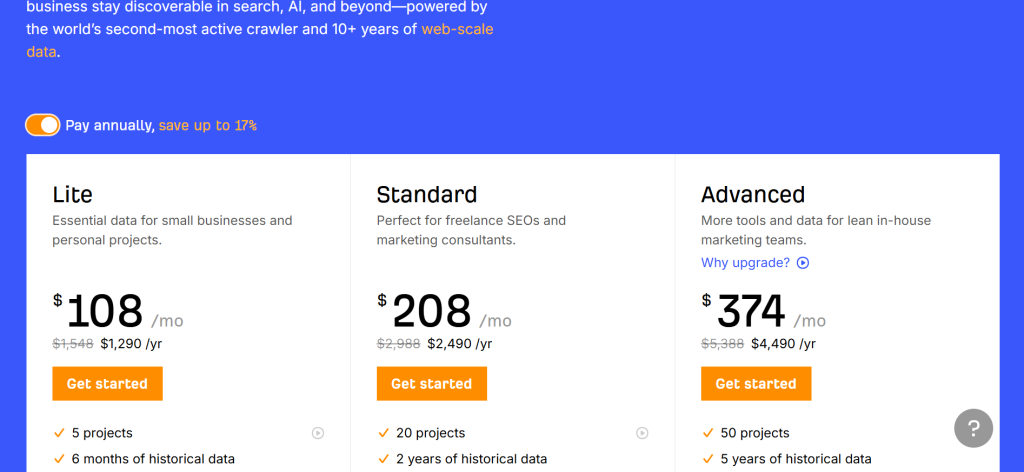
| Pricing | Lite $108/mo (500 credits, 750 tracked keywords). Standard $208/mo (unlimited credits, 2yr history). Advanced $374/mo (3 users, 5yr history). Free Webmaster Tools (limited Site Explorer + Site Audit) |
| Database Size | 26+ billion keywords. 43 trillion backlinks. Data across 200+ countries |
| AI Capabilities | AI-powered keyword suggestions, keyword translation across languages, SERP analysis with backlink correlation, Traffic Potential metric estimates actual clicks, Parent Topic feature groups keyword variations |
| Key Strengths | Click metrics reveal actual traffic potential (not just search volume), most accurate keyword difficulty based on backlink correlation, Parent Topic simplifies content planning by grouping variations, strongest backlink database (43T links) shows why pages rank, SERP overview with detailed metrics for every ranking page |
| Key Weaknesses | No intent classification (Semrush advantage), credit-based system on Lite makes heavy research expensive, complicated new pricing drew user criticism, no free trial (Webmaster Tools only), smaller keyword database than Semrush |
| Integrations | Google Search Console, Ahrefs Webmaster Tools, API (Advanced+), Looker Studio (Advanced+) |
| Best Pairing | Ahrefs for research + backlink analysis, Google Search Console for validation, Surfer SEO for content optimization |
Ahrefs Keywords Explorer differentiates from Semrush on one critical metric: click data. Many keywords have high search volume but generate minimal clicks because featured snippets, knowledge panels, or AI Overviews answer the query directly on the results page. Ahrefs reveals the estimated clicks a keyword generates alongside its search volume, and the Traffic Potential metric estimates the total traffic a page ranking for that keyword could receive from all related keywords it would rank for simultaneously. This distinction matters enormously for content strategy: a keyword with 10,000 monthly searches and 3,000 clicks is worth less than a keyword with 5,000 searches and 4,500 clicks.
Keyword difficulty in Ahrefs is calibrated specifically on backlink data, making it the most practical difficulty metric for link-dependent SEO strategies. The score estimates how many referring domains you would need to rank in the top 10 for each keyword, giving you a concrete link-building target rather than an abstract difficulty number. The Parent Topic feature groups keyword variations under their broadest relevant term, showing that ranking for one piece of comprehensive content could capture traffic from dozens of related long-tail keywords rather than requiring separate pages for each variation.
The SERP overview for any keyword shows every ranking page with its domain rating, URL rating, estimated traffic, number of backlinks, referring domains, and word count. This level of competitive analysis lets you evaluate exactly what you need to produce and promote to compete for any keyword. Combined with Ahrefs’ 43 trillion link backlink database, the largest in the industry, you can analyze the precise link profiles of competing pages and develop targeted link-building strategies.
Where Ahrefs Falls Short
Ahrefs lacks intent classification. Semrush classifies every keyword as informational, commercial, transactional, or navigational. Ahrefs provides no equivalent, leaving users to infer intent from the keyword itself and SERP composition. The Lite plan’s credit system limits heavy research sessions: 500 monthly credits means power users need the $249 Standard plan for unlimited access. Ahrefs introduced a complex new pricing structure that drew significant criticism from long-term users who saw effective costs increase substantially. There is no free trial; the free Webmaster Tools provide limited Site Explorer and Site Audit but no Keywords Explorer access.
The Verdict on Ahrefs
Ahrefs is the best keyword research tool for SEOs whose strategies depend on backlinks and competitive analysis. The click data, backlink-calibrated difficulty scores, and Parent Topic feature make it exceptionally practical for planning content that will actually drive traffic. If understanding why pages rank and what link-building effort is required matters more to your workflow than intent classification, Ahrefs provides the most actionable competitive intelligence.
3. Mangools KWFinder — Best for Finding Low-Competition Keywords Affordably
| Best For | Bloggers, small businesses, and beginner SEOs who need to identify achievable keyword opportunities without the complexity or cost of enterprise tools |
| Pricing | €29/mo (~$31) Entry. €44/mo (~$47) Basic. €80/mo (~$85) Premium. 35% discount on annual plans. 48-hour refund policy. Limited free plan available |
| Database Size | Millions of keywords. Smaller than Semrush/Ahrefs but sufficient for most small-to-medium site research |
| AI Capabilities | Keyword difficulty score calibrated for achievability, SERP analysis with authority metrics (DA, PA, CF, TF), historical search volume trends, related keywords and autocomplete suggestions |
| Key Strengths | Best tool for identifying low-competition keywords you can actually rank for, clean and focused interface beginners understand immediately, affordable pricing starting at ~$31/mo, includes 4 additional tools (SERPChecker, SERPWatcher, LinkMiner, SiteProfiler), historical keyword trend data reveals rising and declining terms |
| Key Weaknesses | Smaller database limits results for very niche or local queries, keyword difficulty may underestimate competition in some verticals, daily search limits on Entry plan (100 keyword lookups/day), no intent classification, lacks competitive gap analysis features |
| Integrations | Google Search Console integration, data export to CSV/Excel |
| Best Pairing | KWFinder for keyword discovery + Google Search Console for performance tracking + Surfer SEO for content optimization |
Mangools KWFinder solves the problem that enterprise tools create for smaller sites: finding keywords they can actually rank for. Semrush and Ahrefs generate massive keyword lists, but the majority of suggestions carry difficulty scores that small sites with limited authority cannot realistically compete for. KWFinder’s difficulty scoring is calibrated specifically to identify achievable opportunities, and the interface highlights low-competition keywords with clear visual indicators that make filtering intuitive even for users who are new to SEO.
The SERP analysis for each keyword shows the top-ranking pages with their Domain Authority, Page Authority, Citation Flow, Trust Flow, backlinks, social shares, and estimated visits. This multi-metric view gives beginners a practical education in what it takes to rank for each keyword they are considering. Historical search volume data reveals whether a keyword’s volume is trending upward, stable, or declining, helping you avoid investing in terms that are losing search interest.
At approximately $31 per month for the Entry plan, KWFinder delivers remarkable value by including four additional tools in the Mangools suite: SERPChecker for detailed SERP analysis, SERPWatcher for rank tracking, LinkMiner for backlink analysis, and SiteProfiler for domain-level SEO metrics. For bloggers and small businesses that need keyword research, rank tracking, and basic competitive analysis in one affordable subscription, the Mangools suite covers all essential needs.
Where Mangools KWFinder Falls Short
The smaller database means KWFinder generates fewer keyword suggestions than Semrush or Ahrefs, particularly for very niche queries, local terms, or non-English markets. There is no intent classification, no competitive gap analysis, and no AI search visibility tracking. The Entry plan limits you to 100 keyword lookups per day, which constrains intensive research sessions. For enterprise-scale keyword research covering hundreds of topic areas, KWFinder lacks the depth and volume that Semrush and Ahrefs provide.
4. SE Ranking — Best Value All-in-One Keyword Research Platform
| Best For | Agencies and growing businesses that need a comprehensive SEO platform with keyword research, rank tracking, site audits, and reporting at a lower price point than Semrush or Ahrefs |
| Pricing | Essential $65/mo. Pro $119/mo. Business $259/mo. 14-day free trial. White-label reporting on Pro+. Annual billing available |
| Database Size | 7+ billion keywords across all countries. Smaller than Semrush (27B) or Ahrefs (26B) but larger than most mid-tier tools |
| AI Capabilities | AI-powered content editor, keyword research with search volume, difficulty, CPC, and competition data, competitive research, on-page SEO checker, keyword grouping and clustering |
| Key Strengths | Best price-to-feature ratio of any all-in-one SEO platform, 7B+ keyword database is substantial for mid-tier pricing, built-in user seats on higher plans (Semrush charges per seat), white-label reporting for agencies, flexible pricing scales with tracked keywords |
| Key Weaknesses | Database smaller than Semrush and Ahrefs for niche queries, less established brand recognition than market leaders, keyword difficulty less tested than Ahrefs’ backlink-calibrated metric, fewer third-party integrations, AI search features less mature than Semrush |
| Integrations | Google Search Console, Google Analytics, Looker Studio, API access, WordPress |
| Best Pairing | SE Ranking for research + rank tracking, Google Search Console for validation |
SE Ranking occupies the sweet spot between enterprise platforms and budget tools. At $65 per month for the Essential plan, it costs less than half of Semrush’s entry price while providing a comprehensive SEO toolkit that includes keyword research, rank tracking, site audits, backlink monitoring, competitive analysis, and an AI-powered content editor. For agencies managing multiple client sites, the built-in user seats on higher-tier plans represent significant savings compared to Semrush, where each additional seat is a separate charge.
The keyword research module provides search volume, keyword difficulty, CPC, and competitive density data across a 7-billion-plus keyword database spanning all countries. While this database is smaller than Semrush or Ahrefs, it covers the vast majority of queries that small-to-medium businesses and agencies research. The keyword grouping feature clusters related terms together for content planning, and the competitive research module reveals which keywords competitor domains rank for.
The white-label reporting capability on Pro and Business plans makes SE Ranking particularly attractive for agencies that need to generate branded reports for clients. The flexible pricing model scales based on the number of tracked keywords and rank checking frequency, allowing businesses to pay only for the monitoring capacity they actually need rather than the one-size-fits-all pricing that Semrush and Ahrefs impose.
Where SE Ranking Falls Short
The 7-billion-keyword database, while substantial, produces fewer suggestions than Semrush or Ahrefs for niche industries and long-tail queries. Keyword difficulty scoring lacks the backlink calibration that makes Ahrefs’ metric uniquely practical, and there is no intent classification comparable to Semrush’s. AI search visibility features are less mature than Semrush’s dedicated AI Visibility Toolkit. Brand recognition matters for agency pitches: telling a potential client you use Semrush carries more weight than SE Ranking, even if the data quality difference is smaller than the price difference suggests.
5. Google Keyword Planner — Best Free Keyword Research Tool (Straight from Google)
| Best For | Anyone who needs free keyword ideas and search volume data directly from Google’s own search index, and PPC advertisers who need CPC and competition data |
| Pricing | Completely free. Requires a Google Ads account (no active campaigns needed) |
| Database Size | Google’s own search index. The only tool powered by first-party Google data |
| AI Capabilities | Keyword suggestions based on Google’s search patterns, search volume ranges (exact numbers with active campaigns), CPC estimates, competition levels, seasonal trend data, geographic targeting |
| Key Strengths | Completely free with no subscription, data comes directly from Google (first-party accuracy), CPC and competition data critical for PPC planning, keyword suggestions reflect actual Google search behavior, geographic targeting down to city level, integrates directly into Google Ads campaigns |
| Key Weaknesses | Search volume shown as ranges (1K–10K) not exact numbers without active ad spend, no keyword difficulty score for organic SEO, no click data or SERP analysis, designed for advertisers not SEO practitioners, no competitive gap analysis or backlink data, lacks intent classification |
| Integrations | Google Ads (native), Google Analytics. No third-party SEO tool integrations |
| Best Pairing | Google Keyword Planner for free CPC/volume data + Mangools or LowFruits for KD and SERP analysis |
Google Keyword Planner remains the only keyword research tool powered by Google’s own first-party search data. Every other tool in this guide estimates search volume using clickstream data, panel data, or proprietary algorithms. Google Keyword Planner provides data from the actual source: Google’s search index. This makes it the most reliable tool for understanding whether a keyword has genuine search demand, even if the precision of that data is limited to ranges for users without active ad campaigns.
For PPC practitioners, Google Keyword Planner provides data that no competitor can match: actual CPC estimates, competition levels based on advertiser bidding activity, and bid range forecasts. These metrics come from Google’s own advertising platform and reflect real market pricing, not the estimates that Semrush, Ahrefs, and other tools calculate from external observation. If you run Google Ads campaigns, Keyword Planner is not optional; it is the authoritative source for planning ad spend.
The geographic targeting capability drills down to city and zip code level, making Keyword Planner valuable for local businesses that need to understand search behavior in their specific service area. Most third-party tools provide country or state-level data at best. For a local plumber in a mid-sized city, knowing the actual search volume for plumbing-related queries in their metro area is more useful than national search volume estimates.
Where Google Keyword Planner Falls Short
Search volume is displayed as ranges (100–1K, 1K–10K) rather than specific numbers unless you are actively spending on Google Ads campaigns. There is no keyword difficulty score for organic SEO, meaning you cannot assess whether a keyword is achievable for your site without using a separate tool. No click data, no SERP analysis, no competitive gap analysis, and no backlink data. The interface was designed for advertisers creating campaigns, not SEO professionals planning content strategy. Google Keyword Planner is best used as a starting point for free volume and CPC data, supplemented by a paid tool for difficulty, intent, and competitive analysis.
6. LowFruits — Best for Finding Quick-Win Keyword Opportunities
| Best For | SEO professionals and content marketers who need to identify keywords where weak competitors currently rank, creating opportunities for faster ranking success |
| Pricing | Standard $29/mo (3,000 credits). Plus $67/mo (10,000 credits). Pro $99/mo (unlimited monthly credits). Pay-as-you-go credits available. 14-day money-back guarantee |
| Database Size | SERP analysis-based rather than traditional database. Analyzes live search results to identify weak spots |
| AI Capabilities | SERP weakness analysis identifies keywords where forums, thin content, and outdated pages currently rank, visual weak-spot indicators for each keyword, competitor ranking extraction, keyword clustering, domain explorer for finding low-competition domains |
| Key Strengths | Unique SERP weakness analysis identifies genuinely achievable keywords by analyzing actual ranking pages, visual indicators show exactly how many weak results appear for each keyword, competitor keyword extraction reveals targets from competitor sitemaps, boosted keyword finder generates 5x more ideas, recently acquired by AIOSEO, adding WordPress integration |
| Key Weaknesses | Credit system means costs can be unpredictable for heavy researchers, not a traditional keyword database (no search volume natively), smaller keyword suggestion volume than Semrush or Ahrefs, requires understanding what constitutes a weak SERP result, does not replace a comprehensive SEO platform |
| Integrations | WordPress via AIOSEO integration, data export to CSV |
| Best Pairing | LowFruits for opportunity identification + Semrush or Ahrefs for volume/difficulty data + Surfer SEO for content optimization |
LowFruits approaches keyword research from a fundamentally different angle than volume-and-difficulty tools. Instead of asking “how many people search for this term?” LowFruits asks “can I actually rank for this term?” It analyzes the live search results for each keyword and identifies terms where weak competitors, such as forums, Reddit threads, thin content, outdated pages, and low-authority sites, currently rank. These weak spots represent genuine opportunities where quality content can achieve ranking faster than traditional difficulty metrics suggest.
The visual weak-spot indicators are what make LowFruits immediately actionable. Each keyword in your results shows icons indicating the number of weak results in the current top 10. A keyword with five or more weak results is a strong candidate for quick ranking success, regardless of what a traditional KD score says. This SERP-level analysis catches opportunities that pure difficulty scores miss because difficulty scores average the strength of ranking pages rather than identifying individual weak positions you could replace.
The competitor ranking extraction feature pulls the top-ranking keywords of competitor domains and their sitemaps, then analyzes the SERP weakness for each. This combination of competitive intelligence and achievability analysis is uniquely powerful for building content calendars filled with keywords that have both strategic value and realistic ranking probability. Following its acquisition by AIOSEO, LowFruits is integrating with WordPress, making the workflow from keyword discovery to content publishing more seamless.
Where LowFruits Falls Short
LowFruits does not replace a comprehensive keyword research platform. It does not provide native search volume data (you need to cross-reference with Google Keyword Planner or another tool), and the keyword suggestion volume is smaller than database-driven tools. The credit system means heavy research sessions can consume credits faster than expected, and monthly credits do not roll over. Understanding what constitutes a “weak” SERP result requires SEO experience that beginners may lack. LowFruits is best used as a supplementary tool for opportunity identification alongside a primary research platform.
7. SpyFu — Best for Competitor Keyword and PPC Intelligence
| Best For | Digital marketers and agencies that need deep competitive intelligence on competitors’ SEO keywords, PPC campaigns, ad copy, and historical search marketing strategies |
| Pricing | Basic $39/mo. Professional $79/mo. Team $299/mo. 30-day money-back guarantee. Unlimited searches on all plans |
| Database Size | Competitor-focused database with 19+ years of historical SEO and PPC data across 100M+ domains |
| AI Capabilities | SpyFu Kombat (3-way domain keyword comparison), competitor keyword gap analysis, historical ranking and ad data spanning 19+ years, PPC bid history, ad copy analysis, SEO keyword grouping |
| Key Strengths | Deepest historical competitor data (19+ years of SEO and PPC history), SpyFu Kombat identifies shared and unique keywords across 3 domains, PPC bid history and ad copy analysis unavailable in most SEO tools, unlimited searches on all plans, most affordable competitor intelligence tool ($39/mo) |
| Key Weaknesses | Keyword database less comprehensive for general research than Semrush/Ahrefs, US-focused (limited international data), difficulty scores less reliable than Ahrefs, interface can feel dated and overwhelming for beginners, data accuracy varies for low-volume niches |
| Integrations | API access, custom PDF reporting, Google Ads integration, data export |
| Best Pairing | SpyFu for competitor analysis + Semrush or Ahrefs for primary keyword research + Google Ads for PPC execution |
SpyFu’s defining advantage is depth of competitive intelligence. Enter any domain and SpyFu reveals every keyword that domain has ranked for organically, every keyword it has bid on in Google Ads, its historical ranking positions, its ad copy variations, and its estimated advertising budget, all spanning over 19 years of historical data. No other tool provides this depth of competitive history. For agencies preparing competitive analyses or businesses trying to understand what strategies their competitors have tested and abandoned over the years, SpyFu’s historical data is irreplaceable.
SpyFu Kombat, the three-way domain comparison tool, is the most intuitive competitive gap analysis available. Enter your domain and two competitors, and Kombat visualizes which keywords all three domains share, which keywords are shared between only two domains, and which keywords are unique to each domain. The keywords your competitors share but you do not rank for represent your highest-priority content gaps. The keywords unique to a single competitor reveal their differentiated strategy.
At $39 per month with unlimited searches on all plans, SpyFu delivers the most affordable comprehensive competitive intelligence. The Professional plan at $79 per month adds API access, branded reporting, and unlimited data exports. For agencies that specialize in competitive analysis and PPC strategy development, SpyFu costs a fraction of Semrush while providing deeper historical PPC data.
Where SpyFu Falls Short
SpyFu’s keyword database is less comprehensive for general keyword discovery than Semrush or Ahrefs. It is primarily a competitive intelligence tool, not a primary keyword research platform. International data is limited compared to Semrush’s 142 country databases. Keyword difficulty scores are less reliable than Ahrefs’ backlink-calibrated metrics. The interface can feel dated and overwhelming, particularly for users new to competitive analysis. Data accuracy for low-volume niche keywords is less consistent than enterprise platforms.
8. AnswerThePublic — Best for Question-Based Keyword Discovery
| Best For | Content creators, bloggers, and marketers discovering the actual questions audiences ask, enabling content that directly matches search intent and fuels FAQ sections |
| Pricing | Individual $5/mo (100 searches/day). Pro $49/mo (unlimited). Team $149/mo (unlimited + sharing). Free tier: 3 searches per day. Now owned by NP Digital/Ubersuggest |
| Database Size | Question and preposition data mined from Google Autocomplete and related searches. Not a traditional volume-based database |
| AI Capabilities | Question mapping (who/what/where/when/why/how), preposition-based keyword discovery, comparison keywords, alphabetical keyword expansion, visual mind-map organization |
| Key Strengths | Reveals the actual questions people ask around any topic (unique data set), visual mind-maps organize results by question type for intuitive scanning, excellent for FAQ creation, blog topic ideation, and voice search optimization, most affordable premium tier ($5/mo), uncovers long-tail keywords traditional tools miss |
| Key Weaknesses | Does not provide search volume or keyword difficulty metrics natively, limited to 3 free searches per day, data must be cross-referenced with volume/difficulty tools, not suitable as a standalone keyword research platform, results can include irrelevant or low-value questions |
| Integrations | Ubersuggest integration (same ownership), data export to CSV, visual export |
| Best Pairing | AnswerThePublic for question discovery + Semrush/Ahrefs for volume + difficulty + Surfer SEO for content optimization |
AnswerThePublic occupies a unique niche in keyword research: it reveals the questions real people type into search engines. Enter a seed keyword and it generates hundreds of questions organized by type (who, what, where, when, why, how), prepositions (for, with, without, near, versus), comparisons, and alphabetical expansions. This question-based data set is different from what volume-driven tools provide and is particularly valuable for creating content that directly answers search intent.
The visual mind-map organization makes AnswerThePublic the most intuitive content ideation tool available. Scan the question map for a topic and you immediately see the gaps in your existing content, the subtopics your audience cares about, and the specific angles that will differentiate your content from competitors who are covering the same broad topic. For FAQ sections, knowledge base articles, and voice search optimization, the question-based data is directly actionable without further transformation.
At $5 per month for the Individual plan, AnswerThePublic is the most affordable premium keyword tool in this guide. The free tier provides three searches per day, which is sufficient for occasional content ideation. Now owned by NP Digital alongside Ubersuggest, AnswerThePublic benefits from integration with Ubersuggest’s search volume and difficulty data, partially addressing the limitation of lacking native volume metrics.
Where AnswerThePublic Falls Short
AnswerThePublic does not provide search volume, keyword difficulty, or any traditional SEO metrics natively. Every question it surfaces needs to be cross-referenced with a tool like Semrush, Ahrefs, or Google Keyword Planner to determine whether it has sufficient search demand and achievable competition. The free tier’s three daily searches are insufficient for regular research. Results often include irrelevant or extremely low-value questions that require manual filtering. AnswerThePublic is a content ideation supplement, not a standalone keyword research platform.
9. Ubersuggest — Best Budget All-in-One SEO Tool
| Best For | Small business owners and solo entrepreneurs who need basic keyword research, rank tracking, and site audits in one affordable platform without the complexity of enterprise tools |
| Pricing | Individual $29/mo. Business $49/mo. Enterprise $99/mo. Lifetime plans available ($290–$990 one-time). Free: limited daily searches |
| Database Size | Millions of keywords. Smaller than Semrush/Ahrefs but covers common queries across major markets |
| AI Capabilities | Keyword suggestions with volume, difficulty, CPC, and seasonal trends, competitive domain analysis, content ideas based on social shares and backlinks, site audit, rank tracking, AI writing assistant |
| Key Strengths | Lifetime plan option eliminates recurring costs ($290+ one-time), simplest interface for SEO beginners, includes rank tracking and site audits alongside keyword research, content ideas feature shows top-performing content by social shares, free Chrome extension for quick keyword data |
| Key Weaknesses | Keyword database smaller and less accurate than enterprise tools, difficulty scores frequently questioned for reliability, limited daily searches on free and lower plans, data lags behind Semrush/Ahrefs in freshness, Neil Patel branding can overshadow product substance |
| Integrations | Chrome extension, Google Search Console, data export |
| Best Pairing | Ubersuggest for basic research + Google Keyword Planner for volume validation + Google Search Console for tracking |
Ubersuggest’s appeal is simplicity and affordability. At $29 per month for the Individual plan, it provides keyword suggestions, search volume, keyword difficulty, CPC data, content ideas based on top-performing competitor content, basic site audits, and rank tracking. For small business owners who need one tool that handles the fundamentals without the complexity of Semrush or Ahrefs, Ubersuggest delivers adequate data in the most beginner-friendly interface of any paid keyword tool.
The lifetime plan option is unique among major keyword research tools. A one-time payment of $290 for Individual or $490 for Business eliminates the recurring subscription costs that make enterprise tools expensive over time. For budget-conscious businesses that plan to use keyword research for years, the lifetime plan represents significantly lower total cost of ownership than any subscription tool.
The content ideas feature analyzes top-performing content for any keyword based on social shares, estimated traffic, and backlink counts, showing you which content formats and angles are generating the most engagement in your space. This bridges the gap between keyword research and content strategy in a way that simpler keyword tools do not attempt.
Where Ubersuggest Falls Short
Ubersuggest’s keyword database is smaller and less accurate than Semrush or Ahrefs, particularly for long-tail and niche queries. Keyword difficulty scores are frequently questioned for reliability in SEO communities, with many practitioners noting that Ubersuggest’s easy ratings often correspond to keywords that are quite difficult in practice. Data freshness lags behind enterprise tools. The daily search limits on free and lower plans constrain intensive research sessions. Professional SEOs generally outgrow Ubersuggest quickly and migrate to Semrush, Ahrefs, or SE Ranking.
10. Moz Keyword Explorer — Best for Priority Scoring and Domain Authority Context
| Best For | SEO professionals who value Moz’s Domain Authority metric and want keyword suggestions with built-in priority scoring that balances volume, difficulty, and organic CTR |
| Pricing | Starter $49/mo. Standard $99/mo. Medium $179/mo. Large $299/mo. Free: 10 keyword queries/mo with Moz account |
| Database Size | Large keyword database. Moz Link Explorer indexes billions of links |
| AI Capabilities | Priority Score combines volume, difficulty, and organic CTR into a single actionable metric, Keyword Suggestions with volume, difficulty, and organic CTR, SERP analysis, Domain Authority and Page Authority metrics, keyword lists for organizing research |
| Key Strengths | Priority Score simplifies keyword selection by combining multiple metrics, Domain Authority (DA) is widely recognized in the SEO industry, organic CTR metric estimates how much traffic the organic results capture, 10 free queries per month without payment, keyword lists help organize research across projects |
| Key Weaknesses | Database smaller than Semrush and Ahrefs, fewer keyword suggestions per seed term, DA has been criticized as gameable and less predictive than actual ranking factors, starter plan limits significantly restrict usage, interface feels less modern than competitors |
| Integrations | Moz Pro suite (Link Explorer, Site Audit, Rank Tracking), STAT (enterprise rank tracking), API access on Standard+ |
| Best Pairing | Moz for keyword research + DA analysis, Google Search Console for validation, Surfer SEO for content optimization |
Moz Keyword Explorer’s differentiating feature is the Priority Score: a single metric that combines search volume, keyword difficulty, and organic click-through rate into an actionable number that tells you which keywords offer the best combination of traffic potential and achievability. Rather than manually balancing volume against difficulty, you can sort by Priority Score to quickly identify the sweet spot where search demand, competitive achievability, and click-through probability all align.
The organic CTR metric estimates what percentage of clicks for each keyword go to organic results versus ads, featured snippets, and zero-click results. This addresses the same problem as Ahrefs’ click data but through a different methodology. Keywords with high volume but low organic CTR may not be worth targeting for SEO if the majority of clicks go to paid ads or are satisfied by SERP features.
Moz’s Domain Authority (DA) remains one of the most widely recognized authority metrics in the SEO industry. While DA has its critics, it provides a useful comparative benchmark for evaluating the competitive landscape for any keyword. The SERP analysis shows DA and Page Authority for every ranking result, giving you a quick visual assessment of whether your domain’s authority is competitive for each keyword.
Where Moz Falls Short
Moz’s keyword database generates fewer suggestions per seed keyword than Semrush or Ahrefs, limiting discovery of long-tail opportunities. Domain Authority has been criticized for being gameable through certain link-building tactics and less predictive of actual ranking ability than page-level metrics. The Starter plan at $49 per month provides limited usage compared to what Mangools or SE Ranking offer at similar or lower prices. The interface feels less modern and responsive than Semrush or Ahrefs, and Moz has lost market share as competitors have innovated faster.
11. Google Trends — Best Free Tool for Seasonal and Trending Keyword Data
| Best For | Content strategists and marketers who need to identify seasonal patterns, rising search trends, and geographic interest variations to time content publication for maximum impact |
| Pricing | Completely free. No account required |
| Database Size | Google’s own search data. Historical data back to 2004 |
| AI Capabilities | Relative search interest over time, geographic interest by region/state/city, related topics and rising queries, real-time trending searches, comparison of up to 5 terms simultaneously, category filtering |
| Key Strengths | Completely free with no limitations, historical trend data going back to 2004, geographic interest comparison shows regional keyword popularity, real-time trending search identification, comparison of up to 5 keywords simultaneously reveals relative interest, predicts seasonal patterns months in advance |
| Key Weaknesses | Shows relative interest (0–100 scale) not absolute search volume, not a keyword suggestion tool (you must know what to search for), no difficulty scores, no SERP analysis, no competitive data, must be combined with other tools for complete keyword research |
| Integrations | Google News, YouTube Trends, Google Shopping Trends, data export to CSV |
| Best Pairing | Google Trends for timing/seasonality + Semrush/Ahrefs for volume + difficulty + content calendar tools for scheduling |
Google Trends answers a question that no other keyword research tool addresses well: when should you publish content for each keyword? The historical trend data, extending back to 2004, reveals the seasonal patterns, growth trajectories, and decline curves for any search term. A keyword might have strong annual volume, but if 80 percent of that volume concentrates in three months, publishing your content two months before the seasonal peak gives you time to earn rankings before demand surges.
The geographic interest comparison drills down to state, metro, and city level, revealing where specific keywords are most popular. For businesses with regional focus or those creating location-targeted content, this geographic data is uniquely valuable and unavailable in most paid keyword tools at this level of granularity. Comparing up to five keywords simultaneously on the same chart reveals which terms are gaining or losing interest relative to each other, helping you identify rising alternatives to declining keywords.
Real-time trending searches surface emerging topics before they appear in traditional keyword databases, giving content creators a first-mover advantage. Google Trends is most powerful when used alongside a volume-and-difficulty tool: identify seasonal timing and trending topics with Google Trends, then validate volume and assess difficulty with Semrush, Ahrefs, or Google Keyword Planner.
Where Google Trends Falls Short
Google Trends shows relative interest on a 0-to-100 scale, not absolute search volume. A score of 100 means peak popularity for that term relative to its own history, but it does not tell you whether that peak represents 1,000 searches or 1,000,000 searches. It does not suggest new keywords, provide difficulty scores, analyze SERPs, or offer any competitive intelligence. Google Trends is a timing and trend tool, not a keyword research tool. It must be paired with volume and difficulty data from other sources to be actionable for content strategy.
12. KeySearch — Best Budget Keyword Research Tool for Beginners
| Best For | Beginner bloggers and small website owners who need affordable keyword research with essential metrics and cannot justify $65+ per month for an all-in-one platform |
| Pricing | $24/mo (Starter). $48/mo (Pro, includes AI content editor and Foresight). 7-day free trial. Annual billing available ($240/yr Starter) |
| Database Size | Millions of keywords. Adequate for blog-level keyword research across major English-speaking markets |
| AI Capabilities | Keyword research with volume, difficulty, and CPC, SERP analysis, competitor analysis, rank tracker (200 keywords on Pro), AI content editor (Pro plan), Foresight competitive research tool (Pro plan), keyword difficulty based on SERP authority metrics |
| Key Strengths | Most affordable full-featured keyword tool at $24/mo, difficulty scoring accurate enough for beginner-to-intermediate needs, Pro plan includes AI content editor and rank tracker, 7-day free trial to evaluate before committing, comprehensive features relative to price point |
| Key Weaknesses | Database lacks depth of enterprise tools for niche and international queries, user interface less polished than competitors, limited to major English-speaking markets primarily, Starter plan lacks rank tracking and AI features, less recognized brand than Mangools or Ubersuggest |
| Integrations | Data export to CSV, Chrome extension for quick lookups |
| Best Pairing | KeySearch for primary research + Google Keyword Planner for volume validation + Google Search Console for tracking |
KeySearch is the entry-level keyword research tool for bloggers and small website owners who need more data than free tools provide but cannot justify the $65-plus per month that most comprehensive platforms charge. At $24 per month for the Starter plan, KeySearch provides keyword suggestions with search volume, keyword difficulty, CPC data, SERP analysis showing authority metrics for ranking pages, and basic competitor analysis. For bloggers publishing a few posts per month who need to validate keyword targets, this feature set is sufficient.
The Pro plan at $48 per month adds meaningful capabilities: an AI content editor for optimization, the Foresight competitive research tool, rank tracking for up to 200 keywords, and 15,000 AI credits. The difficulty scoring is based on SERP authority metrics and is accurate enough for beginner-to-intermediate keyword targeting, particularly for bloggers targeting low-to-medium competition terms.
KeySearch has earned a loyal following among budget-conscious SEOs, with long-term users citing it as the first paid tool they invested in. The 7-day free trial allows evaluation before commitment, and the annual plan reduces costs further. For users who outgrow KeySearch, the natural upgrade path leads to Mangools (for better KD data) or SE Ranking (for a comprehensive all-in-one platform).
Where KeySearch Falls Short
The keyword database lacks the depth required for niche industries, local SEO, and international markets. The user interface is functional but less polished than Mangools, SE Ranking, or enterprise tools. KeySearch is primarily useful for English-speaking markets and lacks the multilingual database coverage of Semrush or Ahrefs. The Starter plan excludes rank tracking and AI features that are included in competitors at similar price points. Brand recognition is limited, which matters less for individual use but more for agencies presenting tools to clients.
Which Keyword Research Tool Should You Choose? A Decision Framework
The right tool depends on your budget, experience level, and the specific aspect of keyword research that drives your results.
If you need the most comprehensive keyword data available: Semrush ($139.95/mo). Largest database, intent classification, Personal KD, AI Visibility tracking. The professional standard.
If backlink strategy drives your SEO and you need click data: Ahrefs ($129/mo). Best difficulty calibration, click metrics, Parent Topic grouping, and the industry’s strongest backlink database.
If you are a beginner or blogger on a budget: Mangools KWFinder (~$31/mo). Best for finding achievable keywords with a clean, focused interface. Includes 4 bonus tools.
If you are an agency that needs the best value all-in-one: SE Ranking ($65/mo). Most features per dollar with built-in user seats, white-label reporting, and 7B+ keyword database.
If you need free keyword data from the source: Google Keyword Planner (free). First-party Google data for volume, CPC, and geographic targeting. Essential for PPC.
If you want to find quick-win ranking opportunities: LowFruits ($29/mo). SERP weakness analysis reveals keywords where weak competitors rank, enabling faster results.
If competitor intelligence is your priority: SpyFu ($39/mo). 19+ years of historical SEO and PPC data. Best competitive gap analysis at the most affordable price.
If you need question-based content ideas: AnswerThePublic ($5/mo). Visual question maps for content ideation, FAQs, and voice search optimization.
If you want the absolute cheapest capable tool: KeySearch ($24/mo). Adequate keyword research for bloggers who need more than free tools but less than enterprise platforms.
If you need seasonal timing and trend data: Google Trends (free). Historical trends since 2004, geographic interest, and real-time trending searches.
Recommended Keyword Research Stacks by Use Case
| Use Case | Primary Tool | Supplement | Validation | Monthly Cost |
| Solo Blogger (Budget) | KeySearch ($24) | Google Trends (free) | Search Console (free) | $24 |
| Blogger (Serious) | Mangools ($31) | AnswerThePublic ($5) | Search Console (free) | $36 |
| Small Biz SEO | SE Ranking ($65) | Google KW Planner (free) | Search Console (free) | $65 |
| Freelance SEO | Semrush Pro ($140) | LowFruits ($29) | Search Console (free) | $169 |
| Agency (5–15 clients) | Semrush Guru ($250) | SpyFu ($39) | Search Console (free) | $289 |
| Enterprise SEO | Semrush Business ($500) | Ahrefs Standard ($249) | Search Console (free) | $749 |
| PPC Specialist | Google KW Planner (free) | SpyFu ($39) | Google Ads (free) | $39 |
| Zero Budget | Google KW Planner (free) | Google Trends (free) | Search Console (free) | $0 |
Keyword Research Capability Comparison Matrix
Not all keyword research tools provide the same types of data. This matrix shows which capabilities each tool offers.
| Tool | Volume | KD Score | Intent | Click Data | SERP Analysis | Gap Analysis | AI Search | PPC Data |
| Semrush | ★★★★★ | ★★★★ | ★★★★★ | ★★★ | ★★★★★ | ★★★★★ | ★★★★★ | ★★★★ |
| Ahrefs | ★★★★★ | ★★★★★ | — | ★★★★★ | ★★★★★ | ★★★★ | ★★★ | ★★★ |
| Mangools | ★★★★ | ★★★★ | — | — | ★★★★ | ★★ | — | ★★ |
| SE Ranking | ★★★★ | ★★★ | ★★★ | — | ★★★★ | ★★★★ | ★★ | ★★★ |
| Google KWP | ★★★ (ranges) | — | — | — | — | — | — | ★★★★★ |
| LowFruits | ★★ (via 3rd party) | ★★★★ (SERP) | — | — | ★★★★★ | ★★★★ | — | — |
| SpyFu | ★★★ | ★★★ | — | — | ★★★ | ★★★★★ | — | ★★★★★ |
| ATP | — | — | ★★★ (question) | — | — | — | — | — |
| Ubersuggest | ★★★ | ★★★ | — | — | ★★★ | ★★★ | — | ★★★ |
| Moz | ★★★★ | ★★★ | — | ★★★ (CTR) | ★★★★ | ★★★ | — | ★★ |
| Google Trends | ★★ (relative) | — | — | — | — | — | — | — |
| KeySearch | ★★★ | ★★★ | — | — | ★★★ | ★★ | — | ★★ |
True Annual Cost: Keyword Research Tool Comparison
Monthly prices tell part of the story. This table reveals the true annual cost including the most common add-ons and limitations.
| Tool | Monthly Price | Annual Price | Users Included | Key Limit | Annual Cost / User |
| Semrush Pro | $139.95/mo | $1,679/yr | 1 | 500 KW tracking | $1,679 |
| Semrush Guru | $249.95/mo | $3,000/yr | 1 | 1,500 KW tracking | $3,000 |
| Ahrefs Lite | $129/mo | $1,548/yr | 1 | 500 credits/mo | $1,548 |
| Ahrefs Standard | $249/mo | $2,988/yr | 1 | Unlimited credits | $2,988 |
| SE Ranking Essential | $65/mo | $780/yr | 1 | Flexible KW tracking | $780 |
| Mangools Entry | €29/mo (~$31) | ~$372/yr | 1 | 100 lookups/day | ~$372 |
| SpyFu Basic | $39/mo | $468/yr | 1 | Unlimited searches | $468 |
| LowFruits Standard | $29/mo | $348/yr | 1 | 3,000 credits/mo | $348 |
| KeySearch Starter | $24/mo | $288/yr | 1 | 500 searches/day | $288 |
| Ubersuggest Lifetime | $290 one-time | $290 total | 1 | Limited daily use | $290 (yr 1) |
Frequently Asked Questions
Which keyword research tool is most accurate for search volume?
No keyword research tool provides perfectly accurate search volume because they all estimate based on different data sources. Google Keyword Planner provides the only first-party Google data but shows ranges rather than exact numbers. In our cross-referencing against Google Search Console impression data, Semrush and Ahrefs consistently provided the most reliable relative volume comparisons between keywords, even if absolute numbers varied. For practical keyword research, relative accuracy (knowing which keyword has more volume) matters more than absolute precision, and both Semrush and Ahrefs deliver this reliably.
Do I need a paid keyword research tool, or are free tools sufficient?
Free tools provide a viable starting point. Google Keyword Planner offers volume ranges and CPC data. Google Trends shows seasonality and rising queries. Google Search Console reveals what keywords your site already ranks for. Combined, these three free tools cover basic keyword research needs. Paid tools add keyword difficulty scores, click data, competitive gap analysis, SERP analysis, and filtering capabilities that save significant time and improve targeting accuracy. For anyone investing more than 10 hours per month in content creation, a paid tool at $24 to $65 per month typically delivers ROI through better keyword selection and reduced time spent on manual SERP analysis.
Is Semrush worth the price difference over Ahrefs?
It depends on your priority. Semrush’s advantages are the larger database (27B+ vs 26B+ keywords), intent classification on every keyword, Personal Keyword Difficulty tailored to your domain, and the AI Visibility Toolkit for tracking brand presence in AI search engines. Ahrefs’ advantages are superior click data showing actual traffic potential, more accurate backlink-calibrated difficulty scores, the Parent Topic feature for content planning, and the strongest backlink database in the industry. If intent data and AI search visibility matter to your strategy, Semrush justifies the $10 per month premium. If backlink strategy and click-through analysis are your focus, Ahrefs provides better data for that workflow.
What is the best keyword research tool for finding easy-to-rank keywords?
LowFruits is purpose-built for this. Its SERP weakness analysis identifies keywords where forums, thin content, and low-authority pages currently rank, revealing genuine quick-win opportunities. Mangools KWFinder is the second-best option, with difficulty scoring specifically calibrated to highlight achievable keywords for smaller sites. For a free approach, use Google Keyword Planner to identify keywords, then manually check the SERPs for weak competitors (forums, Quora results, outdated articles with low domain authority). Any of these approaches is more reliable for finding truly easy keywords than filtering by keyword difficulty scores alone, as KD scores average competition rather than identifying specific weaknesses.
How do AI search engines change keyword research strategy?
AI search engines like ChatGPT, Perplexity, and Google AI Overviews change keyword research in three ways. First, zero-click queries increase as AI provides answers directly, meaning search volume alone no longer predicts traffic. Tools with click data (Ahrefs) or organic CTR estimates (Moz) help identify keywords where organic results still capture clicks. Second, being cited by AI systems becomes a new traffic channel. Semrush’s AI Visibility Toolkit tracks whether your brand appears in AI responses. Third, topic authority matters more than individual keyword targeting because AI systems prefer comprehensive, authoritative sources. Keyword research tools that support topic clustering, such as Semrush’s Keyword Strategy Builder, help you build the topical authority that AI systems reward.
How many keyword research tools should I subscribe to?
Most effective SEO workflows use one primary keyword research tool supplemented by one or two free tools. For professional SEOs, Semrush or Ahrefs serves as the primary platform, supplemented by Google Keyword Planner for CPC validation, Google Search Console for performance tracking, and Google Trends for seasonal timing. Adding a specialized tool like LowFruits for opportunity identification or SpyFu for competitive PPC intelligence creates a powerful combination without redundancy. Subscribing to both Semrush and Ahrefs simultaneously is justified only for agencies managing large client portfolios where the complementary data (intent from Semrush, clicks from Ahrefs) provides measurably better recommendations.
Final Words: Database Size Matters Less Than How You Use the Data
The most common mistake in keyword research is treating the tool as the strategy. A $500 per month Semrush subscription does not produce better content than a $31 Mangools plan if both users target the same keywords and produce the same content quality. The tool reveals opportunities. Your strategy, content quality, and execution determine whether those opportunities convert into traffic and revenue. The best keyword researchers in 2026 use tools for data, not for decisions.
The keyword research tool market has matured past the point where database size is the primary differentiator. Semrush and Ahrefs both provide databases large enough that the marginal difference between 27 billion and 26 billion keywords rarely affects practical research outcomes. The real differentiators are workflow fit, data interpretation features, and specialized capabilities. Semrush’s intent classification and AI Visibility tracking matter if those dimensions drive your strategy. Ahrefs’ click data and backlink difficulty matter if link-dependent ranking is your approach. LowFruits’ SERP weakness analysis matters if finding achievable opportunities quickly is your priority.
The stack that works for most professional content marketers: one primary research tool (Semrush Pro at $140 per month for the most comprehensive data, or Mangools at $31 per month for the best value) plus Google Keyword Planner for free CPC validation, Google Search Console for tracking what actually ranks, and Google Trends for timing decisions. Total cost: $31 to $140 per month for a complete keyword research workflow. Start with the most affordable tool that covers your needs, measure the ROI it delivers through better keyword targeting, and upgrade when the data gap between your current tool and a more expensive one is costing you measurable traffic.