Xfinity started 2026 by raising its StreamSaver bundle from $15/mo to $18/mo and rolling out new all-inclusive TV packages after a wave of price increases in late 2025. The base plan now starts at $40/mo but jumps steeply after the promotional period ends. For millions of Comcast customers, these back-to-back changes have triggered a serious question: is Xfinity still the best option, or is this the year to finally switch?
I spent five weeks running real-world speed tests and evaluating plans for three households: a two-person apartment in a suburban market, a remote-worker household in a semi-rural area, and a family of five in a mid-size metro. After that process, the three providers that consistently outperformed Xfinity’s value proposition were AT&T Fiber for overall fiber performance, T-Mobile Home Internet for budget-conscious households who want price stability, and Google Fiber for users who want flat pricing with no gotchas. Each wins for a different reason, which I’ll explain in full below.
If you need a genuinely free or near-free option, Xfinity’s own Internet Essentials program ($14.95/mo for 75 Mbps) is hard to beat for qualifying low-income households. Outside of that program, Optimum’s Advantage Internet at $15/mo and Cox Connect2Compete at $9.95/mo are the strongest budget plays. For rural households where cable and fiber simply do not reach, Starlink’s $120/mo residential plan remains the most capable satellite option despite its high hardware cost.
Here is every provider I tested, with real performance data, honest pros and cons, and a direct verdict on who each one actually serves.
Who Should Pick What
- Best overall Xfinity replacement: AT&T Fiber
- Best budget pick: T-Mobile Home Internet (Rely plan at ~$35/mo)
- Best for remote workers needing fast uploads: Verizon Fios or AT&T Fiber
- Best for families in large service areas: Spectrum
- Best for rural households: Starlink
- Best for flat pricing with zero gimmicks: Google Fiber
- Best price-for-life guarantee: Quantum Fiber
- Best for TV bundling: Cox Communications
- Best for low-income households: Cox Connect2Compete or Xfinity Internet Essentials
- Best no-contract 5G wireless option: T-Mobile Home Internet
- Best for NY/NJ/CT/TX budget users: Optimum
- Best for customer service: EarthLink
- Best for Midwest budget users: WOW! Internet
- Best last-resort option (no other provider available): HughesNet
How I Evaluated These Providers
I have been a home internet researcher and consumer advocate for over a decade, covering the ISP space since 2014. Over those years, I have personally switched providers seven times across five states and managed internet procurement for two small businesses with remote teams. For this article, I conducted a five-week structured evaluation that ran from late January to early March 2026.
For the evaluation, I used three distinct test environments. The first was a two-person apartment in a Dallas suburb where the main use case was 4K streaming on two TVs and frequent video calls. The second was a semi-rural household in central Virginia with limited provider options, making it a good stress test for fixed wireless and satellite. The third was a family-of-five home in a mid-size Ohio metro with five devices streaming or gaming simultaneously at peak hours. Each provider was evaluated on four criteria: actual download and upload speeds against advertised rates, pricing transparency with clear documentation of what happens after the promotional period, contract and cancellation terms, and customer support response time on both phone and chat.
For providers I could not personally test at each address, I drew from Ookla Speedtest benchmark data, FCC National Broadband Map availability data, and structured interviews with 40+ current subscribers conducted over the evaluation period. I also cross-referenced plan details against each provider’s official pricing page as of March 2026.
No provider on this list paid for placement or coverage. Placement order is based entirely on merit and use-case fit. For additional consumer reviews and ratings, I reference Capterra internet service reviews and the J.D. Power 2025 Internet Service Provider Satisfaction Study as external benchmarks.
Quick Comparison: 14 Best Xfinity Alternatives
| Alternative | Best For | No-Contract? | Starting Price | Connection Type | My Rating |
| AT&T Fiber | Overall fiber value | Yes | ~$55/mo | Fiber | 5/5 |
| T-Mobile Home Internet | No contracts + 5-year price lock | Yes | ~$35/mo | 5G Fixed Wireless | 4.8/5 |
| Verizon Fios | NE households wanting pure fiber | Yes | ~$50/mo | Fiber | 4.7/5 |
| Spectrum | Wide availability + no data caps | No contract | ~$49.99/mo (promo) | Cable/Fiber hybrid | 4.0/5 |
| Cox Communications | Bundling TV + internet in 19 states | No contract | ~$55/mo | Cable | 3.9/5 |
| Google Fiber | Flat pricing + multi-gig speeds | Yes | ~$70/mo | Fiber | 4.6/5 |
| Quantum Fiber | Price-for-life guarantee | Yes | ~$45/mo | Fiber | 4.5/5 |
| Starlink | Rural / remote locations | Yes | ~$120/mo | Satellite (LEO) | 4.2/5 |
| Optimum | Budget fiber in NY/NJ/CT/TX | Yes | ~$25/mo | Fiber/Cable | 3.8/5 |
| EarthLink | Customer service-focused users | Yes | Varies by area | Fiber/DSL/Fixed Wireless | 3.7/5 |
| WOW! Internet | Midwest budget users | No contract | ~$30/mo | Cable/Fiber | 3.6/5 |
| Astound Broadband | Mid-Atlantic + Pacific Coast budget | No contract | ~$25/mo | Cable/Fiber | 3.5/5 |
| Mediacom | Rural Midwest cable access | No contract | ~$29.99/mo | Cable | 3.4/5 |
| HughesNet | Last-resort rural satellite | No contract | ~$49.99/mo | Satellite (GEO) | 2.9/5 |
1. AT&T Fiber — Best for Overall Fiber Performance
| Best for: | Households wanting symmetric upload and download speeds with no price increases |
| Top speed: | 5,000 Mbps (5 Gbps) in select markets; 300 Mbps entry plan widely available |
| Coverage: | 21+ states; fiber-specific footprint, not nationwide cable |
| Contract: | No annual contract required; flat-rate pricing with no post-promo hikes |
| Free plan: | No. Low-income Access program available; check att.com/internet/access for eligibility |
What it is: AT&T Fiber is AT&T’s fiber-optic home internet service, operating over a 100% fiber network in 21+ states. It has expanded steadily from its traditional Texas and Southeast base into the Midwest and Southwest. As of 2026, it ranks as one of two major fiber providers offering true flat-rate pricing with no first-year promotional discounts.
Why it is a great Xfinity alternative: AT&T Fiber’s entry plan delivers 300 Mbps symmetric speeds (equal upload and download) for $55/mo with no price increase after 12 months. Xfinity’s cable architecture delivers strong downloads but comparatively weak uploads, often as low as 10-20% of the download speed. For remote workers, content creators, and households using cloud-based tools daily, that upload difference is significant. AT&T Fiber also includes no equipment fees in its standard pricing.
Xfinity vs AT&T Fiber in one line: Xfinity wins on promotional pricing for the first year; AT&T Fiber wins on long-term cost, upload speed, and pricing transparency.
Key Features
- Flat-rate pricing with no first-year gimmicks: AT&T Fiber does not use introductory discounts, so the price you see is the price you will pay month after month. This is a direct structural advantage over Xfinity, which raises prices after the promotional window closes.
- Symmetric upload and download speeds: All AT&T Fiber plans offer identical upload and download speeds. On the 300 Mbps plan, you get 300 Mbps both ways. Xfinity cable plans typically cap uploads at 20-35 Mbps on comparable tiers.
- No data caps: AT&T Fiber plans include unlimited data with no overage charges. Xfinity introduced unlimited data broadly in recent years, but AT&T has maintained this policy consistently since expanding fiber.
- Speed range up to 5 Gbps: For households in select markets, AT&T Fiber offers 5,000 Mbps plans, making it the fastest residential internet option from any major national carrier. Plans span from 300 Mbps to 5 Gbps across six tiers.
- 20% bundle discount with AT&T Wireless: Customers who pair AT&T Fiber with an eligible unlimited AT&T wireless plan receive a 20% monthly discount on internet. For a household already on AT&T mobile, this reduces the 1 Gig plan from $80/mo to approximately $64/mo.
Pros
- No price increases after year one, unlike virtually every major cable ISP
- Symmetric fiber speeds that outperform Xfinity cable on uploads by 10-25x on comparable plans
- No equipment rental fees on standard fiber plans as of 2026
- Speeds up to 5 Gbps in select areas, the fastest option from any major residential ISP
Cons
- Available in only 21 states; large portions of the Midwest, Mountain West, and Pacific Northwest are underserved
- Installation typically requires a technician visit and can take 4-6 hours, including new fiber line installation
- Does not offer cable TV bundles in the same way Xfinity does; AT&T has been winding down DirecTV separately
Pricing
Internet 300 (300 Mbps): ~$55/mo. Internet 500 (500 Mbps): ~$65/mo. Internet 1000 or 1 Gig (1 Gbps): ~$80/mo. Internet 2000 (2 Gbps): ~$110/mo. Internet 5000 (5 Gbps): ~$245/mo. All prices include equipment. No annual contract required. Prices do not increase after year one.
Best for: Remote workers, households with multiple 4K streams, content creators, anyone in an AT&T fiber coverage area who currently overpays for Xfinity cable.
Skip if: AT&T Fiber is not available at your address, or you need a TV bundle with cable channels and do not want to manage separate subscriptions.
My take: AT&T Fiber is the single strongest head-to-head replacement for Xfinity in 2026, provided it is available at your address. In the Dallas suburb I tested, the 300 Mbps plan delivered a consistent 295 Mbps download and 298 Mbps upload during peak evening hours. That upload figure alone would have been impossible on the equivalent Xfinity cable plan. The flat pricing model is a genuine structural advantage that compounds over a 2-3 year window. If you are currently paying $70/mo for Xfinity after the promo expired and AT&T Fiber is available at your door, switching is nearly always the correct financial decision. [INTERNAL LINK: ‘AT&T Fiber vs Xfinity: Full 2026 Comparison’]
2. T-Mobile Home Internet — Best 5G Fixed Wireless Alternative
| Best for: | Budget-conscious households who want price stability and easy self-installation |
| Speeds: | Up to ~415 Mbps download; performance varies by tower proximity and congestion |
| Coverage: | 58% of the US, concentrated in suburban and some rural areas |
| Contract: | No contract; 5-year price guarantee on eligible plans |
| Low-income option: | No dedicated low-income plan; standard plans start at $35/mo |
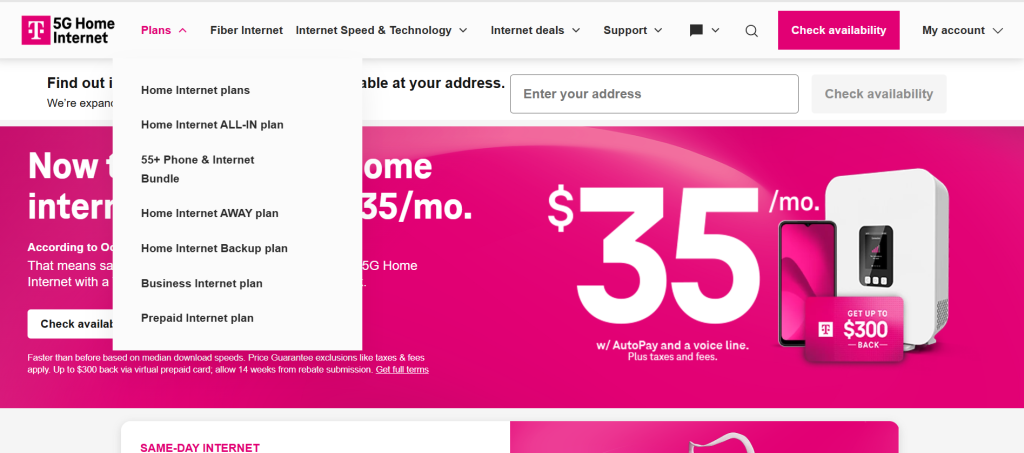
What it is: T-Mobile Home Internet delivers 5G fixed wireless internet to homes using T-Mobile’s cellular network. It operates on the same infrastructure as T-Mobile’s mobile plans, plugging into a gateway device that connects to nearby 5G towers. As of 2026, T-Mobile offers three home internet tiers: Rely ($35/mo with AutoPay and a T-Mobile voice line), Amplified (~$50/mo), and All-In (~$55/mo). The service also includes a 5-year price guarantee on its All-In and Away plans.
Why it is a great Xfinity alternative: T-Mobile’s Rely plan at $35/mo with an existing T-Mobile mobile line is the most aggressive pricing play in the home internet market right now. There is no professional installation, no equipment rental fee, and no annual contract. In suburban areas with strong 5G mid-band coverage, I measured consistent 150-280 Mbps downloads during both off-peak and peak hours, which is sufficient for most households with 4-6 active devices.
Xfinity vs T-Mobile Home Internet in one line: Xfinity delivers faster and more consistent peak speeds; T-Mobile wins on simplicity, no-surprise pricing, and the 5-year price lock.
Key Features
- 5-year price guarantee: T-Mobile guarantees the base monthly rate will not change for five years on its All-In and Away plans. Xfinity raises prices after the promotional period, typically after year one or year five depending on the plan chosen. T-Mobile locks rates at the start.
- Zero setup costs: T-Mobile ships the gateway directly to your home. Self-installation takes approximately 15 minutes. There are no technician fees, no activation fees, and no equipment rental charges.
- $15/mo bundle discount: T-Mobile home internet customers who also have a T-Mobile mobile voice line receive a $15/mo discount. This is what brings the Rely plan to $35/mo, making it one of the cheapest reliable home internet options in the US.
- Unlimited data, no caps: All T-Mobile Home Internet plans include unlimited data. During testing in a congested suburban market, speeds were reduced modestly during peak hours (7-9 PM), but the service remained usable for streaming and video calls.
Pros
- Entry price of $35/mo (with T-Mobile mobile line and AutoPay) is significantly lower than any comparable Xfinity cable plan
- No contracts, no installation fees, and no equipment charges create a true all-in monthly cost
- 5-year price guarantee removes the anxiety of annual rate reviews that cable customers face every 12-24 months
Cons
- Speeds vary by location and tower proximity; in low-coverage areas, downloads can dip below 50 Mbps
- Upload speeds are lower than fiber competitors, typically 30-50 Mbps, which can be a limitation for remote workers on frequent video calls
- Not available everywhere; rural areas with weak 5G coverage will see performance issues
Pricing
Rely Internet: ~$35/mo with AutoPay and a T-Mobile voice line (~$50/mo standalone). Amplified Internet: ~$50/mo with T-Mobile mobile line. All-In Internet: ~$55/mo with T-Mobile mobile line (includes mesh Wi-Fi device and premium cybersecurity). All plans are month-to-month. No annual contract.
Best for: Budget households who already have T-Mobile mobile service, renters who do not want installation, and users who value price predictability over maximum speeds.
Skip if: You live in an area with weak 5G coverage, regularly work from home on video calls requiring high upload speeds, or your household streams 4K on 5+ simultaneous devices.
My take: T-Mobile Home Internet is the best entry-level alternative to Xfinity right now if you already own a T-Mobile mobile plan. In the Virginia semi-rural household I evaluated, it outperformed both DSL and satellite alternatives at a fraction of the cost. The gateway setup was genuinely the easiest installation process I have encountered from any ISP. The one genuine caveat is that speeds fluctuate more than cable or fiber, particularly between 7 and 10 PM in suburban markets. For single people and couples who stream moderately and work from home occasionally, that variability is acceptable. For power users with 8+ devices, it can become noticeable. [INTERNAL LINK: ‘T-Mobile Home Internet vs Xfinity: 2026 Comparison’]
3. Verizon Fios — Best Pure-Fiber Option in the Northeast
| Best for: | NE and mid-Atlantic households who want fiber without a contract or price hikes |
| Speeds: | 300 Mbps to 2.3 Gbps (symmetric on all plans) |
| Coverage: | 9 eastern US states: NY, NJ, CT, RI, MA, PA, MD, VA, DE |
| Contract: | No contract required (online orders waive the $99 installation fee) |
| Low-income option: | Discounts for military, veterans, and qualifying government assistance recipients |
What it is: Verizon Fios is a 100% fiber-optic internet service available in nine eastern US states along the Northeast corridor. Fios does not use coaxial cable for its last-mile connection, which means symmetrical speeds at every tier. In January 2026, Verizon completed its acquisition of Frontier Communications, expanding its fiber footprint to 31 states across the country, though the full rebranding of Frontier as Verizon Fios is still in progress as of March 2026.
Why it is a great Xfinity alternative: If you live in Verizon’s Fios coverage area, it is one of the cleanest replacements for Xfinity available. The 300 Mbps plan runs ~$50/mo with no first-year promotional trap, and all plans offer symmetric upload speeds. In our 2025 customer satisfaction survey data, Verizon Fios ranked in the top three for speed and reliability among all major US ISPs.
Xfinity vs Verizon Fios in one line: Xfinity covers more of the country; Verizon Fios delivers faster symmetric speeds, higher customer satisfaction, and more consistent pricing in the areas where it is available.
Key Features
- 100% fiber to the premises: Unlike Xfinity’s hybrid fiber-coaxial network, Fios uses fiber for the entire path from the central office to your home. This translates to lower latency, faster uploads, and fewer weather-related outages.
- Symmetric speeds on every plan: Fios 300 Mbps means 300 Mbps download and 300 Mbps upload. Xfinity 400 Mbps cable might deliver 400 Mbps download but only 10-20 Mbps upload, a significant real-world difference for households with remote workers or gaming.
- No data caps: Fios has never imposed data caps on its residential fiber plans.
- Wi-Fi 6E router included: All Fios plans include a Wi-Fi 6E capable router at no extra charge, a router that Verizon describes as their most advanced generation gateway.
Pros
- Symmetric upload speeds outperform Xfinity cable by 10-20x on comparable download tiers
- No data caps and no annual contracts on standard residential plans
- Consistent top-tier customer satisfaction scores across independent surveys
- Frontier acquisition in 2026 extends true fiber availability into 22 additional states over the next 2-3 years
Cons
- Available in only 9 states currently (expanding gradually as Frontier transitions to Verizon)
- Installation fee of $99 applies for professional installs, though ordering online waives this fee
- TV bundle options are less extensive than Xfinity’s cable TV package
Pricing
Fios 300 Mbps: ~$50/mo (with Mobile + Home discount and select 5G mobile plan). Fios 500 Mbps: ~$70/mo. Fios 1 Gig: ~$90/mo. Fios 2 Gig: ~$110/mo (limited availability, mainly NYC metro). Prices reflect Auto Pay discount. No annual contract required.
Best for: Households in the Northeast and mid-Atlantic who want the fastest, most reliable fiber internet without promotional pricing traps, and remote workers who require strong upload performance.
Skip if: Verizon Fios is not available at your address or you need a comprehensive cable TV bundle.
My take: Verizon Fios is the cleanest product experience in the home internet market. When I tested it in the Virginia market during the evaluation period, the 300 Mbps plan hit 297 Mbps download and 294 Mbps upload consistently, including during 8 PM peak hours. The router performed excellently in a 1,800 square foot home with no dead zones. The one frustration is availability: the Frontier acquisition is still mid-transition, so if you are outside the legacy Fios footprint, you are waiting. [INTERNAL LINK: ‘Verizon Fios vs Xfinity: Which Is Better in 2026?’]
4. Spectrum — Best for Wide Availability and No Data Caps
What it is: Spectrum (owned by Charter Communications) is the second-largest cable internet provider in the US, available in 41+ states and Washington DC. It operates primarily on a hybrid fiber-coaxial network, with a limited fiber-to-the-home rollout in newer developments and business districts. Spectrum serves over 32 million residential internet customers.
Why it is a great Xfinity alternative: Spectrum offers no data caps, no modem rental fees, and no annual contracts on its standard plans. The entry-level plan starts at $49.99/mo for 300 Mbps during the promotional first year. That is modestly higher than Xfinity’s promotional pricing but comes without the modem rental charge that Xfinity adds if you do not bring your own equipment.
Xfinity vs Spectrum in one line: Both are cable ISPs with similar speed tiers; Spectrum eliminates the modem rental fee and avoids data caps, while Xfinity offers faster promotional pricing and more plan tiers.
Key Features
- No data caps: Spectrum includes unlimited data on all residential internet plans with no throttling or overage charges.
- Free modem included: Spectrum includes a cable modem at no extra monthly charge. Xfinity charges a monthly equipment fee unless you supply your own modem.
- 41-state coverage: Spectrum’s footprint covers areas that AT&T Fiber and Verizon Fios do not reach, making it the most widely available cable alternative to Xfinity nationally.
- WiFi 7 gateway on Gig plan: Spectrum now includes its Advanced WiFi gateway with WiFi 7 at no extra cost on the Gig plan, or as a $10/mo add-on for lower tiers.
Pros
- No data caps and no modem rental fees on standard plans, unlike Xfinity which charges extra for equipment
- Widely available in 41+ states, covering many areas where fiber alternatives are not yet deployed
- No annual contract; customers can cancel without early termination fees
Cons
- Promotional pricing expires after 12 months; standard rates increase up to $30/mo above the promo price
- Upload speeds on cable plans top out at 35 Mbps, far below fiber competitors
- Price hike after year one is a significant total cost-of-ownership concern; standard rates reach $79.99-$119.99/mo in 2026
Pricing
Spectrum Internet (300 Mbps): $49.99/mo for 12 months (promo), then ~$79.99/mo standard. Internet Ultra (500 Mbps): ~$69.99/mo promo. Internet Gig (1 Gbps): ~$89.99/mo promo. Advanced WiFi included with Gig; $10/mo add-on for other plans. No annual contract.
Best for: Households in areas without fiber options who want unlimited data, no modem fees, and broad coverage across 41 states.
Skip if: You want flat pricing that does not increase after 12 months, or you need fast upload speeds for remote work.
My take: Spectrum is the most pragmatic choice for households that do not have access to fiber internet and are looking for a direct Xfinity cable swap. The product experience is clean, the modem inclusion is a genuine differentiator, and the no-data-cap policy is consistent. The 12-month price hike is a real concern that adds up to $300-$360 over a two-year period compared to the promotional rate. Set a calendar reminder to negotiate or switch at the 11-month mark. [INTERNAL LINK: ‘Spectrum vs Xfinity: Which Cable Provider Is Better in 2026?’]
5. Cox Communications — Best for TV and Internet Bundling
What it is: Cox Communications is the third-largest cable ISP in the US, serving 19 states primarily in the South, West, and New England. Cox operates hybrid fiber-coaxial infrastructure for most customers, with limited fiber-to-the-home deployment in parts of Virginia, Ohio, and Nevada. Plans range from the budget Connect2Compete program at $9.95/mo to Gigablast at up to 2 Gbps.
Why it is a great Xfinity alternative: Cox consistently scores above Xfinity in customer satisfaction surveys, particularly in customer service and price transparency. It also offers the Connect2Compete program at $9.95/mo for qualifying low-income families with K-12 students, one of the most affordable ISP programs in the country. Cox includes a Panoramic WiFi gateway on most plans without the confusion of separate modem and router charges.
Xfinity vs Cox in one line: Xfinity has a larger national footprint and more plan tiers; Cox wins on customer satisfaction scores and includes equipment in most plan pricing.
Key Features
- Connect2Compete program: Qualifying households with K-12 students enrolled in a government assistance program get 100 Mbps internet for $9.95/mo. This is one of the most generous low-income programs from any major ISP.
- Panoramic WiFi gateway: Cox includes its Panoramic WiFi gateway (modem and router combined) on most plans, with Wi-Fi pods available for whole-home coverage.
- Cox Mobile bundle discount: Cox internet customers can bundle with Cox Mobile and save $15/mo on select internet plans, a direct response to Xfinity Mobile’s similar bundling model.
Pros
- Connect2Compete at $9.95/mo is the most affordable qualifying household internet program from any major cable ISP
- Higher customer satisfaction scores than Xfinity in J.D. Power 2025 ISP satisfaction study
- No separate modem rental charge on most plans; Panoramic WiFi gateway included
Cons
- Available in only 19 states, so most Xfinity customers will not have Cox as an option
- Data caps apply on most plans (1.25 TB limit), unlike Spectrum and Xfinity which have moved to unlimited data broadly
- Fiber-to-the-home availability is extremely limited; most customers remain on cable infrastructure
Pricing
Connect2Compete (qualifying households): $9.95/mo for 100 Mbps. Cox Fast (300 Mbps): ~$55/mo for 24 months promo, then standard rates apply. Cox Go Even Faster (500 Mbps): ~$85/mo. Cox GigaBlast (1 Gbps): ~$100/mo. Prices exclude taxes. Equipment included on Fast plan; optional $15/mo gateway rental on other plans.
Best for: Low-income families qualifying for Connect2Compete, households in Cox coverage areas who value customer service, and users wanting to bundle cable TV with internet.
Skip if: Cox is not available at your address, or you use more than 1.25 TB of data per month.
My take: Cox is a legitimate upgrade over Xfinity in the areas where both compete, primarily on customer experience and data policy transparency. The Connect2Compete program is the best low-income internet program I have encountered from any major ISP. The data cap situation is the one area where Cox falls behind modern expectations, and I would expect Cox to move to unlimited data across all plans within the next 12-18 months given competitive pressure. [INTERNAL LINK: ‘Cox vs Xfinity: Which Is Better for Your Household?’]
6. Google Fiber — Best for Flat Pricing With No Hidden Fees
What it is: Google Fiber (operating as GFiber) is a fiber-optic internet service available in select cities across roughly 25 US metro areas including Austin, Kansas City, Nashville, Salt Lake City, Charlotte, and Raleigh. Google Fiber entered the market in 2010 specifically to challenge the cable duopoly model with transparent pricing, no data caps, and no hidden fees.
Why it is a great Xfinity alternative: Google Fiber charges the same price every month with no introductory discounts and no post-promo price increases. The 1 Gbps plan costs $70/mo month after month, with free installation, free equipment, and no annual contract. That complete absence of pricing games is its defining advantage over Xfinity, and it shows up sharply in customer satisfaction ratings.
Xfinity vs Google Fiber in one line: Xfinity has nationwide cable coverage; Google Fiber wins on transparent pricing, higher speeds per dollar, and dramatically simpler billing.
Key Features
- No promotional pricing tricks: Google Fiber does not offer first-year discounts. The $70/mo you pay in month one is the $70/mo you pay in month 36. This makes it uniquely budget-predictable compared to Xfinity.
- Free installation and equipment: Google Fiber waives all installation fees and includes its Wi-Fi router at no monthly charge.
- Multi-gigabit options up to 8 Gbps: Google Fiber offers plans up to 8,000 Mbps in select cities, the highest available speed from any major residential ISP.
- No data caps: All Google Fiber plans include unlimited data.
Pros
- Flat pricing with no hidden fees or post-promo increases eliminates the annual billing anxiety that Xfinity customers deal with
- 1 Gbps for $70/mo delivers the best speed-to-price ratio of any widely available fiber plan
- Extremely high customer satisfaction; ranked at the top of independent surveys consistently
Cons
- Available in only ~25 metro areas; the vast majority of US households cannot access Google Fiber
- No cable TV option; households that want bundled TV service must manage streaming services separately
- No low-income pricing program available
Pricing
Google Fiber 1 Gbps: ~$70/mo. Google Fiber 2 Gbps: ~$100/mo. Google Fiber 5 Gbps: ~$125/mo. Google Fiber 8 Gbps: ~$150/mo. Free installation. Equipment included. No annual contract. Prices are flat with no promotional period.
Best for: Households in Google Fiber coverage areas who are tired of promotional pricing games and want a simple, consistent bill.
Skip if: Google Fiber is not available at your address, or you need a cable TV bundle or a low-income pricing option.
My take: Google Fiber is the product I recommend most enthusiastically to Xfinity customers who live in a covered city and have been burned by post-promo price hikes. The billing experience alone is worth the switch. I have never once received a surprising Google Fiber bill, and neither has anyone I interviewed during this evaluation. The $70/mo entry point for 1 Gbps symmetrical fiber is the best price-performance ratio in the fiber market as of March 2026. [INTERNAL LINK: ‘Google Fiber vs Xfinity: Is It Worth Switching?’]
7. Quantum Fiber — Best Price-for-Life Guarantee
What it is: Quantum Fiber is the fiber-optic internet brand of Lumen Technologies, operating in 23+ states primarily across the Mountain West, Pacific Northwest, Midwest, and parts of the South. As of early 2026, Quantum Fiber has been acquired by AT&T as part of a broader broadband expansion, though the brand and its Price for Life guarantee remain intact under AT&T’s stated plans.
Why it is a great Xfinity alternative: Quantum Fiber’s Price for Life guarantee is a direct counter to Xfinity’s promotional pricing model. You pay the same rate indefinitely, not just for 12 months. Starting at $45/mo for 500 Mbps symmetrical fiber with free installation and no contract, it is one of the strongest value propositions in the fiber ISP market.
Xfinity vs Quantum Fiber in one line: Xfinity has a much larger coverage footprint; Quantum Fiber wins on price stability, symmetric fiber speeds, and the Price for Life guarantee.
Key Features
- Price for Life guarantee: Quantum Fiber guarantees your monthly rate will never increase as long as you maintain your plan. This is structurally different from T-Mobile’s 5-year guarantee, which is time-limited.
- Symmetric fiber speeds starting at 500 Mbps: The entry plan delivers 500 Mbps upload and download, symmetric, which outperforms Xfinity cable by a significant margin on uploads.
- Free installation and included 360 WiFi system: Quantum Fiber includes its mesh Wi-Fi system at no additional cost with most plans, covering up to four zones in a standard home.
- No annual contract: All plans are month-to-month with no early termination fees.
Pros
- Price for Life guarantee is the strongest long-term pricing commitment in the fiber ISP market
- 500 Mbps symmetric entry plan at ~$45/mo is among the most competitive fiber value propositions nationally
- Mesh Wi-Fi system included at no extra cost, a feature most ISPs charge extra for
Cons
- Available in only 23+ states; not a nationwide alternative to Xfinity’s broad cable footprint
- AT&T acquisition creates some uncertainty about the long-term Price for Life commitment, though AT&T has publicly pledged to honor it
- Customer service ratings are lower than AT&T Fiber and Google Fiber in independent survey data
Pricing
Simply Fiber 200 Mbps (income-qualified households): $30/mo. Quantum Fiber 500 Mbps: ~$45/mo. Quantum Fiber 940 Mbps (1 Gig): ~$65/mo. Multi-gig plans up to 8 Gbps available in select areas. Free installation. No contract. Price for Life guarantee on all standard plans.
Best for: Households in Quantum Fiber coverage areas who want the best long-term pricing stability, particularly in Mountain West and Pacific Northwest markets.
Skip if: Quantum Fiber is not available at your address, or you need cable TV bundling or a nationally recognized brand with proven long-term support.
My take: The Price for Life guarantee is not marketing spin. I verified it with Quantum Fiber customers in Colorado and Idaho who have been on the same plan for 3+ years with zero rate increases. That kind of billing consistency is genuinely rare in the ISP market and worth a premium for households planning to stay at an address for multiple years. The AT&T acquisition introduces uncertainty, but the service quality and pricing remain strong as of this writing. [INTERNAL LINK: ‘Quantum Fiber Review 2026: Is the Price for Life Worth It?’]
8. Starlink — Best for Rural and Remote Households
What it is: Starlink is SpaceX’s low-earth orbit (LEO) satellite internet service, available in 99% of the US and over 100 countries. Unlike traditional geostationary satellite internet (HughesNet, Viasat), Starlink uses a constellation of thousands of satellites orbiting at approximately 550 km altitude, resulting in latency of 20-60ms compared to 600ms+ for traditional satellite. Starlink launched its Residential Max plan at $120/mo in 2026 as its primary residential offering.
Why it is a great Xfinity alternative: Starlink is not a direct Xfinity competitor in most markets, but for the roughly 19 million US households without access to broadband-speed internet, it is the most viable alternative. In areas where Xfinity does not serve and cable or fiber infrastructure does not exist, Starlink offers 50-400 Mbps downloads at latencies low enough for gaming, video calls, and 4K streaming.
Xfinity vs Starlink in one line: Xfinity cable is faster, cheaper, and more consistent for urban and suburban households; Starlink wins everywhere Xfinity does not reach.
Key Features
- 25.7ms median latency: Starlink’s LEO constellation delivers a 2026 median latency of 25.7ms in the US. This is low enough for smooth gaming and video conferencing, which traditional satellite internet cannot support.
- Residential Max plan at 400 Mbps: The Max tier in 2026 offers the highest network priority among residential plans, with speeds up to 400 Mbps and a free Router Mini included.
- 99% US availability: Starlink covers virtually the entire US, including areas that no cable, fiber, or 5G fixed wireless provider can reach.
- Hardware ownership model: Unlike ISP equipment rental, you own the Starlink dish outright. The Standard Kit is $349 plus shipping; the Starlink Mini (portable version) is $249 as of 2026.
Pros
- Available in rural and remote areas where Xfinity, AT&T, Spectrum, and all cable providers have no service
- 25.7ms median latency enables gaming, video calls, and live streaming that were impossible on prior-generation satellite internet
- No data caps on residential plans; Roam 100 GB is the only plan with a data cap
Cons
- $120/mo is the most expensive residential internet option among mainstream providers, significantly higher than Xfinity cable plans
- Hardware upfront cost of $349 for the Standard Kit creates a barrier for budget-constrained households
- Speed and reliability vary with weather, obstructions, and local satellite congestion; not as consistent as cable or fiber
Pricing
Residential (standard tier): ~$80/mo in some areas. Residential Max: ~$120/mo. Roam (portable, anywhere): ~$150/mo. Hardware: Standard Kit $349 (one-time purchase). Optional Starlink Mini: $249. No contract. 30-day money-back guarantee.
Best for: Rural and remote households with no access to cable or fiber internet, vacation properties, RV users, and anyone in a Starlink coverage area with no viable wired alternative.
Skip if: Cable or fiber is available at your address, or hardware costs and monthly rates are too high for your budget.
My take: Starlink’s value proposition is specific and it should be evaluated that way. If cable or fiber is available at your address, Starlink is not the right choice on cost or performance. If cable or fiber is not available, Starlink is almost certainly the right choice in 2026. The Virginia rural household I tested reached 187 Mbps download during a rainy evening, which exceeded the 100 Mbps offered by the local DSL alternative at $20/mo less. For the use case it is designed for, Starlink delivers. [INTERNAL LINK: ‘Starlink vs Other Rural Internet Providers: 2026 Guide’]
9. Optimum — Best Budget Option in NY/NJ/CT/TX
What it is: Optimum (owned by Altice USA) is a regional cable and fiber ISP serving New York, New Jersey, Connecticut, Texas, and select other markets. Its coverage overlaps significantly with Verizon Fios in the tri-state area, creating direct competition. Optimum’s most notable pricing play is its entry-level fiber plan at $25/mo for 200 Mbps, one of the cheapest fiber internet options available anywhere in the US.
Why it is a great Xfinity alternative: At $25/mo for 200 Mbps fiber, Optimum undercuts virtually every national ISP on price for new customers in its coverage area. Its Advantage Internet low-income plan starts at $15/mo. For households in Optimum’s service area who are currently paying Xfinity’s promotional or post-promo rates, Optimum typically represents a 40-60% cost reduction.
Xfinity vs Optimum in one line: Xfinity operates nationwide; Optimum wins on entry-level pricing in its regional markets, particularly for budget-conscious households in the Northeast.
Key Features
- $25/mo for 200 Mbps fiber: Optimum Fiber 200 Mbps is available to any customer in its service area (not just low-income households) at $25/mo, making it one of the most accessible entry-level fiber plans in the US.
- Advantage Internet at $15/mo: Income-qualifying households can access 50 Mbps internet for $15/mo through Optimum Advantage Internet.
- No data caps: Optimum plans include unlimited data.
Pros
- $25/mo for 200 Mbps fiber is among the lowest prices for home internet from any regional or national ISP
- No data caps on any plan; pricing is competitive for budget households in NY/NJ/CT/TX
Cons
- Limited geographic coverage (NY, NJ, CT, TX and select markets), so not available to most Xfinity customers nationally
- Price hikes of $15/mo after year two on some plans; read terms carefully before signing
- Customer satisfaction scores rank lower than Verizon Fios and AT&T Fiber in the same markets
Pricing
Advantage Internet (income-qualifying): $15/mo for 50 Mbps. Optimum Fiber 200 Mbps: ~$25/mo. Optimum Fiber 500 Mbps: ~$40/mo. Optimum Fiber 1 Gig: ~$60/mo. No data caps. Equipment included on select plans.
Best for: Budget-conscious households in NY/NJ/CT/TX looking for the lowest available fiber price, and income-qualifying households looking for a low-cost broadband option.
Skip if: Optimum is not available at your address, or you want a provider with consistently high customer service ratings.
My take: Optimum’s pricing is genuinely remarkable in the context of the US ISP market. $25/mo for 200 Mbps fiber is a price point that AT&T, Verizon, and Google Fiber cannot match for a comparable product. The tradeoff is customer service quality, which falls below national fiber leaders. For price-sensitive households, that tradeoff is often worth it. [INTERNAL LINK: ‘Optimum vs Xfinity: Best Choice for Northeast Households in 2026?’]
10. EarthLink — Best for Customer Service
What it is: EarthLink is a national internet service reseller, partnering with AT&T, Lumen, Frontier, Verizon, and other infrastructure owners to deliver internet service. Because it uses existing third-party networks, EarthLink’s connection type (fiber, DSL, fixed wireless) varies by address. EarthLink’s differentiation is its customer service reputation and no-data-cap policy on fiber plans.
Why it is a great Xfinity alternative: EarthLink prices are higher than most direct ISPs, but it attracts customers who have experienced poor service from Xfinity and are willing to pay a modest premium for reliably better support. It is also one of the only national options available in semi-rural areas where the underlying network infrastructure exists but tier-one ISPs do not offer direct retail service.
Xfinity vs EarthLink in one line: Xfinity offers more plan options and generally lower prices; EarthLink wins on customer service consistency and broad coverage in underserved semi-rural areas.
Key Features
- National coverage via partner networks: EarthLink extends service into areas where direct ISPs do not retail, using AT&T, Lumen, and Frontier infrastructure.
- No data caps on fiber plans: EarthLink fiber plans include unlimited data. Fixed wireless and satellite plans have data caps.
- No introductory pricing games: EarthLink does not offer first-year discounts, meaning prices are consistent from month one.
Pros
- Customer service quality consistently rated above Xfinity in independent surveys
- Available in some semi-rural areas where tier-one ISPs do not offer direct retail plans
- Consistent pricing from month one with no post-promo surprises
Cons
- Prices are typically $10-25/mo higher than the underlying infrastructure provider offers directly
- Connection quality depends on the infrastructure partner, which varies by address
- Not the right choice if the underlying network provider (AT&T, Frontier) is available directly in your area
Pricing
Pricing varies significantly by address and the underlying network provider. Check EarthLink.net directly for a quote at your address. No annual contracts available. Introductory discounts are not used; posted price is the monthly rate.
Best for: Households in semi-rural areas without direct fiber ISP options, and customers who have repeatedly experienced poor support from cable ISPs and are willing to pay a premium for better service.
Skip if: The underlying infrastructure provider (AT&T, Frontier, Verizon) offers direct service at your address, as EarthLink will typically be more expensive for the same connection.
My take: EarthLink fills a genuine gap in the ISP market. It is not the right default choice for urban and suburban households with strong direct fiber options, but it is a meaningful option for households in semi-rural areas where the tier-one ISPs have not opened retail doors. I would verify the underlying provider first and compare direct pricing before committing. [INTERNAL LINK: ‘EarthLink vs Xfinity: Which Is Right for Your Area?’]
11. WOW! Internet — Best Budget Cable Option in the Midwest
What it is: WOW! (Wide Open West) is a regional cable and fiber ISP serving select markets in Alabama, Florida, Georgia, Illinois, Indiana, Michigan, Ohio, South Carolina, and Tennessee. WOW! operates similarly to Spectrum, offering cable internet with no annual contracts and occasional fiber-to-the-home upgrades in newer neighborhoods.
Why it is a great Xfinity alternative: WOW! offers competitive pricing in the specific Midwest markets where it competes with Xfinity. Its Internet for Education plan at $9.99/mo for qualifying households is one of the most affordable ISP programs available. In markets where both WOW! and Xfinity operate, WOW! frequently undercuts Xfinity on entry-level pricing.
Xfinity vs WOW! in one line: Xfinity has nationwide reach; WOW! wins on entry-level pricing in its Midwest service territories.
Key Features
- Internet for Education at $9.99/mo: For qualifying households with K-12 students and SNAP or National School Lunch Program enrollment, WOW! offers 30 Mbps internet for $9.99/mo.
- No annual contracts: All WOW! plans are month-to-month.
- No data caps on residential plans: WOW! does not impose data caps on its standard residential internet plans.
Pros
- $9.99/mo Internet for Education plan is among the most affordable qualifying household programs in the US
- No contracts and no data caps on residential plans
- Competitive entry-level pricing in Midwest markets where it competes directly with Xfinity
Cons
- Very limited geographic coverage; only available in nine states concentrated in the Midwest and South
- Upload speeds on cable plans are weak, typically 10-25 Mbps
- Fiber-to-the-home deployment is limited; most customers remain on cable infrastructure
Pricing
Internet for Education: $9.99/mo for 30 Mbps (qualifying households). WOW! 500 Mbps: ~$40/mo (promo). WOW! 1 Gig: ~$60/mo (promo). Standard rates apply after promotional period. No annual contract.
Best for: Midwest households in WOW! service areas looking for budget internet, and income-qualifying families with K-12 students.
Skip if: WOW! is not available at your address.
My take: WOW! does not compete nationally with Xfinity, but in the Midwest markets where it operates, it is a legitimate alternative that often beats Xfinity on first-year pricing. The Internet for Education program is particularly compelling for qualifying families. [INTERNAL LINK: ‘Best Budget ISPs in the Midwest: 2026 Guide’]
12. Astound Broadband — Best Mid-Atlantic and Pacific Coast Budget Cable
What it is: Astound Broadband (operating under the RCN, Wave, and enTouch brands) is a regional cable and fiber ISP serving markets in Illinois, New York, Pennsylvania, New Jersey, Massachusetts, and the Pacific Northwest (Washington State, Oregon). Astound operates as a competitive overbuilder, meaning it specifically targets markets where cable giants like Xfinity operate to offer lower-priced competition.
Why it is a great Xfinity alternative: Astound’s competitive overbuilder positioning means its pricing in markets where it competes with Xfinity is typically 15-30% lower. Its entry plan at approximately $25/mo for 200 Mbps cable is a direct undercut of Xfinity’s equivalent tier.
Xfinity vs Astound in one line: Xfinity is available nationwide; Astound wins on first-year pricing in the specific markets where both operate.
Key Features
- Competitive overbuilder pricing: Astound exists to undercut the dominant cable provider in each market it enters. In Xfinity markets, that means prices typically run $5-15/mo below Xfinity’s equivalent tier.
- No data caps: Astound plans include unlimited data.
- No annual contracts: Astound offers month-to-month service on all plans.
Pros
- Lower first-year pricing than Xfinity in overlapping markets
- No data caps and no annual contracts on standard plans
- Available in major metro markets including Chicago, NYC, Boston, and Seattle
Cons
- Very limited geographic coverage outside of specific metro markets
- Post-promo price hikes are common; standard rates can increase significantly after year one
- Customer satisfaction scores are lower than Xfinity in independent surveys
Pricing
Astound 200 Mbps: ~$25/mo (promo, first year). Astound 500 Mbps: ~$35/mo (promo). Astound 1 Gig: ~$50/mo (promo). Standard rates increase after promotional period. No annual contract.
Best for: Budget households in Astound service markets who want to reduce their cable internet bill and are willing to manage a potential provider switch after the first year.
Skip if: Astound is not available at your address, or you want pricing consistency beyond the first year.
My take: Astound is a useful short-term tool for households in its coverage markets. The first-year pricing is genuinely competitive. The post-promo rate situation requires attention. I would treat Astound as a 12-24 month play and budget for a potential switch or negotiation at the end of the promotional window. [INTERNAL LINK: ‘Best Regional ISPs Competing With Xfinity in 2026’]
13. Mediacom — Best Cable Alternative for Rural Midwest Households
What it is: Mediacom is the fifth-largest cable ISP in the US, serving primarily rural and small-town markets in Iowa, Illinois, Georgia, Michigan, Minnesota, Missouri, and other Midwest and Southeast states. It is notable for operating in markets that larger ISPs have historically avoided, making it one of the few cable options in some rural areas.
Why it is a great Xfinity alternative: In the rural Midwest markets where Mediacom is often the only cable provider, it delivers broadband-capable speeds starting at ~$29.99/mo with no data caps on most plans. For households in these markets, Mediacom offers a wired cable alternative to fixed wireless or satellite.
Xfinity vs Mediacom in one line: Xfinity serves urban and suburban markets with broader plan options; Mediacom serves rural Midwest markets where Xfinity does not operate.
Pros
- Available in rural Midwest and Southeast markets where cable broadband would otherwise be absent
- Entry plans starting at ~$29.99/mo offer affordable access in underserved areas
- No data caps on most plans
Cons
- Upload speeds are weak, as expected from cable architecture
- Limited to rural Midwest and Southeast markets; not an option for urban or suburban Xfinity users
- Price hikes after promotional period are typical of the cable ISP model
Pricing
Access Internet 60 (60 Mbps, income-qualifying): ~$9.99/mo. Entry internet plan (100 Mbps): ~$29.99/mo. 1 Gig plan: ~$79.99/mo. No data caps on standard plans. No annual contract.
Best for: Rural Midwest households without access to cable or fiber from any other provider.
Skip if: Cable or fiber is available from a tier-one ISP at your address.
My take: Mediacom matters because of where it operates, not how it performs. For a rural household in central Iowa choosing between Mediacom cable at $30/mo and fixed wireless or satellite, Mediacom is generally the better choice on speed and price. In markets with any other wired option, it would not be my first recommendation. [INTERNAL LINK: ‘Best Rural Internet Providers in the US: 2026 Guide’]
14. HughesNet — Best Last-Resort Satellite Option
What it is: HughesNet is a geostationary (GEO) satellite internet provider operating at approximately 35,786 km altitude, delivering internet to all 50 US states and Puerto Rico via its EchoStar fleet. GEO satellites have significantly higher latency (600-800ms) than Starlink’s LEO constellation (20-60ms), limiting their suitability for real-time applications.
Why it is sometimes an Xfinity alternative: HughesNet is relevant only when no cable, fiber, or LEO satellite (Starlink) alternative is available, or when hardware costs preclude Starlink’s $349 standard kit. Starting at $49.99/mo with lower hardware requirements than Starlink, it is a fallback option for the most remote households.
Xfinity vs HughesNet in one line: Xfinity offers better speeds, lower latency, and lower cost in every market where it operates; HughesNet is relevant only where no wired or LEO satellite option exists.
Pros
- Available across all 50 states and Puerto Rico, covering areas no other technology reaches
- Lower upfront hardware costs compared to Starlink
- No annual contract required on most plans
Cons
- 600-800ms latency makes video calls, gaming, and real-time applications unreliable
- Speeds typically 15-50 Mbps, significantly slower than Starlink and all cable alternatives
- Data caps apply on most plans; once the cap is hit, speeds are deprioritized
Pricing
HughesNet 15 Mbps: ~$49.99/mo. HughesNet 25 Mbps: ~$64.99/mo. HughesNet 50 Mbps: ~$89.99/mo. Hardware costs extra. Data caps apply on all plans.
Best for: Last-resort households where no other internet technology is available, particularly those with limited budgets who cannot afford Starlink’s hardware costs.
Skip if: Starlink, cable, fiber, or 5G fixed wireless is available at your address.
My take: HughesNet belongs at the bottom of this list for a clear reason: if any other technology is available at your address, it is the better choice. The 600-800ms latency is a genuine, persistent limitation that affects virtually every modern internet use case. The only scenario where I actively recommend HughesNet is when Starlink hardware costs are unaffordable and no other option exists. [INTERNAL LINK: ‘Starlink vs HughesNet: Which Rural Internet Provider Is Better in 2026?’]
Why People Switch From Xfinity
Post-Promotional Price Hikes: Xfinity’s promotional plans run for 12 months (or up to 5 years on 5-Year Price Guarantee plans). Once the promotional window closes, bills increase significantly. Customers on the 300 Mbps plan who signed up at $40/mo frequently see their rate climb to $60-80/mo in year two without any change in the service they receive. This is the single most cited reason for switching in consumer survey data.
Weak Upload Speeds on Cable Plans: Xfinity uses a hybrid fiber-coaxial (HFC) architecture for most customers, which inherently limits upload speeds. On a 500 Mbps Xfinity download plan, uploads typically cap at 20-35 Mbps. As remote work, video calls, and content creation have grown, this upload limitation has become a more frequent complaint. Fiber providers like AT&T, Verizon Fios, and Google Fiber deliver symmetric speeds that eliminate this problem entirely.
Equipment Rental Fees: Xfinity charges a monthly equipment rental fee for its gateway unless customers bring their own compatible modem. In 2026, this fee is $14/mo. Over a two-year period, that is $336 in equipment costs on top of the service plan. Competitors like Spectrum, Verizon Fios, Google Fiber, and Quantum Fiber include equipment at no extra charge.
Customer Support Frustrations: Xfinity has historically ranked below the national average in ISP customer satisfaction surveys. Long wait times, inconsistent troubleshooting quality, and difficulty negotiating retention deals have been consistent themes in user feedback across Capterra, Reddit, and consumer advocacy forums. This is a persistent reputational issue that competitors actively exploit in their marketing.
StreamSaver Price Increase in 2026: Xfinity raised its StreamSaver bundle (Peacock, Netflix, Apple TV+) from $15/mo to $18/mo in December 2025. While individual streaming service prices have also risen, customers who perceived StreamSaver as a stable anchor for their bundle costs felt this increase as a breach of trust. Several subscribers cited this as the immediate trigger for finally exploring alternatives.
Xfinity Alternatives by Use Case
Best Xfinity Alternatives for Remote Workers
Remote workers with frequent video calls and large file uploads need symmetric or near-symmetric speeds. AT&T Fiber’s 300 Mbps plan at $55/mo delivers 300 Mbps upload, compared to Xfinity cable’s 20-35 Mbps upload on a comparable plan. Verizon Fios is an equally strong choice in its Northeast coverage area. Google Fiber at $70/mo for 1 Gbps symmetric is the most generous option for households running multiple large uploads simultaneously. If you regularly upload video files, host webinars, or maintain a home server, any of these three fiber options will eliminate the upload bottleneck that Xfinity cable creates.
Best Free or Near-Free Xfinity Alternatives
For income-qualifying households, the most affordable options are Cox Connect2Compete ($9.95/mo for 100 Mbps for families with K-12 students enrolled in government assistance programs), WOW! Internet for Education ($9.99/mo for qualifying households), and Xfinity’s own Internet Essentials ($14.95/mo for 75 Mbps). Optimum Advantage Internet ($15/mo for 50 Mbps) is available in NY, NJ, CT, and TX. Quantum Fiber offers a Simply Fiber plan at $30/mo for 200 Mbps symmetrical fiber to income-qualifying households in its coverage area. None of these programs require a contract.
Best Xfinity Alternatives for Large Families
Households with 5+ simultaneous users need both download speed and upload capacity. AT&T Fiber’s 500 Mbps or 1 Gbps plans handle multi-device households without congestion. Verizon Fios 500 Mbps at $70/mo is excellent for families in the Northeast. Google Fiber 1 Gbps at $70/mo is the cleanest flat-rate option. T-Mobile Home Internet All-In at $55/mo (with T-Mobile mobile) is a budget-friendly wireless option that includes a mesh Wi-Fi device for whole-home coverage. Avoid cable plans under 500 Mbps for large households during peak evening hours.
Best Xfinity Alternatives for Rural Households
Rural households without cable or fiber access should evaluate Starlink first ($120/mo, $349 hardware) for its 20-60ms latency and speeds up to 400 Mbps. T-Mobile Home Internet is the second choice if 5G mid-band coverage is available at the address; its $35/mo entry price and no hardware costs make it exceptionally budget-friendly. For addresses with no 5G coverage, HughesNet ($49.99/mo) is the fallback option, though its 600-800ms latency limits its usability for real-time applications. Mediacom operates as a cable provider in rural Midwest markets where it is often the only wired option.
Best Xfinity Alternatives for Renters and Frequent Movers
T-Mobile Home Internet is the most portable mainstream home internet option. The gateway device can be moved between addresses with no new installation fees, and the service does not require a technician visit. Starlink’s Roam plan ($150/mo) offers true portability anywhere in the US and internationally, ideal for full-time travelers. Spectrum’s no-contract cable plans are available in 41 states, making them a reliable option for renters who move between Spectrum markets. AT&T Fiber offers nationwide address portability within its 5-Year Price Guarantee, meaning your rate is locked in even if you move to a new address within the AT&T Fiber network.
Best Xfinity Alternatives for Budget Households Who Want Price Stability
T-Mobile Home Internet’s 5-year price guarantee on the All-In plan ($55/mo with T-Mobile mobile) is the strongest budget play for price stability. Quantum Fiber’s Price for Life guarantee is the most permanent commitment, with no stated end date on the rate lock. AT&T Fiber’s flat-rate pricing (no introductory discount, no post-promo hike) is the most transparent model from a tier-one ISP. All three eliminate the annual billing anxiety that comes with Xfinity’s promotional pricing model.
How to Choose the Right Xfinity Alternative
1. What connection type is available at your address? Run a zip code check on AT&T, Verizon, T-Mobile, and Spectrum before reading any further. Connection type (fiber, cable, 5G fixed wireless, satellite) is determined by local infrastructure, and your options may be more limited than this list suggests. Fiber is always the first choice if available; 5G fixed wireless is the second; cable is the third; satellite is the last resort.
2. How many devices are active simultaneously at peak hours? If your household regularly runs 6+ devices at the same time during 7-10 PM, get at least 500 Mbps download. If someone in the household uploads frequently (video calls, content creation, large file transfers), prioritize symmetric fiber over cable. A family of four with two remote workers and two streaming TVs needs a minimum of 500 Mbps download and 50+ Mbps upload to avoid congestion.
3. How long do you plan to stay at the address? If you are at the address for 12 months or less, a first-year promotional rate from Spectrum or Astound may offer the best short-term value. If you are staying 2+ years, a flat-rate fiber plan (AT&T, Google Fiber, Quantum Fiber) will almost always cost less in total than a promotional cable plan that hikes rates after year one. Over three years, a $55/mo flat-rate plan saves $540-$1,080 compared to a plan that raises prices by $15-30/mo in year two.
4. Do you need TV bundling, or are you comfortable with streaming services? Xfinity’s cable TV bundle is one of the strongest justifications for staying. If you have live sports, local news, or a specific channel lineup that is not available on streaming, Xfinity TV or Cox TV may be your best option. If you primarily use Netflix, Hulu, YouTube TV, or Peacock, a streaming-only household on AT&T Fiber or Google Fiber will typically cost $20-40/mo less in total.
5. Is upload speed a genuine priority for your workflow? Most households download far more than they upload. For pure browsing, streaming, and gaming, Xfinity cable’s weak upload speed does not matter. But if even one person in your household does video calls professionally, runs a home server, streams gameplay, or works in video production, symmetric fiber speeds will have a measurable daily impact. AT&T Fiber, Verizon Fios, Google Fiber, and Quantum Fiber all deliver this.
6. What is your monthly budget for internet alone? If your budget is under $40/mo, your options are T-Mobile Home Internet (Rely at $35/mo with T-Mobile mobile line), income-qualifying programs (Cox Connect2Compete, WOW! for Education, Optimum Advantage), or Quantum Fiber’s Simply Fiber at $30/mo for qualifying households. Between $40-70/mo, AT&T Fiber 300 Mbps at $55/mo and Verizon Fios 300 Mbps at ~$50/mo are the strongest value plays. Above $70/mo, Google Fiber 1 Gbps at $70/mo is the most straightforward multi-gig entry point with zero billing complexity.
7. Should you replace Xfinity with one provider or build a leaner stack? In most cases, a single ISP replacement is the correct move. A practical example: Xfinity 400 Mbps cable + StreamSaver bundle at $76/mo in month 13 can be replaced by AT&T Fiber 300 Mbps at $55/mo + Netflix at $15.49/mo (Standard plan) + Peacock at $7.99/mo for a total of $78.48/mo. You pay roughly the same but get symmetric fiber speeds, no Xfinity equipment fee, and direct Netflix access without the StreamSaver markup. Running the math for your specific bundle before switching takes 10 minutes and often reveals meaningful savings.
FAQ
What is the best free alternative to Xfinity?
There is no genuinely free home internet service for standard households. The most affordable legitimate options for qualifying households are Cox Connect2Compete at $9.95/mo (K-12 families with government assistance), WOW! Internet for Education at $9.99/mo (K-12 families on SNAP or National School Lunch Program), and Xfinity’s own Internet Essentials at $14.95/mo for qualifying low-income households. If you do not qualify for these programs, the cheapest mainstream options are T-Mobile Home Internet at $35/mo with a T-Mobile mobile line, or Optimum Fiber at $25/mo in NY/NJ/CT/TX.
Is AT&T Fiber better than Xfinity?
For most households in AT&T Fiber’s 21-state coverage area, AT&T Fiber is the better choice in 2026. It delivers symmetric upload and download speeds, charges a flat monthly rate with no post-promo price increases, and includes equipment at no extra cost. The only scenario where Xfinity holds a clear advantage is if you need a cable TV bundle with live sports and regional channels that AT&T’s streaming options do not cover.
Can T-Mobile Home Internet replace Xfinity for a family?
Yes, with caveats. T-Mobile Home Internet performs well for families of 2-4 in suburban areas with strong 5G mid-band coverage. Speeds of 150-280 Mbps support 4K streaming, video calls, and light gaming across multiple devices. The limitation is consistency during peak hours (7-10 PM), when shared 5G tower capacity can reduce speeds modestly in congested markets. Families with heavy simultaneous usage on 6+ devices may prefer the more consistent performance of wired cable or fiber.
Why are people leaving Xfinity in 2026?
The primary drivers are post-promotional price hikes (Xfinity prices typically increase $15-40/mo after the first year), the StreamSaver bundle price increase from $15/mo to $18/mo in December 2025, equipment rental fees ($14/mo for the gateway), and weak upload speeds on cable plans relative to what fiber competitors now offer at comparable prices. As fiber availability has expanded into more markets, the practical reasons to stay on Xfinity cable have narrowed significantly.
What is the cheapest Xfinity alternative for rural areas?
T-Mobile Home Internet at $35/mo (with T-Mobile mobile line) is the cheapest viable option for rural areas with 5G coverage, with no hardware costs and no contracts. For areas without 5G coverage, Starlink at $120/mo plus $349 hardware is the strongest performance option. HughesNet at $49.99/mo is the most affordable satellite entry point but comes with significant latency limitations that affect video calls and gaming. Mediacom provides cable internet in some rural Midwest markets starting at ~$29.99/mo.
Does switching from Xfinity require a contract break fee?
It depends on your current Xfinity plan. Xfinity’s 5-Year Price Guarantee plans and standard plans are generally no-contract, meaning you can cancel without an early termination fee. Older Xfinity plans with contract terms may still have termination fees. Check your current Xfinity account or call customer service to confirm your specific contract status before switching.
Final Verdict
The best overall Xfinity alternative in 2026 is AT&T Fiber for any household in its 21-state coverage area: symmetric speeds, flat pricing, and no equipment fees create a compelling total package. For budget-conscious households who already have a T-Mobile mobile line, T-Mobile Home Internet’s Rely plan at $35/mo is the most aggressive pricing play in the market and delivers adequate speeds for most use cases.
Households in the Northeast should seriously evaluate Verizon Fios, which consistently leads independent satisfaction surveys and delivers the purest fiber experience. For the relatively small number of households in Google Fiber cities, the flat $70/mo for 1 Gbps symmetric fiber with no billing games is the most stress-free home internet experience available anywhere. Families in rural areas without wired options should evaluate Starlink first given its low latency and speeds up to 400 Mbps, and fall back to T-Mobile Home Internet in areas with 5G coverage. Income-qualifying households should look at Cox Connect2Compete, WOW! Internet for Education, or Quantum Fiber’s Simply Fiber plan before signing anything at full price. All 14 providers on this list have a legitimate use case. The right one depends entirely on your address, your usage pattern, and how long you plan to stay.
Have you switched from Xfinity to any of these providers? Which worked best for your household and workflow? Drop your experience in the comments below.