Most companies that invest in marketing automation don’t fail because they chose the wrong platform. They fail in the first 90 days because nobody agreed on what a qualified lead actually looked like.
That sounds like a small thing. It isn’t. It’s the thing that caused Thomson Reuters’ sales team to ignore marketing’s leads for years before someone finally mapped out what “ready to buy” meant in their pipeline. Fix that one definition, add the right scoring logic, and their marketing-attributed revenue jumped 175%. Same team. Same product. Different rules for what got passed to sales.
What follows are 12 real marketing automation case studies — B2B, e-commerce, SaaS, enterprise — with the actual challenge each company faced, what they built, and the numbers that came out the other side. But more than the numbers, I want to show you the reasoning behind each decision, because that’s the part most breakdowns skip.
What Is Marketing Automation?
At its simplest: marketing automation is software that does things based on what your customers do — without someone manually triggering it every time. A prospect visits your pricing page three times in a week, and without anyone at your company noticing, they’ve been scored, flagged for sales, and sent a targeted case study. That’s the basic idea.
What gets automated varies: email campaigns, lead scoring, social scheduling, segmentation, onboarding sequences, cart abandonment flows, reporting. The platforms people use to do it — HubSpot, Oracle Eloqua, Braze, Marketo, ActiveCampaign — each have a different sweet spot, which matters when you’re picking one. We’ll get to that.
Why Marketing Automation Delivers Serious ROI: The Numbers
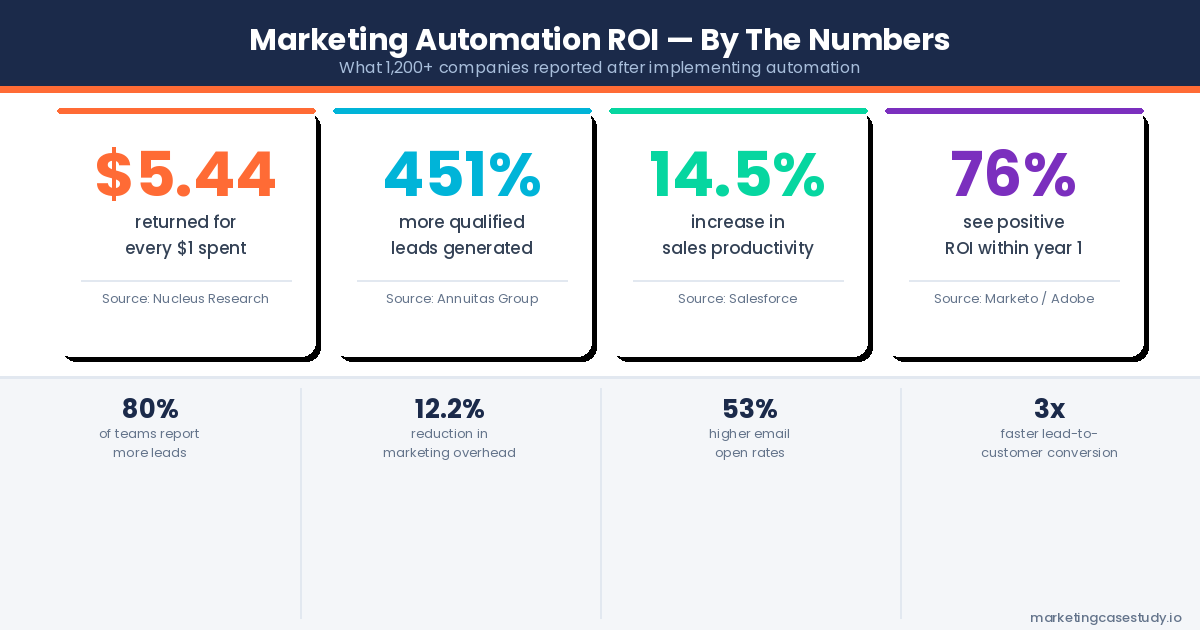
Before the case studies, a few numbers worth knowing. Companies using automation generate 451% more qualified leads than those running manual processes, according to Annuitas Group. The global market hit $6.65 billion in 2024 and is on track for $15.58 billion by 2030. Average return on investment sits at $5.44 for every dollar spent, with 76% of companies seeing positive ROI within year one.
Those are industry averages. What you’ll see below is what happens when a company executes well. The gap between average and exceptional isn’t platform-dependent — it’s almost always a process and alignment problem.
B2B Marketing Automation Case Studies
1. Thomson Reuters: 175% Revenue Increase with Eloqua
Thomson Reuters had a batch-and-blast problem. Same message, entire list, every week. Leads were flowing into the CRM and mostly sitting there, because sales didn’t trust them. Marketing thought they were delivering. Sales thought they were getting noise. Neither was entirely wrong.
The fix wasn’t a new campaign strategy. It was a new definition. They implemented Oracle Eloqua and built a lead scoring model that combined content engagement, firmographic data, and behavioral signals into a single score. A lead didn’t reach sales until it crossed a specific threshold. Not before. That threshold forced a real conversation between marketing and sales about what “ready to buy” actually meant for their enterprise contracts.
The results were significant: a 72% reduction in lead-to-conversion time, a 175% increase in marketing-attributed revenue, and 23% more high-quality leads getting to sales. But the number that mattered internally was probably that last one — not because 23% is dramatic, but because those leads were actually being worked instead of ignored.
Looking back, this is the pattern you see in almost every successful B2B automation implementation: the technology isn’t the unlock. Alignment on lead definitions is.
2. 6clicks: 806% Operational Growth with HubSpot
6clicks is a Governance, Risk, and Compliance software company — the kind of business where the sales cycle is long, the stakeholders are multiple, and staying organized across the customer journey is genuinely hard. Before HubSpot, they were running across Pipedrive, WordPress, and Squarespace, none of which talked to each other in any meaningful way. Data was scattered. Onboarding was inconsistent. Communication dropped at handoffs.
They went all-in on HubSpot — not just Marketing Hub, but the full suite: CRM, Sales Hub, Service Hub, CMS. The decision to consolidate everything rather than patch integrations between tools was deliberate. When all your customer data lives in one place, automation works better because it has access to the complete picture. Triggers are more accurate. Sequences are more relevant. Handoffs don’t drop.
The outcome: 806% operational growth. That’s the kind of number that makes you want to ask what’s behind it, and the honest answer is that a lot of it came from eliminating the manual work that had been quietly consuming the team’s time.
3. HR Cloud: 3x Increase in Sales-Qualified Opportunities
HR Cloud had a leakage problem. Leads were getting generated, they were entering the CRM, and then they were going cold while the sales team manually decided who to follow up with and when. The intent was there in the data. The action wasn’t happening fast enough.
They used HubSpot CRM to trigger behavior-based email sequences the moment a lead took a meaningful action — pricing page visit, resource download, sales email open. Lead scoring flagged the highest-intent prospects immediately. Every interaction synced between marketing and sales automatically, which meant reps weren’t chasing CRM updates and were instead spending their time on conversations.
Sales-qualified opportunities tripled. The manual CRM update burden disappeared. Response time to high-intent signals dropped to near-zero. What’s worth noting here is how little of this required sophisticated technology — it was mostly about removing the delay between signal and response.
E-Commerce Marketing Automation Case Studies
4. Snatcher: $120K Recovered Revenue with Cart Abandonment Automation
About 70% of e-commerce shopping carts get abandoned. Most retailers know this. Most respond with a single generic reminder email that arrives 24 hours later with no urgency and no acknowledgment of why the person left. Snatcher was in that group.
After switching to Omnisend, they built a three-touch recovery sequence: a personalized “Still shopping?” message at the one-hour mark, a second email at 12 hours addressing shipping cost concerns with social proof, and a final urgency message at 24 hours around product availability. The BigCommerce integration handled the product data automatically.
The results were immediate. $120,000-plus in recovered revenue. A 50% open rate on recovery sequences, which is roughly double the industry average for promotional email. Total revenue up 74%. The difference wasn’t a better subject line — it was addressing the actual reason people leave, at the moment they’re most likely to come back.
5. Premier Company: 73% Open Rate on Price Drop Trigger
Premier Company is a small apparel and skateboarding brand with a large catalog and a lean team. When prices change — which happens constantly in specialty retail — manually notifying every customer who’d shown interest in a specific item was simply not possible at any meaningful scale.
A Price Drop Trigger automation through ActiveDEMAND solved this cleanly. The system identified customers who had viewed or saved specific items and sent personalized notifications the moment the price changed. No ongoing management required after initial setup. The team didn’t have to do anything.
Within days of launch: 73% open rate, 12% click-through rate, meaningful increase in sales from previously stalled interest. This is what behavioral triggers do that broadcast emails can’t — a customer who looked at something three times last week already wants it. The price drop is just the push.
6. Dafiti: 300% More Revenue Per User with Braze
Dafiti is one of Latin America’s largest fashion retailers. Their marketing challenge was a common one at scale: when you’re sending the same campaign to millions of customers with wildly different preferences and purchase histories, most of your messaging becomes irrelevant to most of your audience. Engagement drops. Customers unsubscribe. Revenue per contact falls.
Using Braze’s cross-channel engine, they rebuilt campaigns around individual behavior — browsing history, purchase patterns, lifecycle stage. The same campaign infrastructure delivered completely different offers and product recommendations to different customers without building separate campaigns for each segment.
Revenue per user increased 300%. Unsubscribe rates dropped as relevance improved. Customer lifetime value climbed. None of this required a bigger team or a larger content calendar — it required the system to use data that already existed more intelligently.
SaaS and Lead Nurturing Case Studies
7. B2B SaaS Company: Conversion Rate from 2% to 7.2%
This mid-market project management company was generating 500 leads a month and converting 2% of them to paying customers. On its face, that sounds like a traffic problem. It wasn’t. It was a prioritization problem — the sales team was spending equal energy on everyone, which meant they weren’t doing anything particularly well for anyone.
They built a behavioral scoring model that combined product usage data, content engagement, and company fit into a single score. High-scoring leads triggered immediate sales alerts. Mid-tier prospects entered 6-8 week nurturing sequences — educational content, demo invitations, competitive comparisons — tailored to their usage patterns and stated use case. Sales only touched the people who were most likely to convert.
Six months in: lead-to-customer conversion jumped from 2% to 7.2%. Sales productivity improved 40%. Average deal size increased 23%. Monthly recurring revenue grew 89% on the same lead generation budget. The revenue growth wasn’t from more leads — it was from doing more with the leads already in the system.
8. Peakflo: 80% Faster Customer Onboarding
Peakflo is a B2B fintech platform. Their onboarding process before automation looked like what most SaaS companies’ onboarding looks like: a mix of manual check-ins, inconsistent email timing, and customers who were left to figure out the product on their own during the first critical weeks. Some made it. Many didn’t, and they churned before ever experiencing the core value.
They automated the onboarding journey end-to-end using HubSpot — welcome sequences, pre-scheduled demos, feature introduction emails, reminders for incomplete setup steps. The CRM tracked each customer’s onboarding progress and flagged anyone falling behind so a human could step in before the relationship broke down, not after.
Onboarding speed improved 80%. Early-stage churn dropped noticeably. The customer success team, freed from routine onboarding tasks, shifted to relationship management for accounts that actually needed human attention. This is a pattern worth paying attention to: automation doesn’t replace the human element in SaaS onboarding, it identifies exactly where the human is needed.
Enterprise Marketing Automation Case Studies
9. McAfee: 4x Improvement in Conversion Rates
McAfee’s problem was the inverse of most companies. They had too many leads, not fewer. The sales team was drowning in volume, conversion rates were low, and marketing kept celebrating pipeline growth while sales kept missing quota. The relationship between the two teams was, by all accounts, strained.
What surprised observers about their fix was the counterintuitive nature of it: they deliberately reduced lead volume. Implementing Oracle Eloqua, they built a scoring model that filtered aggressively — only leads that crossed a defined qualification threshold ever reached a sales rep. Marketing had to accept that “more leads” wasn’t the goal. Quality was.
Conversion rates improved 4x. Lead volume dropped 35%. Revenue per lead increased. Cost per acquisition fell. The marketing-sales relationship recovered because sales was now receiving prospects they could actually close rather than a long list to sort through. The automation didn’t change what McAfee sold. It changed what their salespeople spent their day doing.
10. Salesforce: 12,000 Hours Saved in Social Media Management
Salesforce’s social media team was managing more than 150 channels globally. Monitoring, approvals, community management, escalations — all of it happening manually across a team that couldn’t scale proportionally with the channel count. Response time was inconsistent. Brand voice varied. The operational overhead was enormous.
Deploying Sprout Social‘s Smart Inbox centralized all 150-plus channels into a single automated management workflow. Trend tracking ran automatically. Approval routing happened in real time. Engagement automation handled routine interactions at scale.
In the first year alone: 12,000 hours saved. Community management efficiency improved 10x. Brand voice became consistent across every global channel. Social media automation doesn’t get the attention that lead nurturing does in case study breakdowns — probably because it doesn’t show up as directly in revenue figures — but for enterprise companies managing global presence, the operational savings are significant.
The Marketing Automation ROI Formula: How to Calculate Your Returns
The number most teams track is open rate. Their CFO wants to see revenue. Those two things are not connected, and the sooner you stop using engagement metrics to justify your automation investment, the better the conversation with finance gets.
The formula is simple: Marketing Automation ROI = ((Revenue Generated – Total Cost) / Total Cost) x 100. Total cost means everything — platform subscription, implementation hours, ongoing management time, and integration costs. Revenue means new revenue from automation-nurtured leads, recovered revenue from abandoned carts and win-backs, and expansion revenue from automated upsell sequences.
A realistic Year 1 example for a mid-market B2B company: platform at $1,200 a month ($14,400 annually), one-time implementation at $8,000, and 10 hours of management per month at $75 an hour works out to $9,000 per year. Total Year 1 cost: $31,400. Conservative additional revenue from automation-nurtured deals: $180,000. That’s a 473% first-year ROI.
On timing: expect operational efficiency gains in the first three months, measurable pipeline impact by months three to six, and full revenue visibility by month 12. Teams that try to evaluate ROI at the 60-day mark are almost always looking at the wrong things.
5 Strategies Every Successful Marketing Automation Case Study Has in Common
After reviewing dozens of implementations, five things show up consistently in the ones that worked. The companies that struggled were almost always missing at least one of them.
The first is process before platform. Every successful case study started by mapping the customer journey before anyone opened a software demo. The tool doesn’t fix a broken process — it amplifies whatever you already have, including the broken parts.
The second is behavioral triggers over scheduled blasts. Not a single high-ROI case study was built on bulk emails sent to the full list on Tuesday morning. Every one of them used behavioral signals — page visits, product usage, content downloads, cart events — as the trigger. The communication finds the customer at the right moment because the customer’s own behavior defines what “right moment” means.
Third: alignment on lead definitions before building any automation. Thomson Reuters, McAfee, and HR Cloud all solved the same underlying problem first. Marketing and sales had different mental models of what “qualified” looked like. Automation enforces whichever definition you bake into the scoring logic — so if that definition is wrong or contested, you’re automating a disagreement at scale.
Fourth: start with one workflow, prove it, then expand. None of these companies built their entire automation infrastructure on day one. They started with the highest-value single use case — usually lead nurturing or cart abandonment recovery — validated the ROI, and then expanded from a position of demonstrated results rather than optimistic projections.
And fifth: continuous testing from launch, not after. The companies with the strongest results didn’t set up their automation and check back quarterly. They ran ongoing experiments on subject lines, send timing, sequence length, and offer type. The automation handled the experiment. They read the results and adjusted.
How to Build Your Marketing Automation Strategy: Step-by-Step
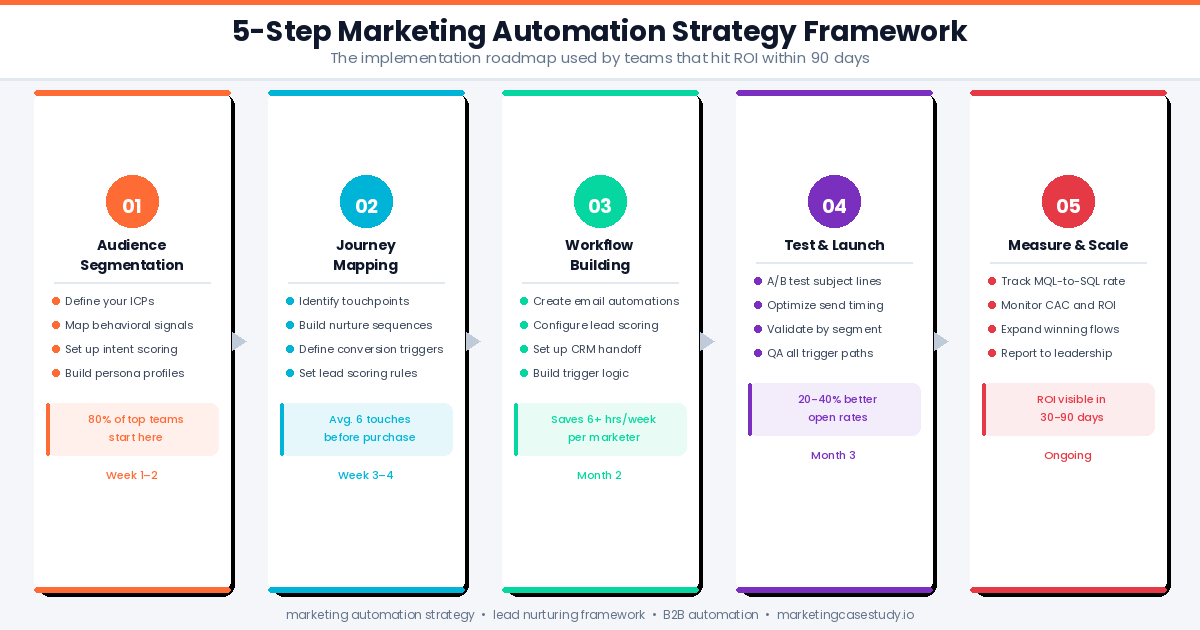
Before touching any software, document every stage from first touch to closed customer to renewal. The places where prospects go cold, where leads sit without action, where customers churn before experiencing value — those friction points are your automation roadmap. They’re telling you exactly where intervention matters most.
Once you have the map, rank your automation opportunities by measurable ROI potential. Cart abandonment recovery and lead nurturing sequences have the clearest and fastest return. Social media scheduling can wait. Start where the financial impact is obvious.
Platform choice matters more than most guides acknowledge. The wrong platform creates months of wasted configuration work. Match the tool to your actual complexity and current team size, not the company you plan to become in three years. A startup trying to run Eloqua is a mistake. A 500-person enterprise running ActiveCampaign for its entire marketing function is also a mistake.
Before launching any workflow, audit your contact database. Duplicates, missing fields, inaccurate segments — these multiply in impact once automation is running. Bad data going in means wrong messages going out, at scale, automatically. This is one of those things that’s obvious in retrospect and painful to fix mid-campaign.
Agree on exactly what you’re measuring before you go live. Conversion rate, sales cycle length, cost per qualified lead — pick your metrics in advance. Give the automation 90 days of runway before your first real optimization pass. Anything shorter and you’re reacting to noise.
Common Marketing Automation Mistakes to Avoid
The most common mistake is over-automating too fast. Teams try to build complex multi-branch workflows before a single automation has been validated. You end up with conflicting sequences, confused customers, and no clean way to diagnose what’s broken. Start narrow. One workflow. Prove it works. Then expand.
Personalization theater is the second one. A first name in a subject line is not personalization — it’s a mail merge. Real personalization means the content, the offer, and the timing are specific to that person’s behavior and stage. If your “personalized” email could be sent to anyone on your list without changing anything, it isn’t personalized.
Data quality gets ignored until it causes a visible problem. Automation multiplies the impact of bad segmentation data. If your audience definitions are wrong, you’re sending the wrong message to the wrong people faster than any human team ever could.
And in B2B especially: no automation should become a wall between a high-intent prospect and a sales conversation. Every workflow needs a defined escalation trigger — a lead score threshold, a pricing page visit, a demo request — that pulls a human into the conversation. The automation handles the routine. The human handles the moment that matters.
Which Marketing Automation Platform Is Right for Your Business?
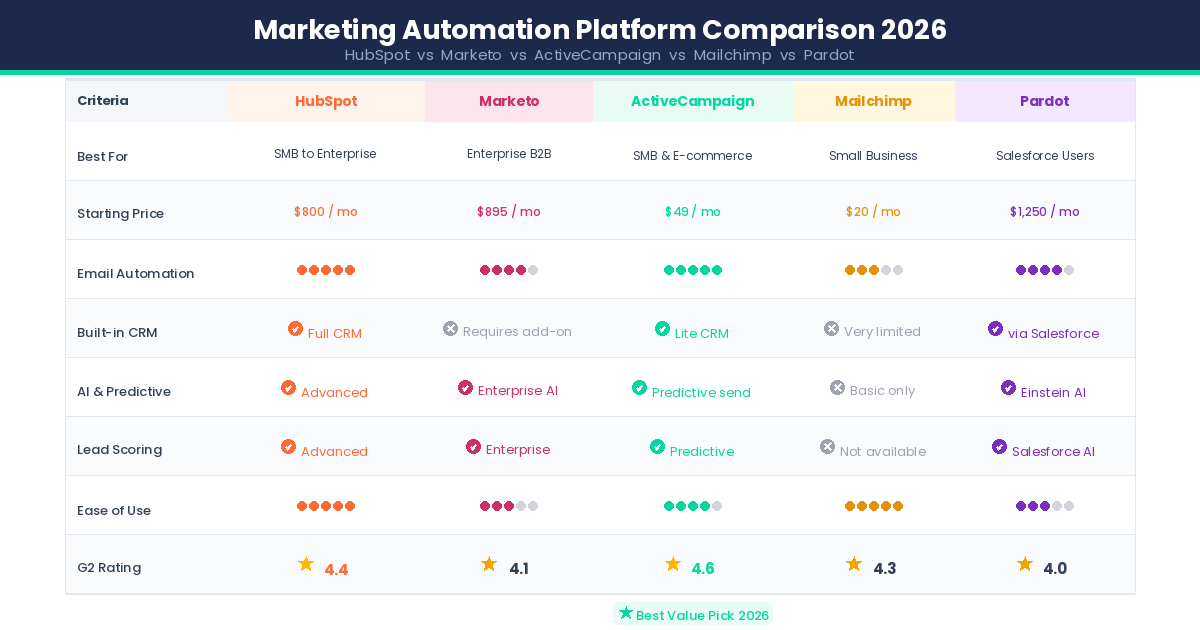
Based on what the case studies above actually used, here is a straight answer on platform fit.
HubSpot works best for SMBs and mid-market B2B companies under $100M in revenue. It has the easiest implementation path, the strongest CRM integration for its tier, and handles lead nurturing and email well. 6clicks, HR Cloud, and Peakflo all used it in the cases above. Marketing Hub Professional starts around $800 per month.
Oracle Eloqua is the right choice for enterprise B2B — companies with 1,000-plus employees, complex multi-touch sales cycles, and dedicated admin resources to manage the platform. It’s the most powerful scoring and segmentation engine available. Thomson Reuters and McAfee both used it. Pricing typically runs $2,000 to $5,000-plus per month.
Braze is built for mobile-first companies, e-commerce brands, and consumer apps that need real-time cross-channel personalization across email, push, SMS, and in-app messaging simultaneously. Dafiti used it to achieve their 300% revenue-per-user increase. Pricing typically starts above $2,500 per month.
Marketo fits enterprise B2B organizations already running the Adobe stack, particularly those doing account-based marketing at scale. More complex to configure than HubSpot, less precise in scoring than Eloqua for most mid-market use cases. Pricing typically $1,500 to $3,000-plus per month.
ActiveCampaign and Klaviyo are the right starting point for small businesses and e-commerce companies under $10M in revenue. Strong automation at accessible pricing ($100 to $500 per month depending on list size). A good place to build the operational muscle before the complexity of a larger platform becomes necessary.
Key Marketing Automation Metrics to Track
Track these from day one. If you can’t measure it before automation, you can’t demonstrate what automation improved.
Lead-to-MQL conversion rate tells you what percentage of raw leads become marketing-qualified. Baseline it before you launch anything, then track the change. MQL-to-SQL conversion rate is your marketing-sales alignment metric — how many of the leads marketing calls qualified does sales actually work? If this number is low, the qualification criteria needs revisiting before any additional automation is built on top of it.
Sales cycle length should compress with good automation. Thomson Reuters cut theirs by 72%. Email sequence engagement — open rate, click rate, reply rate, unsubscribe rate — should be tracked per sequence, not per campaign blast. Those are fundamentally different things. Cost per qualified lead measures efficiency over time. Automation-attributed revenue, meaning revenue from deals where automation touched the prospect during nurturing, is your headline ROI figure. For SaaS companies, onboarding completion rate is the leading indicator of churn before it shows up in your retention data.
Key Takeaways
A few things that hold true across every case study in this guide. The $5.44 average return per dollar invested is real, but it’s an average — the companies executing well are significantly above it, and those who automate a broken process without fixing it first are below it.
The highest-ROI automations are lead nurturing sequences, cart abandonment recovery, and behavioral trigger campaigns. Not bulk email. Not automated social posting. The things that intercept a customer at a meaningful moment in their decision process.
Platform fit matters. HubSpot for SMB and mid-market B2B. Eloqua for enterprise. Braze for mobile and e-commerce at scale. Klaviyo and ActiveCampaign for companies getting started. Choosing the wrong tool for your stage creates friction that compounds over time.
And the thing that shows up in every case study that worked: someone mapped the customer journey and identified the actual friction points before anyone signed a software contract. The automation didn’t create the strategy. It executed one that already existed.
Frequently Asked Questions
What is the average ROI of marketing automation?
Nucleus Research puts the average return at $5.44 for every dollar spent over three years, with 76% of companies reporting positive ROI within the first year. The range is wide. Companies that start with clear process mapping and behavioral trigger logic consistently outperform those that automate existing batch-and-blast campaigns without changing the underlying strategy.
What is a good example of marketing automation?
Thomson Reuters’ lead scoring implementation is one of the clearest B2B examples: they stopped passing every lead to sales and only transferred prospects after they crossed a defined qualification threshold. The result was a 72% reduction in sales cycle length and 175% increase in marketing-attributed revenue. For e-commerce, Snatcher’s cart abandonment sequence recovered $120,000 in revenue by automatically re-engaging customers at one hour, 12 hours, and 24 hours post-abandonment with messages that addressed the actual reason they left.
How long does it take to see results from marketing automation?
Operational efficiency gains — faster follow-up, better segmentation, less manual work — typically appear in the first one to three months. Meaningful pipeline impact shows up between months three and six as nurtured leads begin converting. Full revenue visibility, including closed-won deals from automation-nurtured prospects, usually requires six to twelve months of consistent operation. Teams evaluating ROI at 60 days are almost always measuring the wrong things.
What are the most common marketing automation mistakes?
Over-automating too quickly is the most common: building complex multi-branch workflows before a single sequence has been validated. Second is poor data quality — automation multiplies the impact of bad segmentation, so wrong audience definitions mean wrong messages at scale. Third is measuring activity metrics instead of business outcomes. And fourth, most critically in B2B, is failing to align sales and marketing on what a qualified lead looks like before building any scoring or routing logic. That definition problem is what gets automated, whatever it is.
Which companies benefit most from marketing automation?
B2B companies with longer sales cycles and multiple decision-makers see the highest ROI because automation can systematically nurture several stakeholders over weeks or months — something a human sales team can’t do at scale without significant headcount. E-commerce companies benefit most from behavioral triggers around cart abandonment, price changes, and browse activity. SaaS companies see the strongest impact in onboarding automation, which directly reduces early-stage churn. That said, the case studies above span fintech, healthcare, media, apparel, and enterprise software. Industry matters less than execution quality.

![Marketing Automation Case Study: 12 Real Examples, Strategy & ROI Results [2026]](https://marketingcasestudy.io/wp-content/uploads/2026/05/marketing-automation-case-study-featured-300x158.png)