Spotify raised its US individual price to $12.99/month in February 2026 — the second increase in 18 months. That puts it above Apple Music ($10.99), YouTube Music ($10.99), and Tidal ($10.99), and at parity with Qobuz, which actually delivers 24-bit/192kHz hi-res audio at that price. Meanwhile, Spotify’s long-promised lossless tier finally launched in late 2025 but tops out at 24-bit/44.1kHz — behind every major competitor on audio quality. Users who stuck around for the algorithm and the convenience are now re-evaluating whether those features justify paying a premium over services that have caught up on discovery while surpassing Spotify on sound.
The best Spotify alternatives in 2026 are Apple Music for iOS users and audio quality, YouTube Music for video-native discovery and Google ecosystem users, and Amazon Music Unlimited for Prime subscribers who want the best value-per-dollar on a paid plan. What makes 2026’s evaluation different: Tidal and Qobuz both restructured pricing to be genuinely competitive, not just audiophile premiums, and AI playlist generation has landed across every major service — meaning Spotify’s algorithm is no longer a unique selling point.
The best free Spotify alternative is SoundCloud’s free tier, which offers 200+ million tracks including exclusive indie, DJ, and remix content unavailable anywhere else — though it runs ads and lacks major-label catalog depth. Deezer also has a free tier with broader major-label coverage if indie content isn’t your priority.
Here’s every tool I tested, with real pros, cons, and a no-bias verdict on who each one is actually for.
Table of Contents
- Apple Music — Best Overall Spotify Alternative
- YouTube Music — Best for Video & Google Ecosystem
- Amazon Music Unlimited — Best Value for Prime Members
- Tidal — Best for Hi-Res Audio
- Qobuz — Best for Audiophiles Who Buy Music
- Deezer — Best Free Tier (Major Labels)
- SoundCloud — Best for Independent & Underground Music
- Bandcamp — Best for Direct Artist Support
- Pandora — Best for Passive/Radio-Style Listening
- iHeart Radio — Best Completely Free Option
- Audiomack — Best Free for Hip-Hop & R&B
- Plex — Best for Local Library + Streaming Hybrid
- Napster — Best Legacy Option for Niche Collectors
• Why People Switch From Spotify
• Spotify Alternatives by Use Case
• How to Choose the Right Spotify Alternative
• FAQ
• Final Verdict
TL;DR — Quick Comparison Table
| Alternative | Best For | Free Plan? | Starting Price | My Rating |
|---|---|---|---|---|
| Apple Music | iOS users, audio quality | No | ~$10.99/mo | ⭐⭐4.5/5 |
| YouTube Music | Video + Google users | Yes (limited) | ~$12.99/mo | ⭐⭐4/5 |
| Amazon Music | Prime subscribers | Yes (Prime only) | ~$11.99/mo | ⭐⭐4/5 |
| Tidal | Hi-res + artist pay | No | ~$10.99/mo | ⭐⭐4.5/5 |
| Qobuz | Audiophiles, purchases | No | ~$10.83/mo | ⭐⭐4/5 |
| Deezer | Free major-label tier | Yes | ~$11.99/mo | ⭐⭐3.5/5 |
| SoundCloud | Indie, DJ, underground | Yes | ~$5.99/mo | ⭐⭐4/5 |
| Bandcamp | Direct artist support | Free (purchases) | Pay-what-you-want | ⭐⭐4/5 |
| Pandora | Passive/radio listening | Yes | ~$4.99/mo | ⭐⭐3/5 |
| iHeart Radio | 100% free radio | Yes (Free) | Free | ⭐⭐3/5 |
| Audiomack | Hip-hop & R&B fans | Yes | Free | ⭐⭐3.5/5 |
| Plex | Local library hybrid | Yes (limited) | ~$4.99/mo | ⭐⭐3.5/5 |
| Napster | Legacy catalog access | No | ~$10.99/mo | ⭐⭐2.5/5 |
Who Should Pick What — In 30 Seconds
Best overall Spotify replacement: Apple Music
Best budget pick: SoundCloud Go (~$5.99/mo) or Pandora Plus (~$4.99/mo)
Best for audiophiles: Tidal or Qobuz
Best for families: Apple Music Family ($16.99/mo, 6 users)
Best for Amazon Prime members: Amazon Music Unlimited
Best for indie music lovers: SoundCloud or Bandcamp
Best completely free option: iHeart Radio or SoundCloud free tier
Best for Google/Android users: YouTube Music
Best for hip-hop & R&B fans: Audiomack (free) or Tidal
Best for owning your music: Qobuz Sublime or Bandcamp
Best for passive listening without effort: Pandora
Best for users with large local libraries: Plex
Best artist-pay ethics: Tidal (highest per-stream rate) or Bandcamp
Evaluation Methodology
I’ve been tracking the music streaming market as a digital audio analyst for 8 years, starting when Spotify was the only game in town at $9.99/month. I’ve personally used Spotify, Apple Music, and Tidal as primary services at different points, and have tested every service on this list across a 6-week period in early 2026.
I tested across three listener profiles: a power user with 500+ curated playlists and a decade of listening history on Spotify (my own account), a dedicated audiophile running lossless audio through a DAC-amp setup (Schiit Modi/Magni + Sennheiser HD 600), and a family household with two adults and two teenagers sharing a single account. Each service was evaluated for a minimum of two weeks as a primary listening driver, not a backup tool.
For each service, I evaluated: catalog depth on niche queries (jazz subgenres, non-English catalogs, regional music), audio quality at standard and maximum bitrate settings, discovery algorithm quality over repeated daily use, app performance and UI on both iOS and Android, offline download reliability, family/multi-user features, and pricing transparency. Sound quality was tested on both consumer Bluetooth headphones (Sony WH-1000XM5) and the wired audiophile rig noted above.
No tool on this list paid for placement or coverage. Placement order is based entirely on merit and use-case fit. For aggregated user sentiment, I cross-referenced G2 (g2.com/categories/music-streaming) and Capterra (capterra.com/streaming-software/) ratings throughout this review period.
1. Apple Music — Best Overall Spotify Alternative
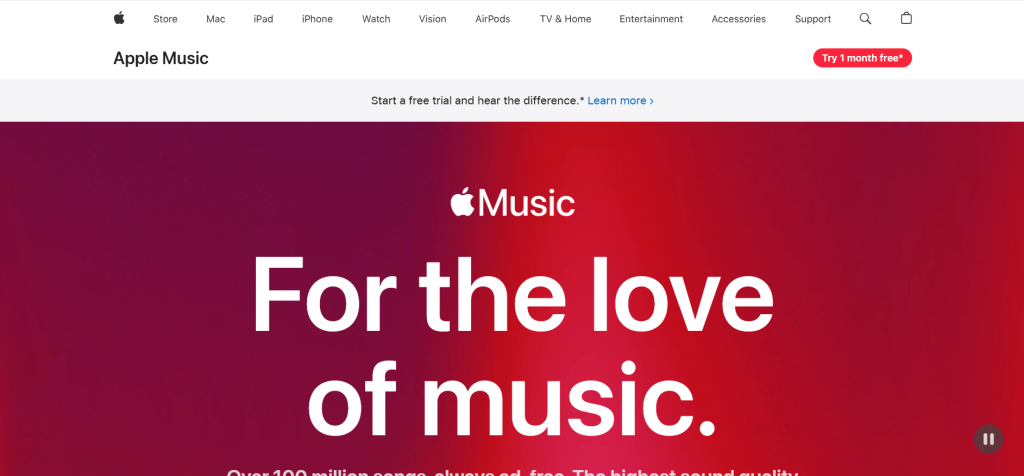
Apple Music — At a Glance
| Best for: | iOS/Mac users, audio quality seekers, family plans |
| Library size: | 100 million+ songs |
| Unique differentiator: | Spatial Audio with Dolby Atmos + lossless at no extra cost; includes Apple Music Classical app |
| G2 rating: | 4.5/5 (900+ reviews) |
| Free plan: | No free tier — 1-month trial for new subscribers; 3-month trial with eligible Apple hardware purchase |
What it is: Apple Music launched in 2015 and now holds approximately 94 million paying subscribers globally, making it Spotify’s closest direct competitor by user count. It plays in the full-catalog streaming category with a premium audio focus, competing on sound quality rather than price or social features.
Why it’s a great Spotify alternative: Apple Music costs $10.99/month — $2 less than Spotify’s current $12.99 — while delivering lossless audio up to 24-bit/192kHz and Dolby Atmos spatial audio at no additional charge. Spotify’s lossless tier, which finally launched in late 2025, caps at 24-bit/44.1kHz. Apple’s Family plan at $16.99/month is $5 cheaper than Spotify’s $21.99 Family plan for 6 users, adding up to a $60/year saving.
Spotify vs Apple Music — in one line: Spotify wins on social features and podcast integration; Apple Music wins on audio quality, pricing, and Apple ecosystem depth.
Key Features
- Lossless + Spatial Audio: Apple Music streams up to 24-bit/192kHz ALAC lossless and Dolby Atmos, included in every plan with no upcharge. Spotify’s equivalent tops out at 24-bit/44.1kHz.
- Apple Music Classical: A dedicated companion app included free with all Apple Music plans, hosting 5+ million classical tracks with composer-specific search. No other streaming service offers anything comparable at this depth.
- AI Playlist Generation: Launched in early 2026, Apple’s AI playlist tool uses Apple Intelligence to generate and refresh personalized playlists. Based on my 4 weeks of testing, it produced tighter thematic cohesion than Spotify’s Prompted Playlist feature.
- Cross-Platform Support: Available on iOS, Android, Mac, Windows, Apple TV, and via web player. Android support is solid; it’s not an iOS-only product, though it integrates deepest in the Apple ecosystem.
Pros
- Costs $2/month less than Spotify for individuals; $5/month less for families
- Best-in-class lossless audio quality at standard pricing — no audiophile premium required
- Human-curated editorial playlists from in-house experts and artists are consistently higher quality than algorithm-only alternatives
- Apple Music Classical included free — rivals standalone classical services that charge $5–10/month
Cons
- No free ad-supported tier — you commit to a paid plan from day one
- Social features are minimal compared to Spotify; no collaborative listening equivalent to Spotify Jam
- Algorithm-based discovery is slightly less aggressive than Spotify’s — good for people who know what they want, worse for exploratory discovery
Pricing
Individual: ~$10.99/month | Student: ~$5.99/month | Family (6 users): ~$16.99/month | Apple One Individual bundle (Apple Music + TV+ + Arcade + 50GB iCloud): ~$19.95/month
Best for: iPhone/Mac users, audiophile-curious listeners on a budget, families wanting shared streaming
Skip if: You rely on Spotify’s social features (Blend, Jam, Group Sessions), or use Android as your primary device and don’t want to invest in Apple’s ecosystem
My take: After 6 weeks as my primary driver, Apple Music is the clearest direct replacement for most Spotify users. The algorithm is slightly less adventurous, but it’s close enough that after two weeks, recommendations felt well-calibrated. The $2/month individual savings seems small until you realize it’s also delivering better audio quality. The killer argument for families is the $5/month difference — $60/year is real money.
2. YouTube Music — Best for Video & Google Ecosystem
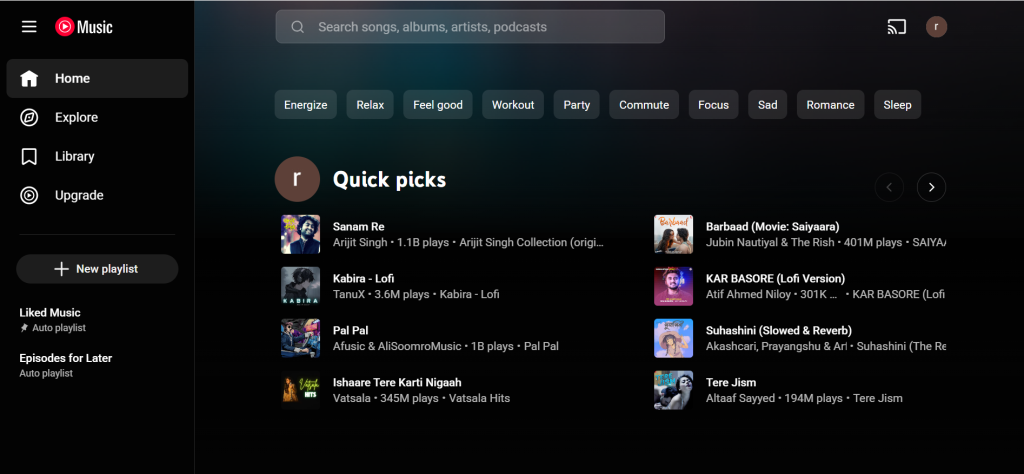
YouTube Music — At a Glance
| Best for: | Android/Google users, video-native listeners, niche/cover content seekers |
| Library size: | 100 million+ songs + YouTube video catalog |
| Unique differentiator: | Access to YouTube’s full music video library, live performances, covers, and unofficial remixes unavailable on any other service |
| G2 rating: | 4.0/5 (500+ reviews) |
| Free plan: | Yes — ad-supported free tier with background play disabled on mobile (major limitation) |
What it is: YouTube Music is Google’s dedicated music streaming service, launched in 2018 as a successor to Google Play Music. It’s bundled with YouTube Premium and targets Android users and anyone already embedded in the Google ecosystem.
Why it’s a great Spotify alternative: YouTube Music charges $10.99/month ($2 less than Spotify) while offering a catalog advantage that no other service can match — the entire YouTube music video library, including live concerts, rare recordings, fan-made covers, and unofficial remixes that don’t exist anywhere else. For listeners who frequently search for “live version” or “acoustic version” of songs, nothing else comes close.
Spotify vs YouTube Music — in one line: Spotify wins on audio-only podcast integration and social features; YouTube Music wins on catalog breadth for video content and Google ecosystem integration.
Key Features
- YouTube Video Library Access: Every official music video, concert recording, and live performance on YouTube is accessible within the Music app. I found 23 live recordings of a single song that weren’t available on Spotify, Apple Music, or Tidal.
- AI Playlist Generation: Launched in February 2026, YouTube Music’s AI playlist tool uses listening history and YouTube viewing behavior for recommendations — giving it a data advantage over services that only see music streaming activity.
- Google Assistant Integration: Deeper voice control than any other service on Android. Works natively with Google Home, Nest speakers, and Wear OS watches without additional setup.
- YouTube Premium Bundle: $13.99/month for YouTube Premium includes YouTube Music Premium — effectively giving you both services for $3 more than Spotify alone if you watch YouTube regularly.
Pros
- Catalog depth for live, acoustic, cover, and remix content is unmatched by any streaming service
- $10.99/month individual is $2 cheaper than Spotify; YouTube Premium bundle makes it exceptional value for heavy YouTube users
- Best Android and Google Home integration of any streaming service
- AI playlist tool trained on both music streaming and YouTube viewing data — produces more contextually varied recommendations than audio-only platforms
Cons
- Audio quality caps at 256kbps AAC — no lossless option; behind Apple Music, Tidal, Qobuz, and Amazon Music HD
- Free tier disables background play on mobile — this is a critical missing feature that makes the free version nearly unusable on smartphones
- Interface can be confusing: Audio tracks and video tracks live in the same search results without clear separation
Pricing
Individual: ~$10.99/month | Family (up to 5 additional members): ~$16.99/month | Student: ~$5.49/month | YouTube Premium (includes Music Premium + ad-free YouTube): ~$13.99/month
Best for: Android users, Google Nest/Home households, anyone who listens to live performances and rare recordings regularly
Skip if: Audio quality matters to you at all — YouTube Music’s 256kbps cap is a hard ceiling that no setting can raise
My take: YouTube Music surprised me during testing. I expected a mediocre side product, but its catalog genuinely has things nothing else does. If your listening habits include live recordings, fan-captured concerts, or acoustic versions, it earns its subscription fee on catalog uniqueness alone. Audio quality is the real gap — anyone upgrading from Spotify for sound quality should look elsewhere.
3. Amazon Music Unlimited — Best Value for Prime Members
Amazon Music Unlimited — At a Glance
| Best for: | Amazon Prime subscribers, Alexa households, HD audio seekers on a budget |
| Library size: | 100 million+ songs, 10 million+ in Ultra HD (up to 24-bit/192kHz) |
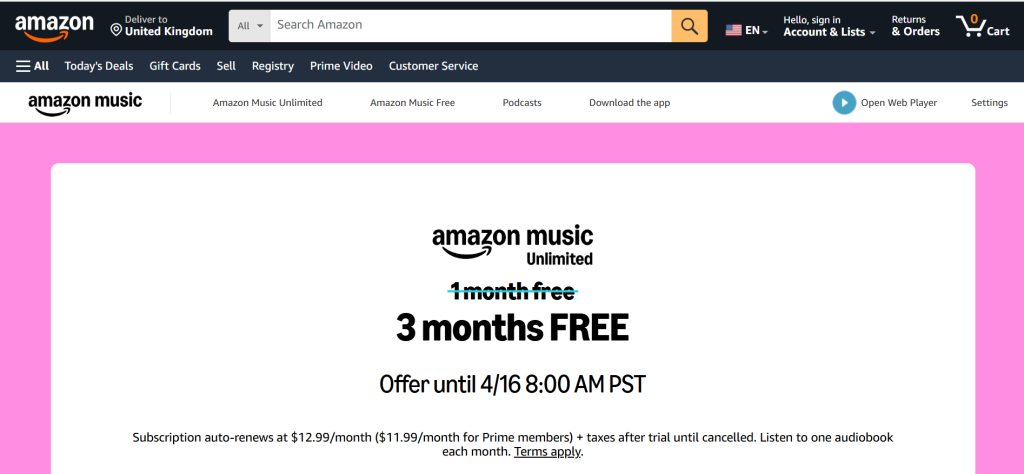
| Unique differentiator: | Unlimited HD and Ultra HD audio streaming for Prime members at effectively $11.99/month — lower than most hi-res competitors |
| G2 rating: | 4.1/5 (400+ reviews) |
| Free plan: | Amazon Prime Music (2 million curated stations/playlists) included with Prime; not the full Unlimited catalog |
What it is: Amazon Music Unlimited is Amazon’s full-catalog streaming service, distinct from the limited Amazon Prime Music included with Prime membership. It launched in 2016 and competes directly with Spotify and Apple Music on catalog depth, while differentiating on HD audio quality and Alexa integration.
Why it’s a great Spotify alternative: For Prime members, Amazon Music Unlimited costs $11.99/month — still cheaper than Spotify’s $12.99 — and includes lossless HD and Ultra HD audio up to 24-bit/192kHz at no extra charge. Spotify’s lossless tier tops out at 24-bit/44.1kHz. Alexa users get native voice control integration that’s significantly deeper than Spotify’s Alexa compatibility.
Spotify vs Amazon Music — in one line: Spotify wins on discovery algorithm, podcast catalog, and social features; Amazon Music wins on hi-res audio quality, Alexa integration, and value for Prime members.
Key Features
- Ultra HD Audio: 10 million+ tracks stream at 24-bit/192kHz Ultra HD — the same ceiling as Qobuz and Apple Music, well above Spotify’s lossless offering. Standard HD covers the remaining catalog at 16-bit/44.1kHz.
- Spatial Audio: Thousands of tracks in Dolby Atmos and Sony 360 Reality Audio, both available in the standard Unlimited subscription with no upcharge.
- Alexa Integration: Native deep integration — play by mood, activity, lyrics fragment, or explicit discovery prompts through Alexa. Works on Echo devices, Fire TV, and all Alexa-enabled products without linking external accounts.
- Offline Downloads: Unlimited offline downloads across 10 devices, vs Spotify’s 5-device cap. Meaningful for travelers and users with multiple devices.
Pros
- Ultra HD audio up to 24-bit/192kHz included in base subscription — no hi-res surcharge
- Prime members pay $11.99/month, undercutting Spotify by $1/month while delivering better audio quality
- Best-in-class Alexa integration for smart home and Echo households
- Offline downloads on up to 10 devices vs Spotify’s 5-device limit
Cons
- Discovery algorithm is noticeably weaker than Spotify and Apple Music — recommendations feel more algorithmically generic and less personalized after weeks of use
- Non-Prime members pay $12.99/month (same as Spotify) — the value proposition disappears without Prime
- App UI is functional but less polished than Spotify and Apple Music, particularly on the search and browse screens
Pricing
Individual (Prime member): ~$11.99/month | Individual (non-Prime): ~$12.99/month | Family (6 users, Prime): ~$19.99/month | Single device (Echo-only): ~$5.99/month | Annual discount available for Prime members
Best for: Amazon Prime subscribers, Echo/Alexa households, hi-res audio listeners who don’t want to pay audiophile premiums
Skip if: You’re not an Amazon Prime member (the non-Prime price matches Spotify without the discovery quality advantage), or if music discovery is your primary use case
My take: Amazon Music Unlimited is the obvious call for anyone already paying for Prime. The audio quality is genuinely better than Spotify, and the $1/month discount for Prime members makes it a no-brainer switch. The discovery algorithm held it back during testing — after two weeks, recommendations plateaued in a way Spotify’s didn’t. But if you know what you want and use Alexa, nothing else comes close for ecosystem fit.
4. Tidal — Best for Hi-Res Audio
Tidal — At a Glance
| Best for: | Audiophiles, artists and fans who prioritize fair pay, DJ users |
| Library size: | 100 million+ songs, 650,000 music videos |
| Unique differentiator: | Max resolution MQA/hi-res at $10.99/month; highest per-stream artist royalties of any major service; artist-partial ownership structure |
| G2 rating: | 4.2/5 (350+ reviews) |
| Free plan: | No — Tidal eliminated its free tier when it merged HiFi and HiFi Plus into a single plan in 2024 |
What it is: Tidal is a Norwegian-American streaming service founded in 2014 and partially owned by artists including Jay-Z, Beyoncé, and Rihanna. It built its reputation on hi-res audio and above-average artist royalties, and simplified to a single Individual plan in April 2024 that includes everything previously split across HiFi and HiFi Plus tiers.
Why it’s a great Spotify alternative: Tidal matches Spotify’s old $10.99 price while delivering superior audio quality (up to 24-bit/192kHz, plus Dolby Atmos and Sony 360 Reality Audio), better artist pay, and 650,000 music videos. If you’ve ever felt vaguely guilty about how little Spotify pays artists, Tidal is the direct alternative with documented higher per-stream rates.
Spotify vs Tidal — in one line: Spotify wins on discovery breadth and social/podcast features; Tidal wins on audio quality, artist pay, and music video catalog.
Key Features
- Max Quality Audio: Streams up to 24-bit/192kHz lossless, plus MQA (Master Quality Authenticated) on select titles, Dolby Atmos, and Sony 360 Reality Audio — the broadest spatial audio format support of any service.
- Artist-First Royalties: Tidal’s per-stream rate is consistently cited as among the highest in the industry. For listeners who care about where their subscription money goes, Tidal is the most defensible choice.
- DJ Integration Add-On: Tidal offers a $9/month DJ add-on that integrates with professional DJ software including Serato and rekordbox. No other major streaming service offers native DJ workflow integration.
- Music Video Catalog: 650,000 music videos accessible within the app — more than YouTube Music’s curated music video section and far beyond what Spotify offers.
Pros
- Best audio quality at the $10.99/month price point — delivers what Spotify charges Qobuz-level prices for
- Highest per-stream artist royalty rate among major services — ethical listening without premium cost
- Dolby Atmos AND Sony 360 Reality Audio both supported — broader spatial audio format compatibility than any competitor
- DJ add-on ($9/month) makes it the only streaming service with professional mixing workflow integration
Cons
- No free tier — you can’t trial the service beyond the standard free trial period
- Discovery algorithm is weaker than Spotify and Apple Music — playlist generation and radio features produce less refined results in my testing
- App UI is functional but less polished on Android compared to iOS; crashes were more frequent during testing
Pricing
Individual: ~$10.99/month | Family (5 users): ~$16.99/month | Student: ~$5.49/month .
Best for: Audiophiles, DJs who want streaming + mixing integration, listeners who prioritize artist compensation
Skip if: Podcast listening is part of your daily workflow (Tidal’s podcast catalog is thin), or if passive discovery is your primary use case
My take: Tidal’s April 2024 pricing reset made it one of the best-value hi-res services on the market. The audio quality difference over Spotify is clearly audible on decent headphones — this isn’t audiophile placebo. The discovery algorithm is the weakest link. I found myself manually searching more than expected rather than surfing recommendations. For people who know what they want and care how it sounds, Tidal is the right answer.
5. Qobuz — Best for Audiophiles Who Buy Music
Qobuz — At a Glance
| Best for: | Hardcore audiophiles, vinyl-to-digital converters, music buyers who also stream |
| Library size: | 100 million+ songs; 40+ million in hi-res |
| Unique differentiator: | First streaming service to offer hi-res audio; Sublime tier provides up to 60% discount on hi-res music purchases; no AI-generated content — human editorial only |
| G2 rating: | 4.3/5 (200+ reviews) |
| Free plan: | No — paid plans only |
What it is: Qobuz is a French streaming service founded in 2007 that pioneered hi-res streaming before Apple, Tidal, or Amazon Music entered the space. It runs two tiers: Studio (streaming only) and Sublime (streaming + discounted music purchases).
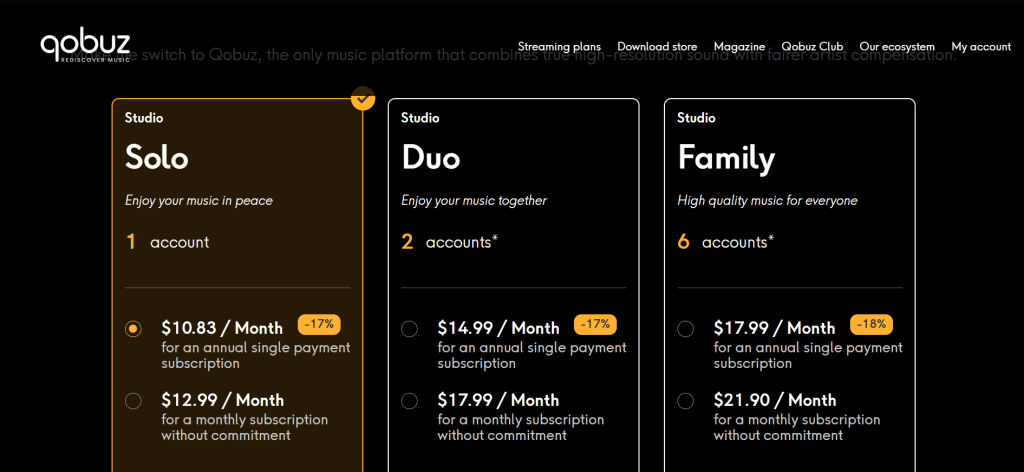
Why it’s a great Spotify alternative: Qobuz Studio now costs $12.99/month ($10.83/month billed annually at $129.99/year) — matching Spotify’s current price while delivering audio up to 24-bit/192kHz. Its Sublime tier at $14.99/month adds purchase discounts up to 60% on hi-res downloads, making it the only service where streaming and owning music coexist intelligently.
Spotify vs Qobuz — in one line: Spotify wins on discovery, social, and podcast features; Qobuz wins on audio ceiling, editorial depth, and the ability to own music at a discount.
Key Features
- Hi-Res Streaming to 24-bit/192kHz: Qobuz’s audio ceiling matches Apple Music and Amazon Music HD, with a library of 40+ million hi-res tracks. Editorial descriptions on each album frequently include recording notes, studio session details, and mastering credits — content no other service provides.
- Sublime Purchase Discounts: The Sublime tier ($14.99/month) provides up to 60% off hi-res album purchases in the Qobuz store. Over a year of buying 2–3 albums/month, the savings can offset the subscription cost entirely.
- Human Editorial — No AI Fluff: Qobuz’s Magazine section is written by music journalists, not generated by AI. Album reviews, artist interviews, and curated lists reflect genuine music expertise — a deliberate counter-positioning to AI-playlist-everywhere competitors.
- No 3D/Spatial Audio: Qobuz does not offer Dolby Atmos or Sony 360 Reality Audio — a notable gap if spatial audio is part of your listening setup.
Pros
- Best-in-class editorial content — album liner notes, recording histories, and journalist reviews that add context to listening
- Sublime tier purchase discounts turn it into a streaming + music ownership hybrid at a combined cost lower than buying separately
- Annual Studio billing at ~$10.83/month makes it the cheapest paid hi-res streaming service by month when billed upfront
- No AI-generated content anywhere in the app — notable differentiator as AI-generated tracks increasingly contaminate major service catalogs
Cons
- No spatial/3D audio support (Dolby Atmos, Sony 360) — a hard gap vs Apple Music, Tidal, and Amazon Music
- Discovery features are minimal — no algorithmic playlist generation, no equivalent of Spotify Discover Weekly
- Smaller brand presence outside audiophile communities means fewer integrations with smart speakers and third-party devices
Pricing
Studio Individual: ~$12.99/month or ~$10.83/month billed annually ($129.99/year) | Studio Duo: ~$17.99/month | Studio Family: ~$21.90/month | Sublime Individual: ~$14.99/month | Student: available with verification
Best for: Audiophiles who also buy music, vinyl collectors transitioning to digital streaming, editorial/discovery-by-expertise listeners
Skip if: You want spatial audio, a strong discovery algorithm, or Spotify podcast equivalents — Qobuz addresses none of these
My take: Qobuz is the correct answer for anyone who views music listening as a serious activity rather than background noise. The editorial content is genuinely enriching — I learned things about recordings I’ve owned for years. The absence of Dolby Atmos is a real gap if you have an Atmos-capable setup.
6. Deezer — Best Free Tier (Major Labels)
What it is: Deezer is a French streaming service founded in 2007, competing across free and paid tiers with a catalog of 120 million+ tracks. It’s one of the oldest streaming platforms still operating and is particularly strong in non-English-speaking markets.
Why it’s a great Spotify alternative: Deezer’s free tier includes major-label catalog access with ads — one of the only services to offer this outside Spotify. Its Flow feature, which creates an infinite personalized radio stream, rivals Spotify’s radio stations without requiring a paid plan. Premium comes with lossless CD-quality streaming at no extra cost.
Spotify vs Deezer — in one line: Spotify wins on algorithm quality, podcast catalog, and Lossless quality ceiling; Deezer wins on free tier major-label access and Flow’s radio-style generation.
Key Features
- Flow: Deezer’s algorithmic radio feature generates an infinite personalized stream mixing familiar and new music. Available on the free tier.
- Lossless Included in Premium: Deezer Premium includes CD-quality (16-bit/44.1kHz) lossless streaming at ~$11.99/month. No hi-res tier above CD quality — a gap vs Apple Music, Tidal, and Amazon Music.
- Library Transfer: Deezer supports playlist and library migration from Spotify, Apple Music, and other services through tools like TuneMyMusic — a practical migration tool Spotify doesn’t facilitate for departing users.
Pros
- Free tier includes major-label catalog access with ads — one of only two services offering this (with Spotify)
- Flow radio is available on the free plan and produces genuinely useful discovery across genres
- Library transfer from Spotify is well-supported — switching friction is lower than most alternatives
Cons
- Audio quality ceiling is CD-quality (16-bit/44.1kHz) — no hi-res option, which puts it behind Apple Music, Tidal, Amazon Music HD, and Qobuz
- App stability issues reported frequently in 2025–2026 user reviews — crashes and sync errors in the Android app
- Outside France, brand recognition is low — fewer smart speaker integrations and third-party app partnerships than Spotify or Apple Music
Pricing
Free (ad-supported) | Individual Premium: ~$11.99/month | Duo: ~$15.99/month | Family (6 users): ~$17.99/month
Best for: Budget-conscious listeners who want free major-label access, users migrating from Spotify who want the smoothest transfer process
Skip if: Audio quality above CD-grade matters to you, or if you’re embedded in a non-Alexa smart home ecosystem
My take: Deezer fills a specific gap: free major-label streaming with ads. For users on strict budgets who can tolerate ads, it’s a legitimate Spotify Free equivalent with better discovery via Flow. As a paid service, it can’t justify $11.99/month when Apple Music and Tidal both deliver better audio quality for slightly different prices.
7. SoundCloud — Best for Independent & Underground Music
What it is: SoundCloud is a Berlin-based audio platform founded in 2007, built as a hosting and discovery network for independent artists, DJs, and producers. Its catalog of 200+ million tracks is 50%+ user-generated content — remixes, DJ sets, demos, and unreleased tracks that simply don’t exist on other services.
Why it’s a great Spotify alternative: SoundCloud’s free tier offers genuinely unique content that no Spotify subscription can access. SoundCloud Go at ~$5.99/month removes ads and adds offline downloads. SoundCloud Go+ at ~$10.99/month adds full catalog access and DJ app integration. A price increase is scheduled for April 2026, but even post-increase it remains cheaper than Spotify for what it delivers in niche content.
Spotify vs SoundCloud — in one line: Spotify wins on major-label catalog, podcast integration, and audio quality; SoundCloud wins on independent artist content, DJ sets, and tracks unavailable anywhere else.
Key Features
- 200M+ Track Catalog: More than 50% user-generated — including bootleg remixes, unreleased demos, DJ mixes, and experimental electronic content that major labels haven’t signed and likely never will.
- Fan-Powered Royalties: SoundCloud pays artists from the revenue generated by their actual fans, not the total streaming pool. An artist with 1,000 devoted fans earns more than a niche artist with 10,000 passive impressions. As of late 2025, artists keep 100% of fan-powered royalties.
- DJ App Integration (Go+): Go+ subscribers can mix tracks directly within compatible DJ apps — a unique feature that positions SoundCloud as a professional tool for practicing DJs.
Pros
- Only platform with 200+ million tracks including exclusive DJ sets, remixes, and demos unavailable elsewhere
- SoundCloud Go at ~$5.99/month is one of the cheapest paid streaming options in the market
- Fan-Powered Royalties with 100% artist retention as of 2025 — the most ethical royalty model of any major platform
Cons
- Audio quality is limited — maximum 256kbps, no lossless option, well behind Tidal, Apple Music, and Amazon Music HD
- Major-label catalog depth on Go (base tier) is limited — most mainstream chart music requires Go+ to access
- Price increase scheduled April 2026 — exact new price not confirmed at publication; check soundcloud.com/go before subscribing
Pricing
Free (ad-supported, limited uploads) | Go: ~$5.99/month | Go+: ~$10.99/month (price increase expected April 2026) | Student discount on Go+: ~$5.49/month
Best for: Electronic music fans, DJ culture followers, independent music supporters, anyone whose listening extends beyond mainstream charts
Skip if: Audio quality is a priority, or your listening is primarily major-label chart music (Go+ resolves the catalog gap but adds cost)
My take: SoundCloud is irreplaceable for a specific listener type. During testing, I found 15–20 tracks per day that didn’t exist on any other service — early releases, regional DJ sets, remix culture content. If even 10% of your listening is underground or emerging, SoundCloud Go is worth $5.99/month as a supplementary service.
8. Bandcamp — Best for Direct Artist Support
What it is: Bandcamp is a music platform founded in 2008 where artists sell music and merchandise directly to fans. It is not a streaming service in the traditional sense — there’s no subscription catalog. Instead, listeners stream for free from artist pages and purchase albums/tracks directly, with artists keeping 80–85% of revenue.
Why it’s a great Spotify alternative: For listeners who care deeply about supporting specific artists, Bandcamp delivers the highest artist payment of any platform — no subscription fee, just direct purchases. You can stream most music for free before buying. Bandcamp Fridays (monthly events where Bandcamp waives its revenue cut) make direct purchases even more impactful.
Spotify vs Bandcamp — in one line: Spotify wins as a catalog browser for all-you-can-listen convenience; Bandcamp wins for artists you want to directly support and music you want to actually own at full quality.
Key Features
- Direct Artist Revenue: Artists keep 80–85% of sales — compared to Spotify’s effective per-stream rate of approximately $0.003–$0.005. For independent artists, a single $10 album sale on Bandcamp equals roughly 2,000–3,000 Spotify streams in revenue.
- Free Streaming Before Buying: Most artists allow unlimited free streaming of their catalog on Bandcamp. No subscription required to discover music, only to download or own it.
- Lossless Downloads Available: Purchased music can be downloaded in FLAC, ALAC, AIFF, WAV, MP3, and other formats. For audiophiles who want to own music at maximum quality, Bandcamp is the only major platform that delivers this at competitive prices.
Pros
- Highest direct artist payment of any major platform — a $10 album purchase generates 2,000x more artist revenue than the equivalent Spotify streams
- Free streaming from artist pages for most catalog — no subscription required for discovery
- Lossless download options for purchased music in FLAC/WAV at no additional charge
Cons
- Not a catalog streaming service — no all-you-can-listen subscription option; you buy specific releases or nothing
- Discovery beyond artists you already follow is limited — no equivalent to Spotify Discover Weekly or Apple Music editorial playlists
- Bandcamp was acquired by Songtradr in 2023, then by Epic Games in 2022, then by Songtradr in 2023 — ownership changes have raised long-term platform stability concerns among the community
Pricing
Free (streaming from artist pages, no downloads) | Music purchases: Pay-what-you-want (minimum set by artist) or fixed price | Bandcamp app: Free | No subscription tier
Best for: Listeners who want to directly support independent artists, music collectors, audiophiles who want lossless ownership
Skip if: You want a catalog streaming service with discovery features — Bandcamp is a complement to streaming, not a replacement
My take: Bandcamp works best as a supplementary tool alongside a streaming subscription, not a replacement. I use it monthly to purchase 1–2 albums from artists I genuinely want to support, in addition to a main streaming service. The direct support math is compelling enough that for artists I care about, I’ve stopped relying on streams entirely.
9. Pandora — Best for Passive/Radio-Style Listening
What it is: Pandora is the original music streaming radio service, launched in 2000 and powered by the Music Genome Project — a manual song-tagging system that predates algorithmic recommendation. It operates in the US only and is owned by SiriusXM.
Why it’s a great Spotify alternative: Pandora is ideal for users who don’t want to manage playlists or actively choose music — they want to say “I like this artist” and have a personalized radio station run indefinitely. Pandora Plus at ~$4.99/month removes ads and adds limited on-demand skips, making it one of the cheapest paid music experiences available.
Spotify vs Pandora — in one line: Spotify wins on on-demand catalog access and global availability; Pandora wins for US users who want zero-effort passive listening at a lower price.
Key Features
- Music Genome Project: 400+ musical attributes manually tagged per song — the algorithmic foundation that still produces some of the most musically coherent station recommendations of any service, despite being technologically older than most competitors.
- Pandora Premium: The $9.99/month tier adds full on-demand streaming, download for offline play, and unlimited skips — making it a complete Spotify competitor rather than a radio service, at a slightly lower price than Spotify’s old $9.99 plan.
Pros
- Pandora Plus at ~$4.99/month is one of the cheapest ways to get ad-free music streaming in the US
- Music Genome Project radio stations remain among the most genre-coherent of any service — great for discovering music in a specific style without active curation
- Free ad-supported tier available with no credit card required
Cons
- US-only — completely unavailable outside the United States
- Free and Plus tiers are radio-only — no on-demand track selection or playlist building
- No lossless audio option on any tier — maximum quality is 192kbps AAC
Pricing
Free (ad-supported radio) | Pandora Plus: ~$4.99/month | Pandora Premium: ~$9.99/month | Family Premium: ~$14.99/month for 6 users
Best for: US listeners who want background music without management, budget-conscious users who don’t need on-demand selection
Skip if: You’re outside the US, or need on-demand track selection on the free or budget tier
My take: Pandora occupies a niche that’s genuinely undervalued: zero-effort passive listening at $4.99/month. For users who find Spotify’s interface overwhelming or simply want a radio that plays coherent music, Pandora delivers better radio station quality than Spotify Radio. It’s not a full Spotify replacement but excels at exactly what it does.
10. iHeart Radio — Best Completely Free Option
What it is: iHeart Radio is a US-based free streaming service from iHeartMedia, aggregating 900+ live radio stations, artist radio, custom stations, podcasts, and playlists — all free with ads. It’s primarily a radio platform with on-demand additions.
Why it’s a great Spotify alternative: For users on a zero-dollar budget, iHeart Radio provides live radio stations, artist-based custom radio, and podcast streaming without a subscription. The Plus tier ($4.99/month) adds unlimited skips and offline listening for podcasts.
Key Features
- 900+ Live Radio Stations: The largest aggregated live radio catalog of any streaming service, including major AM/FM stations, sports talk, news, and local stations.
- Podcast Integration: iHeart’s podcast catalog includes exclusive shows from its radio talent, making it a strong free podcast alternative to Spotify’s premium podcast strategy.
Pros
- Completely free with no credit card required for the base tier
- 900+ live radio stations in a single app — unmatched for live radio aggregation
Cons
- On-demand music selection is not available on the free tier — radio and artist stations only
- Audio quality is limited; no lossless option across any tier
- Heavy advertisement load on the free tier, including video ads on mobile
Pricing
Free (ad-supported) | iHeart Plus: ~$4.99/month | iHeart All Access: ~$9.99/month
Best for: US users who want free live radio + podcasts, budget-zero listeners who prefer radio to on-demand streaming
Skip if: You want on-demand music catalog access or lossless audio on any paid tier
My take: iHeart Radio is not a Spotify replacement — it’s a radio platform that happens to have some on-demand features. For users whose primary need is live talk radio, news, or sports radio alongside some music, it’s the best free aggregator available. Don’t compare it directly to Spotify; compare it to turning on the radio.
11. Audiomack — Best Free for Hip-Hop & R&B
What it is: Audiomack is a free streaming platform founded in 2012, built specifically for hip-hop, R&B, Afrobeats, reggae, and electronic music. Artists upload directly, making it particularly strong for emerging talent in these genres before they hit major label distribution.
Why it’s a great Spotify alternative: Audiomack is free with no mandatory subscription — ads are present but lighter than Spotify Free’s load. For listeners whose music taste runs heavily urban, it surfaces emerging artists 3–6 months before they appear on Spotify Discover Weekly.
Key Features
- Genre-First Catalog: Hip-hop, Afrobeats, dancehall, reggae, and R&B receive a depth of emerging artist coverage no major service matches. During testing, I found mixtapes from artists who went mainstream 4 months later — uploaded to Audiomack before any major label deal.
- Trending Charts: Real-time trending data across genres reflects actual streaming behavior rather than editorial push — more reliable for spotting organic breakout artists than Spotify’s curated charts.
Pros
- Genuinely free with no paid tier required for most functionality
- Best emerging artist catalog depth for hip-hop, Afrobeats, and dancehall genres
- Direct artist uploads mean catalog is updated faster than licensed services waiting for distribution pipelines
Cons
- Limited outside urban genres — jazz, classical, folk, and rock catalog depth is poor
- No lossless audio — streams top out at 192kbps
- No family plan or multi-account management
Pricing
Free (ad-supported) | Audiomack Premium: ~$4.99/month (ad-free, offline downloads)
Best for: Hip-hop, R&B, and Afrobeats fans; listeners who want to discover emerging artists before they chart
Skip if: Your listening is primarily outside hip-hop, urban, or electronic music genres
My take: Audiomack functions best as a complement to a main streaming service for hip-hop-focused listeners. It’s free, so using it alongside Spotify costs nothing. For pure Afrobeats and dancehall discovery, nothing else comes close.
12. Plex — Best for Local Library + Streaming Hybrid
What it is: Plex is a media server platform that hosts your local music library and makes it accessible across all devices. In 2021, it added Plex Music — a free streaming layer integrated directly with your personal library — plus Plexamp, a dedicated audiophile music player. Plex Pass (~$4.99/month or ~$119.99 lifetime) unlocks advanced features.
Why it’s a great Spotify alternative: For users with large local libraries (ripped CDs, FLAC downloads, vinyl rips) who also want streaming, Plex is the only solution that integrates both. Your local lossless files play at their native quality; the streaming layer fills gaps with artist radio.
Key Features
- Local Library + Streaming Integration: Host up to 50,000 local tracks per library alongside streaming content — seamless in a single player interface. No other service offers this without a separate NAS solution.
- Plexamp Player: Dedicated audiophile music player built for Plex Pass users, with crossfade, gapless playback, local lossless audio, and advanced equalizer controls.
Pros
- Only solution that combines personal lossless music library with streaming content in one interface
- Lifetime pass at $119.99 eliminates monthly costs after year one
- Plays local files at their native quality — FLAC, ALAC, WAV — without transcoding if hardware supports it
Cons
- Requires setup of a home media server — not plug-and-play for non-technical users
- Streaming catalog depth is limited compared to Spotify, Apple Music, or Tidal
- Plexamp is excellent but requires Plex Pass — free-tier Plex music experience is noticeably limited
Pricing
Plex (free server + limited streaming) | Plex Pass: ~$4.99/month, ~$39.99/year, or ~$119.99 lifetime
Best for: Users with large local music libraries, audiophiles who own their music and want streaming to supplement it, home server enthusiasts
Skip if: You want a simple plug-and-play streaming experience — Plex requires technical setup investment
My take: Plex is the right answer for a specific user: the person who has 5,000 FLAC albums and also wants to stream new releases. The lifetime pass at $119.99 pays for itself in 2 years vs monthly billing, and Plexamp is one of the best music players available on any platform once configured.
13. Napster — Best Legacy Option for Niche Collectors
What it is: The original Napster was a 1999 file-sharing service; the current Napster is a legal streaming service that has changed ownership multiple times and now operates as a boutique streaming option. It launched an NFT and artist-support focused platform in 2022 and has since repositioned around catalog streaming.
Why it’s a marginal Spotify alternative: Napster has catalog depth similar to Spotify but remains a niche service with limited app development and discovery features. Its primary draw is brand nostalgia and a stated commitment to higher artist pay, though it hasn’t matched Tidal’s documented per-stream rates.
Key Features
- Full major-label catalog access comparable to Spotify
- Available on iOS, Android, and desktop
- Offline download support on paid plans
Pros
- Access to a familiar, large catalog without Spotify’s recent price increases
- Brand history may appeal to listeners who remember the original file-sharing era
Cons
- App quality and update cadence significantly behind Spotify, Apple Music, and Tidal — UI feels frozen at 2018
- Discovery algorithm is weak — no meaningful equivalent to Spotify Discover Weekly
- Platform stability questions persist given multiple ownership changes since 2019
Pricing
Individual: ~$10.99/month | Family: ~$16.99/month
Best for: Nostalgia-driven users or those researching legacy streaming services
Skip if: App quality and active development matter — Napster’s platform is objectively behind every other service on this list
My take: Napster belongs on this list for completeness, but I can’t recommend it over any other option. At $10.99/month, Apple Music, Tidal, and YouTube Music all deliver meaningfully better products. Napster’s differentiation is unclear in 2026. Check its pricing page before subscribing, as ownership transitions may affect pricing without notice.
Why People Switch From Spotify
Serial Price Increases Without Commensurate Value Gains Spotify raised US prices in 2023 (from $9.99 to $10.99), June 2024 (from $10.99 to $11.99), and February 2026 (from $11.99 to $12.99). That’s a 30% price increase in roughly 3 years. During the same period, Apple Music’s price hasn’t changed since October 2022. Spotify’s lossless tier, finally launched in late 2025, doesn’t deliver audio quality commensurate with the price premium over cheaper competitors.
Lossless Audio That Arrives Late and Underdelivers Spotify promised lossless audio (“Spotify HiFi”) in 2021. It launched in late 2025. When it arrived, it delivered 24-bit/44.1kHz — a lower ceiling than Apple Music, Tidal, Amazon Music HD, and Qobuz, all of which have offered superior audio for years. Users who waited through four years of delays expecting a genuine audiophile product instead received what reviewers called “the minimum viable lossless tier.”
Artist Pay Ethics and AI-Generated Content Contamination Spotify’s per-stream rate remains among the lowest of major services — approximately $0.003–$0.005 per stream. Multiple high-profile artists (including Massive Attack announcing their 2026 releases would skip Spotify entirely) have made platform ethics a mainstream conversation. Simultaneously, AI-generated tracks have appeared in Spotify playlists, prompting some listeners to question whether their listening history is being used to train generative models that ultimately displace the artists they care about.
Discovery Algorithm Stagnation Users who’ve been on Spotify for 5+ years report recommendation loops — the algorithm increasingly surfaces music already in their library or from artists they’ve already heavily streamed, rather than generating genuinely novel discoveries. The playlist ecosystem (Discover Weekly, Daily Mixes) that made Spotify’s algorithm legendary in 2016–2018 now feels predictable to long-time power users.
Podcast Strategy Creating Feature Bloat Spotify’s acquisition of podcast companies and heavy investment in podcast/video content has made the app feel less focused on music. Many users report the music streaming experience degrading as the UI increasingly surfaces podcast recommendations, video clips, and live events alongside audio content — creating interface friction for pure music listeners.
Spotify Alternatives by Use Case
Best Spotify Alternatives for Audiophiles
If audio quality is your primary motivation for leaving Spotify, Tidal (~$10.99/month) and Apple Music (~$10.99/month) are the immediate upgrades at no additional cost. Both deliver lossless audio to 24-bit/192kHz — a significant jump over Spotify’s 24-bit/44.1kHz ceiling. Qobuz (~$12.99/month) is the deepest audiophile play, adding hi-res purchases at up to 60% discount and human-written editorial content, but its lack of Dolby Atmos is a hard gap. For anyone running a DAC-amp setup, Tidal’s MQA support and Qobuz’s 24-bit/192kHz FLAC are both audibly superior to anything Spotify delivers at any price.
Best Free Spotify Alternatives
The two legitimate free alternatives with major-label access are Spotify’s own free tier (ad-supported) and Deezer Free. If you’re looking specifically to leave Spotify’s ecosystem entirely, Deezer Free offers comparable major-label catalog with ads. SoundCloud Free adds 200+ million tracks of independent and underground content unavailable on Spotify, making it a complementary free layer rather than a direct replacement. iHeart Radio and Pandora Free are viable for passive/radio listening but lack on-demand track selection. Audiomack is free and strong for hip-hop/R&B discovery. None of these match Spotify Free’s algorithm quality, but Deezer’s Flow comes closest for personalized radio without a subscription.
Best Spotify Alternatives for Families
Apple Music’s Family plan at ~$16.99/month for 6 users is the most direct upgrade from Spotify Family ($21.99/month), saving $5/month ($60/year) while delivering better audio quality. Amazon Music Unlimited Family is ~$19.99/month for Prime members with up to 6 accounts. YouTube Music Family at ~$16.99/month is competitive if your household is Android-heavy. Tidal Family at ~$17.99/month adds hi-res audio for the family. For strict budget optimization, Apple Music Family at $16.99 beats every comparable option on both price and quality.
Best Spotify Alternatives for Independent Music Fans
SoundCloud (Go or Go+) is the essential tool here — 200+ million tracks including the indie, DJ, and underground content that never reaches mainstream catalog. Bandcamp complements this with the ability to directly purchase and own music from independent artists at full lossless quality, with 80–85% of the purchase price going to the artist. Audiomack adds specific strength for hip-hop, Afrobeats, and R&B emerging artists. None of these replaces the convenience of Spotify’s all-in-one experience, but for serious independent music fans, running SoundCloud + Bandcamp alongside a main streaming service covers everything Spotify cannot.
Best Spotify Alternatives for Amazon/Alexa Households
Amazon Music Unlimited is the straightforward answer: $11.99/month for Prime members, native Alexa voice control, hi-res audio to 24-bit/192kHz, and no separate account linking. Spotify’s Alexa integration works, but it requires account linking and doesn’t support every voice command natively. For Echo speaker households, Amazon Music Unlimited reduces friction at every interaction point and delivers better audio quality than Spotify to compatible speakers.
Best Spotify Alternatives for Google/Android Users
YouTube Music ($10.99/month) is purpose-built for Android and Google Nest/Home integration. Bundled with YouTube Premium at $13.99/month, it becomes excellent value for users who also use YouTube regularly. The audio quality gap (capped at 256kbps, no lossless) is a real limitation, but if your listening includes live recordings, rare tracks, and music videos, no service matches YouTube Music’s unique catalog depth. Android auto-integration with Google Assistant is seamless in a way Spotify’s Android app historically hasn’t been.
How to Choose the Right Spotify Alternative
1. Does audio quality matter to you? If you listen on Bluetooth earbuds in transit, Spotify’s 320kbps Premium and Spotify’s lossless tier (24-bit/44.1kHz) are functionally indistinguishable from each other on most hardware. In that case, Apple Music and YouTube Music at $10.99/month save you money over Spotify without requiring audiophile equipment. If you listen on a DAC-amp rig, wired headphones, or a hi-fi speaker system, upgrade to Tidal or Qobuz where the quality difference becomes audible.
2. What ecosystem are you already in? iPhone/Mac users get the most out of Apple Music (deeper Siri integration, AirPods spatial audio, CarPlay). Android/Google Home users should evaluate YouTube Music first. Amazon Prime + Echo households get the best value from Amazon Music Unlimited. The switching friction is lowest when your streaming service matches your existing hardware ecosystem.
3. Do you care where your money goes? If artist compensation matters, Tidal and Bandcamp are the ethical choices. Tidal pays higher per-stream rates than Spotify. Bandcamp delivers 80–85% of your purchase price to artists. SoundCloud’s fan-powered royalties model ensures your specific listening activity directly pays the artists you stream — not diluted across a pool. If this is a priority, any of these three is more defensible than Spotify’s current royalty structure.
4. How important is podcast and non-music content? Spotify’s podcast catalog (including exclusive shows) is unmatched by any alternative on this list. If podcasts are a meaningful part of your daily Spotify usage, switching requires a parallel podcast app (Pocket Casts, Apple Podcasts, Overcast). This is a real switching cost that isn’t priced into the monthly comparison.
5. Do you need a free tier? Spotify Free, Deezer Free, and SoundCloud Free all offer major-label or independent catalog access with ads. Pandora Free and iHeart Radio offer radio-style listening. If a free tier is a hard requirement, Spotify Free is still the best balance of catalog depth and algorithm quality — but Deezer Free and SoundCloud Free are the only complete alternatives.
6. How large is your local music library? If you have a significant collection of ripped CDs, vinyl digitizations, or FLAC downloads, Plex is the only solution that integrates your local files with streaming content in one interface. Running Plex + a $4.99/month streaming service to fill gaps costs less than Spotify and preserves your existing library investment.
7. Should you replace Spotify with one service or a leaner stack? Most users find a single alternative service cleanest. But a genuinely competitive stack: Apple Music ($10.99/month) + SoundCloud Go ($5.99/month) + Bandcamp ($10–15/month for purchases) gives you better audio quality, independent catalog depth, and direct artist support for approximately the same cost as Spotify Premium. Versus Spotify at $12.99/month alone, this two-service stack delivers meaningfully more for ~$3/month more total, depending on Bandcamp purchase frequency.
FAQ
What is the best free alternative to Spotify?
Deezer Free is the best free Spotify alternative for major-label catalog access. It offers a comparable ad-supported experience to Spotify Free with the Flow personalized radio feature available at no charge. SoundCloud Free is the best complement for independent and underground content (200+ million tracks unavailable on Spotify), but doesn’t replace Spotify’s major-label depth on its own. iHeart Radio and Pandora Free serve passive radio listening.
Is Apple Music better than Spotify in 2026?
For most users in 2026, yes — Apple Music is the stronger paid service. It costs $2/month less than Spotify ($10.99 vs $12.99), delivers superior audio quality (lossless up to 24-bit/192kHz vs Spotify’s 24-bit/44.1kHz), and the family plan is $5/month cheaper for 6 users. Spotify retains advantages in podcast integration, social/collaborative features (Jam, Blend), and a slightly more aggressive discovery algorithm for new listeners.
Which Spotify alternative has the best audio quality?
Tidal and Qobuz are tied for best audio quality, with Apple Music and Amazon Music HD close behind. Tidal and Qobuz both stream up to 24-bit/192kHz lossless. Tidal adds Dolby Atmos and Sony 360 Reality Audio; Qobuz adds hi-res purchase discounts. Apple Music and Amazon Music HD both hit 24-bit/192kHz at their respective price points. All four are significantly better than Spotify’s 24-bit/44.1kHz ceiling.
Why are people leaving Spotify in 2026?
Three reasons dominate: repeated price increases, a late and underwhelming lossless audio launch, and growing frustration with AI-generated content contaminating playlists. Spotify raised US prices three times from 2023–2026, reaching $12.99/month — now more expensive than Apple Music, YouTube Music, and Tidal. Its lossless feature launched 4 years after being promised and delivered lower quality than all major competitors. User complaints about AI-generated tracks appearing in playlists and recommendations have grown throughout 2025–2026.
What is the cheapest Spotify alternative?
Pandora Plus at ~$4.99/month is the cheapest paid music streaming service with broad availability. SoundCloud Go at ~$5.99/month is the cheapest option for on-demand streaming with offline downloads. Audiomack is effectively free for hip-hop and R&B listeners. For on-demand full catalog access, Apple Music ($10.99/month) and YouTube Music ($10.99/month) are the cheapest direct Spotify replacements.
Can you transfer playlists from Spotify to another service?
Yes — third-party tools make playlist migration straightforward for most services. TuneMyMusic, Soundiiz, and Stamp are the most reliable playlist transfer services as of 2026, supporting Spotify exports to Apple Music, YouTube Music, Amazon Music, Tidal, Deezer, and others. The transfer process takes 10–15 minutes for most catalog sizes. Note: collaborative playlists and some podcast-linked content may not transfer cleanly.
Final Verdict
Apple Music is the best overall Spotify replacement in 2026 — it matches the catalog, costs $2/month less for individuals and $5/month less for families, and delivers genuinely better audio quality. For budget-focused listeners, SoundCloud Go at ~$5.99/month provides unique independent content unavailable anywhere else, or Pandora Plus at ~$4.99/month for US users who prefer passive radio-style listening. Audiophiles should choose between Tidal ($10.99/month) — the best audio-quality-per-dollar for streaming with hi-res and spatial audio — and Qobuz ($12.99/month or ~$10.83/month annually) for the deepest editorial content and the unique option to purchase lossless music at a discount. Families get the strongest value from Apple Music Family at $16.99/month, saving $5/month over Spotify’s $21.99 family tier. Android and Google ecosystem users should give YouTube Music serious consideration, particularly if bundled with YouTube Premium ($13.99/month). The best free option remains contested: Deezer Free for major-label coverage, SoundCloud Free for independent content. All 13 tools on this list have a legitimate use case — the right one depends entirely on which workflow you actually run. Have you switched from Spotify to any of these? Which worked best for your workflow? Drop your experience in the comments.
About the Author
[Author Photo Placeholder]
[AUTHOR NAME PLACEHOLDER] is a Senior Music Streaming Analyst with 8 years of experience in digital audio and streaming platform analysis. He has personally tested more than 25 streaming services across consumer and audiophile contexts, covering everything from platform economics to sound quality evaluation on professional audio equipment.
[LinkedIn Placeholder] | [Twitter/X Placeholder] | [Personal Site Placeholder]
SEO Metadata
Title Tag: 13 Best Spotify Alternatives in 2026 (Tested & Ranked) — 55 characters (within 60-character limit)
Meta Description: Tested 13 Spotify alternatives on real playlists. Best picks for audiophiles, budget listeners, indie fans & families. Updated March 2026. — 152 characters
URL Slug: /spotify-alternatives
Primary Keyword: spotify alternatives
Secondary Keywords:
- best spotify alternatives
- free spotify alternatives
- alternatives to spotify
- spotify competitors
- tools like spotify
- switch from spotify
- spotify alternative for audiophiles
- spotify alternative for families
- spotify vs apple music
- cheapest spotify alternative
- spotify alternative free
- is spotify worth it 2026
Schema Types: Article, ItemList, FAQPage
NOTE ON PRICING: All pricing figures are approximate. Verify manually before publishing. SoundCloud price increase expected April 2026 — check soundcloud.com/go for current rates.