Data loss is not a theoretical risk. In 2026, the average cost of a data breach exceeds $4.5 million. Regulatory penalties under GDPR, HIPAA, and CCPA have compounded the financial exposure well beyond the breach event itself. Insider threats — whether malicious exfiltration, accidental mishandling, or policy-blind employees copying sensitive files to personal cloud storage — account for over 30 percent of all data incidents. And the attack surface that data loss prevention tools must cover has expanded dramatically: endpoints, cloud storage, email, collaboration platforms, web uploads, and removable media all represent active exfiltration channels in 2026.
The challenge for security teams is that the DLP market has grown as fast as the threat landscape. Legacy DLP tools built for on-premises network monitoring are increasingly inadequate for organizations where most sensitive data lives in Microsoft 365, Google Workspace, AWS S3, and dozens of SaaS platforms. Cloud-native DLP platforms have emerged to fill that gap but create coverage fragmentation alongside legacy tools that still handle endpoint and network visibility. Integrated security platforms that include DLP as a module create licensing complexity. Standalone DLP specialists offer depth at the cost of yet another console to manage.
This guide cuts through that noise. We tested 12 data loss prevention platforms across endpoint protection, cloud data security, email DLP, network monitoring, and insider threat management. Every recommendation includes the specific data protection scenario where that platform delivers the strongest outcome — and where you should look elsewhere.
Quick Comparison: Top 12 Data Loss Prevention Tools for 2026
| Platform | Primary Use | Starting Price | Free Tier | Best Feature | Our Rating |
| Microsoft Purview | M365 and cloud DLP | Included in M365 E3/E5 | No (M365 license) | Native M365 and Azure integration | 9.1/10 |
| Netskope | Cloud DLP and CASB | Custom pricing | No | Granular SaaS and cloud data visibility | 9.2/10 |
| Forcepoint DLP | Enterprise endpoint and network | Custom pricing | No | Behavior-based insider threat detection | 9.0/10 |
| Symantec DLP (Broadcom) | Full-spectrum enterprise DLP | Custom pricing | No | Deep content inspection across all channels | 9.0/10 |
| Zscaler | Cloud-native DLP and CASB | Custom pricing | No | Inline cloud and web DLP at scale | 9.1/10 |
| Varonis | Data access intelligence | $10/user/mo (est.) | No (trial) | Data access intelligence and least privilege | 9.1/10 |
| Digital Guardian | Endpoint DLP for regulated industries | Custom pricing | No | Data-centric endpoint protection | 8.9/10 |
| Tessian | Email DLP and human layer security | Custom pricing | No | AI-powered misdirected email prevention | 8.8/10 |
| Code42 Incydr | Insider risk and data exfiltration | Custom pricing | No | File movement monitoring without over-blocking | 8.9/10 |
| Nightfall AI | Cloud-native DLP for SaaS apps | Free / $11.20/mo | Yes (limited) | Developer-friendly API-based DLP | 8.7/10 |
| Teramind | Insider threat and employee monitoring | $12/user/mo | No (14-day trial) | Behavioral analytics and DLP in one platform | 8.8/10 |
| Google Workspace DLP | Native DLP for Google Workspace | Included in Business+ | No (license) | Deep Drive, Gmail, and Chat protection | 8.6/10 |
How We Evaluated These DLP Platforms
Every platform in this guide was assessed across six dimensions that reflect the real operational demands of a data loss prevention program — not vendor-provided detection rate claims or analyst quadrant placements.
Detection accuracy and false positive rate: A DLP tool that blocks legitimate business activity generates user friction, support tickets, and eventually business pressure to disable the controls entirely. We evaluated not just detection capability but the precision of that detection — the ratio of accurate policy matches to false positives across realistic enterprise data patterns.
Channel coverage breadth: Data exfiltration happens across endpoints, cloud storage, email, web uploads, collaboration platforms, USB devices, and printing. We evaluated how comprehensively each platform covers the channels that represent actual exfiltration risk for modern organizations — not just the channels that legacy DLP architectures were designed to monitor.
Cloud and SaaS visibility: The majority of sensitive data in most organizations now lives in Microsoft 365, Google Workspace, Salesforce, and other SaaS platforms rather than on-premises file servers. We specifically evaluated how well each platform monitors data movement within and between cloud services, not just data leaving the corporate network perimeter.
Policy management and operational overhead: DLP policies that security teams cannot maintain are DLP policies that drift out of alignment with the organization’s actual data risk. We evaluated the operational overhead of building, testing, tuning, and maintaining policies — with particular attention to which platforms reduce that overhead through AI-assisted policy recommendations and automated tuning.
Incident investigation capability: When a DLP alert fires, the security team needs to determine quickly whether an incident occurred, what data was involved, who was responsible, and what remediation is required. We evaluated the quality of each platform’s incident investigation workflow — the speed and completeness of the evidence available after an alert.
Integration with the broader security stack: DLP detections are most valuable when they feed into SIEM, SOAR, and case management platforms for coordinated investigation and response. We evaluated native integrations with common security operations infrastructure.
Why the DLP Landscape Has Changed in 2026
Three developments define the data loss prevention market in 2026 that distinguish it from even three years earlier.
The first is the shift from network-perimeter DLP to data-centric DLP. Legacy DLP architecture monitored data crossing the network boundary — traffic leaving the corporate firewall. In a world where users work from anywhere, data lives in the cloud, and the corporate network boundary has effectively dissolved, perimeter monitoring catches a shrinking fraction of actual data exposure. The leading DLP platforms have moved to data-centric approaches that monitor the data itself — tagging, tracking, and enforcing policy on sensitive content regardless of where it travels or which channel it uses.
The second is the convergence of DLP with insider risk management. Traditional DLP was policy-driven: define what sensitive data looks like, detect when it crosses a boundary, block or alert. This approach is effective against accidental exposure but insufficient for the insider threat problem — the employee who understands the policies and deliberately routes sensitive data through channels the DLP tool does not cover. Behavioral analytics that establish individual baselines and detect anomalous data movement patterns — regardless of the specific channel — have become essential complements to content-based DLP controls.
The third is the emergence of AI-native DLP for cloud applications. The sheer volume of data movement within and between SaaS applications exceeds what signature-based or rule-based DLP systems can monitor without generating alert volumes that overwhelm security operations teams. Machine learning models that understand contextual data sensitivity — distinguishing a legitimate business document from a trade secret extraction attempt based on content, context, user behavior, and destination — have moved from experimental to production-grade, enabling DLP programs to scale to cloud data volumes without proportional scaling of analyst headcount.
Detailed Reviews: Best Data Loss Prevention Tools for 2026
1. Microsoft Purview — Best DLP for Microsoft 365 and Azure Environments
| Best For | Organizations running Microsoft 365 who want native DLP without additional vendor complexity |
| Pricing | Included in M365 E3 (basic DLP). Full capability in M365 E5 Compliance at $12/user/mo add-on |
| Free Tier | No — requires Microsoft 365 licensing |
| Key Strengths | Native integration with Teams, SharePoint, Exchange, OneDrive, and Azure; unified compliance portal; sensitivity labels; Endpoint DLP for Windows; Adaptive Protection with insider risk signals |
| Key Weaknesses | Limited effectiveness outside Microsoft ecosystem; complex licensing across M365 plans; non-Microsoft SaaS coverage requires MCAS integration |
| Best For Orgs | Microsoft 365-dependent organizations, regulated industries already running M365 E5, teams wanting unified compliance and DLP management |
| Channel Coverage | Email, Teams, SharePoint, OneDrive, Windows endpoints, Azure |
| Deployment | Cloud SaaS |
| Best Pairing | Microsoft Sentinel for DLP alert investigation, Netskope or Zscaler for non-Microsoft SaaS coverage |
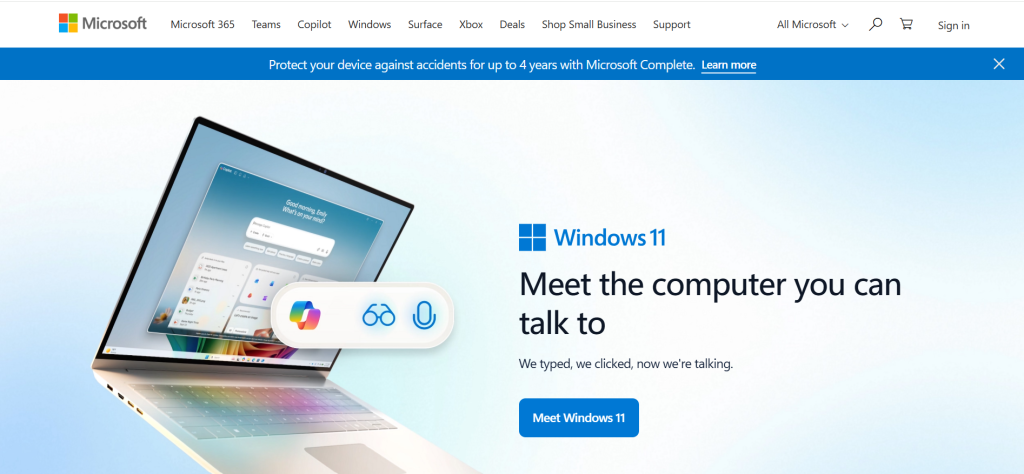
Microsoft Purview’s structural advantage is identical to Microsoft Entra ID’s in identity management: for organizations already running Microsoft 365, it is already present, already connected to every Microsoft application, and already capable of enforcing data protection policy across the most sensitive data channels in most organizations — without an additional vendor relationship. The email, Teams, SharePoint, and OneDrive coverage is native — not an API integration with latency and coverage gaps, but platform-level enforcement that operates in real time within the applications themselves.
Sensitivity labels are the foundational data classification capability that makes Purview’s DLP policies effective rather than approximate. When users classify documents with sensitivity labels — Confidential, Highly Confidential, Internal Use — those labels persist with the documents as metadata, enabling DLP policies that trigger on labeled content rather than relying solely on content inspection to identify sensitive data. The labeling investment compounds across every DLP, governance, and data lifecycle management policy that references those labels.
Adaptive Protection represents the most forward-looking capability in Purview’s current feature set. It dynamically adjusts DLP policy strictness for individual users based on their insider risk score — calculated by Microsoft Purview Insider Risk Management from signals like unusual access patterns, mass downloads, resigned employee status, and policy violations. A user whose behavior has triggered elevated insider risk indicators automatically faces more restrictive DLP controls, requiring justification for actions that other users can perform freely. The DLP response adapts to the actual risk profile of each individual rather than applying the same policy uniformly across the organization.
Where Microsoft Purview Falls Short
Microsoft Purview’s DLP effectiveness drops significantly for data that lives outside the Microsoft ecosystem. Salesforce, Slack, ServiceNow, Box, and the long tail of SaaS applications that most enterprises use alongside Microsoft 365 require either Microsoft Defender for Cloud Apps integration — which adds cost and configuration complexity — or a separate CASB and DLP solution. Organizations with diverse SaaS portfolios that extend substantially beyond Microsoft will find Purview insufficient as a standalone DLP solution.
The Verdict on Microsoft Purview
Microsoft Purview is the right DLP foundation for organizations heavily invested in Microsoft 365 and Azure. The native integration depth for Microsoft applications is unmatched, and organizations running M365 E5 should ensure they are fully utilizing the DLP capabilities already included before evaluating additional DLP vendors. For non-Microsoft SaaS coverage, plan to supplement Purview with a CASB-based solution.
2. Netskope — Best Cloud DLP and CASB for SaaS-Heavy Organizations
| Best For | Organizations with diverse SaaS portfolios that need granular visibility and control over data movement across cloud applications |
| Pricing | Custom enterprise pricing; typically $25–$50/user/year depending on modules |
| Free Tier | No |
| Key Strengths | Granular SaaS activity visibility, inline CASB and DLP, real-time data movement monitoring, managed and unmanaged device support, extensive SaaS app coverage, behavioral analytics |
| Key Weaknesses | Complex deployment and policy management, requires dedicated cloud security expertise, enterprise-tier pricing |
| Best For Orgs | Cloud-first and SaaS-heavy organizations, enterprises with BYOD and contractor populations accessing cloud data |
| Channel Coverage | SaaS applications, cloud storage, web, managed and unmanaged endpoints |
| Deployment | Cloud SaaS (inline proxy architecture) |
| Best Pairing | Microsoft Purview for M365 native DLP, Okta or Entra ID for identity context, any SIEM for alert integration |
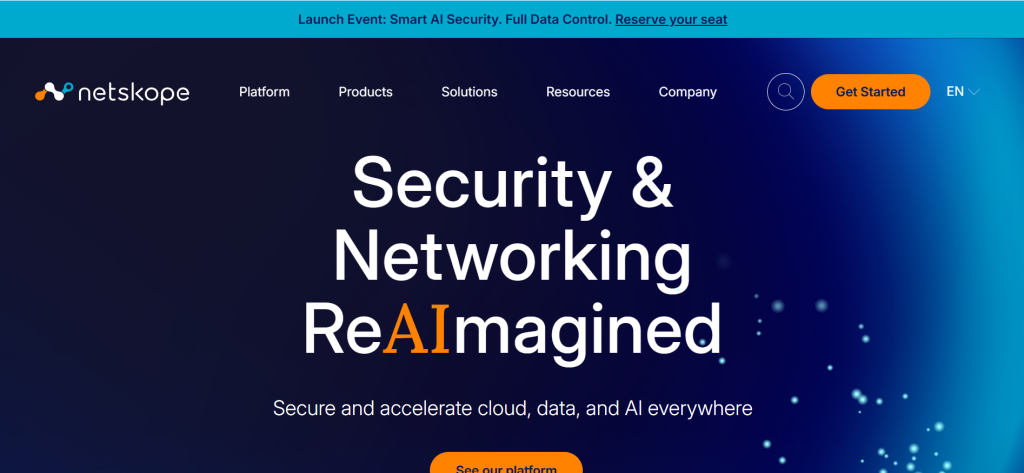
Netskope built its platform around a single architectural insight that distinguishes it from legacy DLP tools: the most dangerous data movements in modern organizations happen within and between cloud applications, not across the traditional network perimeter. An employee who downloads a customer list from Salesforce and uploads it to a personal Google Drive account generates no network perimeter alert — the traffic never touches the corporate firewall. Netskope’s inline proxy architecture sits between users and every cloud application they access, providing the visibility and enforcement layer that perimeter-based DLP cannot.
The granularity of Netskope’s SaaS activity visibility is the platform’s defining capability. Rather than seeing only that a user accessed Salesforce, security teams see which specific records were accessed, whether data was downloaded or exported, what destination the data moved to, and whether that activity matches the user’s historical behavior patterns. This operational detail transforms DLP from a binary block-or-allow decision into a nuanced understanding of data movement that informs both automated policy enforcement and human investigation.
The treatment of unmanaged devices is particularly valuable for organizations with significant contractor or BYOD populations. Netskope can enforce DLP policy for users accessing cloud applications from personal devices — limiting download capabilities, preventing copy-paste of sensitive content, and blocking uploads to personal cloud storage — without requiring MDM enrollment on the personal device. The control is applied at the cloud application layer rather than the device layer, enabling data protection for a population that traditional endpoint DLP tools cannot reach.
Where Netskope Falls Short
Netskope’s deployment requires routing cloud traffic through its proxy infrastructure, which introduces architectural complexity and requires careful configuration to avoid performance degradation. Policy management is powerful but complex, and organizations without experienced cloud security engineers will struggle to build and maintain a DLP policy set that covers the required channels without generating excessive false positives. The pricing reflects the enterprise market positioning — organizations below a certain scale will find the investment difficult to justify.
The Verdict on Netskope
Netskope is the best cloud DLP and CASB platform for SaaS-heavy organizations where the primary data exposure risk is in cloud application activity rather than traditional endpoint exfiltration. For organizations that have maximized Microsoft Purview’s coverage and still have significant DLP gaps in their non-Microsoft SaaS portfolio, Netskope fills that coverage gap more comprehensively than any alternative.
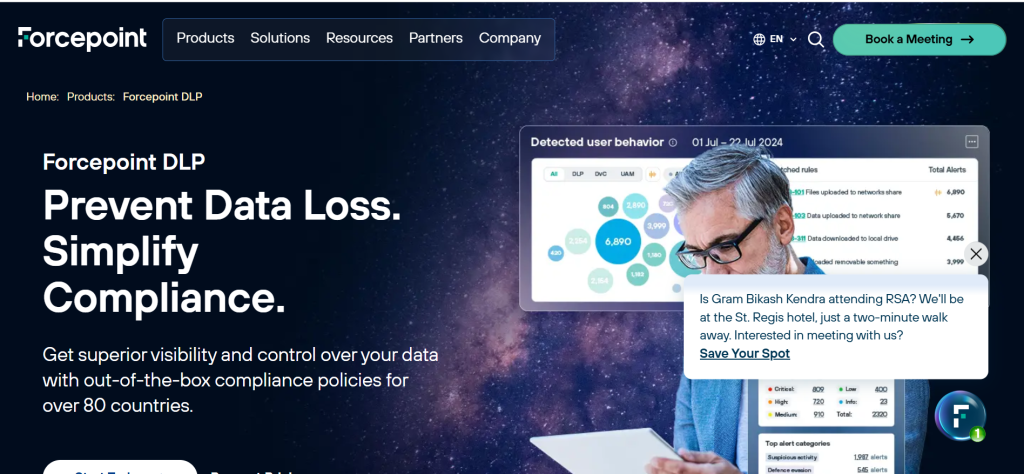
3. Forcepoint DLP — Best Enterprise DLP for Behavior-Based Insider Threat Detection
| Best For | Enterprises needing comprehensive DLP combined with human behavior analytics to address both accidental data loss and deliberate insider threats |
| Pricing | Custom enterprise pricing |
| Free Tier | No |
| Key Strengths | Behavior-based risk scoring, endpoint, network, and cloud DLP in one platform, Risk-Adaptive Protection, low false positive rates, strong policy management |
| Key Weaknesses | Complex initial deployment, enterprise-tier pricing, admin UI requires training |
| Best For Orgs | Government, defense, financial services, and enterprises with elevated insider threat risk |
| Channel Coverage | Endpoint, network, email, cloud, web, removable media, printing |
| Deployment | On-premises, cloud, and hybrid |
| Best Pairing | Any SIEM for behavioral risk score forwarding, Okta or Entra ID for identity context |
Forcepoint DLP’s differentiating capability is Risk-Adaptive Protection — an architecture that connects employee behavior signals to DLP policy enforcement, adjusting the restrictiveness of controls for each individual based on their current risk score rather than applying uniform policy across all users. The behavioral risk scoring draws from a wide input set: unusual working hours, attempts to access unauthorized systems, abnormal data volumes, HR-flagged events like performance improvement plans, and historical policy violations. An employee whose risk score has elevated automatically faces more restrictive DLP controls across every monitored channel simultaneously.
The cross-channel coverage breadth is among the strongest in the market. Forcepoint monitors and enforces DLP policy across endpoint file activity, network traffic, email, web uploads, cloud storage, USB and removable media, and printing — all from a single policy management console. For organizations that have previously struggled with the coverage gaps and policy inconsistencies that come from deploying multiple specialist DLP tools for different channels, Forcepoint’s unified coverage eliminates that fragmentation.
The behavioral approach to DLP is what makes Forcepoint effective against the insider threat scenarios that content-based DLP tools consistently miss. A disgruntled employee who deliberately avoids the data channels that policy rules cover cannot easily evade a behavioral baseline that flags anomalous volume, timing, and destination regardless of which channel they use. The platform’s effectiveness compounds over time as individual behavioral baselines become more accurate and risk scoring becomes more precise.
Where Forcepoint Falls Short
Forcepoint’s implementation requires experienced DLP architects and a significant initial configuration investment to build a policy set that provides the intended coverage without generating the false positives that erode operational confidence in the platform. The administrative interface, while comprehensive, has a learning curve that requires dedicated training for administrators new to the platform. Organizations without in-house DLP expertise may find that professional services investment is necessary to realize the platform’s full capability.
The Verdict on Forcepoint DLP
Forcepoint is the right enterprise DLP platform for organizations where insider threat — both accidental and malicious — is a primary data security concern, and where the channel coverage breadth of a unified platform justifies the implementation investment over multiple specialist tools. Government, defense, and financial services organizations with elevated insider threat risk profiles represent the core use case where Forcepoint’s behavioral approach delivers its maximum differentiation.
4. Symantec DLP (Broadcom) — Best Full-Spectrum DLP for Large Enterprises
| Best For | Large enterprises needing comprehensive content inspection and policy enforcement across every data channel with an established, auditable DLP program |
| Pricing | Custom enterprise pricing through Broadcom |
| Free Tier | No |
| Key Strengths | Deep content inspection accuracy, endpoint, network, storage, and cloud coverage, Exact Data Matching, Vector Machine Learning for unstructured data, strong regulatory compliance templates |
| Key Weaknesses | Complex deployment and ongoing management, Broadcom acquisition created roadmap uncertainty for some customers, high total cost of ownership |
| Best For Orgs | Large enterprises with established DLP programs, regulated industries requiring deep content inspection accuracy |
| Channel Coverage | Endpoint, network, email, web, cloud storage, on-premises storage, printing |
| Deployment | On-premises, cloud, and hybrid |
| Best Pairing | Any SIEM for policy violation log integration, Okta or Entra ID for user identity context |
Symantec DLP built its enterprise market position on content inspection accuracy — the ability to reliably identify sensitive data across unstructured documents, images, structured database exports, and encoded or compressed formats with the false positive rates that enterprise security operations can operationalize. Exact Data Matching fingerprints specific data records from source databases and detects exact matches in monitored traffic, providing the precision needed for PCI DSS cardholder data protection and healthcare patient data management where both false positives and false negatives carry material compliance consequences.
The Vector Machine Learning content detection capability handles the unstructured data challenge that pattern-matching approaches cannot adequately address. Customer contracts, internal memos, proprietary research, and M&A documents do not contain obvious sensitive data patterns like credit card numbers or Social Security numbers — their sensitivity comes from their content and context. VML trains on examples of sensitive documents provided by the organization and learns to recognize similar content in monitored traffic, providing detection capability for the sensitive-but-unstructured data that represents a significant fraction of actual enterprise data loss risk.
The regulatory compliance template library covers the major frameworks that drive DLP program requirements — PCI DSS, HIPAA, GDPR, SOX, and dozens of regional privacy regulations — with pre-built policy configurations that security teams can deploy and customize rather than building from scratch. For organizations implementing DLP primarily to satisfy compliance requirements, these templates provide a documented starting point that auditors can review against the compliance framework requirements.
Where Symantec DLP Falls Short
The Broadcom acquisition of Symantec’s enterprise security portfolio has created ongoing uncertainty about product investment, roadmap, and support quality that some customers cite as a reason to evaluate alternative platforms. Organizations in active DLP platform evaluations should request current roadmap commitments and customer support service level documentation before committing. The deployment and management complexity remains high — Symantec DLP at enterprise scale requires dedicated DLP program resources and regular maintenance investment.
The Verdict on Symantec DLP
Symantec DLP remains a strong choice for large enterprises with established DLP programs that depend on its deep content inspection accuracy and broad channel coverage. Organizations beginning new DLP program implementations should evaluate Symantec alongside Netskope and Forcepoint to determine whether the deployment complexity and current vendor uncertainty is justified by the content inspection depth for their specific compliance requirements.
5. Zscaler — Best Cloud-Native DLP for Zero Trust Architectures
| Best For | Organizations implementing zero trust network access who want DLP integrated into the security service edge rather than deployed as a separate tool |
| Pricing | Custom enterprise pricing; DLP available as part of ZIA and ZPA bundles |
| Free Tier | No |
| Key Strengths | Inline DLP within SSE/SASE architecture, web and cloud DLP without additional infrastructure, integration with CASB and ZTNA, Exact Data Match, Indexed Document Match, cloud sandbox |
| Key Weaknesses | DLP depth secondary to SSE capabilities — specialist platforms provide greater policy granularity; requires Zscaler as primary network security architecture |
| Best For Orgs | Organizations already deploying Zscaler for zero trust network access, enterprises consolidating around SASE architecture |
| Channel Coverage | Web traffic, cloud applications, email (via integration), SSL/TLS inspection |
| Deployment | Cloud SaaS (SSE architecture) |
| Best Pairing | Microsoft Purview for M365 native DLP, CrowdStrike or SentinelOne for endpoint DLP, any SIEM for alert correlation |
Zscaler’s DLP capability is best understood as integrated data protection within a zero trust network security architecture rather than a standalone DLP platform. For organizations that have deployed Zscaler Internet Access as their secure web gateway or Zscaler Private Access for application access, adding DLP capabilities within the same architecture provides inspection of the data crossing the Zscaler proxy without additional infrastructure or agent deployments.
The business case for Zscaler DLP is primarily one of consolidation — reducing the number of security vendors and management consoles while maintaining meaningful data protection coverage across web and cloud traffic. For organizations managing five or more separate security tools, the operational overhead reduction from consolidating web security, CASB, ZTNA, and DLP within Zscaler’s platform can justify the trade-off in DLP feature depth relative to specialist platforms.
Exact Data Match and Indexed Document Match provide the precision-sensitive detection capabilities that regulatory compliance typically requires within the Zscaler architecture. EDM fingerprints specific records from structured data sources — exact credit card numbers, Social Security numbers, or healthcare record identifiers that must not leave the environment — and detects those specific values in monitored traffic. IDM fingerprints document content and detects when substantially similar content appears in outbound data flows, providing coverage for sensitive documents that have been modified to avoid exact match detection.
Where Zscaler Falls Short
Zscaler’s DLP capabilities are comprehensive for the channels it monitors but are limited by its architectural scope. Data stored on endpoints that does not traverse Zscaler infrastructure — local files, USB transfers, printing — requires additional DLP controls. Organizations with complex sensitive data patterns that require nuanced policy configuration may find Zscaler’s DLP policy management less flexible than Netskope or Symantec. Zscaler DLP is most defensible as the data protection layer within a Zscaler SSE deployment rather than as a primary standalone DLP platform choice.
The Verdict on Zscaler
Zscaler is the right DLP choice for organizations that have already committed to Zscaler’s SSE architecture and want to add data protection capabilities without deploying an additional platform. Organizations selecting a DLP platform independently of their network security architecture will generally find more comprehensive capabilities in Netskope, Forcepoint, or Symantec for comparable or lower investment.
6. Varonis — Best Platform for Data Access Intelligence and Insider Threat Detection
| Best For | Organizations needing to understand who has access to sensitive data, who is actually using that access, and detect anomalous data activity |
| Pricing | Estimated $10–$20/user/mo depending on scope and modules |
| Free Tier | No — free risk assessment available |
| Key Strengths | Data access intelligence, automated least-privilege remediation, behavioral analytics, ransomware detection, file activity monitoring across on-premises and cloud, UEBA |
| Key Weaknesses | Not a traditional inline DLP tool — focuses on detection and response rather than real-time blocking; complex initial deployment for large environments |
| Best For Orgs | Organizations with significant file share and cloud storage exposure, regulated industries, security teams focused on insider threat and data access governance |
| Channel Coverage | File systems, SharePoint, OneDrive, Exchange, Active Directory, AWS, Azure, Google Drive, Salesforce |
| Deployment | On-premises, cloud, and hybrid |
| Best Pairing | Microsoft Purview or Netskope for inline DLP enforcement, any SIEM for behavioral alert forwarding |
Varonis approaches data security from a fundamentally different angle than traditional DLP tools. Where most DLP platforms ask “is this data movement a violation?” Varonis asks “who has access to sensitive data, is that access appropriate, and is anyone using it in ways that suggest a threat?” The resulting platform is less about blocking data in transit and more about understanding the data access landscape — identifying overexposed sensitive data, remediating excessive access permissions, and detecting the behavioral anomalies that precede data breaches.
The data access intelligence capability reveals what most organizations discover with alarm during their first Varonis assessment: sensitive data that is far more broadly accessible than anyone realized. Stale permissions from departed employees, groups with access granted for a project three years ago and never revoked, global access groups that give every employee read access to sensitive financial or HR data — Varonis maps this access landscape and provides automated remediation workflows for right-sizing permissions to least privilege. This remediation is preventive DLP: reducing the blast radius of any future compromise by ensuring that sensitive data is not accessible to accounts that should not reach it.
The User and Entity Behavior Analytics (UEBA) engine establishes behavioral baselines for every user and service account in the monitored environment, then alerts on deviations that match known threat patterns. The employee who accesses ten times their normal volume of sensitive files in a single afternoon. The service account that begins accessing file directories it has never touched. The user who downloads a large volume of files immediately after submitting their resignation. These behavioral signals, detected automatically and surfaced with contextual evidence, enable security teams to investigate potential data exfiltration before the data leaves the organization.
Where Varonis Falls Short
Varonis is primarily a detection and response platform rather than an inline blocking tool. Organizations that need to prevent specific data movements in real time — blocking an email attachment containing credit card numbers, preventing a file upload to personal cloud storage — need a separate inline DLP solution alongside Varonis. The platform is most powerful as the intelligence layer that identifies the highest-risk data exposures and behavioral anomalies, with enforcement handled by dedicated DLP controls for the channels where real-time blocking is required.
The Verdict on Varonis
Varonis is the best platform for organizations that want to understand and govern their data access landscape rather than simply monitor data movements. The combination of access intelligence, automated remediation, and behavioral analytics addresses the data security risk that most organizations have but few have measured. For security teams investigating a potential insider threat or a compromised account with access to sensitive data, Varonis provides the fastest path to understanding what data was accessed and whether a breach occurred.
7. Digital Guardian — Best Endpoint DLP for Regulated Industries
| Best For | Regulated industries needing the most comprehensive endpoint data protection with deep content inspection and strict data movement controls |
| Pricing | Custom pricing through Fortra |
| Free Tier | No |
| Key Strengths | Data-centric endpoint protection, full content inspection at the endpoint, USB and removable media control, application control, classification enforcement, strong regulated industry templates |
| Key Weaknesses | Complex deployment and high operational overhead, endpoint agent can impact system performance, significant expertise required for policy management |
| Best For Orgs | Healthcare, financial services, defense contractors, and organizations handling highly sensitive IP requiring endpoint-level enforcement |
| Channel Coverage | Endpoint file operations, removable media, printing, email clients, web browsers, cloud sync clients |
| Deployment | On-premises, cloud, and hybrid |
| Best Pairing | Any SIEM for endpoint DLP alert integration, Okta or Entra ID for user identity context |
Digital Guardian’s data-centric approach to endpoint DLP focuses on the data itself rather than the channel through which it moves. Every sensitive data object is tracked from creation across every operation — copy, move, email, upload, print, screenshot — regardless of which application performs the operation. This data-centric visibility provides an audit trail for sensitive information that channel-based DLP tools cannot match: security teams can reconstruct the complete lifecycle of a sensitive document from its creation through every subsequent action, whether that ultimately results in a policy violation or demonstrates compliant handling.
The removable media and USB control capabilities are among the most comprehensive in the market, making Digital Guardian particularly appropriate for environments where physical data movement is a meaningful risk vector — manufacturing facilities, healthcare institutions, defense contractors, and research organizations where sensitive data may be handled on isolated or air-gapped networks. Block policies for unauthorized USB devices, whitelist-based device authorization, shadow copy logging for all removable media activity, and automatic encryption for files copied to authorized removable media all operate at the endpoint agent level without requiring network connectivity.
For organizations that have implemented data classification — whether through automated classification tools or manual sensitivity labeling — Digital Guardian enforces classification-based policies at the endpoint with the depth that other platforms deliver only at the network level. A document labeled Confidential cannot be emailed to external recipients, uploaded to unauthorized cloud storage, or copied to removable media without triggering the configured policy response — regardless of which application the user attempts to use.
Where Digital Guardian Falls Short
Digital Guardian’s endpoint agent is resource-intensive and requires careful performance tuning for deployment across diverse endpoint hardware. In environments with older or underpowered endpoints, agent performance impact can generate user complaints that create pressure to reduce inspection scope. The policy management complexity is high — realizing the platform’s full capability requires dedicated DLP expertise and ongoing tuning investment. Organizations without experienced DLP practitioners should plan for significant professional services engagement.
The Verdict on Digital Guardian
Digital Guardian is the right endpoint DLP platform for regulated industries where endpoint-level data movement control is a compliance requirement and where the operational investment in a comprehensive endpoint DLP program is justified by the sensitivity and value of the data being protected. For intellectual property protection in manufacturing and research environments, and for clinical data protection in healthcare, Digital Guardian’s data-centric depth provides coverage that cloud-first platforms cannot replicate.
8. Tessian — Best Email DLP for Misdirected Email and Accidental Disclosure
| Best For | Organizations where misdirected emails, accidental attachments, and email-based data exfiltration represent the primary data loss risk |
| Pricing | Custom pricing |
| Free Tier | No |
| Key Strengths | AI-powered misdirected email prevention, behavioral email baseline, anomaly-based exfiltration detection, no rigid rule sets required, easy Microsoft 365 and Google Workspace deployment |
| Key Weaknesses | Email-channel focused — does not cover endpoint, cloud storage, or network DLP; standalone coverage gap requires complementary tools |
| Best For Orgs | Professional services, legal, healthcare, and any organization where email remains the primary data exfiltration risk channel |
| Channel Coverage | Email (Microsoft 365 and Google Workspace) |
| Deployment | Cloud SaaS |
| Best Pairing | Microsoft Purview or Netskope for non-email channel coverage, Varonis for file access intelligence alongside email DLP |
Tessian addresses the email data loss problem from a fundamentally different angle than traditional email DLP tools. Conventional email DLP uses rules and patterns to identify policy violations — emails containing credit card numbers, attachments with healthcare data, messages to competitor domains. This rule-based approach catches predictable violations but fails for the most common category of email data loss: the misdirected email that sends a sensitive document to the wrong recipient because an autocomplete suggestion was accepted without verification.
Tessian’s AI learns each user’s normal email communication patterns — who they regularly email, what types of attachments they send, which external domains are routine business contacts versus anomalous destinations. When a user begins composing an email that deviates from their established patterns — the wrong recipient address, an unusual attachment for this type of communication, a personal email address where a business contact is expected — Tessian surfaces a behavioral warning at the point of sending rather than detecting the violation after the email has been delivered.
This behavioral warning approach achieves something that rule-based email DLP cannot: it catches the data loss events that the sender did not intend to cause. An attorney who begins typing a client name in the To field and accepts an autocomplete suggestion for a different client with a similar name receives a Tessian warning that the recipient pattern is unusual, prompting a verification step that prevents the accidental breach before it happens. The intervention is surgical, occurring only when the pattern genuinely deviates — not for every outbound email, which would create the alert fatigue that erodes DLP effectiveness.
Where Tessian Falls Short
Tessian is an email-channel DLP tool. Its effectiveness for organizations where email is the primary data exfiltration vector is excellent, but it provides no protection for data moving through cloud storage, endpoints, USB devices, web uploads, or any channel other than email. Organizations that select Tessian as their sole DLP control will have significant coverage gaps. It is most appropriately positioned as the email DLP component within a broader DLP program rather than a standalone solution.
The Verdict on Tessian
Tessian is the best email DLP solution for organizations where misdirected emails and accidental attachments represent a significant data loss risk and where the behavioral approach — catching what the user did not intend to do, not just what policy prohibits — is the right fit. Professional services firms, legal organizations, and healthcare providers where client confidentiality depends heavily on email security will find Tessian’s behavioral model more effective than rule-based email DLP for their primary risk scenario.
9. Code42 Incydr — Best Insider Risk Platform for Departing Employee Exfiltration
| Best For | Organizations needing to detect and investigate insider data exfiltration without the employee friction and over-blocking that traditional DLP creates |
| Pricing | Custom pricing |
| Free Tier | No |
| Key Strengths | File movement monitoring without blocking, departure-triggered investigation workflows, risk scoring, minimal false positives, quick cloud deployment |
| Key Weaknesses | Detection-focused rather than prevention-focused — does not block data movement in real time; limited coverage of non-file data channels |
| Best For Orgs | Technology companies, IP-intensive organizations, any company with significant departing employee data theft risk |
| Channel Coverage | Endpoint file operations, cloud sync, removable media, browser uploads, email attachments |
| Deployment | Cloud SaaS |
| Best Pairing | Microsoft Purview or Netskope for real-time blocking alongside Incydr detection, HR systems for departure event triggers |
Code42 Incydr was built around a specific and underappreciated insight about the insider threat problem: most traditional DLP tools fail for insider data theft not because they cannot detect the activity, but because the operational model — block everything that triggers a policy rule — generates so many false positives from legitimate business activity that security teams are forced to tune controls down to the point where actual theft goes undetected. Incydr takes a different approach. It monitors and records file movements without blocking, surfaces the high-confidence risk events that warrant investigation, and provides the forensic evidence to act on those events.
The departure-triggered workflow is Incydr’s most operationally impactful capability. When an employee gives notice, their file activity monitoring automatically escalates — flagging the large upload to personal Google Drive the week before their last day, the mass download of company files to a personal laptop, the forwarding of project files to a personal email address. These events, which are statistically far more likely during the departure window than at any other point in the employment relationship, are surfaced immediately to the HR and security teams who need to address them before the employee leaves.
The risk prioritization engine focuses analyst attention on the file movements that represent genuine exfiltration risk — large volumes of sensitive files going to personal cloud storage, source code repositories being downloaded to removable media, confidential client documents being forwarded to competitor email domains — while filtering out the routine business activity that generates alert fatigue in traditional DLP tools.
Where Code42 Incydr Falls Short
Incydr is a detection and investigation platform, not a prevention platform. It observes and records file movements rather than blocking them. Organizations that need to prevent specific data movements from occurring — real-time blocking of sensitive file uploads to personal cloud storage, automatic encryption of USB copies — need a separate DLP enforcement tool alongside Incydr. The platform is most valuable as the insider risk detection layer within a broader data protection program that includes both preventive controls for known-bad behaviors and detective controls for the nuanced insider threat scenarios that prevention tools cannot reliably catch.
The Verdict on Code42 Incydr
Code42 Incydr is the right insider risk platform for organizations where the primary data security concern is intentional exfiltration by insiders — particularly departing employees, contractors, and privileged users — and where the collateral damage of aggressive DLP blocking on legitimate business activity is an operational constraint. For technology and IP-intensive companies where source code, product roadmaps, and customer data are the primary assets at risk, Incydr’s focused approach to high-confidence insider risk detection provides better operational outcomes than broad DLP enforcement.
10. Nightfall AI — Best Cloud-Native DLP for Developer and SaaS Environments
| Best For | Development teams and cloud-native organizations needing API-based DLP for SaaS applications without complex infrastructure deployment |
| Pricing | Free (limited scanning). Business from $11.20/mo. Enterprise custom |
| Free Tier | Yes — limited scanning across select integrations |
| Key Strengths | Developer-friendly API, pre-built integrations for Slack, GitHub, Google Drive, Jira, Confluence, and S3, real-time and scheduled scanning, PII and PHI detection, fast deployment |
| Key Weaknesses | Less comprehensive than enterprise DLP platforms, limited behavioral analytics, endpoint coverage requires additional tools |
| Best For Orgs | Startups, mid-market technology companies, developer teams scanning for secrets and PII in cloud environments |
| Channel Coverage | Slack, GitHub, Google Drive, Jira, Confluence, AWS S3, Salesforce, and other SaaS apps via API |
| Deployment | Cloud SaaS (API-based) |
| Best Pairing | Microsoft Purview or Netskope for endpoint and broader channel coverage, HashiCorp Vault for secrets management alongside Nightfall’s secrets scanning |
Nightfall AI occupies the accessible end of the cloud DLP market — purpose-built for the cloud-native organization that needs to scan SaaS applications for sensitive data exposure without the deployment complexity, enterprise licensing overhead, or operational expertise requirements of traditional DLP platforms. The developer-first design philosophy means that a security engineer can integrate Nightfall scanning into a new SaaS application through the API in hours rather than the weeks that enterprise DLP platform deployments require.
The pre-built integrations cover the SaaS applications where sensitive data most commonly ends up in cloud-native organizations: Slack channels with customer PII that should not have left CRM, GitHub repositories with API keys and secrets committed accidentally, Google Drive documents with healthcare data in a shared folder with broad access, and Jira tickets with PII embedded in support request descriptions. For organizations that have never systematically scanned these environments for sensitive data exposure, a Nightfall deployment frequently reveals existing exposures that have been accumulating undetected.
The secrets detection capability — identifying API keys, OAuth tokens, private keys, and other credentials exposed in SaaS applications — addresses a specific and critical cloud security risk that general-purpose DLP platforms are often not optimized to catch. Credentials committed to GitHub repositories, shared in Slack messages, or embedded in Confluence documentation represent some of the highest-value targets for external attackers scanning publicly accessible data sources.
Where Nightfall Falls Short
Nightfall is an API-based scanning platform, not an inline DLP tool with real-time enforcement capabilities. It finds sensitive data that already exists in SaaS applications — after it has been shared, committed, or uploaded — rather than preventing that sharing from occurring. For organizations that need real-time prevention, the combination of Nightfall for scanning and a CASB platform for inline enforcement provides better coverage than either alone. The free tier provides limited scanning useful for initial assessment but insufficient for ongoing production use.
The Verdict on Nightfall AI
Nightfall is the right cloud DLP tool for developer-led organizations and startups that need to understand and manage their SaaS data exposure without enterprise DLP complexity. The free tier makes initial scanning accessible for any organization. For mid-market technology companies with cloud-native infrastructure where SaaS data exposure and accidentally committed secrets represent the primary DLP concerns, Nightfall’s ease of deployment and API-first architecture provide a meaningfully faster path to coverage than any enterprise alternative.
11. Teramind — Best DLP Platform with Integrated Employee Behavioral Analytics
| Best For | Organizations wanting DLP combined with comprehensive employee activity monitoring and behavioral analytics in a single platform |
| Pricing | Starter $12/user/mo. UAM $25/user/mo. DLP $30/user/mo |
| Free Tier | No — 14-day free trial |
| Key Strengths | Behavioral analytics, session recording, DLP policy enforcement, insider threat detection, comprehensive audit trails, customizable risk scoring |
| Key Weaknesses | Employee monitoring scope creates cultural and privacy considerations that require careful policy design and change management |
| Best For Orgs | High-security environments, organizations with regulatory requirements for user activity monitoring, contact centers |
| Channel Coverage | Endpoint, email, web, cloud applications, removable media, printing, clipboard monitoring |
| Deployment | On-premises, cloud, and hybrid |
| Best Pairing | Any SIEM for behavioral alert integration, HR systems for policy acknowledgment and consent management |
Teramind combines employee behavioral analytics with DLP policy enforcement in a way that provides security teams with both the detection capability to identify insider threats and the forensic evidence to investigate and act on those detections. The session recording capability captures full video recordings of user sessions — every application, keystroke, and screen — creating an irrefutable audit trail for high-risk events that behavioral alerts flag for investigation.
The risk scoring engine builds individual behavioral baselines and scores deviations across a comprehensive set of indicators: file access anomalies, application usage patterns, communication content analysis, policy violation history, and productivity metrics. Elevated risk scores automatically trigger increased monitoring intensity and can activate DLP policy controls not applied to the general user population — focusing the most intensive monitoring on the users who represent the greatest current risk rather than applying maximum overhead uniformly.
For organizations in industries with regulatory requirements for user activity monitoring — financial services, government, healthcare, and legal — Teramind provides the comprehensive audit trail and activity logging that compliance frameworks require, combined with the DLP enforcement that prevents the violations those frameworks prohibit. The combination of monitoring and enforcement within a single platform simplifies both the compliance program and the incident investigation workflow.
Where Teramind Falls Short
The employee monitoring scope of Teramind requires careful organizational change management and clear privacy policy communication to avoid the trust and morale impacts that employees experience when they discover comprehensive session recording and activity monitoring. In privacy-sensitive cultures or jurisdictions with strong employee privacy regulations — particularly in the EU under GDPR — the deployment scope must be carefully scoped to what is legally permissible and organizationally appropriate.
The Verdict on Teramind
Teramind is the right platform for high-security environments where comprehensive activity monitoring alongside DLP enforcement is both legally permissible and organizationally appropriate. For contact centers, financial trading floors, and high-security government facilities where the sensitivity of the work and the regulatory environment justify comprehensive monitoring, Teramind’s combined behavioral analytics and DLP capability provides the most complete data protection and investigation toolkit available.
12. Google Workspace DLP — Best Native DLP for Google Workspace Organizations
| Best For | Organizations running Google Workspace who want native data protection across Drive, Gmail, and Chat without additional vendor complexity |
| Pricing | Included in Business Plus ($18/user/mo) and Enterprise plans |
| Free Tier | No — requires Business Plus or Enterprise licensing |
| Key Strengths | Native integration with Drive, Gmail, and Chat, content detection for PII and sensitive data, sharing controls and access restrictions, DLP for data in Drive and outbound email |
| Key Weaknesses | Limited to Google Workspace applications — does not cover non-Google SaaS, endpoint, or network channels |
| Best For Orgs | Google Workspace-dependent organizations, education institutions, and SMBs with primarily Google-based data infrastructure |
| Channel Coverage | Gmail, Google Drive, Google Chat, Google Meet (recording content) |
| Deployment | Cloud SaaS |
| Best Pairing | Netskope or Zscaler for coverage beyond Google Workspace, Varonis for Google Drive access intelligence |
Google Workspace DLP provides the same structural advantage for Google-centric organizations that Microsoft Purview provides for Microsoft-centric ones: native, platform-level data protection across the applications where most organizational data lives, without requiring additional vendor deployment. For organizations that have committed to Google Workspace as their productivity platform, the DLP capabilities available in Business Plus and Enterprise licensing represent a low-friction starting point for a data protection program.
The Drive DLP capabilities enforce sharing policies and content restrictions on Google Drive documents and files. Administrators define content detectors — credit card numbers, Social Security numbers, custom regular expressions for proprietary data formats — and configure the policy response when that content is detected in Drive files shared externally or with broad internal access. Automatic label application, sharing restriction, and alert generation provide a layered protection approach that reduces accidental data exposure in the most commonly used data storage environment for Google Workspace organizations.
Gmail DLP inspects outbound email content and attachments, detecting policy-defined sensitive content patterns before messages are delivered to external recipients. The detection library covers common regulatory compliance requirements — PII, PHI, PCI data — with customizable detectors for organization-specific sensitive data patterns. For organizations where Google Workspace is the primary email and document storage platform, this native coverage addresses the two highest-volume data channels without requiring any additional infrastructure.
Where Google Workspace DLP Falls Short
Google Workspace DLP’s coverage ends at the Google application boundary. Data that moves from Google Drive to a third-party application, a non-Google cloud storage service, or an endpoint file system exits the visibility of Google’s DLP controls entirely. Organizations with diverse SaaS portfolios or significant endpoint data movement risks will find Google Workspace DLP insufficient as a standalone DLP program. Netskope or Zscaler provides the CASB layer that extends DLP coverage beyond Google’s native boundaries.
The Verdict on Google Workspace DLP
Google Workspace DLP is the right starting point for organizations whose data infrastructure is primarily Google-based and who want to implement baseline data protection without additional vendor complexity beyond their existing Google licensing. For organizations that have not yet assessed the sensitive data exposure in their Google Drive environment, enabling DLP within Business Plus licensing frequently reveals existing exposures that justify a more comprehensive data protection program.
Which DLP Platform Should You Choose? A Decision Framework
The right DLP platform depends on three variables: your primary data loss channel, your primary threat scenario, and your existing technology ecosystem.
If your data lives primarily in Microsoft 365: Start with Microsoft Purview DLP. Maximize the capability already included in your M365 licensing before evaluating additional vendors. Add Netskope for non-Microsoft SaaS coverage gaps.
If your data lives primarily in Google Workspace: Google Workspace DLP for native coverage. Add Netskope or Zscaler for data that moves beyond Google’s application boundary.
If SaaS application data exposure is your primary concern: Netskope for comprehensive cloud DLP across all SaaS applications. Nightfall AI for faster, lower-cost coverage in cloud-native and developer environments.
If insider threat and employee data theft are your primary risk: Code42 Incydr for departure-focused exfiltration detection. Varonis for data access intelligence and behavioral anomaly detection. Forcepoint for the combination of DLP enforcement and behavioral risk scoring.
If email misdirection is your highest-risk data loss scenario: Tessian for behavioral email DLP that catches what rule-based tools miss.
If compliance requires comprehensive endpoint DLP: Digital Guardian for regulated industries. Forcepoint or Symantec for enterprise-scale endpoint and network coverage.
If you are a startup or mid-market technology company: Nightfall AI for SaaS scanning without enterprise complexity. Microsoft Purview or Google Workspace DLP for the productivity platform you already use.
Recommended DLP Stacks by Organization Type
| Organization Type | Primary Platform | Supporting Tools | Annual Cost Range | Coverage |
| Microsoft-Centric Enterprise | Microsoft Purview E5 | Netskope, Varonis | $150K–$500K+ | M365 native + Cloud SaaS + Access Intelligence |
| Google-Centric Organization | Google Workspace DLP | Netskope, Code42 Incydr | $50K–$200K | Google native + Cloud SaaS + Insider Risk |
| Regulated Industry (Healthcare/Finance) | Symantec or Forcepoint | Varonis, Tessian | $200K–$800K+ | Full-spectrum DLP + Behavioral + Email |
| Insider Threat Focus | Code42 Incydr + Varonis | Microsoft Purview | $100K–$400K | Exfiltration Detection + Access Intelligence |
| Cloud-Native / Developer Organization | Nightfall AI + Netskope | HashiCorp Vault | $20K–$150K | SaaS Scanning + Cloud DLP + Secrets |
| Mid-Market (500–2,000 employees) | Forcepoint or Teramind | Microsoft Purview | $50K–$200K | Endpoint + Behavioral + M365 Native |
| Small Organization (under 200 employees) | Microsoft Purview or Google DLP | Nightfall AI | $5K–$30K | Productivity platform native + SaaS scanning |
Head-to-Head: Which Platform Wins Each Category?
| Category | Winner | Runner-Up | Notes |
| Microsoft 365 DLP | Microsoft Purview | Symantec DLP | Purview on native integration; Symantec on content inspection depth |
| Google Workspace DLP | Google Workspace DLP | Netskope | Google on native integration; Netskope on broader coverage |
| Cloud and SaaS DLP | Netskope | Zscaler | Netskope on SaaS granularity; Zscaler on SSE integration |
| Endpoint DLP | Digital Guardian | Forcepoint DLP | Digital Guardian on depth; Forcepoint on behavioral integration |
| Email DLP | Tessian | Microsoft Purview | Tessian on behavioral misdirection; Purview on M365 native |
| Insider Risk Detection | Varonis | Code42 Incydr | Varonis on access intelligence; Incydr on exfiltration focus |
| Departing Employee Risk | Code42 Incydr | Forcepoint | Incydr purpose-built for departures; Forcepoint on behavioral breadth |
| Enterprise Full-Spectrum DLP | Symantec DLP | Forcepoint DLP | Symantec on content inspection accuracy; Forcepoint on behavioral |
| Developer / Cloud-Native DLP | Nightfall AI | Netskope | Nightfall on deployment simplicity; Netskope on inline enforcement |
| Behavioral Analytics + DLP | Teramind | Forcepoint | Teramind on monitoring depth; Forcepoint on risk-adaptive control |
| Zero Trust Architecture DLP | Zscaler | Netskope | Zscaler on SSE integration; Netskope on SaaS granularity |
| Free Tier Value | Nightfall AI | Microsoft Purview | Nightfall only true free tier; Purview free if M365 licensed |
Frequently Asked Questions
What is data loss prevention and why do organizations need it?
Data loss prevention is the set of tools and processes that identify, monitor, and protect sensitive data from unauthorized disclosure — whether through accidental exposure, insider theft, or external attack. Organizations need DLP to meet regulatory compliance requirements: GDPR, HIPAA, and PCI DSS mandate specific controls over sensitive data, and the penalties for non-compliance have grown substantially in every major jurisdiction. Beyond compliance, the operational and reputational cost of a significant data breach — customer notification, regulatory penalties, litigation, and brand damage — typically dwarfs the cost of preventive DLP controls many times over.
What is the difference between DLP and CASB?
DLP and CASB are complementary but distinct capabilities. Data Loss Prevention focuses on identifying and protecting sensitive data based on content — detecting credit card numbers, healthcare data, or proprietary documents wherever they appear and enforcing policy on their movement. Cloud Access Security Broker focuses on visibility and control over cloud application access — which applications are being used, by whom, from what devices, and with what data activity. Modern CASB platforms include DLP capabilities, and modern DLP platforms include cloud application visibility, making the distinction increasingly academic. In practice, most organizations need both the content inspection of DLP and the cloud application visibility of CASB, either through separate platforms or through an integrated solution like Netskope or Zscaler.
How do organizations avoid the false positive problem that makes DLP programs fail?
False positive management is the primary operational challenge in DLP program implementation. Several practices consistently reduce false positive rates. Start with detection-only modes before enabling enforcement — understand what your policies actually trigger on before blocking anything. Use contextual policies rather than content-only policies — a Social Security number in an HR benefits system is legitimate, while the same number in an outbound email attachment to a personal email address is not. Budget explicitly for policy tuning — DLP policies are not install-and-forget controls. Consider behavioral DLP tools like Tessian and Code42 that detect anomalies rather than relying solely on content patterns, as behavioral detection inherently produces fewer false positives for routine business activity.
Do organizations need both endpoint DLP and cloud DLP?
Most organizations need both. Endpoint DLP controls data movement at the device level — USB copies, printing, local application operations, and email clients. Cloud DLP controls data movement within and between cloud applications — SaaS sharing, cloud storage uploads, and API-based data movement. These channels have minimal overlap, and coverage gaps in either direction create exfiltration paths that the covered channel cannot detect. Organizations beginning a DLP program should prioritize the channel representing the greatest current risk — for cloud-first organizations, that is typically the cloud SaaS channel — and expand coverage systematically rather than attempting to deploy comprehensive coverage simultaneously.
What compliance frameworks require DLP controls?
PCI DSS requires controls over cardholder data — monitoring, restricting, and logging access to systems that process payment card data. HIPAA requires safeguards for protected health information including access controls, audit logging, and transmission security. GDPR requires appropriate technical measures to protect personal data, including controls over data transfers. SOX requires access controls and audit trails for financial data systems. NIST 800-53 and the NIST CSF include data protection controls in their frameworks. ISO 27001 includes information classification and access control requirements. The specific DLP capabilities required vary by framework — organizations should map their compliance obligations to the specific technical controls they imply before selecting DLP platforms.
How should organizations prioritize DLP investment across channels?
Prioritize investment based on where sensitive data actually lives and moves in your specific organization — not where it is theoretically possible for data to move. For most organizations in 2026, the highest-priority DLP investments are cloud and SaaS application coverage (where the majority of sensitive data now resides), email DLP (the channel responsible for the largest volume of accidental data exposure), and insider risk detection (which addresses intentional exfiltration scenarios that content-based DLP tools miss). Endpoint DLP for regulated industries with strict data handling requirements and network DLP for environments with significant on-premises infrastructure follow as the next priority tier.
Final Words: DLP Is a Program, Not a Product
The data loss prevention tools landscape in 2026 offers strong solutions across every data channel and organizational profile — from Nightfall AI’s free tier for cloud-native startups scanning SaaS applications to Symantec and Forcepoint deployments protecting the most sensitive data in global financial institutions. The technical capability is available. The limiting factor is program design and operational commitment.
Two principles should guide every DLP program decision. First, define the sensitive data that matters before selecting or configuring any tool. A DLP program that attempts to protect everything effectively protects nothing — the alert volume from broad policy coverage exceeds what any security team can investigate, and the false positives from over-broad content detection create the operational pressure to disable controls. Identify the three to five data types that represent the greatest business and compliance risk, build policies that protect those data types precisely, and expand from that foundation as operational capacity grows.
Second, accept that DLP is an ongoing operational program rather than a one-time deployment project. Policies drift out of alignment with the organization’s data landscape as new applications are adopted, new data types emerge, and business processes change. The organizations with effective DLP programs dedicate ongoing resources to policy review, false positive analysis, coverage gap assessment, and incident investigation — not just initial deployment. A DLP tool deployed and forgotten provides less protection than no tool at all, because the false confidence it creates delays the point at which the organization recognizes its actual exposure.
The DLP Stack That Works for Most Organizations
For the majority of organizations building or modernizing their DLP program, this foundation covers the critical channels: Microsoft Purview or Google Workspace DLP for the productivity platform that houses most organizational data, Netskope or a comparable CASB for cloud application coverage beyond the primary productivity platform, and Varonis or Code42 Incydr for the insider risk detection that content-based DLP cannot provide alone.
Total coverage: the cloud applications where data lives, the SaaS channels where it moves, and the behavioral signals that indicate when someone is moving it with intent. Build on that foundation with endpoint DLP for channels that require device-level enforcement and email DLP for the misdirected communication risk that behavioral tools like Tessian address most effectively.
The most expensive DLP failure is not a failed deployment. It is the breach that occurs in a channel that the organization knew needed coverage but deprioritized because the deployment seemed complex. Protect the channels where your most sensitive data actually moves — those channels, covered well, deliver more protection than comprehensive coverage of every theoretical exfiltration path delivered poorly.

![Marketing Automation Case Study: 12 Real Examples, Strategy & ROI Results [2026]](https://marketingcasestudy.io/wp-content/uploads/2026/05/marketing-automation-case-study-featured-768x403.png "Marketing Automation Case Study: Real Examples, Strategy & ROI Results [2026] 7")