Public transit apps are a crucial part of daily life in bustling cities, providing commuters with real-time travel information. As smartphone usage continues to rise, these apps face stiff competition. The question arises: How can a transit app rise above the noise and capture attention on user devices?
TransitApp, a leader in the public transportation space, made strategic moves to become a top contender. In this case study, we’ll explore how TransitApp broke a 10-year traffic plateau and soared to become an industry frontrunner in 2023.
About TransitApp
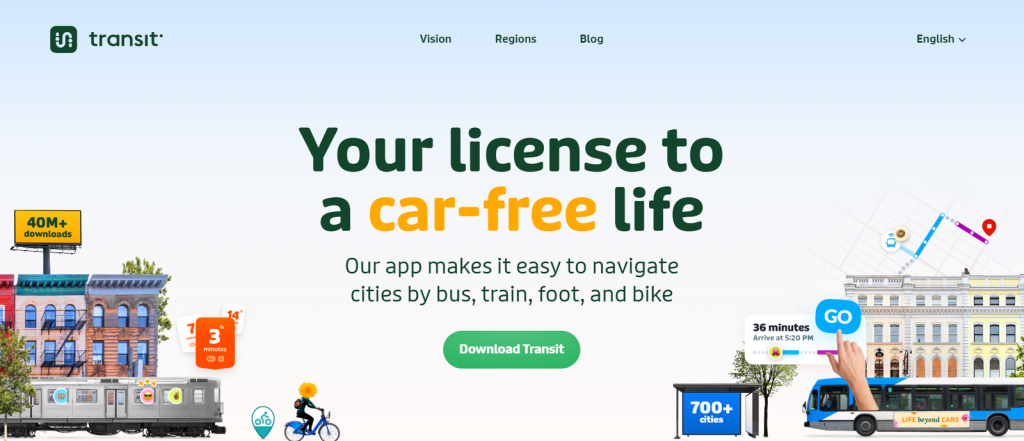
TransitApp is a mobile app that provides real-time data for commuters, including bus, subway, and ferry schedules. The app operates across 300+ cities worldwide, with over 10 million downloads on Android alone. It’s recognized as a top-tier app in the navigation category, ranking #4 in Apple’s navigation apps.
Historical Performance
TransitApp’s journey began in 2012, but it wasn’t until 2016 that they began seeing consistent monthly traffic in the 20-30K range. By 2023, they were poised for a breakthrough, and in April, they saw their traffic surge by 1,134%, reaching an unprecedented 669.8K monthly visits.

What sparked this remarkable growth? Let’s break it down.
Key Strategies that Fueled Traffic Growth
Ramping Up Content Production
Prior to 2021, TransitApp’s website had a relatively modest content base, with fewer than 200 pages. However, in 2023, the company took a strategic leap, expanding their website to 1,610 pages in just a matter of weeks. This dramatic increase was the result of a focused content strategy aimed at targeting highly specific, regional public transportation options, such as buses, subways, ferries, and even trams.
Each new page was carefully crafted to match the search intent of users seeking detailed information about local commuting options. For example, TransitApp created unique landing pages dedicated to specific bus routes, subway lines, and ferry schedules. These pages were rich with helpful information, including route maps, schedules, timetables, and FAQs.
The content was optimized for high-conversion keywords relevant to commuter needs in specific cities. By doing this, TransitApp not only enhanced user experience but also significantly increased its chances of ranking for long-tail keywords. As a result, the app was able to attract organic traffic from commuters who were looking for tailored, localized information.
Additionally, TransitApp ensured that each page was optimized for SEO with elements like title tags, meta descriptions, and header tags, all aligned with target keywords. This created a vast network of interconnected pages that appealed directly to the specific needs of users, ultimately driving more traffic to their site.
Leveraging Programmatic SEO
Scaling content production at such a rapid pace would be a logistical challenge for any company, but TransitApp leveraged the power of programmatic SEO to automate much of the process. Programmatic SEO involves using templates and automation tools to create a large number of pages at scale. Rather than manually writing each individual page, TransitApp fed data into automated systems that generated relevant, user-friendly pages using predefined templates.
The power of programmatic SEO lies in its ability to quickly produce highly customized content for a variety of locations, transportation modes, and schedules. For example, instead of creating a single page for “New York City’s Subway,” TransitApp was able to create individual pages for each subway line, route, and even specific stations. This method saved time and resources while ensuring that each page met the needs of a different subset of their audience.
To make this approach successful, TransitApp provided relevant, up-to-date data, ensuring that the content produced was both accurate and valuable to users. They used templates that included standard elements like route maps, station listings, and timetable information, all designed to deliver a seamless experience for users searching for specific transit information.
With the right data and tools, programmatic SEO allowed TransitApp to scale their content production significantly, improving their chances of ranking for more keywords and reaching more potential users. When implemented effectively, this approach can produce thousands of SEO-friendly pages with minimal manual effort, creating exponential growth in organic traffic.
Using FAQs to Capture Google’s “People Also Ask” Section
A key element in TransitApp’s content strategy was the integration of FAQs (Frequently Asked Questions) into their landing pages. This simple yet effective tactic helped them capitalize on Google’s People Also Ask (PAA) feature, a section that appears in search results with a list of related questions and answers.
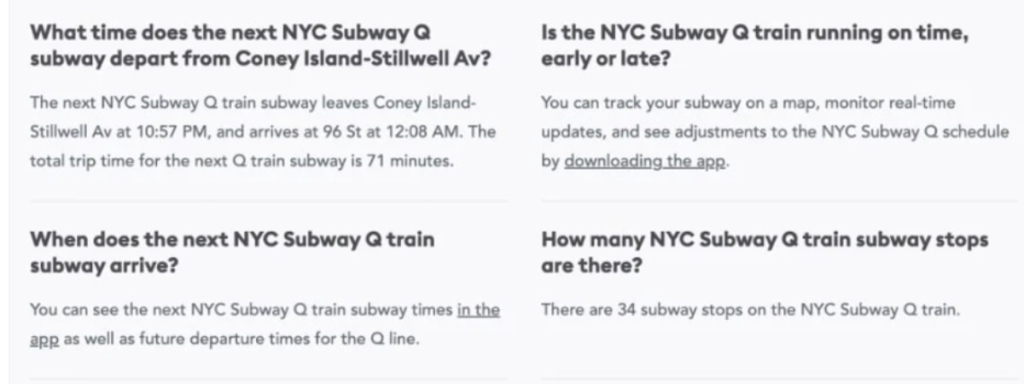
TransitApp’s strategy involved embedding specific, targeted questions on their landing pages that answered common queries about each transit route. These questions were carefully formulated to match search terms that users were likely to ask, such as “What time does the NYC Q train arrive?” or “How many stops are on the bus route 78 in Chicago?”
By optimizing these FAQs with concise, accurate answers and incorporating structured data (FAQ schema), TransitApp was able to earn coveted spots in the PAA section. This placement allowed them to appear in more prominent positions on the search results page, often directly above the regular organic listings.
Being featured in the PAA section is a powerful opportunity for driving traffic because it increases visibility and improves click-through rates (CTR). Since these answers appear right in the search results, users are more likely to click on the link to learn more, driving additional traffic to the website. In 2023, TransitApp ranked for over 11,000 keywords in PAA, greatly expanding their reach and reinforcing their authority in the transit space.
Acquiring High Authority Backlinks

Another critical factor in TransitApp’s SEO success was their backlink strategy. Backlinks from authoritative websites play a significant role in Google’s ranking algorithm, as they serve as “votes of confidence” for a website’s credibility and relevance. In 2023, TransitApp saw a substantial increase in the number of backlinks pointing to their site, with over 1.2 million backlinks by August alone.
The majority of these backlinks came from reputable and relevant sources within the public transit industry, such as local transit authorities, news outlets, and related organizations. This helped TransitApp build a strong, clean backlink profile, which is essential for ranking well in search results.
Importantly, many of these backlinks were dofollow, meaning that search engines could follow these links to discover new pages on TransitApp’s website and pass along valuable link equity. The backlinks were also relevant to their industry, ensuring that TransitApp’s content was endorsed by other trusted sources within the transportation and navigation sector.
In addition to acquiring high-quality backlinks, TransitApp ensured that their content was linked naturally, meaning that the anchor text used for the backlinks fit contextually within the content. This approach helped avoid any penalties from Google, which can occur if a site engages in link schemes or unnatural linking practices.
The result was a significant boost in domain authority and organic search rankings, which contributed directly to their traffic growth. By focusing on obtaining high-quality, relevant backlinks, TransitApp strengthened its credibility in the eyes of both users and search engines, which paid off in the form of higher rankings and increased organic traffic.
Key Takeaways
- Content Production: Expanding content to target a wide array of keywords enhances the chances of ranking and gaining traffic.
- Automation: Using programmatic SEO can help scale content production without compromising quality.
- FAQs for PAA: Optimizing for People Also Ask helps capture more search engine real estate and increase visibility.
- Backlink Strategy: High-quality, relevant backlinks are a powerful tool for improving domain authority and search rankings.
You can also read: How On The Map Marketing Took Filter King From Zero to $460k+
Final Thoughts
TransitApp’s case study exemplifies how a smart content strategy, combined with SEO automation, can lead to massive organic growth. Their journey proves that investing in targeted content, automation, and strong backlinks can yield impressive results for any digital business.
We received assistance from AIOSEO to create this case study. We made it more creative and informative for you. If you have any questions about this review or are interested in publishing your successful marketing case study, please drop us a message.

![Marketing Automation Case Study: 12 Real Examples, Strategy & ROI Results [2026]](https://marketingcasestudy.io/wp-content/uploads/2026/05/marketing-automation-case-study-featured-768x403.png "Marketing Automation Case Study: Real Examples, Strategy & ROI Results [2026] 7")