Identity is the new perimeter. That phrase has been repeated in security circles for years, but in 2026 it has moved from aspirational framing to operational reality. The traditional network boundary — the firewall that separated trusted internal systems from untrusted external ones — no longer meaningfully describes how organizations operate. Employees authenticate from home networks, coffee shops, and hotel lobbies. Applications live in AWS, Azure, and a dozen SaaS platforms simultaneously. Contractors access critical systems for 90-day engagements and need to be deprovisioned cleanly when they leave. Machine identities — service accounts, API keys, CI/CD pipelines — outnumber human identities by an order of magnitude in mature engineering organizations.
In this environment, identity management is not a supporting security function. It is the primary control plane through which every other security decision flows. Who can access what, under what conditions, verified how, and auditable to whom — the answers to those four questions define an organization’s actual security posture more accurately than its firewall rules or its vulnerability scan results.
The problem for security and IT teams is that the identity management market is vast, fragmented, and full of overlapping capabilities that make vendor selection genuinely difficult. SSO platforms have added PAM features. PAM vendors have added MFA. Directory services have added governance. CIEM tools have merged with IGA platforms. Choosing the wrong platform means either paying for capabilities you cannot operationalize or leaving gaps that attackers will eventually find.
This guide evaluates 12 identity management platforms across the full IAM spectrum. Every recommendation includes the specific security requirement and organizational context where that platform delivers the strongest outcome — and where you should look elsewhere.
Quick Comparison: Top 12 Identity Management Tools for 2026
| Platform | Primary Use | Starting Price | Free Tier | Best Feature | Our Rating |
| Okta | Workforce and customer identity | $2/user/mo | No (30-day trial) | Breadth of SSO integrations + lifecycle management | 9.3/10 |
| Microsoft Entra ID | Enterprise identity for Microsoft environments | Free / $6/user/mo | Yes (basic) | Native Azure and M365 integration | 9.1/10 |
| Ping Identity | Enterprise SSO and adaptive MFA | Custom pricing | No | Flexible deployment for complex hybrid environments | 8.9/10 |
| CyberArk | Privileged access management | Custom pricing | No | Industry-leading PAM for critical infrastructure | 9.2/10 |
| HashiCorp Vault | Secrets management and machine identity | Free (OSS) / Custom | Yes (OSS) | Developer-first secrets management at any scale | 9.1/10 |
| SailPoint | Identity governance and administration | Custom pricing | No | Automated access certification and IGA at enterprise scale | 9.0/10 |
| BeyondTrust | PAM and remote access security | Custom pricing | No | Unified privileged access and vendor management | 8.9/10 |
| Duo Security | MFA and zero trust access | Free / $3/user/mo | Yes (10 users) | Frictionless MFA with strong device trust | 9.0/10 |
| JumpCloud | Directory-as-a-service for SMBs | Free / $11/user/mo | Yes (10 users) | Cloud-native directory for non-Microsoft orgs | 8.9/10 |
| Auth0 (by Okta) | Customer identity and access management | Free / $23/mo | Yes (7,500 MAU) | Developer-first CIAM with extensive protocol support | 9.0/10 |
| Saviynt | Cloud-native IGA and PAM convergence | Custom pricing | No | Unified governance and privileged access in one platform | 8.8/10 |
| Delinea | PAM for mid-market organizations | Custom pricing | No | Accessible privileged access management without enterprise complexity | 8.7/10 |
How We Evaluated These Identity Management Platforms
Every platform in this guide was assessed across six dimensions that reflect the actual security and operational demands of identity management — not vendor-provided benchmark scores or analyst quadrant positions.
Security control depth: We evaluated whether each platform’s core security controls — authentication strength, authorization granularity, session management, and credential protection — are genuinely enterprise-grade or surface-level implementations that pass a checkbox audit without providing meaningful protection.
Integration breadth and reliability: Identity management platforms derive their value from the applications, directories, and infrastructure they connect. We evaluated the quality and reliability of integrations — not just the count of listed integrations, but whether the SCIM provisioning actually works, whether the SSO flows handle edge cases, and whether the audit logs contain the data needed for incident response.
Lifecycle management completeness: Provisioning is easy. Deprovisioning is where identity management fails. We specifically evaluated how each platform handles the full identity lifecycle — joiners, movers, and leavers — with particular attention to the deprovisioning workflows that prevent orphaned accounts from becoming attack vectors.
Zero trust alignment: The architecture of each platform was evaluated against zero trust principles: continuous verification, least-privilege access, device trust enforcement, and contextual access policies that adapt to risk signals rather than relying on static network location.
Operational complexity and time-to-value: An identity platform that requires 18 months to deploy and a dedicated team of three to operate does not deliver security value during that implementation window. We evaluated the realistic path from contract signature to meaningful security improvement for each platform.
Total cost of ownership: Identity management platform pricing is notoriously opaque. We evaluated the full cost picture — per-user licensing, module costs, implementation services, and ongoing operational overhead — relative to the security capability delivered.
Why the Identity Management Landscape Has Changed in 2026
Four developments define the identity management market in 2026 that distinguish it from even three years earlier.
The first is the explosion of machine identities. Service accounts, API keys, OAuth tokens, certificates, and CI/CD pipeline credentials now represent the majority of identities in most organizations. The human-focused identity management tools designed in the previous decade are increasingly inadequate for the machine identity problem. Platforms that handle both human and machine identity — HashiCorp Vault for secrets, CyberArk and BeyondTrust for privileged machine accounts — have become essential infrastructure rather than specialist tools.
The second is the convergence of IGA and PAM. Identity governance and administration — the practice of managing who has access to what and certifying that access periodically — and privileged access management — the practice of controlling and auditing high-risk access to critical systems — have historically been separate product categories with separate vendors. The leading platforms in both categories have moved toward convergence, recognizing that the governance and the control are more effective when unified. Saviynt’s convergence platform and CyberArk’s expanded governance capabilities reflect this market direction.
The third is the maturation of CIAM as a distinct discipline. Customer identity and access management has emerged as a genuinely separate practice from workforce IAM, with different requirements around scale (millions of external users vs. thousands of employees), friction tolerance (customers abandon registration flows; employees accept policy mandates), and consent management (GDPR, CCPA, and other privacy regulations impose specific requirements on customer data handling). Auth0 and Okta’s Customer Identity Cloud have defined this category and serve fundamentally different use cases than workforce identity platforms.
The fourth is the AI-driven shift in identity threat detection. Behavioral analytics that identify anomalous access patterns — the contractor downloading 10,000 files at 2 AM, the service account accessing a database it has never touched, the executive logging in from three countries in six hours — are now standard features in enterprise identity platforms rather than premium add-ons. These behavioral baselines are increasingly powered by machine learning models that improve with organizational data rather than relying on static rule sets.
Detailed Reviews: Best Identity Management Tools for 2026
1. Okta — Best Workforce Identity Platform for Breadth and Ecosystem
| Best For | Organizations that need comprehensive SSO, lifecycle management, and MFA across a complex SaaS application portfolio |
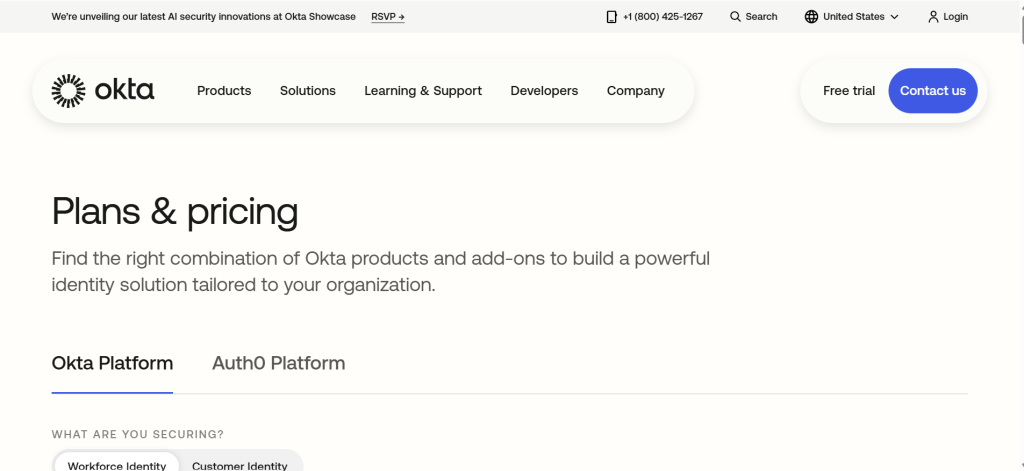
| Pricing | Workforce Identity from $2/user/mo. Advanced MFA $3/user/mo. Lifecycle Management $4/user/mo. Governance additional |
| Free Tier | No — 30-day free trial |
| Key Strengths | 7,000+ pre-built application integrations, automated lifecycle management, adaptive MFA, Universal Directory, robust API, Okta Workflows no-code automation |
| Key Weaknesses | Cost escalates quickly with added modules, high-profile breach history (2022–2023) affected trust, complex licensing model |
| Best For Orgs | Mid-market to enterprise organizations with diverse SaaS portfolios and cloud-first architecture |
| Deployment | Cloud SaaS |
| Zero Trust Support | Strong — adaptive access policies, device trust, continuous re-evaluation |
| Best Pairing | CyberArk for PAM, SailPoint for IGA, Okta’s own PAM and governance modules for unified stack |
Okta built its market leadership on one foundational insight: the value of an identity platform scales with the number of applications it connects. With over 7,000 pre-built integrations in the Okta Integration Network, the practical reality for most organizations is that every application they use is already supported. The IT engineer who would otherwise spend days building a SAML integration for a new SaaS tool can complete the Okta connection in under an hour using a pre-configured template. At scale, across dozens of application additions and changes per year, this integration breadth compounds into significant operational leverage.
The lifecycle management capability automates the joiner-mover-leaver workflow that represents both the highest operational volume and the highest risk surface in enterprise identity management. When a new employee is created in Workday, Okta provisions accounts in every application that person’s role requires — automatically, within minutes, with the correct access levels determined by role mapping rules rather than manual ticket processing. When that employee changes departments, access adjusts. When they terminate, every account is deprovisioned simultaneously. The orphaned account — the terminated employee’s credentials that remain active because someone forgot to submit an IT ticket — is one of the most common paths to credential-based breaches, and automated lifecycle management eliminates it structurally.
Okta Workflows, the platform’s no-code automation engine, extends lifecycle management into custom business logic that standard provisioning rules cannot handle. Multi-step approval workflows for sensitive access requests, conditional access grants that require manager approval above a certain permission level, automatic access reviews triggered by risk signals — these workflows are built in a visual interface without code, making complex identity logic accessible to identity administrators who are not developers.
Where Okta Falls Short
Okta’s modular pricing model means that the cost of a comprehensive implementation — SSO plus adaptive MFA plus lifecycle management plus governance plus PAM — escalates significantly beyond the entry-level per-user pricing. Organizations that purchase Okta for basic SSO and then discover they need the Lifecycle Management and Governance modules often face total costs that were not apparent in the initial purchase decision. The platform’s 2022 and 2023 security incidents, while addressed, created lasting reputational damage that security-sensitive organizations factor into their evaluation. Organizations in highly regulated industries sometimes prefer on-premises or hybrid deployment options that Okta’s cloud-only architecture does not support.
The Verdict on Okta
Okta is the right workforce identity platform for cloud-first organizations with diverse SaaS portfolios that need comprehensive SSO, automated lifecycle management, and adaptive MFA from a single platform. The integration breadth is genuinely unmatched, and the operational leverage of automated provisioning and deprovisioning delivers measurable security improvement from the first month of deployment. Budget carefully for the modular licensing, and evaluate whether Okta’s own PAM and governance modules or best-of-breed alternatives better serve your specific compliance requirements.
2. Microsoft Entra ID — Best Identity Platform for Microsoft-Centric Organizations
| Best For | Organizations running Microsoft 365 and Azure who want native identity management without additional vendor complexity |
| Pricing | Free (basic Azure AD). P1 $6/user/mo. P2 $9/user/mo (includes PIM and Identity Protection) |
| Free Tier | Yes — basic SSO and MFA for Azure and M365 applications |
| Key Strengths | Native M365 and Azure integration, Privileged Identity Management (PIM), Conditional Access, Identity Protection with risk-based policies, Entra Verified ID, massive scale |
| Key Weaknesses | Complex licensing across the Microsoft stack, configuration complexity for advanced features, less effective for non-Microsoft SaaS portfolios, UI/UX less intuitive than Okta |
| Best For Orgs | Microsoft 365-dependent organizations, Azure-hosted workloads, hybrid on-premises and cloud environments |
| Deployment | Cloud SaaS with hybrid connectivity to on-premises Active Directory |
| Zero Trust Support | Very strong — Microsoft’s zero trust architecture is built around Entra ID as the control plane |
| Best Pairing | Microsoft Sentinel for identity threat detection, Microsoft Defender for Endpoint for device compliance, CyberArk or Delinea for enhanced PAM |
Microsoft Entra ID — formerly Azure Active Directory — occupies a structurally advantaged position for organizations that have already committed to the Microsoft ecosystem. For any organization running Microsoft 365, the identity layer is already present, already licensed at some tier, and already integrated with every Microsoft application in the portfolio. The decision for these organizations is not whether to use Entra ID but how deeply to invest in its more advanced capabilities and whether to supplement it with specialist tools for PAM and governance.
Privileged Identity Management (PIM), available in the P2 license tier, implements just-in-time privileged access for Azure and M365 admin roles. Instead of maintaining standing privileged accounts that represent persistent attack surface, PIM allows administrators to elevate to privileged roles for time-limited sessions with full audit logging and optional approval workflows. The security improvement from eliminating standing privileged access is significant — the majority of identity-based breaches exploit standing privileges rather than requiring attackers to escalate access. PIM’s just-in-time model removes the persistent target.
Conditional Access policies are where Entra ID’s zero trust implementation delivers its most practical value for IT and security teams. Policies evaluate real-time risk signals — device compliance state, sign-in risk score, user risk score, location, application sensitivity — and enforce appropriate access controls ranging from MFA prompts to complete access blocking. A user signing in from an unfamiliar location on an unmanaged device attempting to access sensitive financial data can be blocked entirely while the same user on a compliant managed device from their normal location gets seamless access. This risk-adaptive enforcement is the operational expression of zero trust principles.
Where Microsoft Entra ID Falls Short
Entra ID’s advantage becomes a limitation outside the Microsoft ecosystem. SSO integrations for non-Microsoft SaaS applications work through standard SAML and OIDC protocols, but the management experience, troubleshooting tools, and pre-built integration quality for third-party applications do not match the depth of the Microsoft-native experience. Organizations with large, diverse SaaS portfolios that extend well beyond Microsoft applications often find Okta’s integration network provides better practical coverage. The licensing model — with meaningful capability differences between Free, P1, and P2 — requires careful evaluation to understand what capabilities are actually included at each tier.
The Verdict on Microsoft Entra ID
Microsoft Entra ID is the right identity foundation for organizations deeply invested in Microsoft 365 and Azure. The P2 tier’s combination of PIM, Identity Protection, and Conditional Access provides enterprise-grade identity security that matches or exceeds standalone identity platforms at a price point that is often already included in Microsoft E5 licensing. Organizations that have not maximized the identity capabilities included in their existing Microsoft licensing before evaluating additional identity vendors are leaving significant security value unrealized.
3. CyberArk — Best Privileged Access Management Platform for Critical Infrastructure
| Best For | Enterprises and critical infrastructure organizations that need the most comprehensive, auditable privileged access management available |
| Pricing | Custom enterprise pricing; typically $50,000–$500,000+/year depending on scope |
| Free Tier | No — enterprise sales process required |
| Key Strengths | Industry-leading PAM depth, credential vaulting, session isolation and recording, just-in-time access, secrets management, cloud and DevOps PAM, workforce identity acquisition |
| Key Weaknesses | High implementation complexity and cost, requires dedicated PAM expertise to operate effectively, significant ongoing operational overhead |
| Best For Orgs | Financial services, healthcare, government, critical infrastructure, and any enterprise where privileged account compromise is a material risk |
| Deployment | On-premises, cloud, and hybrid |
| Zero Trust Support | Very strong — CyberArk’s architecture implements least privilege, just-in-time access, and continuous session monitoring |
| Best Pairing | Okta or Entra ID for workforce SSO, SailPoint for IGA, SIEM platforms for privileged session log forwarding |
CyberArk has occupied the leadership position in privileged access management for over two decades, and the depth of its PAM capability reflects that accumulated development focus. The platform’s core architecture — a hardened credential vault that stores privileged credentials encrypted and inaccessible to administrators without explicit checkout procedures, combined with session isolation that proxies privileged connections through CyberArk infrastructure rather than allowing direct system access — represents the most mature implementation of privileged access control available in the market.
The Privileged Session Manager captures video recordings of every privileged session alongside keystroke logs, command histories, and file transfer records. For organizations subject to audit requirements — PCI DSS, SOX, HIPAA, NERC CIP — the ability to produce a complete, searchable record of every action taken during a privileged session significantly reduces audit burden and provides forensic capability that is invaluable during incident response. When a critical database is compromised and the investigation requires understanding every command executed against that system in the preceding 90 days, CyberArk’s session records provide the answer.
The Just-in-Time access capabilities extend CyberArk’s privileged access model to cloud infrastructure, DevOps pipelines, and ephemeral workloads where traditional standing privileged accounts are architecturally inappropriate. Infrastructure engineers can request temporary elevated access to a production environment, with that access automatically provisioned, time-limited, fully logged, and automatically revoked — without human approval overhead for routine operations, and with approval workflows for higher-risk access requests.
Where CyberArk Falls Short
CyberArk’s comprehensive capability comes with proportionate implementation complexity. Successful CyberArk deployments require experienced PAM architects, significant professional services investment, and ongoing operational expertise that most organizations need to develop through dedicated training or retain through managed services. Organizations that purchase CyberArk expecting to self-implement without expertise frequently end up with a partially deployed system that provides less security value than a simpler, fully deployed alternative. The licensing cost is also enterprise-tier, and organizations below a certain maturity level — where basic MFA and lifecycle management have not yet been implemented — will realize more security improvement per dollar from foundational controls.
The Verdict on CyberArk
CyberArk is the right privileged access management platform for enterprises where privileged account compromise represents a material risk — financial services protecting transaction systems, healthcare protecting patient data systems, critical infrastructure protecting operational technology, and any organization where a successful privileged account attack has catastrophic business consequences. For organizations below that risk profile or maturity level, Delinea or BeyondTrust provide meaningful PAM capability at lower implementation complexity and cost.
4. HashiCorp Vault — Best Secrets Management Platform for Developer and Cloud-Native Environments
| Best For | Engineering teams that need centralized secrets management for applications, infrastructure, and CI/CD pipelines |
| Pricing | Open Source (free, self-hosted). HCP Vault Dedicated from $0.03/hr. Enterprise custom pricing |
| Free Tier | Yes — open source version is fully featured for self-hosted deployments |
| Key Strengths | Dynamic secrets generation, fine-grained secret leasing and renewal, multiple authentication methods, cloud-agnostic, extensive secrets engine library, strong CLI and API, Vault Agent for application integration |
| Key Weaknesses | Operational complexity of self-hosted deployment, requires engineering expertise to implement well, open source version lacks enterprise HA features, UI less intuitive than commercial alternatives |
| Best For Orgs | Engineering-led organizations, cloud-native companies, DevOps and platform engineering teams |
| Deployment | Self-hosted (OSS), HashiCorp Cloud Platform (managed), or enterprise on-premises |
| Zero Trust Support | Strong for machine identity — dynamic secrets eliminate standing credentials |
| Best Pairing | Okta or Entra ID for human identity, Kubernetes secrets integration for container workloads, Terraform for infrastructure-as-code secrets injection |
HashiCorp Vault addresses the identity management problem that most human-focused IAM platforms are architecturally unable to solve: secrets management for machines, applications, and automated processes. Every application that connects to a database, every CI/CD pipeline that deploys infrastructure, every microservice that calls an external API requires credentials — and those credentials, if managed poorly, become some of the most dangerous attack vectors in a modern technology environment. Hardcoded credentials in source code, long-lived API keys stored in environment variables, and shared service account passwords that have not rotated in three years are the machine identity equivalent of Post-it note passwords.
Vault’s dynamic secrets model fundamentally changes the risk profile of application credentials. Instead of issuing long-lived database credentials that an application stores and uses indefinitely, Vault generates unique, short-lived credentials on demand when an application requests access. The database credentials used by a microservice instance have a 1-hour TTL. When the instance terminates or the TTL expires, those credentials are automatically revoked. The blast radius of a credential compromise shrinks from “attacker has persistent database access” to “attacker has database access for the remaining TTL of a specific credential set.”
The secrets engine library covers the breadth of the modern infrastructure landscape. AWS, Azure, and GCP secret engines generate cloud provider credentials dynamically. Database secret engines support PostgreSQL, MySQL, MongoDB, and dozens of other databases. PKI secret engines issue X.509 certificates with appropriate TTLs. SSH secret engines issue signed SSH certificates for server access. For platform engineering teams building the internal developer platform, Vault provides the secure secrets layer that every internal tool can leverage through a consistent API rather than each team building their own credential management approach.
Where HashiCorp Vault Falls Short
Vault’s open source version requires operational expertise to deploy, configure, and maintain at production reliability standards. High availability configurations, disaster recovery, performance replication, and monitoring require engineering investment that organizations without experienced platform engineers may underestimate. The UI is functional but significantly less intuitive than commercial alternatives for users who prefer a graphical management experience. Organizations without dedicated platform engineering teams may find that HCP Vault — HashiCorp’s managed cloud offering — eliminates the operational burden at a predictable cost, or that a simpler secrets management tool better fits their maturity level.
The Verdict on HashiCorp Vault
HashiCorp Vault is the best secrets management platform for engineering-led organizations that need comprehensive machine identity security across cloud-native infrastructure and application deployments. The open source version is a legitimate production-grade option for organizations with the engineering expertise to operate it. For organizations building a zero trust architecture, Vault for machine identity alongside Okta or Entra ID for human identity covers the two most critical dimensions of the identity control plane.
5. SailPoint — Best Identity Governance and Administration Platform for Enterprise Compliance
| Best For | Enterprise organizations that need automated access certification, role management, and identity governance at scale for regulatory compliance |
| Pricing | Custom enterprise pricing; IdentityNow SaaS and IdentityIQ on-premises available |
| Free Tier | No |
| Key Strengths | AI-driven access recommendations, automated access certification campaigns, role mining and management, policy enforcement, separation of duties, regulatory compliance reporting |
| Key Weaknesses | High implementation complexity, significant professional services investment required, best realized with dedicated IGA program resources |
| Best For Orgs | Financial services, healthcare, public sector, and large enterprises with SOX, HIPAA, or other regulatory compliance requirements |
| Deployment | SaaS (IdentityNow) or on-premises (IdentityIQ) |
| Zero Trust Support | Strong governance layer — ensures access decisions are defensible and continuously reviewed |
| Best Pairing | Okta or Entra ID for SSO and provisioning, CyberArk for PAM, HR systems for joiner-mover-leaver triggers |
SailPoint built its market position around a problem that authentication and SSO platforms do not solve: knowing, at any given moment, exactly who has access to what across an organization — and being able to certify that every access grant is appropriate, authorized, and compliant with policy. For organizations subject to SOX, HIPAA, PCI DSS, or other regulatory frameworks that require formal access controls and periodic access reviews, this governance capability is not optional. The question is whether it is implemented through a purpose-built IGA platform or through manual processes that create audit risk.
The AI-driven access recommendations change the economics of access certification fundamentally. Traditional access certification campaigns require managers to review lists of their employees’ access and certify each item — a process that, applied conscientiously, requires significant time and, applied superficially, provides no real assurance. SailPoint’s AI analyzes peer access patterns, role definitions, and historical certification decisions to recommend certify or revoke decisions for each access item. The reviewer sees not just the access item but the AI’s recommendation and its reasoning. This transforms certification from a rubber-stamp exercise into a risk-focused review where human attention concentrates on the genuinely anomalous access rather than routine confirmations.
Role mining uses the same analytical engine to identify natural access clusters across the organization — the set of permissions that 90 percent of engineers have in common, the access pattern that distinguishes an analyst from a senior analyst — and proposes formalized roles from those empirical patterns. This bottom-up role definition approach produces roles that reflect actual work patterns rather than the theoretical org chart, and the resulting role-based access model is significantly more maintainable than individual entitlement assignments.
Where SailPoint Falls Short
SailPoint is a governance platform, not an authentication platform. Organizations that select SailPoint expecting it to replace their SSO or MFA solution will find it incomplete for that use case. The platform’s value is maximized when it sits above an existing authentication and provisioning infrastructure — Okta or Entra ID handling the authentication and directory layer, SailPoint governing the access decisions made against that layer. Implementation complexity and professional services investment are significant. Organizations without a dedicated IGA program and executive sponsorship rarely realize SailPoint’s full value, and implementations that fail to achieve adoption typically stall at access certification campaigns without progressing to the strategic governance capabilities that justify the investment.
The Verdict on SailPoint
SailPoint is the right identity governance platform for enterprises with regulatory compliance requirements that mandate formal, auditable access controls and periodic access certification. The AI-driven access recommendations and role mining capabilities reduce the operational overhead of running a meaningful IGA program at scale. Organizations evaluating SailPoint should budget honestly for implementation services and plan for a multi-year program investment — the security and compliance value is real, but it requires program commitment to realize.
6. BeyondTrust — Best PAM Platform for Unified Privileged Access and Remote Vendor Management
| Best For | Organizations that need PAM combined with secure remote access management for vendors, contractors, and third parties |
| Pricing | Custom pricing based on modules and scale |
| Free Tier | No |
| Key Strengths | Privileged Remote Access for vendor management, Password Safe for credential vaulting, Endpoint Privilege Management for workstation least privilege, strong session management and recording |
| Key Weaknesses | Multi-product architecture can feel disjointed, implementation complexity for full platform deployment, less depth than CyberArk for advanced PAM scenarios |
| Best For Orgs | Organizations with significant third-party access requirements, manufacturing and OT environments, mid-to-large enterprises |
| Deployment | On-premises, cloud, and hybrid |
| Zero Trust Support | Strong — least privilege, session isolation, and vendor access controls align with zero trust principles |
| Best Pairing | Okta or Entra ID for workforce identity, SIEM platforms for privileged session log integration |
BeyondTrust’s differentiation within the PAM market is its strength in third-party and vendor access management — the specific privileged access scenario where organizations provide external parties with access to internal systems for maintenance, support, or managed service delivery. This is one of the most dangerous and undercontrolled identity attack surfaces in most organizations. Third-party access is often granted through VPN connections that provide broader network access than the vendor needs, with shared credentials that cannot be attributed to specific individuals, and without session monitoring that would detect unauthorized activity.
Privileged Remote Access replaces this approach with a vendor access model built on least-privilege principles. Vendors access only the specific systems they require, through a web-based access portal that requires no VPN client or remote access software on their end. Sessions are isolated, recorded, and attributable to specific vendor users. Time-limited access can be granted for specific maintenance windows and automatically revoked when the window closes. For organizations managing dozens of third-party vendor relationships with access to critical systems, this control replaces one of the most commonly exploited access paths with an auditable, least-privilege alternative.
Endpoint Privilege Management addresses the workstation-level privileged access problem that PAM vaulting alone does not solve. Standard users operating with local administrator rights — a common configuration in many organizations — represent a persistent lateral movement risk. BeyondTrust’s EPM removes local admin rights from standard users while providing just-in-time elevation for specific approved applications and tasks. The workstation attack surface shrinks substantially when users cannot install arbitrary software or modify system configurations.
Where BeyondTrust Falls Short
BeyondTrust’s product portfolio is the result of multiple acquisitions, and the integration between products — Privileged Remote Access, Password Safe, and Endpoint Privilege Management — reflects that history in some areas of the management experience. Organizations looking for the deepest, most integrated PAM architecture will find CyberArk’s more unified platform more capable for complex enterprise scenarios. BeyondTrust’s sweet spot is organizations with specific third-party access or endpoint privilege requirements where its differentiated capabilities are the primary driver.
The Verdict on BeyondTrust
BeyondTrust is the right PAM platform for organizations where third-party vendor access and endpoint privilege management are the primary identity risk drivers. The Privileged Remote Access capability in particular addresses a risk that most PAM platforms do not handle as comprehensively. For organizations with large managed service provider relationships, significant contractor populations, or OT environments with third-party maintenance requirements, BeyondTrust provides a stronger vendor access security model than any comparable platform.
7. Duo Security — Best MFA and Zero Trust Access Platform for Fast Deployment
| Best For | Organizations of any size that need reliable, user-friendly MFA and device trust enforcement deployed quickly |
| Pricing | Free (up to 10 users). Essentials $3/user/mo. Advantage $6/user/mo. Premier $9/user/mo |
| Free Tier | Yes — up to 10 users with core MFA functionality |
| Key Strengths | Fastest MFA deployment in the category, excellent user experience, Duo Push authentication, device health checks, VPN and on-premises application integration, extensive documentation |
| Key Weaknesses | Less comprehensive than full IAM platforms for SSO and lifecycle management, Cisco acquisition has slowed some innovation, advanced features require higher tiers |
| Best For Orgs | Organizations of all sizes deploying MFA as a primary security control, environments with on-premises applications requiring MFA |
| Deployment | Cloud SaaS with on-premises proxy for legacy application support |
| Zero Trust Support | Strong for device trust and authentication — integrates with broader zero trust architecture as the verification layer |
| Best Pairing | Okta or Entra ID for SSO, any SIEM for authentication event logging |
Duo Security’s market position rests on two capabilities: the best MFA user experience in the category and the fastest path from purchase to deployed, functioning MFA across an organization. The Duo Push authentication flow — a mobile notification that the user approves with a single tap — has become the reference implementation for user-friendly strong authentication. The adoption rates organizations achieve with Duo Push consistently exceed those of competing MFA implementations because the friction is low enough that users do not route around it.
The device trust capability extends MFA from “who is this person?” to “what device are they using?” Duo’s Device Health Application assesses endpoint security posture — OS patch level, disk encryption status, firewall state, screen lock configuration — and can block or prompt for additional authentication when device health falls below defined thresholds. A user authenticating with valid credentials from an unmanaged personal device with an unpatched OS can be blocked from accessing sensitive applications while the same user on a company-managed, fully patched device gets seamless access. This device trust layer is a core zero trust enforcement mechanism that pure credential-based MFA cannot provide.
The coverage breadth for on-premises applications is where Duo differentiates from cloud-first IAM platforms. Organizations with legacy on-premises applications — ERP systems, clinical systems, manufacturing control systems — that predate modern identity federation protocols can integrate MFA through Duo’s proxy architecture without modifying the applications themselves. For organizations with hybrid technology environments that include significant on-premises infrastructure, this backward compatibility is operationally significant.
Where Duo Security Falls Short
Duo is an MFA and device trust platform, not a comprehensive IAM platform. It does not handle SSO for cloud applications, automated lifecycle management, identity governance, or privileged access management. Organizations that need only strong MFA deployed quickly will find Duo excellent. Organizations that need a broader identity platform will find Duo most valuable as the authentication enforcement layer within a larger identity architecture anchored by Okta, Entra ID, or a comparable platform. The Cisco acquisition has also created some market uncertainty about the product roadmap, with some organizations preferring Okta’s or Entra ID’s native MFA capabilities to reduce vendor complexity.
The Verdict on Duo Security
Duo Security is the right MFA platform for organizations that need to deploy strong authentication quickly, that have on-premises application portfolios requiring MFA without protocol modernization, or that are specifically focused on the device trust enforcement layer of a zero trust architecture. The free tier for 10 users makes it accessible for initial evaluation. For organizations already committed to Okta or Entra ID as their primary identity platform, evaluating the native MFA capabilities of those platforms before adding Duo to the stack is worth doing.
8. JumpCloud — Best Cloud Directory for Non-Microsoft Environments
| Best For | Small to mid-market organizations that need a cloud-native directory service without a Microsoft Active Directory dependency |
| Pricing | Free (up to 10 users and 10 devices). Platform Plus $11/user/mo. Platform Prime $19/user/mo |
| Free Tier | Yes — 10 users and 10 devices with full platform features |
| Key Strengths | Cloud-native directory replacing Active Directory, cross-OS device management (Windows, Mac, Linux), SSO, MFA, RADIUS, LDAP, SCIM, zero trust policies |
| Key Weaknesses | Less mature ecosystem than Microsoft or Okta, some enterprise features still developing, limited PAM and IGA capabilities |
| Best For Orgs | SMBs and mid-market organizations, Mac-first or Linux-heavy engineering environments, companies avoiding Microsoft ecosystem dependency |
| Deployment | Cloud SaaS |
| Zero Trust Support | Strong for SMB scale — device trust, conditional access, and continuous verification built in |
| Best Pairing | Any cloud application portfolio for SSO, endpoint management tools for deeper device management |
JumpCloud addresses the fundamental infrastructure dependency that many small and mid-market organizations have historically accepted as unavoidable: Active Directory. For decades, Active Directory was the only credible directory service, which meant Windows infrastructure was effectively mandatory for any organization that needed centralized identity management. JumpCloud built a cloud-native directory service that replicates Active Directory’s core functions — user authentication, device management, policy enforcement, group management — without requiring on-premises Windows infrastructure.
The cross-platform device management capability is particularly valuable for organizations with heterogeneous environments. JumpCloud manages Windows, macOS, and Linux devices from the same console, applying policies, pushing software, and enforcing security configurations across all operating systems without separate management tools for each platform. For engineering organizations where Linux servers and macOS developer workstations are primary endpoints alongside Windows devices, this unified management eliminates the operational fragmentation of managing each platform through separate tools.
The SSO and LDAP/RADIUS integration capabilities mean JumpCloud functions as a complete identity infrastructure for organizations that do not require the scale or compliance depth of enterprise platforms. A 200-person technology company running on AWS with a macOS-heavy engineering team and a Google Workspace-based productivity stack can replace the entire legacy Active Directory and on-premises infrastructure with JumpCloud — cloud-hosted, zero on-premises infrastructure, managing identity and device compliance from a single console.
Where JumpCloud Falls Short
JumpCloud’s capabilities are appropriately scaled for SMB and mid-market organizations and begin to show limitations at enterprise scale. The governance and compliance capabilities do not match SailPoint or Saviynt for organizations with formal IGA requirements. The PAM capabilities do not match CyberArk or BeyondTrust for organizations managing critical privileged access. Larger enterprises with complex compliance requirements or sophisticated privilege management needs will find JumpCloud insufficient and should evaluate Okta or Entra ID alongside specialist PAM and IGA tools. The 10-user free tier is genuinely useful for evaluation and small initial deployments.
The Verdict on JumpCloud
JumpCloud is the best identity platform for small to mid-market organizations that want cloud-native directory services, cross-platform device management, SSO, and MFA without Active Directory dependency or enterprise licensing overhead. For Mac-first or Linux-heavy engineering organizations that have historically managed identity through fragmented tools, JumpCloud provides a unified identity layer at a price point and implementation complexity level that enterprise platforms cannot match.
9. Auth0 (by Okta) — Best Customer Identity and Access Management Platform for Developers
| Best For | Development teams building customer-facing applications that need flexible, developer-friendly CIAM with extensive protocol and social login support |
| Pricing | Free (7,500 MAU). Essentials from $23/mo. Professional from $240/mo. Enterprise custom |
| Free Tier | Yes — 7,500 monthly active users with core CIAM features |
| Key Strengths | Developer-first design, universal login, extensive social and enterprise connection support, machine-to-machine tokens, Actions for custom logic, anomaly detection, strong documentation |
| Key Weaknesses | Pricing escalates sharply with MAU growth, complex pricing model, enterprise features require higher tiers, some features removed post-Okta acquisition |
| Best For Orgs | SaaS companies, consumer applications, B2B platforms, any developer team building external-facing authentication |
| Deployment | Cloud SaaS with private cloud options at enterprise tier |
| Zero Trust Support | CIAM-focused — anomaly detection, bot detection, breached password detection |
| Best Pairing | Any backend framework or language through Auth0 SDKs, Okta for internal workforce identity alongside Auth0 for customer identity |
Auth0 operates in a fundamentally different domain from workforce identity platforms. Where Okta and Entra ID manage the identities of employees — a population of thousands with high trust, strong policy enforcement leverage, and tolerance for friction — Auth0 manages the identities of customers, a population of potentially millions with low trust, no policy enforcement leverage, and minimal tolerance for any friction that leads to abandoned registration flows. The design priorities of a consumer CIAM platform are genuinely different from a workforce IAM platform, and Auth0 was purpose-built for the consumer and developer-facing use case.
The developer experience is the platform’s defining characteristic. Auth0 provides SDK coverage for virtually every programming language and framework. The Universal Login component handles the authentication UI, rendering consistently across devices and browsers without each development team building and maintaining their own authentication pages. The Actions framework allows developers to inject custom JavaScript logic at specific points in the authentication flow — post-login enrichment, pre-registration validation, MFA step-up triggers — without modifying the core Auth0 platform. For teams that have previously built and maintained custom authentication infrastructure, Auth0 eliminates an ongoing engineering maintenance burden that provides no competitive differentiation.
The social login integration covers the full range of identity providers that consumer applications need to support. Google, Apple, Facebook, GitHub, LinkedIn, Twitter, and dozens of others are available as pre-configured connections. Enterprise SSO connections for B2B SaaS applications — where enterprise customers want to authenticate their employees through their own corporate identity provider — are handled through the same configuration interface. A SaaS platform supporting both individual consumers and enterprise customers can configure both use cases within a single Auth0 tenant.
Where Auth0 Falls Short
Auth0’s pricing model scales with monthly active users, and the escalation from the free tier through Professional and Enterprise can be steep for applications with large user bases. Organizations building applications that expect millions of active users need to model the fully loaded Auth0 cost carefully before committing to the platform at scale. The Okta acquisition has also created some feature and roadmap uncertainty — several features present before the acquisition have been modified or deprecated. For workforce identity use cases, Auth0 is the wrong tool; the Okta Workforce Identity Cloud serves that use case, and the two platforms are intentionally distinct.
The Verdict on Auth0
Auth0 is the best CIAM platform for development teams building customer-facing applications who want to eliminate the engineering overhead of building and maintaining custom authentication infrastructure. The 7,500 MAU free tier enables meaningful development and early production use without cost. Organizations building B2B SaaS platforms where enterprise SSO for customer organizations is a requirement will find Auth0’s enterprise connection support particularly valuable.
10. Saviynt — Best Converged IGA and PAM Platform for Cloud-First Organizations
| Best For | Organizations that want identity governance and privileged access management from a single cloud-native platform rather than separate best-of-breed products |
| Pricing | Custom enterprise pricing |
| Free Tier | No |
| Key Strengths | Converged IGA and PAM in a single platform, cloud-native architecture, application access governance, cloud infrastructure entitlement management (CIEM), strong SaaS application governance |
| Key Weaknesses | Younger platform with smaller customer base than SailPoint or CyberArk, PAM depth less mature than CyberArk for complex infrastructure scenarios |
| Best For Orgs | Cloud-first enterprises, organizations standardizing on SaaS, organizations that want IGA and PAM under a single contract and management interface |
| Deployment | Cloud SaaS |
| Zero Trust Support | Strong — converged governance and access control supports continuous authorization principles |
| Best Pairing | Okta or Entra ID for SSO, cloud providers’ native IAM for infrastructure access alongside Saviynt governance |
Saviynt’s core proposition is the convergence of identity governance and privileged access management — two capabilities that have historically required separate platforms from separate vendors — into a single cloud-native platform. For organizations building or modernizing their identity security program, this convergence has practical operational appeal: a single administrative interface, a single data model connecting governance decisions to access controls, and a single vendor relationship rather than the integration overhead of connecting SailPoint to CyberArk.
The Cloud Infrastructure Entitlement Management (CIEM) capability addresses the cloud identity sprawl problem that is unique to organizations with significant AWS, Azure, or GCP footprints. Cloud IAM — the permissions granted to human users, roles, and machine identities within cloud infrastructure — tends toward over-provisioning in practice, because the granularity of cloud permissions is high and the path of least resistance during development is granting broad permissions that get the work done. CIEM continuously analyzes cloud entitlements against actual usage, identifies permissions that have never been used, and recommends right-sizing that reduces cloud attack surface without impacting operational functionality.
The SaaS application governance capabilities extend identity governance beyond traditional enterprise applications to the long tail of SaaS applications that most IGA platforms struggle to cover comprehensively. Shadow IT discovery, combined with access governance for discovered applications, gives security teams visibility into and control over the identity risk that unmanaged SaaS adoption creates.
Where Saviynt Falls Short
Saviynt’s PAM capabilities, while functional and improving, do not match the depth of CyberArk or BeyondTrust for complex privileged access scenarios in heterogeneous on-premises infrastructure. Organizations with demanding PAM requirements — OT environments, mainframe access, complex Unix privilege management — may find Saviynt’s PAM module insufficient and need to supplement or replace it with a specialist PAM platform. As a younger platform, Saviynt has a smaller customer reference base than established players, which creates some evaluation uncertainty for organizations in conservative industries.
The Verdict on Saviynt
Saviynt is the right platform for cloud-first enterprises that want to converge IGA and PAM under a single cloud-native platform rather than managing separate products. The CIEM capability is particularly differentiated for organizations with significant cloud infrastructure footprints where cloud entitlement sprawl is a recognized risk. Organizations with complex on-premises infrastructure requiring deep PAM capabilities should evaluate whether Saviynt’s PAM depth is sufficient or whether a best-of-breed PAM supplement is necessary.
11. Delinea — Best PAM Platform for Mid-Market Organizations
| Best For | Mid-market organizations that need meaningful privileged access management without the implementation complexity and cost of CyberArk |
| Pricing | Custom pricing; generally positioned below CyberArk for equivalent scope |
| Free Tier | No — trial available |
| Key Strengths | Secret Server for credential vaulting, Privilege Manager for endpoint least privilege, cloud-native options, faster implementation than enterprise PAM alternatives, reasonable mid-market pricing |
| Key Weaknesses | Less feature depth than CyberArk for advanced enterprise scenarios, smaller integration ecosystem, less brand recognition in enterprise evaluations |
| Best For Orgs | Mid-market organizations (200–5,000 employees), organizations beginning their PAM program, companies that found CyberArk over-engineered for their needs |
| Deployment | On-premises, cloud, and hybrid |
| Zero Trust Support | Strong for mid-market — least privilege, credential vaulting, and session management align with zero trust principles |
| Best Pairing | Okta or Entra ID for workforce SSO, any SIEM for privileged session log integration |
Delinea — formed from the merger of Thycotic and Centrify — occupies the mid-market PAM position that CyberArk’s enterprise complexity and pricing does not serve well. For the organization managing 500 to 5,000 employees with privileged access requirements that are real but not at the complexity level of critical national infrastructure, Delinea provides the credential vaulting, session management, and endpoint privilege management capabilities that constitute a meaningful PAM program — without the implementation project that CyberArk requires.
Secret Server, Delinea’s credential vaulting product, provides the core PAM capability — encrypted storage of privileged credentials, controlled checkout procedures, automatic password rotation, and complete audit trails of every access event. The implementation path is significantly more accessible than CyberArk’s: organizations can deploy Secret Server and vault their first set of privileged credentials within days rather than the weeks or months that enterprise PAM implementations typically require. For mid-market security teams without dedicated PAM expertise, this implementation accessibility is a practical prerequisite for successful adoption.
Privilege Manager handles the endpoint least privilege challenge — removing local administrator rights from standard users while providing just-in-time elevation for specific approved tasks. For mid-market organizations where local admin prevalence is a known risk factor, Privilege Manager provides a practical path to least privilege enforcement that does not require the operational overhead of an enterprise PAM program.
Where Delinea Falls Short
Delinea’s mid-market positioning means it trades feature depth for implementation accessibility. Advanced scenarios — complex Unix privilege management, mainframe access controls, deep OT environment PAM, sophisticated DevSecOps secrets integration — may exceed Delinea’s capability ceiling. Organizations with those requirements should evaluate CyberArk. The brand recognition disadvantage compared to CyberArk can also create internal stakeholder friction during the evaluation process, as security buyers who have heard of CyberArk but not Delinea may require additional qualification effort.
The Verdict on Delinea
Delinea is the right PAM platform for mid-market organizations that need to build a meaningful privileged access management program without enterprise-grade implementation complexity. The Secret Server platform provides the credential vaulting and audit capability that constitutes the core of any PAM program, with an implementation path that mid-market security teams can execute without dedicated PAM architects. For organizations that evaluated CyberArk and found it over-engineered for their current requirements, Delinea provides the better practical fit.
12. Ping Identity — Best Enterprise SSO for Complex Hybrid Environments
| Best For | Large enterprises with complex hybrid on-premises and cloud environments that need flexible, standards-based SSO with deployment model optionality |
| Pricing | Custom enterprise pricing |
| Free Tier | No |
| Key Strengths | Deployment flexibility (cloud, on-premises, hybrid), strong federation standards support, PingFederate for complex federation scenarios, PingAccess for API access management, enterprise-grade scalability |
| Key Weaknesses | Less intuitive management experience than Okta, smaller SaaS integration library, higher implementation complexity for cloud-first organizations |
| Best For Orgs | Large enterprises with on-premises infrastructure, regulated industries requiring on-premises deployment options, organizations with complex federation requirements |
| Deployment | On-premises, cloud SaaS, and hybrid |
| Zero Trust Support | Strong for complex environments — adaptive MFA, risk-based access, API access management |
| Best Pairing | CyberArk or BeyondTrust for PAM, SailPoint for IGA, existing on-premises directories |
Ping Identity serves the enterprise identity market segment where deployment flexibility is a genuine requirement rather than a preference — specifically, large organizations in regulated industries where data residency requirements, security policy mandates, or technical constraints make cloud-only identity platforms architecturally inappropriate. Government agencies, financial institutions with strict data sovereignty requirements, healthcare organizations with on-premises clinical systems, and large enterprises with established on-premises identity infrastructure have requirements that cloud-SaaS-first platforms like Okta cannot fully accommodate.
PingFederate, Ping’s federation server, handles the identity federation scenarios that are too complex for standard integration templates. Cross-organization federation, legacy SAML 1.1 application integration, complex attribute mapping and transformation requirements, and high-volume transaction scenarios that require on-premises processing — these are the use cases where PingFederate provides capabilities that cloud-native alternatives cannot match. For enterprises managing hundreds of federation relationships with partners, customers, and legacy applications, this federation depth is operationally significant.
PingAccess adds API access management to the Ping portfolio — securing access to APIs with fine-grained authorization policies rather than relying on application-level access control alone. For enterprises exposing significant API surfaces to partners and customers, this centralized API authorization layer provides the governance visibility and control that individual application implementations cannot deliver consistently.
Where Ping Identity Falls Short
Ping Identity’s flexibility and power come at the cost of complexity and management overhead. The platform requires experienced identity engineers to implement and operate effectively, and the management experience is less intuitive than Okta or Entra ID for common operations. For cloud-first organizations without on-premises infrastructure requirements, Okta’s integration breadth and management simplicity typically provide better practical value. Ping’s SaaS application integration library is smaller than Okta’s, which matters for organizations with diverse cloud application portfolios.
The Verdict on Ping Identity
Ping Identity is the right SSO platform for large enterprises with complex hybrid environments, on-premises deployment requirements, or sophisticated federation scenarios that cloud-native platforms cannot accommodate. For organizations where deployment flexibility is a hard requirement — not just a preference — Ping provides the architectural options that Okta and other SaaS-only platforms cannot match. Cloud-first organizations without those constraints will generally find Okta or Entra ID more practical choices.
Which Identity Management Platform Should You Choose? A Decision Framework
The right identity management platform depends on three factors: your primary identity challenge (workforce SSO vs. privileged access vs. customer identity vs. governance), your environment architecture (cloud-native vs. hybrid vs. on-premises), and your organization’s security maturity and program investment capacity.
If your primary need is workforce SSO and lifecycle management: Okta for cloud-first organizations with diverse SaaS portfolios. Microsoft Entra ID P2 if you are already invested in Microsoft 365 and Azure. Ping Identity if you have significant on-premises infrastructure or data sovereignty requirements.
If your primary need is privileged access management: CyberArk for enterprise-scale critical infrastructure with maximum PAM depth requirements. BeyondTrust if third-party vendor access management is a primary driver. Delinea for mid-market organizations that need meaningful PAM without enterprise implementation complexity.
If your primary need is secrets management for engineering teams: HashiCorp Vault for developer and cloud-native environments. Any PAM platform with secrets management capabilities as a secondary function for operational technology or traditional infrastructure.
If your primary need is identity governance and compliance: SailPoint for enterprise-scale IGA with regulatory compliance requirements. Saviynt if you want IGA and PAM convergence in a single cloud-native platform.
If your primary need is customer identity for applications: Auth0 for developer teams building customer-facing applications. Okta Customer Identity Cloud for larger-scale or enterprise CIAM requirements.
If you are a small to mid-market organization without Active Directory: JumpCloud for cloud-native directory services, cross-platform device management, SSO, and MFA in a single platform.
If MFA deployment is your most urgent requirement: Duo Security for the fastest path to organization-wide MFA with strong user experience. Evaluate native MFA capabilities in Okta or Entra ID if you are already committed to those platforms.
Recommended Identity Management Stacks by Organization Type
| Organization Type | Primary Platform | Supporting Tools | Annual Cost Range | Coverage |
| Cloud-First Enterprise | Okta + CyberArk | SailPoint, HashiCorp Vault | $200K–$1M+ | SSO + PAM + IGA + Secrets |
| Microsoft-Centric Enterprise | Entra ID P2 + CyberArk | SailPoint, Delinea for endpoint | $150K–$800K+ | SSO + PAM + IGA + Governance |
| Mid-Market (200–2,000 employees) | Okta or JumpCloud + Delinea | Duo Security | $50K–$200K | SSO + PAM + MFA |
| SMB (under 200 employees) | JumpCloud Platform | Duo Security | $10K–$50K | Directory + SSO + MFA + Device |
| Developer/Engineering Focus | Entra ID or Okta + HashiCorp Vault | Duo Security | $30K–$150K | SSO + Secrets + MFA |
| Regulated Enterprise (Financial/Healthcare) | Ping Identity + CyberArk | SailPoint, Saviynt for CIEM | $300K–$2M+ | Federation + PAM + IGA + Compliance |
| SaaS Product Company | Auth0 + Okta (internal) | — | $20K–$200K+ | CIAM + Workforce Identity |
| Hybrid Enterprise | Ping Identity + BeyondTrust | SailPoint or Saviynt | $200K–$1M+ | Federation + PAM + IGA |
Head-to-Head: Which Platform Wins Each Category?
| Category | Winner | Runner-Up | Notes |
| Workforce SSO | Okta | Microsoft Entra ID | Okta on integration breadth; Entra ID on Microsoft ecosystem depth |
| Microsoft Environment SSO | Microsoft Entra ID | Okta | Entra ID unbeatable for M365 and Azure native integration |
| Enterprise PAM | CyberArk | BeyondTrust | CyberArk on depth; BeyondTrust on vendor access |
| Mid-Market PAM | Delinea | BeyondTrust | Delinea on implementation accessibility; BeyondTrust on endpoint |
| Secrets Management | HashiCorp Vault | CyberArk Conjur | Vault on developer experience; Conjur on enterprise integration |
| Identity Governance | SailPoint | Saviynt | SailPoint on maturity; Saviynt on cloud-native convergence |
| Customer Identity (CIAM) | Auth0 | Okta CIC | Auth0 on developer experience; Okta CIC on enterprise scale |
| MFA & Device Trust | Duo Security | Okta MFA | Duo on UX and speed; Okta on platform integration |
| Hybrid Environment SSO | Ping Identity | Microsoft Entra ID | Ping on deployment flexibility; Entra on Microsoft native |
| SMB / Mid-Market Directory | JumpCloud | Microsoft Entra ID | JumpCloud on non-Microsoft environments; Entra on Microsoft |
| IGA + PAM Convergence | Saviynt | CyberArk | Saviynt on unified platform; CyberArk on individual depth |
| Free Tier Value | JumpCloud | Auth0 | JumpCloud 10-user free tier most comprehensive; Auth0 best for CIAM |
Frequently Asked Questions
What is the difference between IAM, IGA, and PAM?
Identity and Access Management (IAM) is the broad category covering all systems that manage digital identities and control resource access — including directories, SSO, MFA, and provisioning. Identity Governance and Administration (IGA) is a specific discipline within IAM focused on ensuring access decisions are appropriate, authorized, and compliant — covering access certification, role management, separation of duties, and policy enforcement. Privileged Access Management (PAM) is the discipline focused specifically on controlling, monitoring, and auditing high-risk privileged access — administrative accounts, service accounts, and other credentials that provide elevated system access. Most enterprise identity programs require all three, typically implemented through a combination of platforms.
What should organizations implement first — SSO, MFA, or PAM?
MFA first, without question. The majority of successful identity-based attacks exploit stolen or weak credentials. MFA is the single highest-impact control for reducing that risk and can be deployed across most organizations within weeks. SSO second — it both improves user experience and centralizes the authentication control point where MFA enforcement can be applied consistently. PAM third — it protects the privileged accounts that represent the highest-value targets for attackers who have already gained initial access. IGA capabilities — access certification, governance — come after the foundational controls are in place and the organization has the maturity to run a meaningful governance program.
What is zero trust identity management, and which platforms support it?
Zero trust identity management implements the principle that no identity — human or machine — should be trusted by default, regardless of network location. In practice, this means continuous verification (authentication that re-evaluates at each access request rather than at session initiation only), least-privilege access (granting only the permissions actually required for the specific task), device trust enforcement (access decisions that consider endpoint security posture alongside credential validity), and context-aware access policies (adjusting access requirements based on risk signals like location, behavior, and request sensitivity). Okta, Microsoft Entra ID, Duo Security, and CyberArk all provide strong zero trust capability, with the right choice depending on which dimension of zero trust is the primary control gap.
How do organizations manage machine identities alongside human identities?
Machine identity management requires a different toolset from human identity management. Service accounts and privileged machine credentials are typically managed through PAM platforms (CyberArk, BeyondTrust, Delinea). Application secrets, API keys, and certificates are managed through secrets management platforms (HashiCorp Vault, CyberArk Conjur). Cloud infrastructure entitlements are managed through CIEM capabilities (Saviynt, Wiz, Ermetic). The machine identity problem is increasingly recognized as the larger and more dangerous identity risk surface in most organizations — machine identities outnumber human identities by 10 to 1 or more in mature engineering organizations, and machine credential exposure typically provides direct access to production systems.
What compliance frameworks drive identity management requirements?
Several major compliance frameworks impose specific identity management requirements. SOX requires access controls, segregation of duties, and auditable access certification for financial systems. PCI DSS requires MFA for all access to cardholder data environments and individual account IDs for all users. HIPAA requires audit controls, unique user identification, and automatic logoff for healthcare systems. NIST 800-53 (federal systems) and NIST CSF provide control frameworks that include extensive identity management requirements. ISO 27001 includes access control domains that map to IAM capabilities. NERC CIP (critical infrastructure) has specific requirements for electronic security perimeters and remote access. Each framework implies specific platform capabilities, and regulated organizations should map their compliance requirements to platform capabilities during the selection process rather than after implementation.
When does an organization need both Okta and Microsoft Entra ID?
Some organizations operate both platforms — Entra ID for Microsoft 365 and Azure native workloads, and Okta as the primary SSO broker for the broader SaaS portfolio with Okta federating into Entra ID for the Microsoft applications. This architecture makes sense for large enterprises with deep Microsoft investments who also have complex SaaS portfolios that benefit from Okta’s integration breadth. For most organizations, however, choosing one primary identity platform and extending it to cover the full portfolio is operationally simpler and provides better governance visibility than running parallel identity stacks. The decision typically rests on whether the Microsoft ecosystem or the broader SaaS portfolio represents the primary identity surface.
Final Words: Identity Management Is the Foundation of Every Other Security Control
The identity management tools landscape in 2026 offers genuinely strong solutions at every organizational scale and security maturity level — from JumpCloud’s free tier for 10-person teams to CyberArk and SailPoint implementations that secure the most critical infrastructure in global financial institutions. The market has matured to the point where the limiting factor for most organizations is not access to capable tools but the program investment required to implement them effectively and the organizational discipline to use them consistently.
Two principles should guide identity platform selection. First, start with the highest-impact controls for your specific threat profile and current maturity level rather than attempting to implement everything simultaneously. MFA prevents the credential stuffing attacks that compromise most organizations. Automated deprovisioning prevents the orphaned account breaches that follow most employee terminations. Just-in-time privileged access prevents the standing privilege exploitation that characterizes sophisticated attacks on critical systems. Implement these controls completely before expanding to governance, advanced analytics, and convergence capabilities. A partially implemented enterprise platform provides less security value than a fully implemented simpler one.
Second, evaluate the operational model alongside the technology. The best identity platform is the one your team can actually operate at the required quality level — which means having the expertise to configure it correctly, the processes to review its outputs, and the organizational authority to enforce its policies. A CyberArk implementation that is not maintained, reviewed, and updated delivers less security value than a Delinea implementation that is. Choose platforms that match your operational capacity as well as your security requirements, and build toward the more sophisticated capabilities as your program matures.
The Identity Stack That Works for Most Organizations
For the majority of mid-market and enterprise organizations building or modernizing their identity program, this foundation covers the critical controls: Microsoft Entra ID P2 or Okta for workforce SSO and lifecycle management (the primary identity control plane), Duo Security or the native MFA capabilities of the chosen SSO platform for strong authentication, and Delinea or CyberArk for privileged access management calibrated to the complexity of the infrastructure being protected.
Total coverage: workforce authentication, access lifecycle management, privileged account protection — the three identity controls that address the credential-based attacks that account for the majority of successful breaches. Build on that foundation with IGA capabilities as the governance program matures, secrets management as engineering infrastructure scales, and CIAM capabilities if customer-facing applications require it.
The most dangerous identity management decision is not choosing the wrong platform. It is choosing no platform, or choosing a platform and deploying it partially, and operating on the assumption that the identity risk is managed when it is not.

![Marketing Automation Case Study: 12 Real Examples, Strategy & ROI Results [2026]](https://marketingcasestudy.io/wp-content/uploads/2026/05/marketing-automation-case-study-featured-768x403.png "Marketing Automation Case Study: Real Examples, Strategy & ROI Results [2026] 6")