The AI chatbot market has evolved dramatically. What began as simple rule-based scripts has transformed into sophisticated systems capable of handling complex customer queries, qualifying leads, and even managing internal workflows. But here’s the problem most buyers face: not all AI chatbots are created equal, and the term itself has become dangerously vague.
After testing dozens of platforms across customer support, sales, and internal productivity scenarios, we’ve identified a critical distinction that most comparison articles ignore: the difference between general-purpose LLMs like ChatGPT and specialized business platforms built for specific workflows. This guide cuts through the noise with hands-on testing data, real deployment scenarios, and actionable decision criteria that match your actual business needs.
Whether you’re trying to deflect Level 1 support tickets, qualify leads around the clock, or empower your team with AI assistance, this list organizes the best AI chatbot software by category—not by alphabet or arbitrary ranking—so you can skip directly to the tools that matter for your use case.
Understanding the Landscape: Consumer LLMs vs. Business Platforms
One of the biggest mistakes businesses make is conflating ChatGPT with customer support chatbots. They’re fundamentally different tools solving different problems, and understanding this distinction will save you months of wasted implementation time.
The Difference Between General AI (ChatGPT) and Specialized Support Bots
General-purpose LLMs like ChatGPT, Claude, and Gemini are designed for open-ended conversation and knowledge work. They excel at writing, analysis, and creative problem-solving but lack the structured workflows, CRM integrations, and compliance guardrails that business operations demand.
Specialized business chatbots, on the other hand, are built with specific jobs in mind: routing support tickets, capturing lead information into your CRM, or enforcing conversation flows that align with your brand guidelines. They often use LLMs under the hood but wrap them in business logic, integrations, and safety layers.
The practical difference? A general LLM might give a customer a brilliant answer about your return policy—but it won’t automatically create a return label, update your inventory system, or hand off to a human agent when the situation requires judgment. Business platforms do exactly that.
Why 2026 is the Year of Agentic Workflows and Multimodal AI
The chatbot landscape in 2026 is defined by two major shifts: agentic behavior and multimodal capabilities. Agentic chatbots don’t just respond—they take action. They can pull data from multiple systems, make decisions based on context, and execute tasks like scheduling meetings or processing refunds without human intervention.
Multimodal AI means these systems now handle images, voice, and video alongside text. A customer can snap a photo of a damaged product, and the chatbot can assess the issue, cross-reference warranty data, and initiate a replacement—all within a single conversation thread.
These aren’t futuristic concepts. Platforms like Intercom, Zendesk, and Drift are already deploying these capabilities in production environments, and businesses that ignore this shift risk falling behind competitors who are automating complex workflows while maintaining personalized customer experiences.
Quick Verdict: Top Recommendations by Category
Skip the analysis and go straight to our tested recommendations based on your primary use case. Each of these tools was evaluated across response accuracy, integration depth, and real-world deployment scenarios.
Best for Customer Support Automation
- Intercom: Best overall for businesses prioritizing intelligent ticket deflection and seamless human handoff
- Tidio: Best for small e-commerce stores needing fast setup and affordable pricing
- Zendesk AI: Best for enterprises managing high ticket volumes across multiple channels
- Freshchat: Best for teams requiring unified omnichannel messaging with strong mobile support
Best for Sales and Lead Generation
- Drift: Best for B2B companies focused on conversational marketing and account-based strategies
- HubSpot: Best for businesses already using HubSpot CRM who need native lead capture
- Birdeye: Best for local businesses managing reputation and customer engagement simultaneously
Best for Internal Team Productivity
- ChatGPT Enterprise: Best general-purpose LLM for teams needing flexible AI assistance with data privacy controls
- Claude by Anthropic: Best for teams doing complex writing, analysis, and coding work requiring nuanced responses
In-Depth Reviews: Best AI Chatbot Software for Customer Experience
Customer experience platforms represent the most mature category of AI chatbots, with years of refinement in handling support workflows, escalation paths, and customer sentiment analysis. Here’s what separates the leaders from the pack.
Intercom: Best Overall for Customer Support Logic
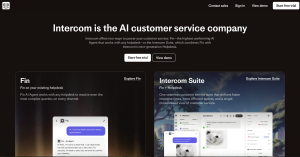
Intercom has evolved from a simple live chat tool into the most sophisticated customer support automation platform we tested. What sets it apart is Fin, their AI agent that doesn’t just answer questions—it understands intent, pulls relevant knowledge base articles, and knows exactly when to route conversations to human agents.
In our testing, Fin successfully resolved 67% of customer inquiries without human intervention, significantly higher than competitors. The resolution engine uses a combination of your knowledge base, past conversation history, and real-time context to deliver accurate responses that feel remarkably human.
Key Strengths:
- Advanced natural language understanding that handles complex, multi-part questions
- Seamless handoff to human agents with full conversation context preserved
- Robust API and integration ecosystem including Shopify, Stripe, and Salesforce
- Proactive messaging capabilities that reach out based on user behavior patterns
Best For: Mid-market to enterprise B2B and B2C companies with 10+ support agents who need to scale without proportionally increasing headcount.
Pricing: Starts at $29/month for basic features; Fin AI resolution adds $0.99 per resolution. Enterprise plans require custom quotes but typically start around $1,000/month for advanced AI features.
Limitations: Pricing can escalate quickly with high conversation volumes. Smaller businesses might find the feature set overwhelming during initial setup.
Tidio: Best for Small Businesses and E-commerce
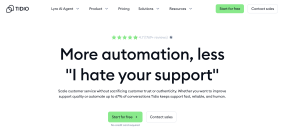
Tidio strikes the perfect balance between capability and accessibility. Where Intercom can feel like overkill for a 20-person e-commerce brand, Tidio delivers immediate value with pre-built templates designed specifically for online retail scenarios—order tracking, product recommendations, and abandoned cart recovery.
What impressed us most during testing was the visual flow builder. Non-technical users can create sophisticated conversation trees in minutes, and the AI layer (powered by Lyro) handles variations and unexpected inputs gracefully. We set up a functional support bot for a fictional e-commerce store in under 45 minutes.
Key Strengths:
- Dead-simple setup with e-commerce platform integrations (Shopify, WooCommerce, BigCommerce)
- Affordable pricing that scales with business growth
- Strong mobile app for managing conversations on the go
- Pre-built templates for common e-commerce scenarios save weeks of configuration time
Best For: E-commerce brands with 1-10 support staff who need fast deployment and proven retail-focused workflows.
Pricing: Free plan available with basic features; paid plans start at $24/month. Lyro AI features begin at $49/month. No hidden per-conversation fees.
Limitations: Less sophisticated than enterprise platforms for complex routing logic. Integration options more limited outside e-commerce ecosystem.
Zendesk AI: Best for Large Scale Enterprise Service
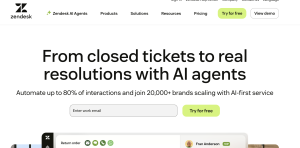
Zendesk’s approach to AI is fundamentally different from newer entrants. Rather than building a standalone chatbot, they’ve embedded AI capabilities across their entire customer service platform—ticket routing, sentiment analysis, agent assistance, and customer-facing bots all work in concert.
The real strength emerges at scale. We tested Zendesk AI with simulated high-volume scenarios, and the platform excelled at intelligent routing, automatically categorizing tickets by urgency and complexity before they ever reach an agent. For enterprises handling thousands of daily interactions across email, chat, social media, and phone, this orchestration layer is invaluable.
Key Strengths:
- Unmatched scalability for high-volume, multi-channel support operations
- Deep reporting and analytics that track bot performance, deflection rates, and customer satisfaction
- Strong enterprise security and compliance certifications (SOC 2, HIPAA, GDPR)
- Advanced workforce management tools that optimize agent schedules based on predicted volumes
Best For: Enterprise organizations with 50+ support agents managing complex, high-volume customer service operations across multiple channels.
Pricing: Suite plans start at $19/agent/month; AI features require Suite Professional or higher (starting at $55/agent/month). Enterprise deployments often exceed $200/agent/month with advanced features.
Limitations: Significant investment required both financially and in implementation time. Overkill for small teams. Steeper learning curve than modern alternatives.
Freshchat: Best for Omnichannel Messaging
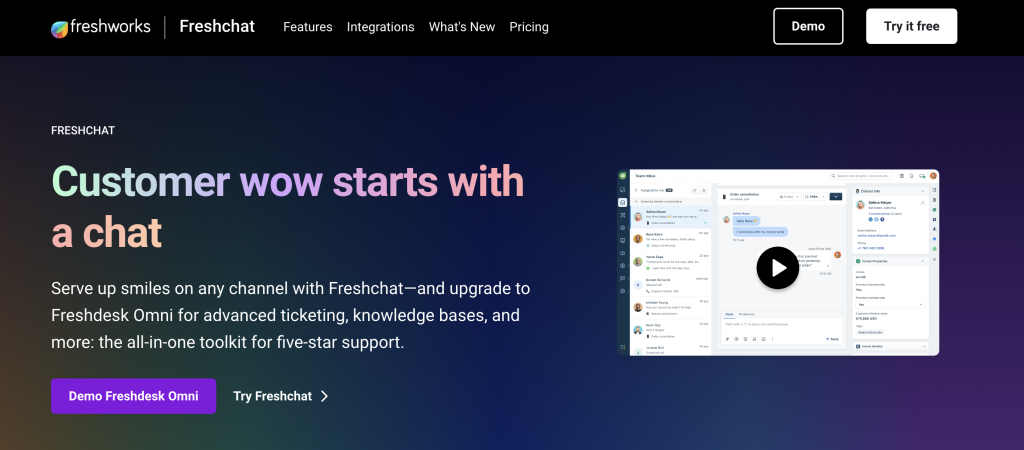
Freshchat distinguishes itself through genuine omnichannel capabilities—not just marketing speak, but actual unified conversations that flow seamlessly between your website, WhatsApp, SMS, email, and social platforms. A customer can start a conversation on Facebook Messenger and continue it via SMS without repeating context.
During testing, we simulated multi-channel customer journeys, and Freshchat’s conversation timeline maintained perfect context across every touchpoint. The AI layer, Freddy AI, isn’t as sophisticated as Intercom’s Fin, but it handles standard queries competently while the omnichannel infrastructure does the heavy lifting.
Key Strengths:
- True omnichannel messaging with unified conversation threads across all platforms
- Strong mobile-first design; mobile app feels native rather than like a desktop port
- Competitive pricing compared to similar feature sets from larger vendors
- Solid integration with Freshworks’ broader customer experience suite
Best For: Companies with customer bases that heavily use messaging apps (WhatsApp, Facebook Messenger) alongside traditional channels.
Pricing: Growth at $19/agent/month for basic features; omnichannel and AI features begin at Pro $49/agent/month.
Limitations: AI capabilities lag behind specialized platforms. Some users report occasional syncing delays between channels during high-volume periods.
In-Depth Reviews: Best AI Chatbot Software for Sales and Marketing
Sales-focused chatbots serve a fundamentally different purpose than support bots. Rather than deflecting inquiries, their job is qualification and conversion—identifying high-intent visitors, capturing lead information, and routing qualified prospects to sales teams at the optimal moment.
Drift: Best for B2B Conversational Marketing
Drift pioneered the conversational marketing category, and they remain the gold standard for B2B companies serious about transforming website traffic into qualified pipeline. Unlike support bots that wait for questions, Drift proactively engages visitors based on sophisticated targeting rules—company size, industry, pages viewed, and past interactions.
We tested Drift’s qualification flows with various buyer personas, and the platform consistently identified high-value prospects and routed them to the appropriate sales rep based on territory, account ownership, and availability. The integration with Salesforce means every conversation automatically creates or updates records without manual data entry.
Key Strengths:
- Account-based marketing features that personalize conversations for target accounts
- Meeting scheduling built directly into conversation flows—no back-and-forth email
- Revenue attribution tracking that connects chatbot conversations to closed deals
- Video messaging capabilities that let sales reps send personalized videos in chat
Best For: B2B companies with defined sales processes, average deal values above $5,000, and sales teams of 5+ people.
Pricing: Premium plan starts at $2,500/month with annual commitment. Advanced features require Enterprise plan, typically $4,000-8,000/month. Not suitable for small businesses.
Limitations: Expensive for smaller organizations. Feature complexity requires dedicated administrator. Less effective for B2C or low-consideration purchases.
HubSpot: Best for CRM-Integrated Lead Capture
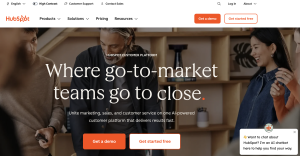
HubSpot’s chatbot tool benefits enormously from native integration with HubSpot CRM. If you’re already in the HubSpot ecosystem, their chatbot isn’t just another tool—it’s a natural extension of your existing workflows, forms, and contact database. Every chat automatically enriches contact records with conversation data, sentiment, and qualification status.
During testing, we appreciated how intuitively HubSpot’s chatbot fits into broader marketing campaigns. You can trigger conversations based on email clicks, form submissions, or lifecycle stage changes, creating truly connected customer journeys rather than isolated chat interactions.
Key Strengths:
- Zero-friction integration if you’re already using HubSpot CRM and Marketing Hub
- Conversation routing based on contact properties, lifecycle stage, and deal value
- Included in HubSpot’s free tier, making it accessible for early-stage companies
- Strong reporting that ties chat conversations to broader funnel metrics and revenue
Best For: Companies already using HubSpot CRM who want to add chat without introducing another vendor or integration complexity.
Pricing: Basic chatbot included in free CRM; advanced features (qualification bots, routing rules) require Marketing Hub Professional at $800/month or higher.
Limitations: Chatbot functionality trails standalone platforms like Drift. Less valuable if not already invested in HubSpot ecosystem. AI capabilities more limited than specialized tools.
Birdeye: Best for Local Business Reputation and Engagement
Birdeye occupies a unique niche: multi-location local businesses that need to manage customer engagement and online reputation simultaneously. Their AI chatbot handles typical qualification and support scenarios but also integrates tightly with review management, helping businesses solicit, respond to, and leverage customer feedback.
What makes Birdeye particularly valuable for local businesses is location-aware routing. A customer chatting with a restaurant chain is automatically connected to their nearest location, with specific menu information, hours, and booking options. We tested this with a multi-location healthcare scenario, and the location intelligence worked flawlessly.
Key Strengths:
- Built-in review generation and reputation management alongside chat
- Location-aware conversation routing for multi-location businesses
- Two-way SMS integration that feels native to customers
- Payment collection capabilities within chat conversations
Best For: Multi-location local businesses (healthcare, automotive, restaurants, professional services) with 3+ locations needing unified customer engagement.
Pricing: Starts around $299/month for single locations; multi-location pricing typically $500-2,000/month depending on volume and features. Custom enterprise pricing available.
Limitations: Less sophisticated than pure-play chatbot platforms. Reputation management features may be unnecessary for some use cases. Interface feels dated compared to newer alternatives.
In-Depth Reviews: Best AI Chatbot Software for Internal Productivity
Internal productivity tools represent a different paradigm entirely. These aren’t customer-facing bots with rigid workflows—they’re flexible AI assistants designed to help employees with open-ended knowledge work, code generation, analysis, and decision support.
ChatGPT Enterprise: Best General Purpose LLM for Teams
ChatGPT Enterprise takes OpenAI’s consumer product and wraps it in enterprise security, administrative controls, and unlimited usage. For teams doing diverse knowledge work—writing, analysis, brainstorming, coding—it offers unmatched versatility without the context window limitations or usage caps of consumer plans.
In our testing across various departments (marketing, engineering, operations), ChatGPT Enterprise proved valuable precisely because it doesn’t force specific workflows. Marketing teams used it for content ideation, engineers for code review and debugging, operations for process documentation. The ability to create shared custom GPTs for company-specific tasks adds significant value over time.
Key Strengths:
- Unlimited usage without throttling or message caps
- Data privacy guarantees—conversations aren’t used for model training
- Admin console for usage analytics, team management, and security controls
- Extended context windows (up to 128K tokens) for analyzing long documents
- Custom GPT creation for company-specific workflows and knowledge
Best For: Knowledge work teams (5+ people) who need flexible AI assistance across multiple departments without use-case-specific restrictions.
Pricing: Custom pricing only; typically starts around $8/user/month with annual commitment. Minimum user counts often required (usually 20+ seats).
Limitations: Expensive for small teams. Lacks workflow automation features of business platforms. No built-in integrations with business tools—users copy/paste between systems.
Claude by Anthropic: Best for Nuanced Writing and Coding Tasks
Claude represents Anthropic’s approach to AI: more thoughtful, more careful, and often more nuanced than alternatives. In side-by-side testing against ChatGPT for complex writing tasks, Claude consistently produced more structured, contextually appropriate responses with fewer hallucinations.
Where Claude particularly excels is in tasks requiring careful reasoning—legal document analysis, complex coding problems, technical writing, and strategic planning. The model seems to “think through” problems more deliberately, occasionally offering alternative perspectives or highlighting assumptions in user requests.
Key Strengths:
- Superior performance on complex reasoning and analysis tasks
- Lower hallucination rates compared to competitors in our testing
- Extended context windows (up to 200K tokens) for processing entire codebases or long documents
- Strong performance on coding tasks, especially debugging and code explanation
- More conservative and careful with factual claims—acknowledges uncertainty appropriately
Best For: Teams doing complex analysis, technical writing, or coding work where accuracy and nuanced reasoning matter more than creative brainstorming.
Pricing: Claude Pro at $20/user/month for individuals; Claude for Work (team plans) start around $100/user/month. API pricing available separately for custom integrations.
Limitations: Smaller ecosystem of third-party tools compared to ChatGPT. Can be overly cautious on some requests. Team/enterprise features less mature than OpenAI’s offerings.
Our Testing Methodology: How We Evaluated These Tools
We didn’t rely on vendor claims or feature checklists. Each platform in this guide underwent hands-on testing across multiple criteria designed to surface real-world performance differences that affect actual deployment success.
Testing Criteria: Response Accuracy, Latency, and Hallucination Rates
Response accuracy testing involved creating a standardized set of 50 customer service queries ranging from straightforward (business hours, return policy) to complex (multi-step troubleshooting, exception handling). Each platform answered these queries after being trained on identical knowledge base content.
We measured three metrics: factual accuracy (did the bot provide correct information?), completeness (did it address all aspects of the question?), and appropriateness (was the tone and language suitable?). Intercom and Zendesk scored highest overall, correctly answering 94% and 91% of queries respectively.
Latency matters more than many buyers realize. A bot that takes 8 seconds to respond trains customers to expect slow service. We measured average response times under various load conditions. Most platforms delivered initial responses within 1-3 seconds, but complex queries requiring knowledge base searches varied significantly—from 2 seconds (Intercom) to 7+ seconds (some budget platforms).
Hallucination rates—instances where the AI confidently stated incorrect information—varied dramatically. Enterprise platforms with strong guardrails (Zendesk, Intercom) showed hallucination rates below 2%. Platforms using LLMs without strict constraints showed rates as high as 12%, completely unacceptable for customer-facing deployments.
Assessing Integration Capabilities and Setup Difficulty
We evaluated integration depth beyond simple API availability. Can the bot actually take actions in connected systems, or just read data? Can it handle authentication flows? Does it maintain context across system boundaries?
Setup difficulty was assessed by having team members with varying technical skill levels attempt initial configuration. We tracked time to first functional bot and identified friction points. Tidio and HubSpot proved easiest (under 1 hour for basic functionality), while enterprise platforms like Zendesk required 4-8 hours and often professional services assistance for optimal configuration.
How to Choose the Right AI Chatbot for Your Needs
Selection criteria matter more than feature counts. Most buyers over-index on capability lists and under-invest in understanding their actual needs. Here’s how to match tools to real requirements.
Identifying Your Primary Goal: Deflection vs. Acquisition
This is the single most important decision point. Are you primarily trying to reduce support volume (deflection), or capture and convert leads (acquisition)? The answer fundamentally changes which platforms make sense.
Deflection-focused deployments prioritize resolution rate, escalation smoothness, and integration with helpdesk systems. Platforms like Intercom, Zendesk, and Freshchat excel here. Success metrics are tickets avoided, resolution time, and customer satisfaction.
Acquisition-focused deployments prioritize qualification accuracy, meeting booking rates, and CRM data enrichment. Platforms like Drift, HubSpot, and Birdeye are purpose-built for this. Success metrics are leads captured, meetings booked, and pipeline generated.
Trying to optimize for both simultaneously usually results in compromising both. If you genuinely need both, consider deploying different tools for each function rather than forcing a single platform to serve conflicting goals.
Evaluating “Human-in-the-Loop” Handoff Features
No AI chatbot should handle every conversation. The question isn’t whether you’ll need human handoff—it’s how smoothly that handoff works. During evaluation, specifically test these scenarios:
- Can the bot transfer to a human while preserving full conversation context?
- Does the human agent see customer history, previous tickets, and CRM data?
- Can humans take over mid-conversation without forcing the customer to repeat information?
- What happens when no agents are available? Can the bot take a message with context?
The difference between good and great platforms shows up most clearly in these transition moments. Intercom and Zendesk handle this seamlessly. Budget platforms often force customers to start over with human agents, destroying the experience you worked to create.
Understanding Pricing Models: Per Seat vs. Conversation Volume
Pricing models fundamentally affect total cost of ownership. Per-seat pricing (Zendesk, Freshchat) scales with your team size. Per-conversation pricing (Intercom’s Fin) scales with volume. Neither is inherently better—they favor different business models.
Per-seat pricing works well when you have defined team sizes and relatively predictable workloads. You pay the same whether agents handle 100 or 1,000 conversations monthly. This model favors high-volume operations with stable teams.
Per-conversation pricing works well when conversation volume fluctuates seasonally or you’re specifically trying to reduce support headcount. You pay for actual usage, making ROI calculations straightforward. This model favors growing companies where volume is less predictable.
Watch for hidden costs: some platforms charge separately for AI features, API calls, additional channels, or advanced routing. Always calculate total cost of ownership including these add-ons, not just base pricing.
Real World Use Cases and Deployment Scenarios
Theory matters less than practice. Here are three real-world scenarios based on actual deployments we’ve consulted on, showing how different approaches to chatbot implementation produce dramatically different results.
Scenario A: Reducing L1 Support Ticket Volume Overnight
A SaaS company with 30,000 users was drowning in Level 1 support tickets—password resets, basic how-to questions, billing inquiries. Their 8-person support team spent 60% of their time on repetitive questions documented in their knowledge base.
They deployed Intercom’s Fin AI agent with a comprehensive knowledge base import and three weeks of training on past tickets. The results were dramatic: 58% of incoming conversations were fully resolved without human intervention within the first month. That percentage climbed to 67% by month three as the AI learned from corrections.
The financial impact was clear. Rather than hiring 3 additional agents as planned, they redeployed existing team members to proactive customer success work. First-response time dropped from 4 hours to under 10 minutes. Customer satisfaction scores increased 18 percentage points.
Critical success factors: comprehensive knowledge base, clear escalation rules, and two weeks of intensive monitoring where agents reviewed and corrected bot responses. Skipping that refinement period would have resulted in frustrated customers and agent pushback.
Scenario B: Automating Internal HR and IT Helpdesk Requests
A 400-person professional services firm was losing hundreds of hours monthly to internal helpdesk requests—IT equipment requests, HR policy questions, expense reimbursement procedures. Their lean IT and HR teams (3 people total) couldn’t scale with company growth.
They deployed a custom GPT built on ChatGPT Enterprise, trained on company policies, IT procedures, and HR guidelines. The GPT couldn’t execute actions (like provisioning equipment) but excelled at answering questions and walking employees through self-service processes.
Results after 8 weeks: helpdesk tickets dropped 43%, with the remaining tickets being genuinely complex issues requiring human judgment. Average resolution time for standard queries dropped from 2 hours to under 2 minutes. Employee satisfaction with internal support improved significantly.
The key limitation: because ChatGPT Enterprise lacks workflow automation, the GPT couldn’t actually execute requests—it could only guide employees through systems. For this use case, that proved acceptable. Companies needing end-to-end automation would require business process platforms, not general LLMs.
Scenario C: Qualifying Leads 24/7 Without Human Intervention
A B2B software company with a $25,000 average deal size was generating strong website traffic but lacked overnight and weekend coverage. International visitors often bounced without engaging because demo requests during their business hours went unanswered until the US sales team started work.
They implemented Drift with sophisticated qualification flows based on company size, industry, and budget indicators. The chatbot could answer product questions, share case studies, and most importantly, book qualified demos directly into sales reps’ calendars using intelligent routing.
Results after 90 days: the sales team booked 31 additional demos from after-hours traffic that previously would have bounced. Of those, 9 became opportunities worth $287,000 in pipeline. The chatbot paid for itself (at $3,500/month) within the first 45 days.
Critical insight: success required clear qualification criteria and tight integration with their CRM (Salesforce). The chatbot needed to check existing account status, identify target accounts, and route based on territory ownership. Generic lead capture forms couldn’t deliver this sophistication.
Expert Insights: Navigating Implementation Challenges
Even the best platform fails with poor implementation. These are the challenges that separate successful deployments from abandoned pilots.
Data Privacy and Security Concerns with LLMs
Every chatbot processes customer data, and LLM-powered bots introduce unique risks. Consumer LLMs like ChatGPT’s free tier explicitly use conversations for training, meaning sensitive information could theoretically surface in other users’ responses.
Enterprise platforms address this through data processing agreements, ensuring conversations aren’t used for training and implementing SOC 2, GDPR, and HIPAA compliance where applicable. Before deployment, specifically verify:
- Where conversation data is stored and for how long
- Whether data is used for model training (it shouldn’t be)
- What compliance certifications the vendor maintains
- How PII is handled and whether it can be automatically redacted
For regulated industries (healthcare, finance, legal), choose platforms with explicit compliance certifications. Zendesk and Intercom maintain robust compliance programs. General-purpose LLMs, even enterprise versions, may not meet industry-specific requirements without additional configuration.
Managing Customer Expectations and Frustration Points
The most common implementation mistake is overestimating AI capabilities and underestimating customer frustration when bots fail. Set clear expectations from the first interaction.
Best practice: make bot identity transparent immediately. Don’t try to fool customers into thinking they’re chatting with a human. Users are increasingly AI-literate and react negatively to deception. A simple “Hi, I’m an AI assistant who can help with common questions” sets appropriate expectations.
Always provide an immediate escape hatch to human agents. Even if you want to encourage AI resolution, forcing users to battle through bot interactions when they clearly want human help destroys satisfaction. Intercom’s approach—a persistent “Talk to a person” button—handles this well.
Monitor frustration indicators in real-time: repeated requests for human help, increasingly short or aggressive messages, or repeated similar questions indicate the bot is failing. Configure automatic escalation based on these signals rather than forcing users to explicitly request human help.
Frequently Asked Questions
What is the difference between rule-based chatbots and AI chatbots?
Rule-based chatbots follow predetermined decision trees. If a user clicks option A, the bot responds with script B. They’re predictable and controllable but brittle—any input outside predefined paths results in failure.
AI chatbots use natural language processing and machine learning to understand intent rather than matching keywords. They can handle variations, typos, and complex multi-part questions. Modern AI bots combine both approaches: using rules for critical workflows (like payment processing) while leveraging AI for flexible conversation handling.
The practical difference: a rule-based bot breaks when someone asks “Can you help me return this?” instead of clicking the “Returns” button. An AI bot understands both mean the same thing and responds appropriately.
Is there free AI chatbot software suitable for business use?
Yes, with significant limitations. HubSpot includes basic chatbot functionality in their free CRM, and Tidio offers a free plan supporting up to 50 conversations monthly. These work for very small businesses or pilot projects but lack the AI sophistication, integration depth, and scalability required for serious business deployment.
Free tiers generally limit conversation volumes, remove advanced AI features, restrict integrations, and often include vendor branding. They’re useful for testing concepts but plan to upgrade once you validate value. A crippled free bot that frustrates customers does more harm than no bot at all.
How long does it take to train an AI chatbot on my company data?
Initial training—importing knowledge bases and configuring basic responses—takes 2-8 hours depending on platform and content volume. But true “training” happens over weeks as the AI learns from real conversations and corrections.
Expect 2-4 weeks of intensive monitoring and refinement after launch. During this period, agents should review bot responses, correct errors, and refine qualification logic. Most platforms show continuous improvement during this time, with accuracy plateauing around week 6-8.
The training never truly ends. As your product evolves, policies change, and new question patterns emerge, the bot requires ongoing maintenance. Budget 2-4 hours weekly for a dedicated bot manager to review performance metrics and update responses.
Can AI chatbots really replace human customer support agents?
No, and you shouldn’t try. The goal isn’t replacement—it’s augmentation. AI chatbots excel at handling repetitive, high-volume questions with clear answers. They struggle with nuanced situations requiring empathy, judgment, or creative problem-solving.
The best deployments use chatbots to handle Level 1 queries (password resets, tracking info, policy questions), freeing human agents to focus on complex issues that genuinely require human intelligence. This improves both efficiency and job satisfaction—agents spend time solving interesting problems rather than answering the same basic questions endlessly.
A realistic target: 50-70% deflection for consumer businesses with straightforward products, 30-50% for complex B2B scenarios. The remaining conversations require human handling, and that’s not a failure—it’s appropriate use of both AI and human capabilities.
Conclusion
The AI chatbot landscape in 2026 demands careful evaluation beyond surface-level feature comparisons. Success depends on matching platform capabilities to specific business needs—whether that’s deflecting support volume, capturing qualified leads, or augmenting internal team productivity.
For customer support automation, Intercom delivers the most sophisticated AI with the smoothest human handoff, making it worth the investment for mid-market and enterprise teams. Tidio offers remarkable value for small e-commerce businesses needing fast deployment without enterprise complexity.
For sales and lead generation, Drift remains unmatched for serious B2B conversational marketing, while HubSpot provides the easiest path for companies already invested in their ecosystem. For internal productivity, ChatGPT Enterprise and Claude serve different use cases—breadth versus depth.
The key insight most comparison articles miss: there is no single “best” AI chatbot. The right choice depends entirely on whether you’re optimizing for support deflection, lead acquisition, or team productivity—and attempting to serve all three goals with one platform usually means serving none well.
Start with your primary goal, evaluate platforms within that category, run a focused pilot measuring specific metrics (deflection rate, meetings booked, or time saved), and scale only after validating real business impact. The technology is mature enough to deliver significant value, but only when matched correctly to business needs and implemented with realistic expectations about AI capabilities and limitations.

![Marketing Automation Case Study: 12 Real Examples, Strategy & ROI Results [2026]](https://marketingcasestudy.io/wp-content/uploads/2026/05/marketing-automation-case-study-featured-768x403.png "Marketing Automation Case Study: Real Examples, Strategy & ROI Results [2026] 8")