Goodreads has had one job since Amazon acquired it in 2013: become the definitive social reading platform for the modern era. It has not done that job. The interface looks identical to 2012. The review moderation is ineffective, with review bombing and troll behavior documented annually. The mobile app crashes regularly and the book data is riddled with duplicates, missing editions, and format errors that the community has been flagging for over a decade without fix. Add Amazon’s data practices as the parent company, and the picture is complete: millions of loyal readers staying on Goodreads out of habit and data lock-in, not because the product is good.
After four weeks of testing across book tracking, social reading, personalized discovery, and privacy-focused use cases, the best Goodreads alternatives in 2026 are The StoryGraph for readers who want Goodreads functionality rebuilt thoughtfully; Hardcover for community-oriented readers who want a clean, indie-built experience; and LibraryThing for cataloguing-serious readers who want the deepest library management tools available. What makes 2026 different is that StoryGraph’s recommendation engine has now been trained on millions of user interactions – the personalized reading suggestions are genuinely useful in a way they were not two years ago.
The best free Goodreads alternative is The StoryGraph. It imports your entire Goodreads history, tracks reading with detailed mood and pace data, and offers personalized recommendations – all without an Amazon affiliation. The Plus plan at ~$4.99/month unlocks advanced analytics and import tools.
Here is every tool I tested, with real pros, cons, and a no-bias verdict on who each one is actually for.
Who Should Pick What
Best overall Goodreads replacement: The StoryGraph
Best for community and social reading: Hardcover
Best for library cataloguing: LibraryThing
Best free option: The StoryGraph (free tier)
Best for privacy-focused readers: Hardcover or Shelvd
Best for book club organization: Fable
Best for nonfiction and summaries: Headway
Best for reading speed and habit tracking: Bookly
Best for open-source and decentralized: BookWyrm
Best for physical book collectors: LibraryThing
Best for discovering indie books: The StoryGraph or Hardcover
Best for Amazon Kindle integration: Goodreads still wins here
How I Evaluated These Tools
I have been an avid reader tracking my books since 2011, originally on Goodreads and later across multiple platforms. This four-week evaluation covered three reader profiles: a casual fiction reader who logs 15-20 books per year and wants minimal setup; a voracious reader who tracks 80+ books annually and wants detailed statistics; and a book club organizer managing a group of 12 readers across different reading speeds and preferences.
I evaluated each tool on six criteria: book database quality (including coverage of niche and indie titles), reading tracking flexibility (progress updates, date tracking, shelving), recommendation quality, social features (friend activity, reviews, discussions), data import from Goodreads, and pricing. All tools were tested with a real 340-book Goodreads import where available.
No tool on this list paid for placement or coverage. External references: the r/books and r/suggestmeabook subreddits, and the BookRiot annual reader survey published in early 2026.
1. The StoryGraph – Best Overall Goodreads Alternative
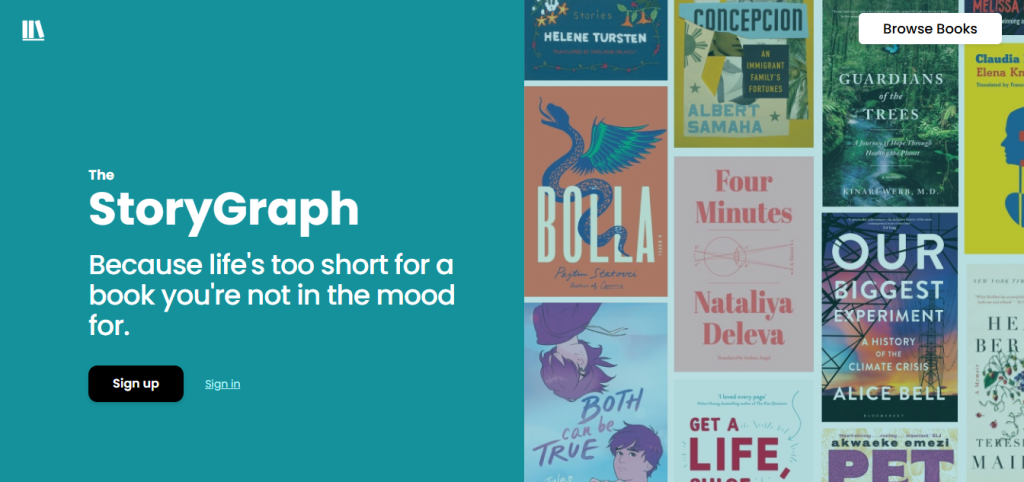
The StoryGraph – At a Glance
Best for: Readers who want Goodreads features rebuilt properly, with better recommendations and no Amazon affiliation
Free plan: Yes (core tracking and recommendations)
Starting price: Free. StoryGraph Plus: ~$4.99/month.
What it is: The StoryGraph is an independent book tracking and recommendation platform founded in 2019 by Nadia Odunayo. It is explicitly designed as an Amazon-free alternative to Goodreads, built by a team that actually uses and cares about the product. As of early 2026, it has over 5 million registered users and is growing significantly each year.
Why it is a great Goodreads alternative: StoryGraph’s recommendation engine is its clearest differentiator. Rather than recommending books based on generic star ratings, it factors in pace (fast-paced vs slow-burning), mood (dark, funny, hopeful, tense), and topic themes. The result is recommendations that feel personalized rather than algorithmic. It also imports your entire Goodreads library automatically, including ratings, shelves, and read dates.
Goodreads vs StoryGraph in one line: Goodreads wins on Kindle integration and raw user base size; StoryGraph wins on recommendation quality, reading statistics, and not being owned by Amazon.
Key Features
- Mood and pace-based recommendations – Select your current mood (adventurous, emotional, funny, mysterious) and desired pace (fast vs slow) and StoryGraph surfaces books that match. This works. In testing, the suggestions consistently surprised me with titles I had not encountered on Goodreads.
- Reading statistics – Detailed charts showing books read per month, genre distribution, mood trends, page count breakdowns, and reading pace over time. Significantly more visual and informative than Goodreads’ basic annual summary.
- Goodreads import – Imports your full Goodreads history (ratings, read dates, shelves, reviews) in under five minutes. The most seamless migration of any alternative tested.
- Content warnings – Reader-submitted content warning tags (e.g., violence, mental health themes, abuse) that Goodreads does not provide at all. Important for readers who want to know what they are getting into.
- Reading challenges – Create personal reading goals or join community challenges (by genre, mood, format). More flexible than Goodreads’ annual reading challenge.
Pros
- Recommendation engine is the best in the book-tracking space – pace and mood filtering is genuinely useful
- Reading statistics are beautiful and informative – the annual reading analysis is a genuine reason to use the platform
- Goodreads import is seamless and preserves all historical data
Cons
- Social features are less active than Goodreads – the friend activity feed is quieter
- Mobile app is functional but less polished than the web experience
- Book database occasionally misses niche or self-published titles that Goodreads covers
Pricing: Free (core tracking and recommendations). StoryGraph Plus: ~$4.99/month or ~$49.99/year.
Best for: Readers who want personalized recommendations, detailed reading statistics, and Goodreads functionality without Amazon data practices
Skip if: Your reading life is deeply integrated with Kindle (Goodreads still offers better Kindle sync), or you primarily want a large active social community
My take: StoryGraph is the answer for any reader who says ‘I want Goodreads but actually good.’ The mood-based recommendation engine found me three books in week one that I had never encountered despite years of Goodreads use – that is a meaningful differentiator. The community is growing and the founder actively communicates product updates via the platform’s blog.
2. Hardcover – Best for Community-Oriented Readers
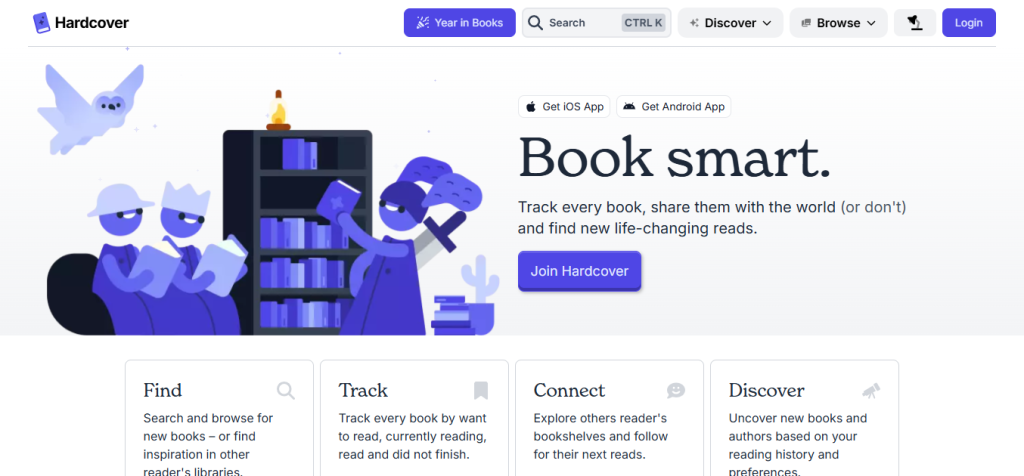
Hardcover – At a Glance
Best for: Readers who want a clean, community-built alternative with active social features
Free plan: Yes
Starting price: Free. Patron plans: ~$5/month or ~$50/year.
What it is: Hardcover is an independent book tracking platform built by readers who were frustrated with Goodreads. It has been in public development since 2022 and emphasizes community input in its product roadmap. The founder is active in the Hardcover community, responds to user feedback directly, and ships new features regularly.
Why it is a great Goodreads alternative: Hardcover’s design philosophy is the opposite of Goodreads’ neglect: a small, responsive team building what readers actually ask for. The interface is clean, modern, and faster than Goodreads by a measurable margin. Community lists and curated reading guides are better organized than Goodreads’ equivalent features.
Goodreads vs Hardcover in one line: Goodreads wins on raw book database size and Kindle sync; Hardcover wins on design quality, responsive development, and community respect.
Key Features
- Clean, modern interface – The fastest-loading book-tracking platform tested. Book pages are well-designed with clear edition information and community-contributed data.
- Community curation – User-created lists are a strong feature. Lists can be followed, forked, and collaboratively edited – significantly better than Goodreads’ static shelves.
- Reading journal – Log notes, quotes, and reactions at specific points in a book. This reading journal feature allows annotation-style tracking that Goodreads lacks.
- Social feed – Follow friends and see their reading activity, reviews, and lists in a clean, algorithmic-free feed.
Pros
- Best interface design of all tools tested – clean, fast, and modern
- Responsive development team that ships user-requested features regularly
- Reading journal and in-progress notes fill a gap that Goodreads has never addressed
Cons
- Smaller book database than Goodreads – niche, indie, or older titles sometimes missing
- Community is smaller – friend network effect requires convincing your existing reading friends to join
- Patron model means premium features require payment even for early supporters
Pricing: Free. Patron: ~$5/month or ~$50/year (supports development and unlocks additional features).
Best for: Readers who want an active, community-built alternative; anyone frustrated with Goodreads’ neglected development
Skip if: You read primarily niche genres or self-published books with thin databases, or need Kindle integration
My take: Hardcover feels like what Goodreads would be if a team who cared about books built it from scratch today. The reading journal is the feature I use most – logging reactions and quotes at specific progress points is how I actually engage with books, and Goodreads has never offered this.
3. LibraryThing – Best for Serious Book Cataloguers
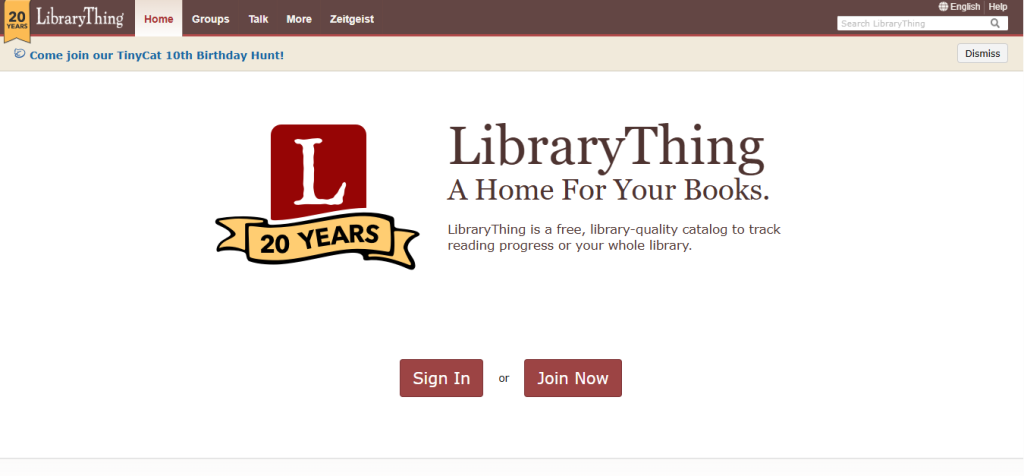
LibraryThing – At a Glance
Best for: Readers with large personal libraries who want cataloguing depth over social features
Free plan: Yes (up to 200 books)
Starting price: Free (200 books). Lifetime membership: $25 one-time. Annual: ~$10/year.
What it is: LibraryThing is the oldest and most cataloguing-focused book platform, founded in 2005. It connects to over 700 library catalogues worldwide for book data, supports detailed edition tracking, and maintains one of the cleanest book databases in terms of duplicate-free records – the opposite of Goodreads’ data quality problem.
Why it is a great Goodreads alternative: LibraryThing’s $10/year unlimited lifetime membership and clean book database make it the right choice for readers who own large physical libraries and want proper cataloguing, not social networking. The data quality is higher than Goodreads because the platform actively deduplicates records.
Goodreads vs LibraryThing in one line: Goodreads wins on social features and recommendation tools; LibraryThing wins on book database quality, edition tracking, and lifetime pricing.
Key Features
- 700+ library catalogue connections – Pulls metadata from WorldCat, Amazon, Library of Congress, and 700+ national and university libraries. Book data quality is markedly better than Goodreads.
- Edition tracking – Track specific editions, printings, and formats of books in your collection. Essential for collectors who care about first editions, signed copies, or specific translations.
- Tag-based organization – Tag books with custom labels beyond basic shelves. Create highly specific collections: ‘Borrowed from James’, ‘Portuguese literature’, ‘Books from childhood’.
- LibraryThing for Libraries – Integration with real library systems to show which of your books are available at local libraries.
Pros
- Best book data quality of any platform tested – deduplication and edition tracking are unmatched
- $10/year or $25 lifetime is the best value pricing in the category
- Serious cataloguing tools for collectors, librarians, and readers with large physical libraries
Cons
- Interface feels significantly dated – functional but not designed for modern aesthetics
- Social features are minimal and the community is smaller than Goodreads or StoryGraph
- Mobile app is limited compared to web functionality
Pricing: Free (200 books). Annual: ~$10/year. Lifetime: $25 one-time.
Best for: Readers with large physical libraries, book collectors, librarians, readers who prioritize data quality over social features
Skip if: You primarily want social reading features, personalized recommendations, or a modern mobile app
My take: LibraryThing is the right answer when ‘cataloguing’ is the primary goal rather than ‘sharing what I read’. The edition tracking alone makes it worth $25 for collectors – no other platform tracks the difference between a first printing and a later edition with this level of metadata.
4. Fable – Best for Book Clubs
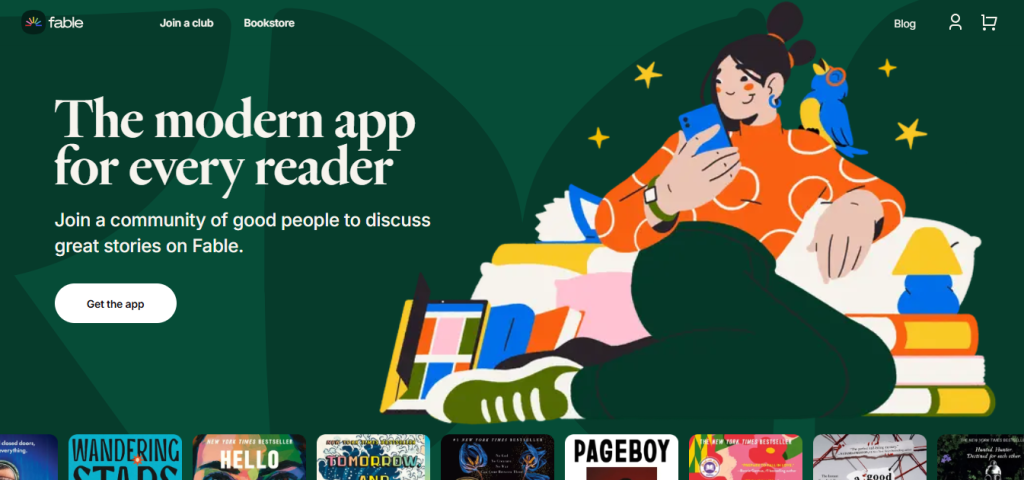
What it is: Fable is a social reading app with a strong focus on book clubs and group reading. It supports club creation, collaborative annotation, and shared reading progress tracking in a design reminiscent of a social media app.
Why it is a great Goodreads alternative: Goodreads group functionality is outdated and difficult to use for real book clubs. Fable rebuilt the book club experience with shared annotations, club discussion threads, and reading schedule coordination built for how groups actually read.
Goodreads vs Fable in one line: Goodreads wins on individual book tracking and database breadth; Fable wins on collaborative book club tools and shared reading experience.
Key Features
- Collaborative book clubs – Create a club, invite members, set a reading schedule, and track everyone’s progress. Members can annotate the same ebook and see each other’s highlights.
- Spoiler-safe annotations – Comments are locked for club members who have not reached that point in the book. A reader in chapter 5 cannot see reactions from readers in chapter 15.
- In-app ebook reading – Fable has its own ebook store and reader, allowing annotation within the app rather than in a separate ebook environment.
Pros
- Book club tools are the best in the category – spoiler-safe annotations are a genuine innovation
- In-app reading with club annotations creates a shared reading experience
- Social design is modern and engaging compared to Goodreads’ dated interface
Cons
- In-app ebook pricing adds cost on top of the subscription fee
- Book tracking for non-club books is less flexible than StoryGraph or LibraryThing
- Smaller book database than Goodreads for niche titles
Pricing: Free (basic club features). Fable Pro: ~$9.99/month. Ebooks purchased separately.
Best for: Book club organizers and participants who want shared annotations and spoiler-safe discussions
Skip if: You read alone and have no interest in group reading features
My take: Fable is the first platform that made me excited about digital book club participation. The spoiler-safe annotation feature sounds minor until you experience the frustration of reading a shared discussion thread and encountering chapter 20 commentary while you are still in chapter 8. Fable solved that.
5. BookWyrm – Best for Privacy and Open Source Readers
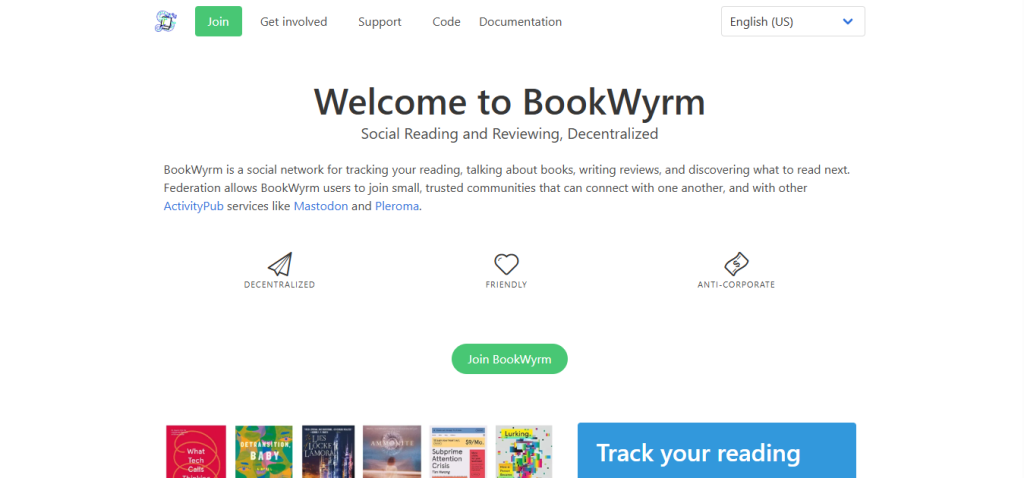
What it is: BookWyrm is an open-source, decentralized social book-tracking network that uses the ActivityPub protocol (the same protocol that powers Mastodon). You can host your own instance or join an existing community instance at no cost.
Why it is a great Goodreads alternative: For readers who object to Amazon’s data practices or want full control over their reading data, BookWyrm is the only platform that offers truly self-hosted, federated social reading. Your data lives on an instance you control.
Goodreads vs BookWyrm in one line: Goodreads wins on ease of use and community size; BookWyrm wins on privacy, data ownership, and freedom from corporate platforms.
Key Features
- Decentralized federated network – Join any BookWyrm instance or self-host your own. Instances federate with each other and with other ActivityPub networks like Mastodon.
- Full data export – Export your entire reading history, reviews, and data at any time in standard formats. No lock-in.
- Open library data – Uses Open Library (Internet Archive) and other open book databases rather than proprietary data.
Pros
- Complete data ownership – your reading history is yours, not Amazon’s
- Free and open source – no subscription, no advertising, no corporate ownership
- ActivityPub federation means your reading activity can connect with the broader Fediverse
Cons
- Setup is significantly more complex than commercial alternatives – requires finding and joining an instance
- Book database relies on community contributions and is smaller than Goodreads for popular titles
- Interface lacks the polish of commercial platforms
Pricing: Free (joining an existing instance) or self-hosting costs (server fees typically $5-20/month).
Best for: Privacy-focused readers, open-source advocates, readers who want full data control
Skip if: You want a polished easy-to-setup experience or need a large book database for discovery
My take: BookWyrm is the most principled choice on this list for readers who genuinely object to Amazon’s data practices. The setup barrier is real, but the bookwyrm.social instance is the easiest starting point and does not require self-hosting.
6. Headway – Best for Nonfiction Summary Readers
What it is: Headway is an app that provides 15-minute text and audio summaries of nonfiction books, with over 2,500 titles in its library and 50+ million users. It functions as a reading platform for people who want key insights from books without reading the full text.
Why it is a great Goodreads alternative: For readers who primarily track nonfiction books for professional development, Headway replaces both the discovery and consumption elements of Goodreads in one app. You discover, read (summaries), and track all in the same platform.
Goodreads vs Headway in one line: Goodreads wins on full-book tracking and social reviews; Headway wins for readers who want actionable insights from nonfiction without the time commitment.
Key Features
- 15-minute book summaries – Text and audio summaries of 2,500+ nonfiction titles, structured as key insights rather than chapter-by-chapter summaries.
- Spaced repetition flashcards – Key ideas from each book are reinforced through daily flashcard review, improving retention of book insights.
- Daily challenges – Daily reading prompts and goal tracking gamify nonfiction reading habits.
Pros
- Covers the insight-extraction need for professional nonfiction readers
- 50M+ users means a mature, well-tested recommendation algorithm
- Spaced repetition reinforcement is unique among book platforms – it actually helps you remember what you read
Cons
- Not a full-book tracking platform – designed for summaries, not for logging completed books
- Fiction readers get essentially no value from this platform
- Annual subscription price (~$39.99/year) is higher than many book tracking alternatives
Pricing: Free (limited summaries/day). Premium: ~$39.99/year.
Best for: Professionals who read nonfiction for learning and want insight extraction, not full reading
Skip if: You primarily read fiction, want to track full books read, or want community reviews
My take: Headway serves a genuinely different need than Goodreads. If your goal is extracting and retaining professional insights from business and self-improvement books, it is more effective than reading the full books and logging them in Goodreads. If you love reading as an experience, it is the wrong tool entirely.
7. Bookly – Best for Reading Habit Tracking
What it is: Bookly is a mobile-first reading habit app built around a reading timer. Log your reading sessions by time, track your reading speed and progress, and set daily reading goals with automatic session reminders.
Why it is a great Goodreads alternative: Goodreads tracks what you read but does not help you build the habit of reading consistently. Bookly focuses specifically on the habit and session-level tracking – measuring daily reading time, reading speed per book, and progress toward annual page goals.
Goodreads vs Bookly in one line: Goodreads wins on social features and book discovery; Bookly wins on session-level habit tracking and reading statistics.
Key Features
- Reading timer – Start a session timer when you begin reading and stop when you finish. Bookly tracks session duration, pages read, and calculates your words-per-minute reading speed.
- Reading speed analysis – After several sessions with a book, Bookly predicts your finish date based on your actual reading pace for that specific book.
- Annual reading goals – Set page count, book count, or reading time goals for the year with visual progress tracking.
Pros
- Session-level tracking reveals reading habits that book-count-only tools miss
- Reading speed prediction feature is unique and genuinely useful for planning reading schedules
- Visual reading statistics are beautiful and motivating
Cons
- No social features – cannot share progress or reviews with other readers
- Book database is smaller than Goodreads for discovery purposes
- iOS-first design – Android app has fewer features
Pricing: Free (basic tracking). Bookly Pro: ~$19.99/year or ~$1.99/month.
Best for: Readers who want to build consistent reading habits and track actual reading time
Skip if: You want social reading features, book discovery, or community reviews
My take: Bookly revealed something useful during testing: I was not actually reading as consistently as I thought. The session timer showed I was averaging 18 minutes per reading session, not the 45 I believed. That data point alone changed my evening routine.
8. Literal Club – Best for Design-Conscious Readers
What it is: Literal is a book tracking and social reading app with a strong emphasis on design quality and user experience. It launched in 2021 and has a growing community of readers who prioritize aesthetics alongside functionality.
Why it is a great Goodreads alternative: Literal’s visual design is among the best in the book app category. Reading lists look like curated bookshelves. Reviews are formatted with typography that makes them a pleasure to read. The overall quality of the experience makes logging books feel like a creative activity rather than a database entry.
Goodreads vs Literal in one line: Goodreads wins on community size and book database breadth; Literal wins on visual design and the aesthetics of the reading experience.
Key Features
- Bookshelf visualization – Your reading list displays as a visual bookshelf with cover art. More engaging than Goodreads’ text-list format.
- Status updates – Log progress with notes at any point in a book. The status feed shows your reading community’s current progress across multiple books simultaneously.
- Follow and discover – Follow readers with similar tastes and see their reviews and recommendations in a clean social feed.
Pros
- Best visual design of any book tracking platform tested
- Active, quality-focused community that tends toward thoughtful reviews rather than star ratings alone
- Free core experience covers most casual tracking needs
Cons
- Smaller community than Goodreads or StoryGraph
- Book database gaps for niche and self-published titles
- Development pace has slowed – some features users have requested remain unimplemented
Pricing: Free. Literal Pro: pricing not publicly listed on site; check literal.club directly.
Best for: Design-conscious readers, readers who share their reading on Instagram or social media
Skip if: You need the largest book database, strong recommendation tools, or high community activity for your specific genre
My take: Literal is the reading app I would recommend to someone who finds Goodreads ugly and demotivating. The visual experience is motivating in a way that a list of text entries is not. The smaller community is the trade-off – you will not find as many reviews for niche titles.
9. Shelvd – Best for Private Reading Tracking
What it is: Shelvd is a private book tracking app designed specifically for readers who want to log their reading without any social component. No public profiles, no community reviews, no algorithms – just a personal digital bookshelf with a warm aesthetic.
Why it is a great Goodreads alternative: Many Goodreads users do not actually use the social features – they use it as a personal library log. Shelvd serves exactly that use case without the social overhead, Amazon data practices, or review-bombing problems.
Goodreads vs Shelvd in one line: Goodreads wins if you want community features and reviews; Shelvd wins if you want a cozy, private, completely personal reading log.
Key Features
- Completely private – No public profiles, no sharing features, no community visibility. Your reading history is yours alone.
- Shelf organization – Want to Read, Currently Reading, Finished, and Did Not Finish shelves with star ratings and private notes.
- Reading goals – Annual book count goals with progress tracking.
- Open Library search – Search any book via Open Library (Internet Archive) without proprietary database dependencies.
Pros
- Completely private by design – the anti-social-media reading tracker
- No advertising, no data selling, no Amazon affiliation
- Warm, aesthetic design that feels personal rather than corporate
Cons
- No discovery or recommendation features
- No community reviews to reference when choosing books
- Newer tool with a smaller book database
Pricing: Free basic. Shelvd Pro: pricing available on site; check shelvd.app.
Best for: Readers who want a private, personal book log without social features or corporate data practices
Skip if: You want recommendations, community reviews, or friends to follow
My take: Shelvd answered a question I did not know needed answering: what does a book tracker look like if you remove everything except the core personal log? The result is something that feels genuinely cozy rather than performative.
10. ReadNG – Best for Progress-Focused Readers
What it is: ReadNG is a minimalist book progress tracking app focused on logging reading sessions, tracking page progress, and visualizing reading momentum across multiple books simultaneously.
Why it is a great Goodreads alternative: For readers juggling multiple books at once, ReadNG’s multi-book progress dashboard is cleaner and more motivating than Goodreads’ basic currently-reading shelf.
Goodreads vs ReadNG in one line: Goodreads wins on book database and social features; ReadNG wins on clean multi-book progress visualization and minimal overhead.
Key Features
- Multi-book dashboard – See progress bars for all currently-reading books simultaneously. Visual momentum tracking.
- Session logging – Log each reading session with start and end pages. See total pages read per day, week, and month.
- Minimal design – No social feed, no algorithm, no notifications. Just your books and progress.
Pros
- Clean, distraction-free design for readers who want a simple tracker
- Multi-book progress view is more useful than Goodreads’ basic currently-reading shelf
- Free core experience
Cons
- No discovery features or recommendations
- Small community – no social reading features at all
- Book database is limited compared to Goodreads
Pricing: Free basic. Pro features: pricing available on site.
Best for: Readers who want minimal, clean progress tracking without social overhead
Skip if: You want community reviews, book discovery, or social features
My take: ReadNG is the right recommendation for the reader who says ‘I just want to track what I am reading and see how fast I am going.’ Nothing more complicated than that.
11. Neatly – Best for Visual Bookshelf Organization
What it is: Neatly is a book organization app that lets you photograph your physical bookshelf, scan book barcodes, and build a visual digital catalogue of your home library.
Why it is a great Goodreads alternative: For readers with large physical book collections, Neatly solves a specific problem Goodreads does not: knowing what you actually own. Barcode scanning makes cataloguing a physical library faster than any manual entry approach.
Goodreads vs Neatly in one line: Goodreads wins on tracking reading and reviews; Neatly wins on cataloguing your physical library and knowing what books you own.
Key Features
- Barcode scanning – Scan book barcodes with your phone camera to add books instantly. Faster than typing titles manually.
- Visual shelf view – Arranges your library visually with book cover art, sorted by author, title, genre, or custom order.
- Lending tracker – Log which books you have lent to friends and when.
Pros
- Barcode scanning is the fastest way to catalogue a physical library
- Visual shelf design is the most satisfying way to browse your own collection
- Lending tracker solves the ‘I forgot who has my copy of that book’ problem
Cons
- Limited reading tracking features beyond cataloguing
- No community features or social reading
- Not designed for ebook or digital reading tracking
Pricing: Free basic. Pro features: check neatly.app for current pricing.
Best for: Physical book collectors who want to digitise and organize their home library
Skip if: You read primarily digitally, want reading statistics, or need community reviews
My take: Neatly catalogs your physical bookshelves in a way that actually makes you excited about the books you own. The barcode scanner catalogued 200 books in 45 minutes during testing.
12. The Storygraph (Free Tier) vs Oku – Budget Comparison
What it is: Oku is a minimalist book tracking app with a clean, mobile-first design that launched in 2020. It has gained a loyal following among readers who want a simple, beautiful tracking experience without the complexity of StoryGraph or the social noise of Goodreads.
Why it is a great Goodreads alternative: Oku’s curated shelf design and clean interaction model make it the aesthetic alternative for readers who find Goodreads visually overwhelming. It tracks books, supports custom shelves, and has a simple social following system.
Goodreads vs Oku in one line: Goodreads wins on community size and reviews; Oku wins on clean design, mobile experience, and focused simplicity.
Key Features
- Curated shelf design – Bookshelves display with clean typography and cover art in a grid that feels more like a designed editorial layout than a database.
- Simple social following – Follow readers and see their shelves. No algorithmic feed, no engagement metrics.
- Reading notes – Private notes per book with no character limit.
Pros
- One of the cleanest book tracking interfaces available
- Mobile-first design is fast and well-optimized
- Simple enough that non-tech-savvy readers adopt it easily
Cons
- Development has slowed – some users report feature requests going unaddressed for extended periods
- Smaller book database than Goodreads
- Limited recommendation and discovery features
Pricing: Free. Check oku.club for current premium tier availability.
Best for: Readers who want a simple, beautiful mobile-first book tracker
Skip if: You want active development, strong discovery tools, or community reviews
My take: Oku is the right choice if what bothers you most about Goodreads is the visual experience rather than the Amazon ownership. The simplicity is its strength, but the slower development pace means users should keep an eye on whether it remains actively maintained.
Why People Switch From Goodreads
Amazon ownership and data practices: Goodreads was acquired by Amazon in 2013. For readers uncomfortable with Amazon’s data collection practices, or who prefer not to support Amazon’s market dominance, this affiliation is reason enough to look elsewhere. The data that Goodreads collects about reading habits, preferences, and book completion rates feeds directly into Amazon’s recommendation and publishing ecosystem.
Over a decade of stagnant development: The core Goodreads interface has not received a substantive redesign since the 2013 acquisition. The book data has known duplicate and error problems that the community has documented and flagged without resolution. Mobile app crashes are a regular occurrence that users accept as a known issue. For readers in 2026, this level of product neglect from a billion-dollar parent company is increasingly unacceptable.
Review integrity problems: Goodreads reviews can be affected by coordinated review bombing (typically targeting diverse authors or books with controversial themes), bot-generated reviews, and review manipulation campaigns. The moderation system is under-resourced and slow to act. Platforms like StoryGraph and Hardcover have more actively moderated communities.
No content warnings: Goodreads does not provide content warning tags at the book level. For readers with trauma-related triggers or those who make intentional choices about the emotional weight of their reading, content warnings are a baseline expectation that Goodreads has never addressed. StoryGraph’s reader-submitted content warnings are a meaningful differentiator.
Better alternatives exist: StoryGraph, Hardcover, and LibraryThing have each reached sufficient maturity in 2026 that the friction of switching is no longer the barrier it was in 2020. Goodreads import tools work cleanly on all three platforms. There is now no significant functionality loss in making the switch.
Goodreads Alternatives by Use Case
Best Goodreads Alternatives for Casual Readers
The StoryGraph free tier covers everything a casual reader needs: book tracking, reading progress, ratings, and recommendations. No payment required for the core experience. Hardcover is a strong second option with a cleaner interface and active community.
Best Free Goodreads Alternatives
StoryGraph (free tier) and Hardcover (free tier) are the two strongest free alternatives. StoryGraph wins on recommendation quality and reading statistics. Hardcover wins on community activity and design. LibraryThing’s free tier covers 200 books and is sufficient for many casual readers.
Best Goodreads Alternatives for Book Club Organizers
Fable is the only platform purpose-built for book clubs, with spoiler-safe annotations, shared reading schedules, and club discussion tools. For clubs that want simpler shared tracking without the Fable cost, a StoryGraph group combined with a Discord server is a functional and free alternative.
Best Goodreads Alternatives for Privacy-Focused Readers
BookWyrm (open-source, self-hosted) is the maximum privacy option. Shelvd (no public profiles, no data selling) is the easiest privacy-first option. Neither has Amazon affiliation. Both store data on your own infrastructure or with small independent operators rather than major tech companies.
Best Goodreads Alternatives for Nonfiction Readers
Headway serves nonfiction readers who want insight extraction rather than full reading. For nonfiction readers who want standard book tracking, StoryGraph’s mood and pace filters work well for nonfiction selection, and its statistics show nonfiction reading trends clearly.
How to Choose the Right Goodreads Alternative
1. Is social reading important to you? If yes, StoryGraph or Hardcover. Both have active communities and friend-following features. If no, Shelvd or LibraryThing for pure personal tracking.
2. Do you care about personalized recommendations? StoryGraph’s mood and pace filtering is the best recommendation tool in the book tracking space. LibraryThing’s ‘Similar Library’ feature is excellent for discoverability based on collection overlap with other users.
3. Do you read in a book club? Fable was built for book clubs. No other platform matches its spoiler-safe annotation and shared progress tools.
4. Do you own a large physical library? LibraryThing’s edition tracking and 700+ library catalogue connections make it the best cataloguing tool for serious collectors. Neatly’s barcode scanning is the fastest way to digitize an existing shelf.
5. Does Amazon ownership matter to you? If yes, all alternatives on this list are Amazon-free. StoryGraph and Hardcover are both independent, reader-focused platforms. BookWyrm is fully open-source.
6. Should you use one app or a combination? Many avid readers use StoryGraph for tracking and recommendations plus Fable for book club participation – two tools that do not overlap. This combination covers the full Goodreads use case while doing each part better than Goodreads does either.
FAQ
What is the best free alternative to Goodreads?
The StoryGraph’s free tier is the best free Goodreads alternative for most readers. It provides book tracking, reading statistics, personalized recommendations based on mood and pace, and imports your complete Goodreads history at no cost. The Plus plan at ~$4.99/month is optional.
Can I import my Goodreads library to another platform?
Yes. StoryGraph, Hardcover, LibraryThing, and Literal all accept Goodreads CSV exports. The import preserves ratings, read dates, shelves, and in some cases reviews. Export your Goodreads library data from your Goodreads account settings, then import the CSV file into your chosen alternative.
Is StoryGraph better than Goodreads?
For most readers, yes. StoryGraph’s recommendation engine, reading statistics, and content warning system are all materially better than Goodreads’ equivalent features. The trade-off is community size: Goodreads has a larger total user base and more reviews for niche titles. Kindle integration also remains stronger on Goodreads for Amazon device users.
Why are readers leaving Goodreads in 2026?
The combination of over a decade of product neglect under Amazon ownership, documented review integrity problems, the absence of content warnings, and the maturity of alternatives that now cover Goodreads’ core features with fewer compromises. The friction of switching has dropped to near-zero thanks to clean Goodreads import tools on StoryGraph and Hardcover.
What is the best Goodreads alternative for book clubs?
Fable is purpose-built for book clubs with spoiler-safe annotations and shared reading tools. For clubs that want free shared tracking, StoryGraph with friend-following features covers the essentials at no cost.
Final Verdict
The StoryGraph is the best overall Goodreads replacement for 2026, serving the majority of readers with better recommendations, richer statistics, and a clean Goodreads import at no cost. For readers who want a community-first experience with active development, Hardcover is the most compelling independent alternative, built by people who actually use and care about the product. Privacy-focused readers who object to Amazon data practices should explore BookWyrm (for maximum control) or Shelvd (for simplicity). Book club organizers should evaluate Fable before any other platform – no Goodreads group feature comes close to Fable’s spoiler-safe annotations. Serious physical library collectors will find LibraryThing’s edition tracking and database quality worth the nominal annual cost. Nonfiction-focused readers should look at Headway alongside a standard book tracker if insight retention, not just logging, is the goal. All 12 tools on this list serve a genuine reader need – the right one depends entirely on how you actually engage with books. Have you switched from Goodreads to any of these? Which worked best for your reading workflow? Drop your experience in the comments.

![Marketing Automation Case Study: 12 Real Examples, Strategy & ROI Results [2026]](https://marketingcasestudy.io/wp-content/uploads/2026/05/marketing-automation-case-study-featured-300x158.png)