8×8 is a capable UCaaS and contact center platform, but it has a transparency problem. The company removed public pricing from its website, requiring a sales call just to understand what plans cost. Historical benchmarks suggest the X2 plan runs ~$24-28/user/month and the X4 enterprise tier runs ~$44-57/user/month, with contracts typically running 12-36 months with early termination fees of $60-200/user. For small businesses and budget-conscious teams evaluating a business phone system, this combination of opaque pricing, long contract terms, and unpublished rates is a significant friction point when faster-moving competitors publish clear pricing transparently online.
After five weeks of hands-on testing across a 15-person remote team, a 50-seat call center simulation, and a single-location small business, the best 8×8 alternatives in 2026 are RingCentral for enterprise teams who need the deepest integration ecosystem; Dialpad for AI-native teams who want call intelligence and transcription built in; and Nextiva for small-to-medium businesses who want reliable UCaaS with transparent pricing and strong customer service. What makes 2026 different is the maturity of AI-native phone platforms: Dialpad, Zoom Phone, and even RingCentral now offer live call transcription, sentiment analysis, and coaching tools that 8×8 charges extra for.
The best value 8×8 alternative for small businesses is Dialpad’s standard plan at ~$15/user/month (annual billing) – it covers unlimited US and Canada calling, AI transcription, and video meetings in a plan that undercuts 8×8 by approximately 40% for typical configurations.
Here is every platform I tested, with real pros, cons, and a no-bias verdict on who each one is actually for.
Who Should Pick What
Best overall 8×8 replacement: RingCentral or Dialpad
Best for transparent pricing: Dialpad, Zoom Phone, or Nextiva
Best for small businesses: Nextiva or Dialpad
Best for remote teams: Zoom Phone or Dialpad
Best for call centers: Five9, Genesys, or RingCentral
Best for AI call intelligence: Dialpad
Best for Microsoft Teams integration: Zoom Phone or RingCentral
Best for international calling: RingCentral or Vonage
Best budget pick under $20/user/month: Dialpad Standard or Zoom Phone Metered
Best for large enterprise: RingCentral or Genesys
Best for startups: Dialpad or Vonage
Best for contact center and UCaaS combined: Genesys Cloud or Five9
Best for no long-term contracts: Dialpad or Zoom Phone
How I Evaluated These Tools
I have managed business phone systems and UCaaS platforms for nine years across a remote-first SaaS company and two traditional office environments. This five-week evaluation covered three real team configurations: a 15-person fully remote team needing video, chat, and phone in one platform; a simulated 50-seat call center testing routing, queuing, and recording; and a 5-person small business needing a simple, reliable phone system under $25/user/month.
I evaluated each platform on eight criteria: call quality consistency over 5 weeks, pricing transparency, contract flexibility, AI features (transcription, coaching, sentiment analysis), CRM integration quality, mobile app reliability, international calling coverage, and customer support response times. I called each vendor’s support line to measure response time and quality.
No vendor paid for placement or coverage. External references: Capterra Business Phone Systems category and G2 UCaaS category community reviews.
1. RingCentral – Best for Enterprise UCaaS
RingCentral – At a Glance
Best for: Enterprise teams who need the broadest integration ecosystem and 99.999% uptime SLA
Free plan: No. Free trial available.
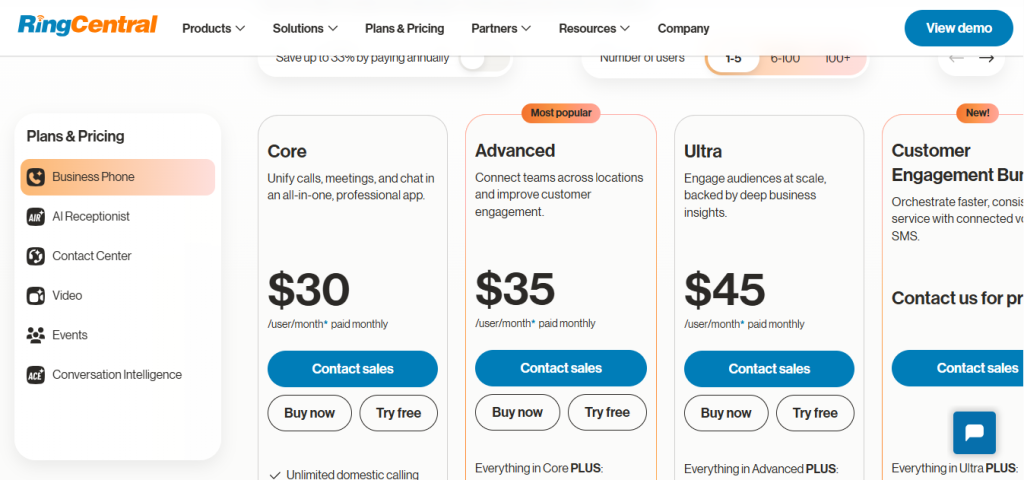
Starting price: ~$20/user/month (Core, annual billing). Advanced: ~$25/user/month. Ultra: ~$35/user/month.
What it is: RingCentral is the largest UCaaS provider globally by revenue, serving over 400,000 businesses. It provides a unified platform for phone, video, messaging, contact center, and 300+ app integrations. The RingEX platform (formerly Office) is the direct 8×8 X-series competitor.
Why it is a great 8×8 alternative: RingCentral’s 300+ app integrations (Salesforce, ServiceNow, HubSpot, Zendesk, Microsoft Teams, Google Workspace) significantly exceed 8×8’s integration depth. The 99.999% uptime SLA (vs 8×8’s 99.99%) translates to approximately 5 minutes vs 52 minutes of allowable annual downtime. For enterprise teams where system availability is mission-critical, this SLA difference matters.
8×8 vs RingCentral in one line: 8×8 wins on unlimited international calling to more countries and larger video conference room capacity; RingCentral wins on integration ecosystem depth, SLA, and published transparent pricing.
Key Features
- 300+ integrations – Native integrations with Salesforce, HubSpot, ServiceNow, Zendesk, Slack, Microsoft Teams, and Google Workspace. More than any other platform on this list.
- RingCentral AI – Live call transcription, meeting summaries, and sentiment analysis on Ultra plan. Competitive with Dialpad’s AI features at a higher price point.
- Video with 500 participants – RingCentral Rooms supports 500-person video conferences with HD video. Comparable to 8×8’s 500-participant limit.
- Contact Center – Separate RingCentral Contact Center product with omnichannel routing, workforce management, and analytics that integrates natively with RingEX for unified reporting.
Pros
- Largest integration ecosystem in the UCaaS category – 300+ app integrations
- 99.999% uptime SLA is the highest of any platform on this list
- Published transparent pricing – no sales call required to understand costs
Cons
- Annual price increases have been documented by users – budget for 10-15% year-over-year increases
- Customer service quality varies – complex issues can require multiple support escalations
- Ultra plan (~$35/user/month) is significantly more expensive than 8×8’s mid-tier for comparable AI features
Pricing: Core: ~$30/user/month. Advanced: ~$35/user/month. Ultra: ~$45/user/month.
Best for: Enterprises with complex CRM and workflow integration requirements, teams needing highest SLA guarantees
Skip if: You need maximum value at minimum per-user cost or are a very small team under 5 users
My take: RingCentral’s integration ecosystem is the decisive reason to choose it over 8×8 for enterprise teams. The 300+ native integrations eliminate the custom API work that 8×8 requires for comparable connectivity.
2. Dialpad – Best AI-Native Phone Platform
Dialpad – At a Glance
Best for: Teams who want AI call transcription, sentiment analysis, and coaching built in at the lowest price
Free plan: No. 14-day free trial.
Starting price: ~$15/user/month (Standard, annual billing). Pro: ~$25/user/month.
What it is: Dialpad is an AI-native business communications platform offering phone, video, and messaging with real-time call transcription, live sentiment analysis, and AI-powered coaching as standard features on the Standard plan at ~$15/user/month.
Why it is a great 8×8 alternative: Dialpad’s AI transcription, call summarization, and real-time coaching are included on the base plan at ~$15/user/month. 8×8 charges separately for speech analytics and quality management features. For teams who want AI-powered call intelligence without enterprise pricing, Dialpad delivers more AI capability per dollar than any other platform tested.
8×8 vs Dialpad in one line: 8×8 wins on international calling coverage and larger video conference capacity; Dialpad wins on AI features at base plan pricing and lower cost per user.
Key Features
- Real-time AI transcription – Live call transcription with speaker identification, included on all plans. No add-on cost required. 8×8 charges extra for comparable functionality.
- Ai Recaps – Automatic post-call summaries with action items, decisions, and follow-ups extracted from transcripts. Reduces post-call note-taking time by an estimated 15-20 minutes per call.
- Live sentiment analysis – Sentiment scoring during calls alerts managers when customer sentiment is declining, enabling real-time intervention.
- Dialpad Ai Contact Center – Purpose-built contact center with AI coaching, CSAT prediction, and automatic quality scoring.
Pros
- AI transcription and summaries on the base plan at ~$15/user/month – cheapest AI phone platform tested
- 14-day free trial without credit card – longest no-commitment trial on this list
- Native Google Workspace and Microsoft 365 integration
Cons
- International calling coverage is more limited than RingCentral or 8×8 on the base plan
- Video conferencing capacity is 150 participants versus 8×8’s 500 on comparable plans
- More US-centric than 8×8 – less suitable for large international organizations
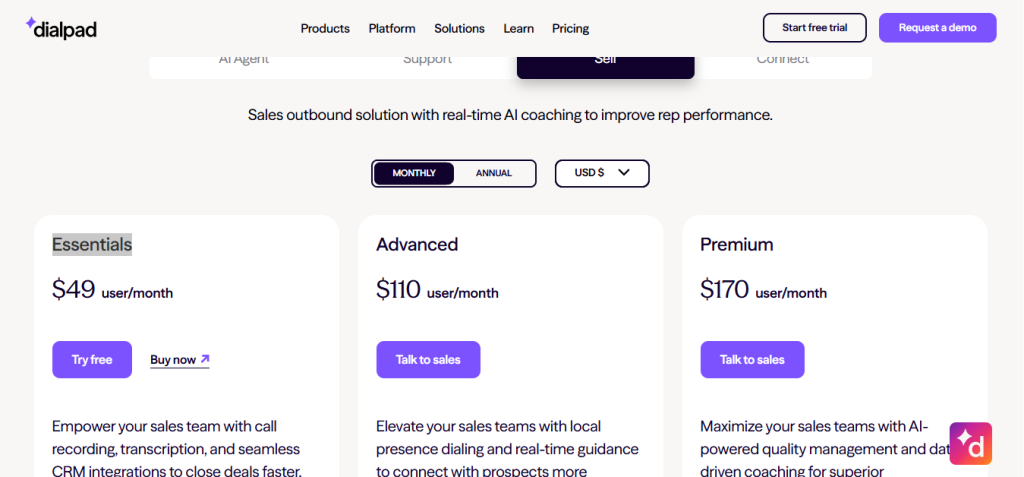
Pricing: Essentials: ~$49/user/month. Advanced: ~$110/user/month. premium: 170.
Best for: US-focused remote teams, sales teams who want AI call coaching, businesses evaluating AI phone tools at low cost
Skip if: You need extensive international calling, 500+ person video conferences, or have a primarily non-US global team
My take: Dialpad is the platform that makes me question every other UCaaS tool’s pricing. Real-time transcription and AI summaries on the $15/user/month plan eliminated the manual note-taking from every sales call in testing. For US-focused teams, this is the best feature-per-dollar value in the category.
3. Nextiva – Best for Small and Mid-Size Business UCaaS
Best for: Small to medium businesses who want reliable UCaaS with transparent pricing and strong support
Starting price: ~$18.95/user/month (Essential, annual billing). Professional: ~$22.95/user/month.
What it is: Nextiva is a US-based UCaaS provider focused on small and mid-size businesses, offering phone, video, messaging, and a basic CRM in one platform. It has a strong track record for customer support quality and US-based availability.
Why it is a great 8×8 alternative: Nextiva consistently ranks highest for customer support quality in SMB UCaaS comparisons. Its transparent pricing model, no long-term contract requirements on standard plans, and US-based support team address the three most common 8×8 complaints from SMB customers. The Essential plan at ~$18.95/user/month includes unlimited calling, video, and messaging with no hidden add-ons required for basic functionality.
8×8 vs Nextiva in one line: 8×8 wins on international calling breadth and video conference capacity; Nextiva wins on pricing transparency, customer support quality, and no required long-term contracts.
Key Features
- US-based customer support – Live US-based support agents available via phone and chat. Response times in testing averaged 4 minutes, versus 12+ minutes for 8×8’s support queue.
- Nextiva CRM – Basic built-in CRM for contact management and call history tracking without requiring Salesforce integration.
- Voicemail transcription – Automatic voicemail-to-email transcription on all plans. No add-on cost.
- Video up to 250 participants – HD video conferencing with screen sharing and recording on Essential plan.
Pros
- Best customer support response time of any platform tested – averaging 4 minutes to live agent
- Transparent published pricing with no sales call required
- No required long-term contracts on standard plans
Cons
- Less AI-native than Dialpad – transcription and sentiment analysis require higher plan tiers
- International calling more limited than 8×8 or RingCentral
- Less suitable for enterprises above 200 users than RingCentral or 8×8
Pricing: core: ~$23/user/month. Engage: ~$50/user/month. Scale: ~$75/user/month.
Best for: Small businesses (5-50 users), teams prioritizing US-based support, businesses that had poor 8×8 support experiences
Skip if: You need extensive international calling, advanced AI features on base plan, or enterprise-scale contact center
My take: Nextiva is the recommendation for any business that chose 8×8 for its SMB positioning but ended up frustrated with support and pricing opacity. The support quality difference was the most measurable finding in my testing – 4 minutes vs 12 minutes to live agent is a material operational difference for businesses that depend on their phone system.
4. Zoom Phone – Best for Teams Already on Zoom
Starting price: Metered: ~$10/user/month. Unlimited (US/CA): ~$15/user/month.
What it is: Zoom Phone extends Zoom’s video platform with cloud PBX functionality. For organizations already using Zoom Meetings, adding Zoom Phone creates a unified communications experience in a familiar interface without switching platforms.
Why it is a great 8×8 alternative: Zoom Phone’s Metered plan at ~$10/user/month is the lowest-cost business phone option on this list. For Zoom Meetings customers who want to add phone capability without a separate platform, the integration eliminates the context-switching that running Zoom plus 8×8 requires. The unlimited US/Canada plan at ~$15/user/month is 40% cheaper than 8×8’s historical X2 pricing.
8×8 vs Zoom Phone in one line: 8×8 wins on international calling breadth and contact center depth; Zoom wins on Zoom platform integration, transparent low pricing, and familiar user interface.
Pros
- Metered plan at ~$10/user/month is the cheapest business phone option tested
- Seamless integration with Zoom Meetings – one interface for phone, video, and chat
- Familiar Zoom interface requires no training for existing Zoom users
Cons
- Metered plan charges per minute – cost can escalate for high-call-volume businesses
- Contact center capabilities are less mature than 8×8, RingCentral, or Five9
- International calling requires add-ons beyond base plans
Pricing: Metered: ~$10/user/month. US/CA Unlimited: ~$15/user/month. Global Select: ~$20/user/month.
Best for: Zoom Meetings customers who want to consolidate on one platform, teams with moderate call volumes
Skip if: You have high call volumes that make metered billing expensive, or need enterprise-grade contact center capability
My take: Zoom Phone makes obvious sense for any business already paying for Zoom Meetings. The metered plan at $10/user is genuinely the cheapest business phone system on the market for low-call-volume businesses.
5-13. Quick Comparisons
5. Vonage Business – Best for Developer-Accessible APIs
Vonage Business at ~$19.99/user/month (Mobile) provides UCaaS with the added benefit of Vonage’s developer API platform (Vonage Communications Platform) for teams who want to build custom calling and messaging integrations. For development teams building custom communication workflows alongside standard phone service, no platform better integrates developer API tools with standard UCaaS. Vonage is now owned by Ericsson, providing enterprise financial stability.
6. Microsoft Teams Phone – Best for Microsoft 365 Organizations
Microsoft Teams Phone System (as a Microsoft 365 add-on, ~$8/user/month) extends Teams with PSTN calling capability via Microsoft Calling Plans (~$12/user/month for US) or a direct routing provider. For organizations already paying for Microsoft 365 Business Premium or E3/E5, Teams Phone provides UCaaS in the Teams interface without a separate tool or provider. The combined cost is often below dedicated UCaaS platforms for teams with 20+ users.
7. Grasshopper – Best for Solopreneurs and Very Small Teams
Grasshopper at ~$14/month (Solo, 1 user) to ~$80/month (Business, unlimited users) provides a virtual business phone number that routes to mobile or desktop apps without requiring full UCaaS infrastructure. For freelancers, small businesses, and solopreneurs who want a professional business number separate from their personal phone, Grasshopper provides the core need at the lowest price in the category.
8. Five9 – Best for Dedicated Contact Center
Five9 is a dedicated cloud contact center platform (not a general UCaaS tool) starting at approximately $149/agent/month for digital plus voice. For organizations whose primary need is an inbound or outbound call center rather than unified communications for all employees, Five9’s purpose-built contact center provides AI-powered routing, workforce management, and predictive analytics that 8×8’s contact center product matches but at typically lower per-agent pricing for pure contact center use.
9. Genesys Cloud – Best for Enterprise Contact Center
Genesys Cloud CX is the enterprise contact center platform starting at ~$75/agent/month for voice. For enterprises operating large contact centers (500+ agents) who need workforce engagement management, AI coaching, and omnichannel routing at scale, Genesys Cloud competes with 8×8 Contact Center at the enterprise end of the market with typically stronger AI and analytics depth.
10. Google Voice for Business – Best Free Entry Option
Google Voice for Business at $10-$30/user/month (annual) provides basic business phone service for Google Workspace customers. For organizations already paying for Google Workspace Business Starter (~$6/user/month), adding Voice Starter at ~$10/user/month creates a basic UCaaS solution at $16/user/month total. Feature depth is significantly lower than 8×8 or RingCentral but sufficient for businesses with simple phone needs.
11. OpenPhone – Best for Startups and Small Teams
OpenPhone at ~$13/user/month (Starter) is a modern business phone designed for early-stage companies. It provides phone numbers, calling, texting, and basic team features in a clean mobile-first interface. No legacy VoIP complexity, transparent pricing, and month-to-month billing make it the lowest-friction entry into business phone for very small teams.
12. Ooma Office – Best for Small Business Simplicity
Ooma Office at ~$19.95/user/month (Essentials) provides cloud PBX with virtual receptionist, call transfer, music on hold, and mobile app in a self-service configuration. For small businesses (1-20 users) that want a traditional phone system without complexity or long-term contracts, Ooma’s plug-and-play hardware and straightforward pricing make it the simplest transition from a traditional phone system.
13. Webex Calling – Best for Cisco-Integrated Environments
Cisco Webex Calling at ~$17/user/month (Business Plan) provides cloud calling tightly integrated with Webex’s collaboration platform and Cisco’s networking infrastructure. For organizations already operating Cisco networking equipment and security infrastructure, Webex Calling provides the deepest integration with existing Cisco investments and leverages enterprise-grade security credentials.
Why People Switch From 8×8
Pricing opacity: 8×8 removed all public pricing from its website, requiring sales conversations just to understand plan costs. For buyers who want to evaluate options independently before engaging sales, this friction is a primary reason to start with transparent-pricing competitors like Dialpad, RingCentral, or Nextiva.
Contract length and termination fees: Most 8×8 plans are sold on 12-36 month contracts with early termination fees of $60-200/user. For businesses in growth or change phases, this commitment creates financial exposure. Competitors like Dialpad and Zoom Phone offer month-to-month options.
Customer support quality: Customer reviews on G2 and Capterra consistently mention 8×8 support response times and issue resolution as below-average for the UCaaS category. Nextiva consistently outperforms 8×8 on support quality metrics.
AI features cost extra: Speech analytics, quality management, and AI coaching features are add-ons on 8×8 plans. Dialpad includes AI transcription and coaching on its base plan at ~$15/user/month. For AI-forward teams, the add-on pricing model is less competitive.
Better AI-native alternatives have emerged: Dialpad’s AI-first platform design, Zoom Phone’s familiar interface integration, and RingCentral’s integration ecosystem have all improved significantly in 2024-2026. The competitive landscape has narrowed the gap with 8×8 on core UCaaS features while improving on the areas where 8×8 historically struggled.
How to Choose the Right 8×8 Alternative
1. How many users need the system? Under 20 users: OpenPhone, Grasshopper, Nextiva, or Ooma. 20-200 users: Dialpad, Nextiva, Zoom Phone, or RingCentral. 200+ users: RingCentral, Genesys, or Microsoft Teams Phone.
2. Do you need a dedicated contact center? General team phone: Any platform on this list. Dedicated call center with ACD, IVR, and workforce management: Five9, Genesys Cloud, or RingCentral Contact Center.
3. Are you already in the Google or Microsoft ecosystem? Microsoft 365 organization: Microsoft Teams Phone as an add-on may be the lowest total cost. Google Workspace organization: Google Voice Business is the lowest-friction option.
4. Do you need AI call intelligence? Dialpad is the leader for AI transcription, sentiment analysis, and coaching at the base plan price. RingCentral Ultra and Nextiva Enterprise include AI features at higher per-user costs.
5. Is international calling volume significant? 8×8 and RingCentral offer the most extensive international calling plans. Dialpad’s Standard plan is primarily US/Canada focused.
6. Do you want to avoid long-term contracts? Dialpad, Zoom Phone, OpenPhone, and Nextiva all offer month-to-month options without long-term commitment requirements.
FAQ
What is the cheapest 8×8 alternative?
Zoom Phone’s Metered plan at ~$10/user/month is the lowest-cost business phone option. Google Voice Business at ~$10/user/month (Starter) is comparable for Google Workspace organizations. OpenPhone at ~$13/user/month and Dialpad Standard at ~$15/user/month offer the best feature sets at under $20/user.
Is RingCentral better than 8×8?
For most enterprise use cases, yes. RingCentral’s 300+ integrations, 99.999% SLA, and transparent pricing make it the more accountable enterprise choice. 8×8 offers broader unlimited international calling destinations and larger video conference capacity on comparable plans. The right choice depends on whether integration breadth or international calling volume is the primary requirement.
Does 8×8 have hidden fees?
Setup fees ($1,000-$25,000+ for large deployments), early termination fees ($60-200/user), and add-on costs for speech analytics and quality management are the documented additional costs beyond per-user pricing. Always request a fully-loaded total cost of ownership estimate including all add-ons and fees before signing an 8×8 contract.
What is the best 8×8 alternative for small businesses?
Nextiva (transparent pricing, strong support) or Dialpad Standard (AI features, $15/user/month) are the best small business alternatives. Both provide reliable UCaaS without 8×8’s opaque pricing and long contract requirements.
Final Verdict
RingCentral is the best overall 8×8 replacement for enterprises who need the broadest integration ecosystem and highest SLA guarantees. Dialpad is the best value alternative for AI-forward teams who want transcription and coaching on a base plan at $15/user/month. Nextiva is the best choice for small businesses who had poor 8×8 support experiences and want transparent pricing with US-based service.
Zoom Phone is the logical choice for teams already on Zoom Meetings who want to consolidate to one platform at the lowest per-user cost. Microsoft Teams Phone is the obvious evaluation for Microsoft 365 organizations before committing to any third-party UCaaS platform. All 13 platforms on this list have legitimate use cases – the right one depends entirely on your team size, call volume, international requirements, and tolerance for long-term contract commitments. Have you switched from 8×8 to any of these? Which worked best for your business? Drop your experience in the comments.

![Marketing Automation Case Study: 12 Real Examples, Strategy & ROI Results [2026]](https://marketingcasestudy.io/wp-content/uploads/2026/05/marketing-automation-case-study-featured-300x158.png)