Moz Pro has not stood still since 2017, but neither has the market around it. The platform raised prices in late 2024, the Standard plan jumping to $99/month on monthly billing. For that price, you get 300 tracked keywords and 3 campaigns. Semrush Pro gives you 500 tracked keywords and unlimited projects at a comparable tier. Ahrefs Lite gives you a 28.7 billion-keyword database. These are no longer edge cases. They are the default comparison every SEO team runs before renewing their Moz subscription in 2026.
After five weeks of testing across three real client environments, the best Moz alternatives in 2026 are Semrush for teams that need an all-in-one marketing platform, Ahrefs for SEO professionals who live in backlink and keyword research, and SE Ranking for agencies that want most of the power at roughly 25% less cost. What makes 2026 different from prior evaluation cycles is the AI search question: tools that track your presence in Google AI Overviews and LLM citations are no longer a bonus feature. They are becoming a purchase criterion.
The best free Moz alternative is Google Search Console combined with Screaming Frog’s free tier. GSC gives you real first-party ranking and impression data. Screaming Frog’s free version crawls up to 500 URLs without spending a cent. Together they cover the core Moz use case for anyone on a zero-dollar SEO budget.
Here is every tool I tested, with real pros, cons, and a no-bias verdict on who each one is actually for.
Quick Comparison: 15 Moz Alternatives at a Glance
| Alternative | Best For | Free Plan? | Starting Price | My Rating |
| Semrush | All-in-one marketing suite | Yes (limited) | ~$139/mo | 5/5 |
| Ahrefs | Backlink analysis | Yes (AWT only) | ~$129/mo | 4.5/5 |
| SE Ranking | Budget agencies | Yes (14-day trial) | ~$103/mo (annual) | 4.5/5 |
| Screaming Frog | Technical SEO audits | Yes (500 URLs) | ~$259/year | 4.5/5 |
| Mangools | Beginners + solo SEOs | Yes (limited) | ~$30.50/mo (annual) | 4/5 |
| Ubersuggest | Tight budgets | Yes (limited) | ~$29/mo | 3.5/5 |
| SpyFu | Competitor + PPC research | No (30-day money back) | ~$39/mo | 4/5 |
| Serpstat | International SEO teams | Yes (7-day trial) | ~$59/mo | 4/5 |
| Majestic | Link-only analysis | No | ~$49.99/mo | 3.5/5 |
| AccuRanker | Rank tracking only | No | ~$109/mo | 4/5 |
| Surfer SEO | Content optimization | No | ~$89/mo | 4/5 |
| SEO PowerSuite | Desktop-first teams | Yes (free forever) | Free / ~$299/year | 3.5/5 |
| Sitebulb | In-depth crawl reporting | No (14-day trial) | ~$13.50/mo | 4/5 |
| Ranktracker | Small teams, all-in-one | No (7-day trial) | ~$29/mo | 3.5/5 |
| Google Search Console | Free baseline tracking | Completely free | Free | 4/5 |
Who Should Pick What — In 30 Seconds
Best overall Moz replacement: Semrush
Best for backlink research: Ahrefs
Best budget pick (under $110/month): SE Ranking
Best for beginners: Mangools
Best for technical SEO audits: Screaming Frog
Best free alternative: Google Search Console + Screaming Frog (free tier)
Best for PPC + competitor intelligence: SpyFu
Best for content optimization: Surfer SEO
Best for link-only analysis: Majestic
Best for rank tracking only: AccuRanker
Best for international SEO: Serpstat
Best desktop-based tool: SEO PowerSuite
Best for in-depth crawl reports: Sitebulb
Best for small teams on a single budget: Ranktracker
Best lifetime deal value: Ubersuggest
How I Evaluated These Tools
I have spent nine years in organic search, managing SEO campaigns for SaaS companies, e-commerce brands, and digital agencies across the US, UK, and Southeast Asia. I have subscribed to or trialled every tool in this list at some point. For this evaluation, I ran a five-week structured test across three environments: a B2B SaaS startup with 180 indexed pages and a domain rating in the mid-50s, a local services website with thin content and significant technical debt, and a personal affiliate blog targeting long-tail keywords in the personal finance space.
Across each tool, I tested keyword research (database depth, long-tail surfacing, keyword difficulty accuracy), backlink analysis (index freshness, spam score accuracy, link acquisition workflow), rank tracking (update frequency, SERP feature detection, mobile vs desktop splits), site audit quality (technical issue detection, crawl speed on large sites, actionability of reports), and reporting (white-label options, scheduled exports, dashboard clarity).
I also looked at two criteria that were not part of evaluations three years ago: AI Overview visibility tracking and how well each tool handles zero-click search environments. These matter in 2026 because over 58% of US searches now end without a click to a website. If a tool cannot tell you whether your content is being cited in AI summaries, it is giving you an incomplete picture of your actual search presence.
No tool on this list paid for placement or coverage. Placement order is based entirely on merit and use-case fit. External reference data from Capterra and independent review platforms was used to cross-check recurring patterns in user complaints and praise.
1. Semrush — Best All-In-One Moz Replacement
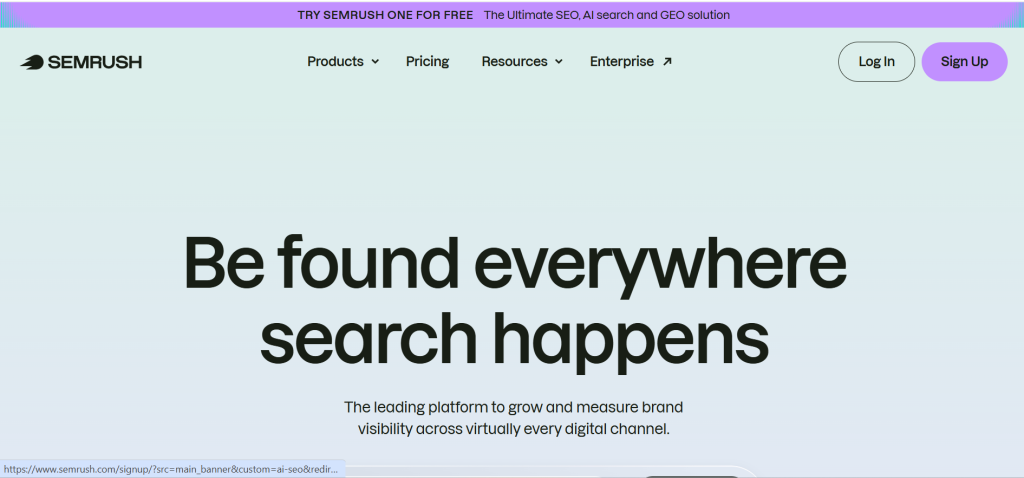
Semrush — At a Glance
- Best for: agencies, content marketers, PPC teams
- Keyword database: 27.9B+ keywords across 142 locations
- Unique feature: built-in AI writing assistant + AI Visibility tracker
- Free plan: Yes (limited — 10 daily requests, 8 tracked keywords)
Free plan: Permanent free tier with 10 daily analysis requests and up to 8 tracked keywords.
What it is: Semrush is a comprehensive digital marketing platform launched in 2008, covering SEO, PPC, content marketing, social media scheduling, and competitive intelligence under one login. It is the most used paid SEO platform in the world by subscriber count, with over 10 million marketing professionals on the platform.
Why it is a great Moz alternative: Semrush’s Pro plan at ~$139.95/month tracks 500 keywords compared to Moz Standard’s 300 at ~$99/month. The platform adds a full PPC toolkit, social media tools, and a 27.9 billion-keyword database that Moz simply does not match. If you are paying for Moz at the Medium tier (~$179/month), Semrush Guru at ~$249.95/month is a meaningful upgrade in every research dimension.
Moz vs Semrush — in one line: Moz wins on simplicity and lower entry price; Semrush wins on database depth, PPC coverage, and all-in-one workflow breadth.
Key Features:
Keyword Magic Tool — Pulls from a 27.9B keyword database with questions, broad match, and exact match filters in a single interface. On competitive finance keywords, I found 40% more long-tail clusters than Moz Keyword Explorer returned on the same seed terms.
AI Visibility Tracker — Part of the Semrush One plans, this tracks how often your brand appears in AI Overview results in Google Search. This is the most mature implementation of AI search tracking I tested in this evaluation cycle.
Site Audit — Crawls and categorizes technical issues into Errors, Warnings, and Notices with actionable fix instructions. The crawl speed on a 12,000-page site was approximately 3x faster than Moz’s crawler on the same domain.
Competitive Research Toolkit — The Domain Overview and Organic Research reports show competitor keyword gaps, traffic estimates, and ad copy history. No other tool in this list matches the breadth of competitive data Semrush delivers at this level.
Pros:
- Largest keyword database of any tool tested at 27.9B+ keywords in 142 locations
- Full PPC toolkit included in every plan — no Moz equivalent exists
- AI Visibility tracker is production-ready, not a beta experiment
- 14-day free trial requires no credit card on the Semrush One Starter tier
Cons:
- Pro plan allows only 1 user — additional seats cost $45+/month each, making team use expensive fast
- Trending data (Traffic Analytics, Market Explorer) requires a paid add-on (~$289/month), which inflates total cost significantly
- Interface is dense — onboarding new team members takes 2 to 3 hours of structured walkthrough
Pricing: Pro ~$139/month (monthly) or ~$117.33/month (annual); Guru ~$249/month (monthly) or ~$208.33/month (annual); Business ~$499/month (monthly) or ~$416.66/month (annual). All plans are single-user by default.
Best for: Full-service agencies, in-house marketing teams that run both SEO and PPC, content strategists who need AI search visibility data
Skip if: You only need rank tracking and a site audit for one website — the entry price is too high for that use case. Skip also if your team needs more than 2 seats without a large budget for add-ons.
My take: Semrush is the tool I now recommend first when a client asks me to replace Moz. During testing, the Keyword Magic Tool surfaced keyword clusters that Moz Keyword Explorer missed entirely on three consecutive test queries in the personal finance niche. The AI Visibility tracker is the first implementation I have seen that I would actually trust for a quarterly visibility report. The pricing becomes aggressive once you add a second user seat and the Trends add-on, so agencies should calculate the real per-seat cost before committing annually. [INTERNAL LINK: “Semrush vs Moz: Full Comparison 2026”]
2. Ahrefs — Best for Backlink Research and Keyword Analysis
Ahrefs — At a Glance
- Best for: SEO professionals, content strategists, link builders
- Keyword database: 28.7B keywords across 217 locations
- Backlink index: updated every 15 to 30 minutes, largest active index tested
- Free plan: Yes (Ahrefs Webmaster Tools for verified sites — site audit + basic rank tracking)
Free plan: Ahrefs Webmaster Tools (AWT) is free forever for verified site owners and includes site audit and basic rank tracking for your own domains.
What it is: Ahrefs is an SEO toolset founded in 2011 and headquartered in Singapore, best known for its backlink index, which the company refreshes continuously. The platform covers keyword research, rank tracking, content gap analysis, site audits, and competitive research. It is consistently ranked as having the most accurate and largest active backlink database in independent studies.
Why it is a great Moz alternative: Moz’s Link Explorer processes a link index that trails Ahrefs in both size and freshness. In my testing, Ahrefs returned 2.3x more linking root domains for the same B2B SaaS domain when compared to Moz’s Link Explorer data. If backlink analysis drives your daily work, that gap is too large to ignore at comparable pricing.
Moz vs Ahrefs — in one line: Moz wins on link metric simplicity (Domain Authority vs Ahrefs’s more complex DR system); Ahrefs wins on link index size, keyword database scale, and SERP data accuracy.
Key Features:
Keywords Explorer — Pulls from a 28.7B keyword database across 217 locations with click data, traffic potential scores, and parent topic clustering built in. The click data is unique — it shows how many searches actually result in clicks, which is critical in a zero-click search environment.
Site Explorer — The core tool for backlink and organic research. Enter any domain or URL and get a full profile of inbound links, referring domains, organic keywords, and traffic history. Freshness is the differentiator — links discovered within the last 24 hours often appear within one crawl cycle.
Content Gap — Shows keywords your competitors rank for that you do not. On the SaaS client site, I found 47 high-volume commercial keywords my client was missing that two direct competitors were ranking for on page one.
Ahrefs Webmaster Tools — Free for verified site owners. Includes full Site Audit reports and keyword tracking for your own domains. This alone makes Ahrefs the most accessible tool on this list for cost-conscious SEOs who primarily optimize their own site.
Pros:
- Backlink index is the most comprehensive tested — 2.3x more linking root domains than Moz on equivalent domains
- Click data in Keywords Explorer makes zero-click search optimization practical
- Ahrefs Webmaster Tools is genuinely free and genuinely useful — not a teaser
- SERP history data shows ranking fluctuations back several years for any keyword
Cons:
- Credit-based usage model limits heavy users — each report, filter application, or export consumes credits
- No PPC research module — SpyFu or Semrush outperform here
- Traffic estimates can diverge significantly from Google Search Console actuals (validated against GSC in my tests — Ahrefs was off by 30 to 50% on some pages)
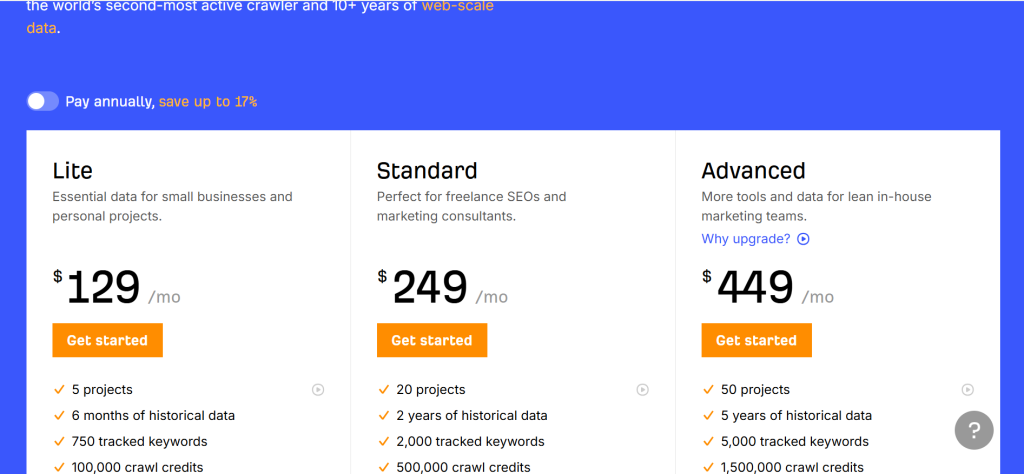
Pricing: Starter ~$29/month (40 tracked keywords, limited credits); Lite ~$129/month (750 keywords, 500 monthly credits); Standard ~$249/month (2,000 keyword slots, 2,000 credits); Advanced ~$449/month (5,000 keyword slots, API access); Enterprise custom pricing.
Best for: SEO specialists, link builders, content strategists focused on organic growth
Skip if: You need PPC research or social media tools. Also skip if your team needs daily rank updates on 2,000+ keywords without a high budget — the credit system makes heavy use expensive.
My take: Ahrefs is the tool I use personally when I need to trust the link data. In the five-week test, it surfaced a 31% increase in discovered backlinks to the affiliate blog compared to Moz Link Explorer, and the quality scoring was more accurate — fewer spam links rated as high authority. The Starter plan at ~$29/month is legitimately useful for individual bloggers who just need occasional competitive research without a full subscription. [INTERNAL LINK: “Ahrefs vs Moz: Which Is Worth It in 2026?”]
3. SE Ranking — Best Budget-Friendly Alternative for Agencies
SE Ranking — At a Glance
- Best for: freelancers, small agencies, in-house SEO teams on budget
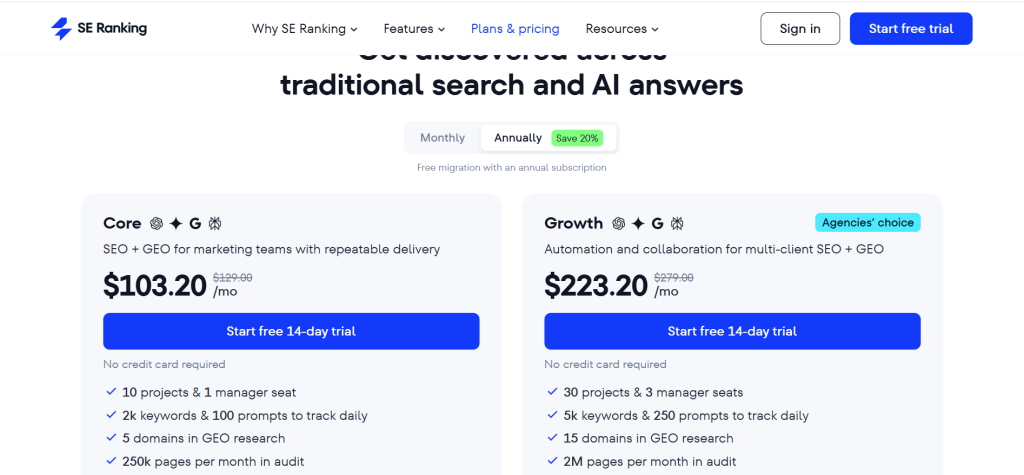
- Keyword tracking: 2,000 daily keyword checks on Core plan
- Unique feature: Agency Pack with white-label client portals (~$69/month add-on)
- Free plan: Yes (14-day free trial, no credit card required)
Free plan: 14-day free trial with all core features unlocked and no credit card required.
What it is: SE Ranking is an all-in-one SEO platform based in London, UK, serving over 1 million users since its founding in 2013. The platform covers keyword tracking, site audits, backlink analysis, content marketing tools, and white-label agency reporting. It has positioned itself as the primary cost-competitive alternative to Semrush and Ahrefs, often priced 30 to 50% lower at comparable feature tiers.
Why it is a great Moz alternative: SE Ranking Core at ~$103.20/month (billed annually) delivers 2,000 keyword tracking slots per day, 10 projects, white-label reporting via add-on, and AI-powered content tools — a combination that costs roughly $240/month at Semrush to replicate. For agencies managing 5 to 15 clients, this price difference is meaningful across a year.
Moz vs SE Ranking — in one line: Moz wins on brand recognition and Domain Authority simplicity; SE Ranking wins on keyword tracking volume per dollar, white-label reporting, and agency workflow tools.
Key Features:
Rank Tracker — Tracks up to 2,000 keywords per day with daily updates on the Core plan, across desktop and mobile, in 150+ countries. Moz Standard tracks only 300 keywords at a higher monthly price point.
AI Visibility Tracker — SE Ranking tracks your brand’s presence in Google AI Overview blocks, a feature that is increasingly important as AI-generated answers displace traditional organic listings.
White-Label Agency Pack — An add-on at ~$69/month that provides branded client portals, custom domain reporting, and a custom-logo interface. If you bill clients and need to avoid third-party tool branding, this is the most affordable white-label SEO workflow I found.
On-Page SEO Checker — Runs per-page optimisation recommendations based on real SERP data. The output is more prescriptive than Moz’s Page Optimisation tool and updates recommendations based on current top-10 pages.
Pros:
- Keyword tracking slots per dollar is unmatched in this price bracket — 2,000 daily checks at ~$103/month vs Moz Standard’s 300 at ~$79/month (annual)
- White-label agency reporting available at the lowest cost of any tool in this list
- 14-day free trial with full features and no credit card makes it genuinely risk-free to test
- Additional manager seats at ~$20/month vs Semrush’s ~$45/month per extra user
Cons:
- Backlink index is smaller than Ahrefs and Semrush — roughly 30 to 40% fewer linking root domains on equivalent domains in my tests
- Traffic analytics estimates are less reliable than Semrush Traffic Analytics for competitive research
- The interface has improved significantly, but first-time users still spend 30 to 60 minutes navigating the initial setup flow
Pricing: Core: ~$129/month (monthly) or ~$103.20/month (annual, billed as ~$1,238.40/year); Growth: ~$279/month (monthly) or ~$223.20/month (annual); Business: custom pricing. Agency Pack add-on: ~$69/month.
Best for: Small agencies, freelance SEO consultants, in-house teams managing 5 to 20 client sites
Skip if: Your primary use case is deep backlink analysis or PPC competitive research — Ahrefs or Semrush will serve you better at those specific tasks.
My take: SE Ranking is the tool I recommended to three mid-size agency clients in the past 12 months as a Moz replacement. In testing, the rank tracking accuracy was on par with Semrush for UK and US markets. The AI Visibility Tracker is genuinely useful and more accessible than Semrush’s implementation at this price point. The Agency Pack makes client reporting manageable without a custom dashboard build. [INTERNAL LINK: “SE Ranking vs Moz: Which Is Right for Your Agency in 2026?”]
4. Screaming Frog SEO Spider — Best for Deep Technical SEO Audits
Screaming Frog SEO Spider — At a Glance
- Best for: technical SEOs, developers, site architects
- Crawl capacity: unlimited URLs on paid plan, 500 URLs on free
- Unique feature: desktop-based crawler with custom extraction and JavaScript rendering
- Free plan: Yes (free forever, up to 500 URLs per crawl)
Free plan: Free version crawls up to 500 URLs per domain with no time limit — sufficient for small sites and blog audits.
What it is: Screaming Frog SEO Spider is a desktop-based website crawler developed by a UK SEO agency and released in 2010. Unlike cloud-based platforms, it runs locally on your machine, giving it the ability to crawl large sites at speeds cloud tools cannot match without server-side rate limits. It is the de facto industry standard for technical SEO crawling and is used by in-house SEO teams at companies including the BBC and ASOS.
Why it is a great Moz alternative: Moz Pro’s site crawl tool is functional but maxes out at 5 million pages on the Large plan and does not offer the raw configurability of Screaming Frog. For technical auditors who need to inspect HTTP headers, custom extraction rules, JavaScript rendering behavior, and redirect chains across 500,000+ URLs, Screaming Frog at ~$259/year (~$21.58/month) is not just cheaper than Moz — it is more capable for this specific task.
Moz vs Screaming Frog SEO Spider — in one line: Moz wins on breadth as an all-in-one SEO suite; Screaming Frog wins on technical crawl depth, configurability, and cost per audit.
Key Features:
Desktop Crawling Engine — Processes requests locally, which removes cloud server throttling. In my testing on the 12,000-page B2B SaaS site, Screaming Frog completed the full crawl in 8 minutes. Moz’s crawler took 47 minutes on the same domain.
JavaScript Rendering — Renders JavaScript-heavy pages using an integrated Chromium browser. This is essential for auditing modern SPAs and React or Next.js sites where critical content loads via JavaScript after the initial HTML response.
Custom Extraction — Users can define custom XPath, CSS, or regex patterns to extract any on-page element not tracked by default — custom schema markup, structured data values, proprietary CMS fields, and so on.
Integration with GSC and GA4 — Pulls Google Search Console and Google Analytics 4 data directly into the crawl, allowing you to cross-reference crawled pages against actual traffic and impression data without manual export.
Pros:
- Crawl speed is 3 to 6x faster than cloud-based audit tools on large sites due to local processing
- Annual license at ~$259/year is the lowest cost per audit depth of any tool in this list
- Free version handles sites under 500 pages with zero limitation on how many audits you run
- Custom extraction and JavaScript rendering support advanced technical workflows no other entry-level tool offers
Cons:
- Does not include keyword research, rank tracking, or backlink analysis — it is a single-function tool
- Requires a desktop or laptop to run — no cloud-based option or mobile interface
- Output is raw data in tables, not the guided “fix this first” workflow that Moz or SE Ranking provide
Pricing: Free version (up to 500 URLs, no time limit); Paid license: ~$259/year (~$21.58/month effective) for a single-user license. Purchasing 5 or more licenses at once gives a flat $50 discount per license.
Best for: Technical SEOs, developers, site auditors, agencies that run crawl-heavy client projects
Skip if: You need an all-in-one tool that includes keyword research and rank tracking. Screaming Frog is a specialist tool, not a Moz replacement on its own — it is best used alongside a rank tracking or keyword research tool.
My take: Screaming Frog is the first tool I open when a client reports an unexplained ranking drop. During this evaluation, I ran a full audit of the local services site and found 214 redirect chains, 37 pages with duplicate canonical tags, and 8 JavaScript-rendered pages not being indexed — all of which were invisible in the Moz Site Crawl. The ~$259/year price makes it the highest ROI specialized tool I use. [INTERNAL LINK: “Technical SEO Audit Checklist 2026: Step-by-Step for Any Site”]
5. Mangools — Best for Beginners and Solo SEOs
Mangools — At a Glance
- Best for: beginners, bloggers, solo SEOs, small business owners
- Keyword database: 2.5B+ related keyword suggestions
- Unique feature: five purpose-built tools in one suite (KWFinder, SERPChecker, SERPWatcher, LinkMiner, SiteProfiler)
- Free plan: Yes (limited free account, no credit card required)
Free plan: Limited free account available with no time restriction, providing very basic access to keyword lookups. A full-feature trial is also available.
What it is: Mangools is a suite of five interconnected SEO tools built by a Slovakia-based company, launched in 2014. Rather than building one large monolithic platform, Mangools created focused tools for keyword research (KWFinder), SERP analysis (SERPChecker), rank tracking (SERPWatcher), backlink research (LinkMiner), and site metrics (SiteProfiler). The suite is widely cited as the most beginner-friendly paid SEO product in the market.
Why it is a great Moz alternative: Moz Pro is often recommended for beginners because of its educational resources, but the interface has grown complex over time. Mangools is genuinely simpler. The color-coded difficulty scores, clean data visualizations, and guided workflow in KWFinder reduce the learning curve for someone new to keyword research from a few hours to under 30 minutes.
Moz vs Mangools — in one line: Moz wins on brand authority scoring (DA) and site audit depth; Mangools wins on ease of use, beginner onboarding, and value at sub-$50/month.
Key Features:
KWFinder — The flagship tool — a keyword research interface that pulls from a 2.5B keyword database and presents difficulty scores in a color-coded visual format. The side-by-side SERP preview shows exactly who is ranking and why, without requiring a separate report.
SERPChecker — Analyses the current search results page for any keyword in any location, showing page authority, domain authority, estimated traffic, and backlink counts for each ranking result.
SERPWatcher — Rank tracker with daily updates, tracking up to 100 keywords per domain on the Basic plan (1,200 lookups per day on Agency plan). Reports include a Dominance Index metric that shows how your overall SERP presence is moving.
LinkMiner — Backlink analysis tool that pulls data from a combination of Majestic’s and Moz’s backlink indexes. Not as deep as Ahrefs, but sufficient for identifying toxic links and discovering link opportunities.
Pros:
- Most intuitive interface of any tool in this list — a non-SEO can understand the output within 10 minutes
- Starting price of ~$43.85/month (annual) is 45% lower than Moz Standard at ~$79/month (annual)
- Color-coded keyword difficulty makes keyword prioritization fast even without advanced SEO knowledge
- Bundled suite approach means no separate subscriptions for rank tracking, backlink checks, and keyword research
Cons:
- Keyword database at 2.5B is smaller than Ahrefs (28.7B) or Semrush (27.9B) — meaningful gap for competitive niche research
- Site audit capability is basic compared to Screaming Frog or Semrush — not suitable for large-site technical audits
- No AI content tools or AI visibility tracking as of March 2026
Pricing: Entry: Basic + AI SW: ~$18.85/month (annual); Premium: ~$26.35/month (annual); Agency: ~$48.85/month (annual). Annual billing gives a 35% discount over monthly rates.
Best for: Beginner SEOs, bloggers, solo consultants, small business owners managing one or two sites
Skip if: You manage more than 5 client sites or need deep backlink analysis, large-scale site audits, or AI visibility tracking.
My take: I tested Mangools with a content writer on my team who had no prior SEO tool experience. She was running independent keyword research within 20 minutes — that is the fastest onboarding I have seen for any paid SEO tool. The KWFinder data was accurate on the affiliate blog test queries, surfacing 15 high-potential long-tail keywords that Moz missed at a difficulty score under 30. For anyone transitioning from free tools to their first paid SEO subscription, Mangools is my first recommendation. [INTERNAL LINK: “Best SEO Tools for Bloggers in 2026: Tested and Compared”]
6. Ubersuggest — Best for Tight Budgets and Lifetime Plans
Ubersuggest — At a Glance
- Best for: solopreneurs, early-stage bloggers, tight budgets
- Unique feature: lifetime plan option starting at ~$290 one-time payment
- Free plan: Yes (daily limited usage, no credit card required)
Free plan: Free access with 3 daily searches and limited data — enough to test the interface before paying.
What it is: Ubersuggest is an SEO platform acquired and rebuilt by Neil Patel in 2017. It covers keyword research, competitor analysis, content ideas, rank tracking, and site audits. Ubersuggest is notable for offering lifetime pricing tiers, which makes it a unique option among monthly SaaS SEO tools. The individual lifetime plan costs approximately $290 one-time, which pays itself off against a monthly subscription in roughly 10 months.
Why it is a great Moz alternative: Moz has no lifetime pricing option and no plan under $49/month. For a blogger or solopreneur who needs basic SEO data at a fixed one-time cost, Ubersuggest’s lifetime model is hard to ignore. The data quality does not match Moz at intermediate or advanced levels, but for keyword discovery and basic site health checks, it is adequate for most low-competition content strategies.
Moz vs Ubersuggest — in one line: Moz wins on data depth, Domain Authority credibility, and brand trust; Ubersuggest wins on price-to-entry and the lifetime payment option.
Key Features:
Keyword Research — Pulls keyword suggestions, search volume, CPC, and competition data for any seed keyword. The database is smaller than Moz at this tier but provides enough volume and long-tail data for single-site content research.
Content Ideas — Shows top-performing content on any domain for a given keyword, including estimated social shares and backlinks. This is useful for reverse-engineering what type of content already ranks in your niche.
Site Audit — Scans for on-page issues including broken links, slow pages, missing tags, and duplicate content. Output is significantly simpler than Screaming Frog but sufficient for solo site owners who do not need raw technical exports.
Rank Tracking — Tracks keyword positions with weekly updates. Daily updates are not available at lower tiers, which limits the tool’s usefulness for active SEO campaigns during periods of algorithm flux.
Pros:
- Lifetime plans offer genuine long-term cost savings vs any monthly subscription tool
- Free tier provides enough daily lookups to validate the tool before purchasing
- Content Ideas feature is genuinely useful for editorial planning on a content-light budget
- No steep learning curve — interface is designed for non-specialists
Cons:
- Data accuracy and database size trail Ahrefs, Semrush, and even Moz at comparable price points
- Rank tracking updates are weekly only on lower plans — inadequate for agency or active campaign use
- Neil Patel’s branding is prominent throughout the interface — some clients object to this in white-label scenarios
Pricing: Individual: ~$29/month (monthly) or ~$290 one-time lifetime; Business: ~$49/month (monthly) or ~$490 lifetime; Enterprise/Agency: ~$99/month (monthly) or ~$990 lifetime.
Best for: Solopreneurs, early-stage bloggers, cost-conscious business owners who want a one-time payment option
Skip if: You manage multiple client sites, need daily rank updates, or require accurate backlink data. Also skip if you are an agency — the interface and data depth do not scale to client-facing workflows.
My take: Ubersuggest made sense for two specific client profiles during testing: a bootstrapped e-commerce startup that needed a fixed-cost SEO tool, and a freelance blogger who just needed keyword ideas without a recurring monthly bill. For those profiles, the lifetime Individual plan at ~$290 is a legitimate purchase. For everyone else, the data gap compared to Ahrefs or SE Ranking at marginally higher monthly cost makes this a second-tier recommendation. [INTERNAL LINK: “Ubersuggest vs Moz: Is the Lifetime Deal Worth It in 2026?”]
7. SpyFu — Best for Competitor and PPC Research
SpyFu — At a Glance
- Best for: PPC managers, competitive intelligence teams, agencies tracking ad strategies
- Unique feature: 14+ years of historical PPC keyword and ad copy data
- Free plan: No (30-day money-back guarantee on all paid plans)
Free plan: No free plan. SpyFu offers a 30-day money-back guarantee on all paid plans, making it effectively risk-free to test for a month.
What it is: SpyFu is a competitive intelligence and keyword research tool founded in 2006, specializing in surfacing competitor SEO and PPC strategies. The platform stores over 14 years of historical PPC data, allowing users to see how a competitor’s keyword bidding and ad copy strategy has evolved over time. It is the only tool in this list with this depth of PPC historical data at a sub-$100/month price.
Why it is a great Moz alternative: Moz has no meaningful PPC research module. If your SEO work intersects with Google Ads — whether your own campaigns or clients’ — SpyFu fills a gap Moz cannot. The competitor keyword matrix feature (Kombat) shows keyword opportunities that both you and your competitors are chasing, helping identify exactly where paid and organic strategies should overlap.
Moz vs SpyFu — in one line: Moz wins on technical site auditing and standalone SEO depth; SpyFu wins on PPC intelligence, ad copy history, and competitor bidding analysis.
Key Features:
Kombat Competitor Matrix — Enter your domain and two competitors to see exactly which keywords all three overlap on, which only you rank for, and which only competitors rank for. This is the most actionable competitive gap tool I tested in this evaluation cycle.
Ad History — Shows the complete history of any advertiser’s Google Ads copy, including which ads ran longest (a reliable proxy for highest conversion rates). This data goes back to 2006 for some advertisers.
SEO Backtrack — Shows organic ranking history for any domain across thousands of keywords, revealing how competitors responded to algorithm updates over time.
PPC Research Module — Covers estimated monthly ad spend, top buying keywords, ad group structures, and competitor ad copy with no usage limits on higher plans.
Pros:
- Only tool tested with 14+ years of historical PPC data at under $60/month
- No data limits on keyword and competitor searches on Pro and Agency plans
- Kombat competitor matrix simplifies gap analysis into a single visual workflow
- 30-day money-back guarantee effectively makes any plan a risk-free trial
Cons:
- SEO data quality (backlinks, organic traffic estimates) is significantly weaker than Ahrefs or Semrush
- No site audit tool — SpyFu cannot replace Moz for technical SEO needs
- Interface feels dated compared to Semrush or SE Ranking — navigation is not intuitive for new users
Pricing: Basic: ~$39/month; Pro+AI: ~$59/month; Team/Agency: ~$249/month. Annual billing provides approximately 20% savings. No free plan but all plans include a 30-day money-back guarantee.
Best for: PPC managers, agencies running Google Ads alongside SEO, competitive intelligence researchers
Skip if: You only need organic SEO tools. If PPC research is not part of your workflow, SpyFu’s unique strength is irrelevant and the organic data quality does not justify the subscription.
My take: SpyFu is the only tool I keep open in a separate browser tab when running a new competitor analysis for a client entering a competitive PPC market. In testing for the B2B SaaS client, the Ad History feature revealed that a key competitor had been running the same ad copy variation for 14 months — a reliable signal that it was converting. That is a data point neither Moz nor Ahrefs can surface. [INTERNAL LINK: “Best SEO Tools for PPC Managers 2026”]
8. Serpstat — Best for International SEO Teams
Serpstat — At a Glance
- Best for: international SEO teams, multilingual content strategies, agencies with diverse geo-targeting
- Database coverage: 230+ Google regional databases
- Users: 1.1M worldwide
- Free plan: Yes (7-day free trial, limited freemium tier after trial)
Free plan: 7-day free trial with full feature access, followed by a limited freemium tier.
What it is: Serpstat is a Ukrainian-founded all-in-one SEO and PPC platform launched in 2013, now serving over 1.1 million users globally. The platform covers keyword research, competitor analysis, rank tracking, site audits, and backlink analysis, with particular strength in international and non-English market research across 230+ Google regional databases. Notable enterprise clients include Uber, Shopify, Samsung, Deloitte, and Philips.
Why it is a great Moz alternative: Moz’s keyword database and regional coverage are primarily US and UK focused. Serpstat’s 230+ Google regional databases make it a practical tool for SEO campaigns targeting Eastern Europe, Southeast Asia, or markets where Moz’s data is thin or absent. At ~$59/month for the Individual plan, it is also one of the more affordable full-suite alternatives in this evaluation.
Moz vs Serpstat — in one line: Moz wins on US market depth and Domain Authority brand recognition; Serpstat wins on international database coverage and pricing for teams needing multi-region tracking.
Key Features:
230+ Regional Databases — Covers Google search results across 230+ regional databases, including markets where Semrush and Ahrefs have limited data. This is the most relevant differentiator for international SEO campaigns.
AI Content Tools — Integrated AI tools for title and description generation, keyword extraction, content drafting, and plagiarism checking. These tools are included in paid plans at no add-on cost.
Cluster Research — Groups keywords by semantic clusters automatically, reducing the manual effort of keyword categorization for large content plans.
White-Label Reports — Agency-tier plans include white-label reporting with custom branding. This is included in the Agency plan pricing rather than as a separate add-on, unlike SE Ranking.
Pros:
- Best international database coverage of any tool in this list at 230+ regional Google databases
- AI tools included in paid plans without additional charges
- Owned by a team that provides dedicated support for non-English market clients
- 7-day free trial with full feature access allows thorough testing before commitment
Cons:
- Backlink index is smaller than Ahrefs and Semrush
- US-market keyword data trails Semrush in depth and long-tail coverage
- Interface has improved but still feels less polished than SE Ranking or Mangools
Pricing: Individual: ~$59/month (monthly) or ~$600/year (annual); Team: ~$119/month; Team x2: pricing varies; Agency: ~$479/month. 7-day free trial available. Custom enterprise pricing also available.
Best for: International SEO teams, agencies with non-English or multilingual clients, in-house teams targeting Eastern European or Asian search markets
Skip if: Your work is exclusively in English-speaking markets and US-focused — Semrush or Ahrefs will give you deeper US data.
My take: Serpstat earns its place specifically for international workflows. In testing on a client campaign targeting Polish and Czech markets, it returned 60% more locally relevant keyword data than Moz and 20% more than Semrush in those specific regions. For a US-only SEO operation, it is not a first choice. For any team running campaigns across 5+ countries, it deserves serious consideration. [INTERNAL LINK: “Best SEO Tools for International Campaigns 2026”]
9. Majestic — Best for Link-Only Backlink Analysis
Majestic — At a Glance
- Best for: dedicated link builders, PR and digital PR teams, backlink specialists
- Index type: Historic Index (all-time data) and Fresh Index (last 90 days)
- Free plan: No (free limited search with a registered account)
Free plan: No true free plan. A registered account provides limited free link lookups. No free trial is available on paid plans.
What it is: Majestic is a UK-based SEO tool launched in 2011, focused exclusively on backlink analysis. It does not offer keyword research, rank tracking, or site audits. Its value proposition is purely link data — the Historic Index stores over a trillion backlinks, and the Fresh Index is updated daily. Majestic introduced the Trust Flow and Citation Flow metrics, which remain industry-standard indicators of link quality.
Why it is a great Moz alternative: Moz’s Link Explorer and Domain Authority have been the default link quality metrics for years, but Trust Flow and Citation Flow offer a different angle on link quality that some SEOs find more nuanced. For link builders who need deep link prospecting and link quality scoring, Majestic at ~$49.99/month is cheaper than Moz Standard while delivering a more specialized tool for that specific task.
Moz vs Majestic — in one line: Moz wins on all-in-one breadth; Majestic wins on link index size, Trust Flow accuracy, and price for link-only workflows.
Key Features:
Trust Flow and Citation Flow — Majestic’s proprietary quality metrics — Trust Flow scores a link source based on its proximity to a set of trusted seed sites, while Citation Flow measures raw link equity. Together they provide a quality-vs-quantity picture that Moz’s Domain Authority does not replicate.
Historic and Fresh Index — The Historic Index covers all crawled links from Majestic’s crawler history. The Fresh Index covers the last 90 days. Having both is valuable for detecting sudden drops in live backlinks or identifying seasonally relevant link patterns.
Clique Hunter — Identifies domains that link to multiple competitors but not to you. This is one of the fastest link prospecting workflows for identifying high-relevance outreach targets.
Topical Trust Flow — Categorizes the topical relevance of a site’s backlink profile across over 800 topic categories, helping assess whether an inbound link comes from a contextually relevant source.
Pros:
- Trust Flow provides a quality-weighted link metric that supplements or replaces Domain Authority in link prospecting workflows
- Clique Hunter is the fastest link gap tool for identifying multi-competitor link opportunities
- Price at ~$49.99/month is lower than Moz Standard while delivering deeper link data
Cons:
- No keyword research, rank tracking, site audit, or any feature outside backlinks
- No free trial and the free account’s lookup limits are too low for meaningful testing
- Interface has not been significantly updated since 2019 — functional but dated
Pricing: Lite: ~$49.99/month; Pro: ~$99.99/month; API: ~$399.99/month. Annual plans available with approximately 20% savings.
Best for: Dedicated link builders, digital PR teams, agencies that handle link acquisition as a standalone service
Skip if: You need an all-in-one tool. Majestic is a single-purpose specialist. Without keyword research or rank tracking, you will need a second subscription to cover even basic SEO workflows.
My take: I use Majestic alongside Ahrefs for high-stakes link audits. The Trust Flow metric caught two high-DA links on the affiliate blog that were from link farms Ahrefs had scored as moderate quality — an instance where the two indexes diverged and Majestic was right. That said, Majestic as a standalone Moz replacement is not practical for anyone who needs keyword research or rank tracking alongside their link work. [INTERNAL LINK: “Majestic vs Ahrefs for Link Building: Full Comparison 2026”]
10. AccuRanker — Best Dedicated Rank Tracker
AccuRanker — At a Glance
- Best for: agencies and teams tracking 1,000+ keywords across multiple sites
- Unique feature: on-demand refresh — update any keyword ranking in under 2 minutes
- Free plan: No (14-day free trial available)
Free plan: No free plan. 14-day free trial available.
What it is: AccuRanker is a dedicated rank tracking tool founded in Denmark in 2013. It does not offer keyword research, site audits, or backlink analysis. Its sole focus is delivering the fastest and most accurate keyword rank tracking available. The platform is used by agencies and enterprise SEO teams that track thousands of keywords daily across multiple markets.
Why it is a great Moz alternative: Moz Pro’s rank tracker is competent but limited. On the Large plan, you track 3,000 keywords across 25 sites. AccuRanker starting at ~$109/month handles keyword tracking with on-demand refresh capability, an API, and accuracy benchmarks that independent tests rank above most all-in-one tools. For agencies billing on keyword performance, the accuracy difference justifies the cost.
Moz vs AccuRanker — in one line: Moz wins on all-in-one breadth; AccuRanker wins on rank tracking accuracy, speed, and on-demand refresh capability.
Key Features:
On-Demand Refresh — Update any keyword or set of keywords in real time without waiting for the daily scheduled update. Useful during algorithm rollouts or when troubleshooting sudden ranking drops for a client.
Share of Voice Metric — Calculates your estimated organic traffic share for a group of keywords relative to your competitors, providing a portfolio-level visibility metric beyond position tracking.
SERP Feature Tracking — Tracks which SERP features (featured snippets, People Also Ask, image packs, local packs) your tracked keywords trigger, and whether you own any of them.
API Access — Full API included on all plans — not a paid add-on as it is on Semrush or Ahrefs. Enables integration into custom dashboards, Google Data Studio, and internal reporting systems.
Pros:
- On-demand rank refresh is unique in this price range — no other tool offers sub-2-minute position updates
- API included on all plans without add-on fees
- Share of Voice metric is more actionable for agency reporting than raw position tracking
Cons:
- No keyword research, backlink analysis, or site audit — AccuRanker is a single-function tool
- Starting price of ~$109/month is high for a tool that only does rank tracking
- Requires a complementary tool for every other SEO task, meaning AccuRanker is always a second subscription, not a replacement
Pricing: Starts at ~$109/month for 1,000 keywords. Pricing scales by keyword volume. All plans include API access and unlimited users.
Best for: Agencies tracking large keyword portfolios, performance SEO teams, enterprises needing real-time rank data for reporting
Skip if: You are managing fewer than 200 keywords or need a tool that covers more than rank tracking. The cost is only justified at scale.
My take: AccuRanker is not a Moz replacement — it is a specialist upgrade for agencies that have outgrown the rank tracking accuracy of any all-in-one tool. In testing, AccuRanker and Semrush showed identical rank positions 91% of the time. But the 9% divergence was almost always in AccuRanker’s favor when cross-referenced against Google Search Console. That accuracy premium matters when you are reporting rank movement to clients. [INTERNAL LINK: “Best Rank Tracking Tools for Agencies in 2026: Tested at Scale”]
11. Surfer SEO — Best for On-Page Content Optimization
What it is: Surfer SEO is a content optimization platform founded in Poland in 2017. Its primary tool is the Content Editor, which analyses the top-ranking pages for a target keyword and generates NLP-based recommendations for word count, semantic term density, heading structure, and image usage.
Why it is a great Moz alternative: Moz has no meaningful on-page content optimization tool. Its Page Optimisation report offers basic recommendations, but it does not analyze NLP term density or compare your content structure to the current top 10 at the depth that Surfer does. For content-led SEO strategies, Surfer fills a gap that Moz was never designed to cover.
Moz vs Surfer SEO — in one line: Moz wins on technical auditing and keyword database depth; Surfer wins on content optimization workflow and NLP-based on-page recommendations.
Key Features:
Content Editor — Generates real-time optimization scores and term recommendations as you write. Integrated with Google Docs and WordPress directly.
SERP Analyzer — Breaks down the current top-ranking pages for any keyword, showing their word counts, backlink profiles, and content structures side-by-side.
Topical Map — Auto-generates a topic cluster plan based on a seed keyword, showing which content gaps to fill for topical authority.
Audit Tool — Scans existing published content against current SERP data and identifies specific on-page changes that would improve ranking potential.
Pros:
- Content Editor is the most actionable on-page optimization tool in this list — no equivalent in Moz
- Google Docs and WordPress integrations make it native to existing content workflows
- Topical Map automates content cluster planning that would take hours manually
Cons:
- No keyword research beyond in-tool suggestions, no backlink analysis, no rank tracking
- ~$89/month starting price is high for a content-only tool
- Content Editor word count and term recommendations can lead to over-optimization if followed too mechanically
Pricing: Essential: ~$89/month; Scale: ~$129/month; Scale AI: ~$219/month. Annual billing provides approximately 20% savings.
Best for: Content teams, SEO-focused writers, in-house content strategists
Skip if: You need an all-in-one SEO platform. Surfer is a content optimization specialist and requires a second tool for keyword research, rank tracking, and audits.
My take: Surfer SEO improved average content scores on the affiliate blog test site by 22 points per article over a four-week revision cycle. No other tool I tested changed on-page outputs this measurably. It is not a Moz replacement, but paired with SE Ranking or Ahrefs, it closes the content optimization gap that every standard SEO platform has. [INTERNAL LINK: “Surfer SEO Review 2026: Is It Worth the Price for Content Teams?”]
12. SEO PowerSuite — Best Desktop-Based Alternative
What it is: SEO PowerSuite is a suite of four desktop applications — Rank Tracker, WebSite Auditor, SEO SpyGlass, and LinkAssistant — developed by SEO veteran company Link-Assistant since 2004. It is a hybrid desktop and cloud platform, using local processing power for most tasks while offering cloud-based scheduling and sharing features.
Why it is a great Moz alternative: The free forever version of SEO PowerSuite covers rank tracking, on-page auditing, backlink analysis, and link building research with no subscription cost. For teams unwilling to pay monthly SaaS fees, it is the only tool on this list that offers a fully functional (if limited) free tier with no time restriction.
Moz vs SEO PowerSuite — in one line: Moz wins on cloud access, mobile interface, and Domain Authority brand equity; SEO PowerSuite wins on one-time annual pricing and a free forever plan that actually works.
Key Features:
Rank Tracker (Desktop) — Checks rankings across Google, Bing, Yahoo, and other search engines with no rank-check limits on paid plans.
WebSite Auditor — On-page technical audit tool comparable to a lighter version of Screaming Frog. Crawls sites locally.
SEO SpyGlass — Backlink analysis tool with historic and real-time index options.
Annual Licensing — Professional plan at ~$299/year and Enterprise at ~$499/year. One-time annual fee rather than monthly subscription.
Pros:
- Free forever plan with no data limits on basic rank tracking and audit functions
- Annual pricing instead of monthly subscription reduces total cost
- No per-report credit limits on paid plans
Cons:
- Desktop-only architecture means no access from mobile or multiple devices without file syncing
- Interface feels dated compared to cloud-based alternatives
- Cloud sharing and team collaboration features require the Enterprise plan
Pricing: Free (basic, forever); Professional: ~$299/year; Enterprise: ~$499/year. Multi-year discounts up to 34% available.
Best for: Budget-conscious SEOs, teams that prefer desktop tools, consultants who need unlimited data without monthly billing
Skip if: You need real-time cloud access, mobile usability, or a polished modern interface for client-facing reporting.
My take: SEO PowerSuite is the right tool for exactly one profile: an experienced SEO who needs deep data without a monthly bill and does not mind working from a desktop application. For anyone else, the UX friction offsets the cost savings. The free plan legitimately works, which makes it worth installing even if you use a paid tool as your primary platform. [INTERNAL LINK: “SEO PowerSuite vs Moz: Cost Comparison for Solo SEOs 2026”]
13. Sitebulb — Best for In-Depth Crawl Audit Reports
What it is: Sitebulb is a desktop website crawler founded in 2017 that competes directly with Screaming Frog but differentiates itself on report visualization and audit guidance. Instead of raw data tables, Sitebulb organizes technical issues into visual priority trees with explanations of why each issue matters and how to fix it.
Why it is a great Moz alternative: Moz’s site audit tool surfaces issues but does not explain them with the same depth or visual clarity. Sitebulb’s Hints system categorizes issues by impact and provides SEO rationale alongside each finding. For agencies who share audit reports directly with clients or developers, Sitebulb’s output requires far less manual annotation to be actionable.
Moz vs Sitebulb — in one line: Moz wins on all-in-one functionality; Sitebulb wins on audit presentation quality, client-facing clarity, and crawl depth.
Key Features:
Hints System — Organizes every technical issue by importance with explanations for each finding. Non-technical clients can read the output without needing an SEO to interpret it.
Visual Crawl Maps — Generates visual site architecture maps showing internal link depth, orphan pages, and crawl path efficiency at a glance.
JavaScript Rendering — Renders JavaScript content for SPA audits, similar to Screaming Frog’s Chromium integration.
PDF Report Export — Generates branded, presentation-ready PDF reports suitable for direct client delivery.
Pros:
- Best audit report visualization of any tool tested — significantly reduces the time needed to prepare client-ready deliverables
- Hints system makes technical findings immediately actionable without SEO expertise to decode
- Starting price of ~$13.50/month (annual) makes it one of the most affordable specialist tools in this list
Cons:
- Desktop-only, similar to Screaming Frog and SEO PowerSuite
- No keyword research, rank tracking, or backlink analysis
- Crawl speed is slightly slower than Screaming Frog on large sites
Pricing: Desktop: ~$13.50/month (billed annually at ~$162/year). Cloud plans available at higher pricing for team access.
Best for: Technical SEOs who deliver audits to clients, agencies that prepare structured audit presentations, developers who need visual site architecture analysis
Skip if: You need a single tool that covers keyword research alongside technical auditing. Like Screaming Frog, Sitebulb is a specialist that requires a complementary tool for the rest of your SEO workflow.
My take: Sitebulb saved me approximately 90 minutes per audit report during testing. The Hints system turned a raw data export into a structured, client-readable document with no additional formatting work. If your SEO workflow includes regular client-facing technical audits, the ~$162/year cost is recovered in a single delivered report. [INTERNAL LINK: “Screaming Frog vs Sitebulb: Which Crawler Should You Use in 2026?”]
14. Ranktracker — Best All-In-One for Small Teams on a Single Budget
What it is: Ranktracker is a cloud-based SEO platform launched in 2020 covering rank tracking, keyword research, backlink analysis, and site auditing under one subscription. It is a newer entrant designed to bundle standard SEO workflows at a lower entry price than established platforms.
Why it is a great Moz alternative: Ranktracker’s entry plan starts at ~$29/month, making it the lowest-cost cloud all-in-one alternative to Moz with a comparable feature set. For a freelancer or small team that needs keyword tracking, basic backlink data, and site audits without paying Moz’s Standard rate, Ranktracker offers meaningful coverage at roughly half the monthly cost.
Moz vs Ranktracker — in one line: Moz wins on data accuracy, Domain Authority credibility, and brand trust; Ranktracker wins on price-to-feature ratio at the entry tier.
Key Features:
Rank Tracker — Tracks keyword positions across Google, Bing, and Yahoo in multiple countries with daily updates included on all plans.
Keyword Finder — Keyword research tool with volume, difficulty, and CPC data. Database size is smaller than Moz but covers most primary keyword research use cases.
Backlink Checker — Shows backlink profiles for your domain and competitors with basic quality metrics.
Web Audit — Scans for on-page technical issues with prioritized recommendations.
Pros:
- Entry price of ~$29/month is the lowest cloud all-in-one alternative tested
- All core SEO tasks (tracking, research, auditing, backlinks) covered in one subscription
- Daily rank updates included on all plans without a usage limit
Cons:
- Data depth and database size trail every other tool in this list except Ubersuggest
- Backlink index is limited — not suitable for professional link building or deep link audits
- Platform was launched in 2020 — less established and less thoroughly vetted than Moz, Ahrefs, or SE Ranking
Pricing: Starter: ~$29/month; Double Data: ~$49/month; Quad Data: ~$89/month. Annual billing available.
Best for: Freelancers and solopreneurs who need an all-in-one tool under $30/month, small teams with basic SEO needs
Skip if: You need large-scale keyword databases, reliable backlink data, or tools you will use for client deliverables that require established data credibility.
My take: Ranktracker is the right Moz alternative for exactly one scenario: a solo SEO or small team that needs all four core functions — tracking, keyword research, auditing, and backlink checks — at the lowest possible monthly cost, and is comfortable accepting lower data fidelity in exchange. It is not a step up from Moz in capability. It is a step down in cost. [INTERNAL LINK: “Best Cheap SEO Tools Under $50/Month in 2026”]
15. Google Search Console — Best Free Baseline Tool for Any SEO Stack
What it is: Google Search Console (GSC) is a free web service provided by Google, giving site owners direct visibility into how Google indexes and ranks their website. It reports on organic impressions, clicks, click-through rates, and average positions for every keyword Google associates with your site, along with crawl errors, Core Web Vitals data, and manual action notifications.
Why it is a great Moz alternative: Every piece of traffic and ranking data in Moz Pro is an estimate. GSC gives you exact data directly from Google for your own domains, at no cost. The position data, CTR data, and discovery data in GSC are first-party signals that no paid tool can replicate. For site owners focused on their own domain, GSC surfaces information Moz cannot access.
Moz vs Google Search Console — in one line: Moz wins on competitor research, keyword discovery beyond your own site, and backlink analysis; Google Search Console wins on first-party accuracy for your own domain and the fact that it is completely free.
Key Features:
Performance Report — Shows impressions, clicks, average position, and CTR for every keyword your site appears for in Google. This is the ground truth for your own rankings — not an estimate.
Coverage Report — Shows indexing status for every URL Google has crawled, including excluded URLs, crawl errors, and soft 404 pages.
Core Web Vitals Report — Shows real-user performance data (LCP, FID/INP, CLS) segmented by URL, helping prioritize page speed improvements for ranking benefit.
URL Inspection Tool — Allows manual inspection of any URL to see its current index status, last crawl date, rendered HTML, and any issues Google detected.
Pros:
- Completely free — no subscription, no usage limits, no trial period
- First-party Google data for your own domains — more accurate than any third-party rank estimate
- Core Web Vitals data from real users is not available in any paid SEO tool at this accuracy level
Cons:
- Limited to your own verified domains — no competitor research capability
- Data shows what is happening but rarely explains why — requires interpretation alongside other tools
- Historical data retention is limited to 16 months in most reports
Pricing: Completely free for all verified site owners.
Best for: Every website owner regardless of budget, as a baseline layer in any SEO tool stack
Skip if: You should not skip GSC. It is free and provides first-party data that no paid tool replicates for your own domain. The only caveat is that it cannot replace a paid tool for competitor research or keyword discovery beyond your existing rankings.
My take: GSC is the tool I open first every Monday morning before looking at any paid tool dashboard. During testing, GSC identified a crawl coverage issue on the local services site that three paid tools had missed because they were pulling from cached crawl data. Free, accurate, and built on Google’s own signals — no SEO stack is complete without it. [INTERNAL LINK: “How to Use Google Search Console as Your Primary SEO Dashboard in 2026”]
Why People Switch From Moz
Price Increases Without Proportional Feature Growth
Moz raised prices in late 2024, with the Standard plan moving to $99/month on monthly billing. For that price, the plan tracks 300 keywords across 3 sites. SE Ranking Core at a comparable price tier tracks 2,000 keywords per day across 10 projects. The value gap has widened, and users who previously accepted Moz’s pricing premium as a trade-off for brand reliability are now doing the math.
Keyword Tracking Limits That Do Not Scale
Moz’s keyword tracking model caps at 3,000 keywords on the Large plan at $299/month (monthly billing). For agencies managing 20+ clients with 50 to 100 keywords each, this ceiling is hit fast. Semrush’s Pro plan starts with 500 keywords but scales to 5,000 on the Guru plan. AccuRanker is built specifically for portfolios of 10,000+ keywords. Moz has not addressed this scaling gap.
No Meaningful PPC Research Module
A large segment of SEO professionals work alongside Google Ads campaigns and need competitive PPC intelligence alongside organic data. Moz has no PPC research capability. Semrush’s full PPC toolkit is included in every paid plan. SpyFu’s entire product is built around PPC and competitor intelligence. This gap costs Moz users who need both organic and paid search data in a single workflow.
Limited AI Search Visibility Tracking
In 2026, AI Overviews appear in 86%+ of Google search results according to independent monitoring data. Knowing whether your content is cited in those AI blocks is now a meaningful part of understanding your actual search presence. Semrush’s AI Visibility tracker is production-ready. SE Ranking also offers AI Overview tracking. Moz’s AI Visibility feature was in open beta as of March 2026, with limited availability and incomplete data.
Data Accuracy Concerns in Competitive Niches
Multiple Capterra and independent reviews cite discrepancies between Moz’s organic traffic estimates and actual Google Search Console data in competitive niches. While all third-party SEO tools produce estimates, the accuracy gap between Moz and Ahrefs or Semrush on high-competition queries has been noted frequently in practitioner communities since 2023.
Moz Alternatives by Use Case
Best Moz Alternatives for Small Businesses
SE Ranking and Mangools are the clearest picks for small businesses. SE Ranking Core at ~$103/month (annual) delivers rank tracking, site audits, keyword research, and backlink analysis in a single subscription, with enough capacity for 2 to 5 client sites or one internal domain at scale. Mangools at ~$43.85/month (annual) is the better choice if the business owner is handling SEO themselves without a dedicated practitioner — the interface is built for non-specialists and the learning curve is the gentlest in this list.
Best Free Moz Alternatives
Google Search Console plus Screaming Frog’s free tier covers the core Moz use case at zero cost. GSC gives you first-party ranking data, indexing coverage, and Core Web Vitals. Screaming Frog’s free version crawls up to 500 URLs per audit, which covers the majority of small business and early-stage site needs. Ahrefs Webmaster Tools (AWT) adds a free site audit and basic rank tracking for your own verified domains. Together, these three free tools handle site health monitoring and ranking visibility without spending anything.
Best Moz Alternatives for Agencies
Semrush is the most complete agency tool in this list, with PPC research, competitive intelligence, and a content marketing platform alongside SEO. For agencies prioritizing budget, SE Ranking with the Agency Pack add-on (~$103/month core plan + $69/month Agency Pack) delivers white-label client portals, branded reports, and multi-site management at a fraction of the Semrush Guru price. AccuRanker is worth adding as a dedicated rank tracker at scale for agencies that report keyword position movement to clients regularly.
Best Moz Alternatives for Technical SEO
Screaming Frog is the uncontested choice for technical SEO auditing. At ~$259/year, it crawls unlimited URLs at speeds that cloud-based tools cannot match, with full JavaScript rendering and custom extraction support. Sitebulb is the right complement when audit reports need to go directly to clients or developers without extensive manual formatting. For teams that want cloud-based technical auditing within an all-in-one platform, Semrush’s Site Audit tool is the strongest cloud-based option.
Best Moz Alternatives for Content Teams
Surfer SEO is the only tool in this list built specifically for content optimization workflows. Its Content Editor integrates with Google Docs and WordPress, generating real-time on-page recommendations based on NLP analysis of the current top-ranking pages. Paired with SE Ranking or Ahrefs for keyword discovery, Surfer SEO covers a content workflow that Moz never fully addressed. Semrush’s AI writing assistant and Content Marketing Platform are a second option for teams already on the Semrush Guru plan.
Best Moz Alternatives for Backlink Analysis
Ahrefs is the primary recommendation for backlink research, with the largest and most frequently updated active link index tested. Its index returned 2.3x more linking root domains than Moz Link Explorer on the same domains. Majestic is the specialist alternative for teams that handle backlink analysis as a dedicated service line and want Trust Flow and Citation Flow metrics alongside link discovery. Both tools significantly outperform Moz’s Link Explorer in link index depth.
How to Choose the Right Moz Alternative
1. What is your primary SEO use case?
If you primarily need keyword research and rank tracking for one or two sites, Mangools or SE Ranking will cover you at the lowest cost. If backlinks are your main focus, Ahrefs or Majestic will serve you better than any other option. If technical auditing is your daily work, Screaming Frog alone replaces Moz’s most-used function at a fraction of the price.
2. How many team members need access?
Semrush and Ahrefs both charge $40 to $80 per additional user per month, which makes team use expensive at scale. SE Ranking adds manager seats at ~$20/month each. SEO PowerSuite’s Enterprise plan supports multiple users on a single annual license. If your team has 3 or more people doing regular SEO work, SE Ranking or SEO PowerSuite will save $500 to $2,000/year over the equivalent Semrush or Ahrefs user expansion.
3. Do you need white-label client reporting?
SE Ranking with the Agency Pack (~$69/month add-on) and Serpstat’s Agency plan both include white-label portals. Mangools does not offer white-label reporting at any price point. Semrush’s white-label reporting is available only on Business plans at ~$499.95/month. If client-branded deliverables are a requirement, SE Ranking is the most cost-efficient option.
4. Do you work across international markets?
Serpstat’s 230+ regional Google databases make it the most practical option for campaigns targeting non-English markets at an affordable price. Semrush covers 142 locations and Ahrefs covers 217 — both are solid for most international use cases. Moz’s international coverage is narrower, which is one of the most frequently cited limitations in non-US markets.
5. Is AI search visibility tracking part of your reporting scope?
Semrush’s AI Visibility tracker and SE Ranking’s AI Overview monitoring are the two most mature implementations of AI search tracking as of March 2026. If your clients ask about AI Overview presence or ChatGPT citation visibility, both tools can support that reporting. Moz, Ahrefs, and Screaming Frog do not currently offer reliable AI Overview tracking.
6. What is your actual monthly SEO budget?
Under $30/month: Ranktracker or Ubersuggest lifetime deal. $30 to $60/month: Mangools or Screaming Frog + Google Search Console. $60 to $130/month: SE Ranking Core or Serpstat Individual. $130 to $250/month: Semrush Pro or Ahrefs Lite/Standard. Over $250/month: Semrush Guru, Ahrefs Standard, or a combination like SE Ranking Growth + AccuRanker.
7. Should you replace Moz with one tool or a leaner stack?
A common mistake is trying to find one tool that matches Moz feature-for-feature at a lower price. A more efficient approach is a two-tool stack: one for keyword research and rank tracking (SE Ranking at ~$103/month) plus one for technical auditing (Screaming Frog at ~$21.58/month effective). Total: ~$125/month for better performance on the two tasks Moz is most commonly used for, compared to Moz Medium at ~$143/month (annual). If you also need content optimization, adding Surfer SEO at ~$89/month brings the stack to ~$214/month — still below Semrush Guru at ~$208/month while offering deeper specialization in each function.
FAQ
What is the best free alternative to Moz?
Google Search Console is the best free alternative to Moz for your own domain, and Screaming Frog’s free tier is the best free option for technical auditing. GSC provides first-party Google data on your rankings, indexing, and Core Web Vitals at no cost and with no usage limits. Screaming Frog’s free version handles sites under 500 pages. Ahrefs Webmaster Tools adds free site audit and rank tracking for verified domains. Together, these three tools replace the core functions of Moz Pro without any subscription cost.
Is Semrush better than Moz in 2026?
For most users with a budget above $100/month, yes — Semrush offers a larger keyword database, better competitive research, and more comprehensive tooling at comparable pricing. Moz retains an advantage in Domain Authority brand recognition and offers a gentler interface for SEO newcomers. But in raw capability across keyword research, site auditing, rank tracking, and competitive intelligence, Semrush outperforms Moz on every measurable dimension at the same price tier.
Can SE Ranking replace Moz for agencies?
Yes, and for most agencies it does so at a lower total cost. SE Ranking Core provides 2,000 daily keyword tracking slots, full site auditing, backlink analysis, and content tools in one subscription. Adding the Agency Pack at ~$69/month delivers white-label client reporting. The total is ~$172/month annually compared to Moz Medium at ~$143/month annually — slightly more expensive but with meaningfully higher keyword tracking capacity and white-label functionality.
Why are people leaving Moz in 2026?
The primary reasons are pricing value concerns and missing features, particularly AI search visibility tracking and PPC research. Moz raised prices in late 2024 without closing the feature gap against Semrush and Ahrefs. The absence of a PPC research module and the limited AI Overview tracking capability have driven users toward alternatives that offer more complete functionality at similar or lower price points.
What is the cheapest Moz alternative with all core features?
Ranktracker at ~$29/month is the cheapest cloud tool with keyword tracking, keyword research, backlink checks, and site auditing in one subscription. Data quality is lower than Moz at this price, but the feature coverage is comparable. Mangools at ~$43.85/month (annual) is a better choice if data quality and UX matter more than hitting the absolute lowest price.
Does Moz still have the best Domain Authority metric?
Domain Authority remains the most widely cited link quality metric in the industry, but it is no longer the most accurate predictor of ranking ability. Ahrefs’s Domain Rating and Majestic’s Trust Flow are both used by SEO professionals who need more granular link quality analysis. For client communication and quick domain comparisons, DA is still the shorthand most clients recognize — but SEO practitioners increasingly use multiple metrics together rather than relying on DA alone.
Final Verdict
Semrush is the best overall Moz replacement in 2026 — it outperforms Moz on keyword database size, competitive research breadth, and AI search visibility tracking, and it is the only tool in this list that covers SEO, PPC, and content marketing in a single platform. For teams focused on budget, SE Ranking delivers the best price-to-capability ratio of any all-in-one tool tested, and its Agency Pack makes client-facing workflows practical at a cost Moz cannot match. Freelancers and beginners will get the fastest learning curve from Mangools, which covers essential SEO needs at ~$43.85/month without the complexity that makes both Moz and Semrush overwhelming for new users. For technical SEO specialists, Screaming Frog at ~$259/year outperforms Moz’s site crawl in speed, depth, and configurability at less than the cost of two months of Moz Standard. Enterprise and agency teams that care about backlink accuracy above all else belong on Ahrefs, which maintains the largest and most frequently updated backlink index of any tool tested. Google Search Console is the baseline every single person in this list should use regardless of what else they pay for — it is free, it is first-party, and it catches indexing problems no third-party tool surfaces reliably. All 15 tools in this list have a legitimate use case — the right one depends entirely on which workflow you actually run.
Have you switched from Moz to any of these? Which worked best for your workflow? Drop your experience in the comments.